Citation Cleanup: Fix NAP Errors and Rank Higher
# Citation Cleanup: Fix NAP Errors and Rank Higher
Citation cleanup means auditing every online mention of your business name, address, and phone number (NAP) and correcting the ones that don't match your official record. Google Business Profile is your anchor. Every directory, from Bing Places to Data Axle, needs to say the exact same thing.
Here's your next move, right now:
- —Pick your canonical NAP (exact business name, USPS-formatted address, one phone number) and match it to Google Business Profile.
- —Search your business name plus city on Google and scan the first two pages for mismatched listings.
- —Note every directory where the address, phone, or hours are wrong. That's your fix list.
Get this right and you'll see it fast: better map-pack placement, fewer customers calling a disconnected number, and a cleaner signal to every AI search tool now pulling business data to answer local queries. If the list gets long, Vaultio handles it as a done-for-you service.
Key Takeaways
Citation cleanup fixes local search visibility by matching NAP data across Google Business Profile, aggregators, and directories, then verifying the correction held.
| Point | Details |
|---|---|
| Set one canonical NAP | Match your exact business name, address, and phone to Google Business Profile before editing anything else. |
| Fix aggregators first | Data Axle, Neustar/Localeze, and Foursquare corrections propagate to hundreds of smaller sites in 30 to 90 days. |
| DIY works for one location | Simple, single-location businesses with time to spare can handle cleanup without a vendor. |
| Demand a before-and-after report | Any vendor worth hiring shows timestamped URLs proving the fix actually happened. |
| Vaultio runs it as done-for-you | Manual audit, aggregator submissions, outreach, and a verification report, backed by a 30-day money-back guarantee. |
Table of Contents
- —What Does a Citation Cleanup Service Actually Cover?
- —How Does the Citation Cleanup Process Work Step by Step?
- —Why Are Aggregator Fixes the Highest-Leverage Move?
- —Should You DIY Citation Cleanup or Hire a Pro?
- —How Long Does Citation Cleanup Take and What Does It Cost?
- —How Vaultio Approaches Citation Cleanup for Contractors
- —Where to Verify Citation Data and Vendor Claims
- —Get Your Citations Fixed Without Doing It Yourself
- —Frequently Asked Questions
- —Sources
What Does a Citation Cleanup Service Actually Cover?
A real citation cleanup isn't a one-click fix. It starts with a full NAP inventory across every platform where your business appears, then moves into duplicate detection, claiming profiles you don't yet control, editing the ones you do, and merging or removing duplicates that split your search signal.
The scope should include:
- —Full NAP inventory across major directories, social platforms, and niche/vertical sites
- —Duplicate detection and removal, including old listings from previous addresses or phone numbers
- —Direct edits to Google Business Profile, Bing Places, Apple Maps, Yelp, Facebook, and the Better Business Bureau
- —Aggregator submissions to Data Axle, Neustar/Localeze, and Foursquare
- —A prioritized fix list ranked by traffic impact and difficulty
- —A before-and-after report with URLs and verification steps
What's usually excluded: editing a news article that got your address wrong, cleaning up an old blog mention that isn't editable, or a full content overhaul. If you need that, expect it as a separate line item.
Pro Tip: Ask any vendor for a sample before-and-after report before you sign anything. If they can't produce one, they haven't done this work enough times to show it.
How Does the Citation Cleanup Process Work Step by Step?
Every credible vendor follows roughly the same sequence, whether they call it a "citation cleanup," a "local citation audit," or an "NAP consistency project."
- 1.Establish the canonical NAP. Document the exact business name, address format, and phone number that will serve as the source of truth, matched to Google Business Profile and your site's structured data.
- 2.Inventory everything. Combine automated crawling with manual checks of aggregator records, primary directories, and vertical-specific sites (think Angi for contractors or Avvo for legal services).
- 3.Prioritize by impact. Aggregators and major consumer platforms go first because they carry the most downstream weight. Easy wins get cleared quickly to build momentum.
- 4.Claim, edit, merge, submit. Vendors claim listings you don't control, edit the ones you do, request merges or removals for duplicates, and submit correction requests to aggregators.
- 5.Manual outreach for stubborn cases. Some directories won't budge through a self-service portal. That means emails, phone calls, and follow-ups with support teams.
- 6.Report and re-audit. A finished project includes timestamped before-and-after URLs and a recommended schedule for the next check.
A full audit should happen at least twice a year, or immediately after any move, phone number change, or rebrand.
Pro Tip: Don't assume an aggregator fix "took" just because you submitted it. Automated tools can propose corrections that still contain errors, which is exactly why manual verification matters more than the submission itself.
Why Are Aggregator Fixes the Highest-Leverage Move?
Data aggregators sit upstream of hundreds of smaller directories, review sites, and mapping apps that most business owners have never heard of. Fix the aggregator record once, and the correction can ripple outward without you touching another single listing.
That's the leverage. Aggregators act as gatekeepers that feed accurate (or inaccurate) business data downstream automatically.
Three sources matter most:
- —Data Axle feeds a wide network of consumer and business directories
- —Neustar/Localeze distributes to mapping and navigation platforms
- —Foursquare supplies location data to apps and services well beyond its own platform
Statistic Callout: Corrections submitted to major aggregators typically take 30 to 90 days to fully propagate downstream. Budget your follow-up audit accordingly instead of assuming the fix is instant.
Verify aggregator fixes by re-searching your business name on a rotating sample of downstream sites every few weeks rather than checking once and moving on.
Should You DIY Citation Cleanup or Hire a Pro?
One location, a simple NAP, and a free afternoon? Handle it yourself. Claim your major profiles, fix the obvious mismatches, and check back monthly.
Multiple locations, aggregator tangles, or a stack of duplicate listings from a past rebrand? That's when a vendor earns their fee, especially since services that only build listings without ongoing management leave you exposed to the same drift months later.
Before hiring anyone, ask:
- —How many home-service or local businesses have you handled in this exact vertical?
- —Do you submit directly to Data Axle, Neustar/Localeze, and Foursquare, or only edit profiles you can log into?
- —What does the before-and-after report look like, specifically?
- —Is there a money-back guarantee if the work doesn't hold up?
Red flags worth walking away from: pricing that's never clearly stated, no mention of a manual audit, no sample report, or a promise to "instantly" fix aggregator data with zero evidence. Aggregator propagation takes weeks. Anyone claiming otherwise is selling you a story.
How Long Does Citation Cleanup Take and What Does It Cost?
Profiles you control directly, like Google Business Profile or Facebook, update within days of a correction. Aggregator-driven propagation across the smaller directory network usually runs four to twelve weeks.
Pricing generally falls into two shapes: a flat one-time cleanup fee for a single location, or a tiered structure for multi-location businesses. Ongoing monitoring runs as a separate subscription, since citation cleanup isn't a one-time task; new duplicates and data drift show up again over time.
What drives the price up:
- —Number of locations and listings under management
- —Volume of duplicate or conflicting listings to merge
- —Vertical-specific directories that require separate handling
- —How much aggregator-level correction work is required
How Vaultio Approaches Citation Cleanup for Contractors
Vaultio runs citation cleanup as a manual, verified process, not a set-it-and-forget-it script. The sequence: full audit, prioritized fix list, direct aggregator submissions to Data Axle, Neustar/Localeze, and Foursquare, manual outreach for the listings that won't budge through a portal, then a verification report.
A cleaned-up citation profile is table stakes for a contractor who wants to show up first when someone searches "plumber near me" at 11 p.m. with a burst pipe.
Pro Tip: Ask for the re-audit cadence in writing before you sign. A vendor that disappears after the first report isn't managing your citations, they're just billing you once.
Here's the coverage breakdown:
Vaultio backs the work with a 30-day money-back guarantee and home-service industry experience across plumbing, HVAC, electrical, roofing, and similar trades. Propagation timelines still follow the same 30 to 90 day window as any aggregator fix, and press mentions that can't be edited stay out of scope.
Why Citation Cleanup Deserves a Spot on Every Contractor's Checklist
A contractor with clean, matching listings across Google Business Profile, Bing Places, and every major aggregator shows up more often and gets called by the right number. Skip the cleanup and you're quietly capping your own visibility while paying for ads to fix a problem that started with a wrong phone number on Data Axle. Pair any cleanup with steady Google Business Profile activity and review generation, since citations alone won't carry rankings forever.
Where to Verify Citation Data and Vendor Claims
Cross-check vendor claims against a few reliable sources before you sign anything:
- 1.Moz's guide to local citation management for how aggregators distribute data downstream
- 2.LocalDominator's citation audit walkthrough for a step-by-step DIY process
- 3.The Boring Digital Co.'s breakdown of why this work is foundational, not optional
Academic tools like Zotero or EndRefWorks handle research citations, a completely different discipline from business NAP cleanup, so don't confuse the two when a vendor name-drops "citation management" in a pitch.
Statistic Callout: Experienced practitioners often treat the first 20 hours of citation work as covering the top 30 to 50 listings that matter most for a small business, a useful benchmark when scoping your own project or a vendor's quote.
Get Your Citations Fixed Without Doing It Yourself
Vaultio is the alternative to spending your weekend chasing directory support lines. For home service contractors, this is the difference between a technician fixing wrong phone numbers between service calls and a team that submits directly to Data Axle, Neustar/Localeze, and Foursquare while you keep running your business.
Vaultio's citation cleanup runs as part of a broader local SEO buildout: manual audit, aggregator fixes, outreach for the listings that resist self-service, and a verification report with timestamped proof. It's backed by a 30-day money-back guarantee, so you're not betting blind on results.
If you run a plumbing, HVAC, electrical, roofing, or similar home-service business and your listings are scattered across old addresses and duplicate phone numbers, get a local SEO evaluation from Vaultio and find out exactly what's dragging down your map-pack ranking right now.
Frequently Asked Questions
How much does citation cleanup typically cost? Pricing varies by location count and how many duplicate or incorrect listings need fixing, but expect either a flat one-time fee for a single location or a tiered rate for multiple locations, plus an optional ongoing monitoring subscription.
How long until I see results from citation cleanup? Profiles you control directly update within days. Aggregator-driven fixes across the broader directory network usually take several weeks to a few months to fully propagate.
Can I do citation cleanup myself? Yes, if you manage one location with a simple NAP and have time for manual claiming and verification. Multiple locations or heavy duplicate issues usually justify hiring a vendor.
What's the difference between citation cleanup and citation building? Cleanup corrects and consolidates existing listings. Building creates brand-new listings on directories where your business doesn't yet appear. Most engagements involve both.
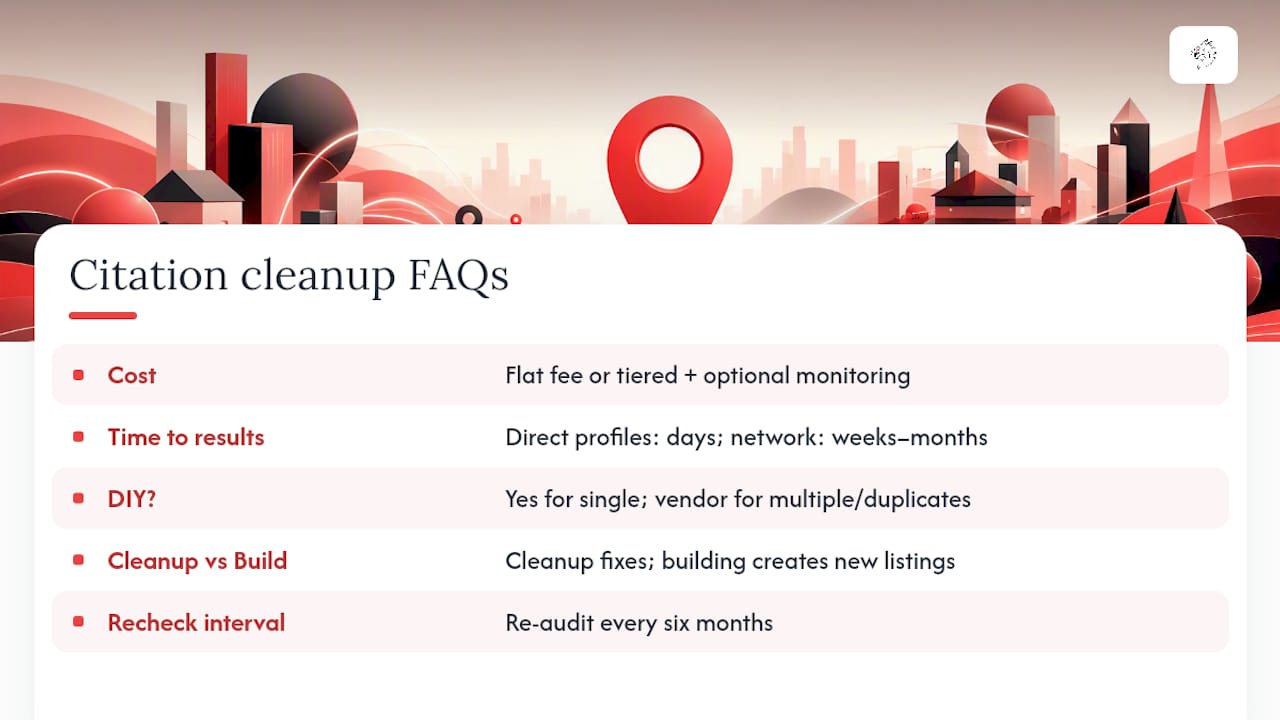
Do I need to redo citation cleanup after fixing it once? Yes. New duplicates and data drift appear over time, especially after moves, rebrands, or phone number changes, so a re-audit every six months is standard practice.
Sources
- —Local Citation Management | Local SEO - Moz
- —Citation cleanup — the boring digital co.
- —How to Perform a Local Citation Audit (Step-by-Step Guide)
Recommended
Ready to Implement This?
We'll build your complete lead generation system in 72 hours. No contracts. 30-day money-back guarantee.