Generative AI Local Business Ranking in 2026

# Generative AI Local Business Ranking in 2026
Generative AI local business ranking is defined as the process by which AI-powered search engines, including ChatGPT, Google AI Overviews, and Perplexity, select and recommend specific local businesses in response to user queries. For home service contractors, this matters more than any other digital shift in recent memory. Only 1.2% of local business locations get recommended in AI search results. That number tells you exactly how competitive this space is, and exactly why getting it right now gives you a real edge over every plumber, HVAC tech, and roofer in your market who is still playing by 2022 rules.
What are the top generative AI local ranking factors for home services?
AI search engines do not rank businesses the same way Google Maps does. They pull signals from multiple data sources and weigh them differently. Understanding those weights is the first step to showing up where customers are actually searching.
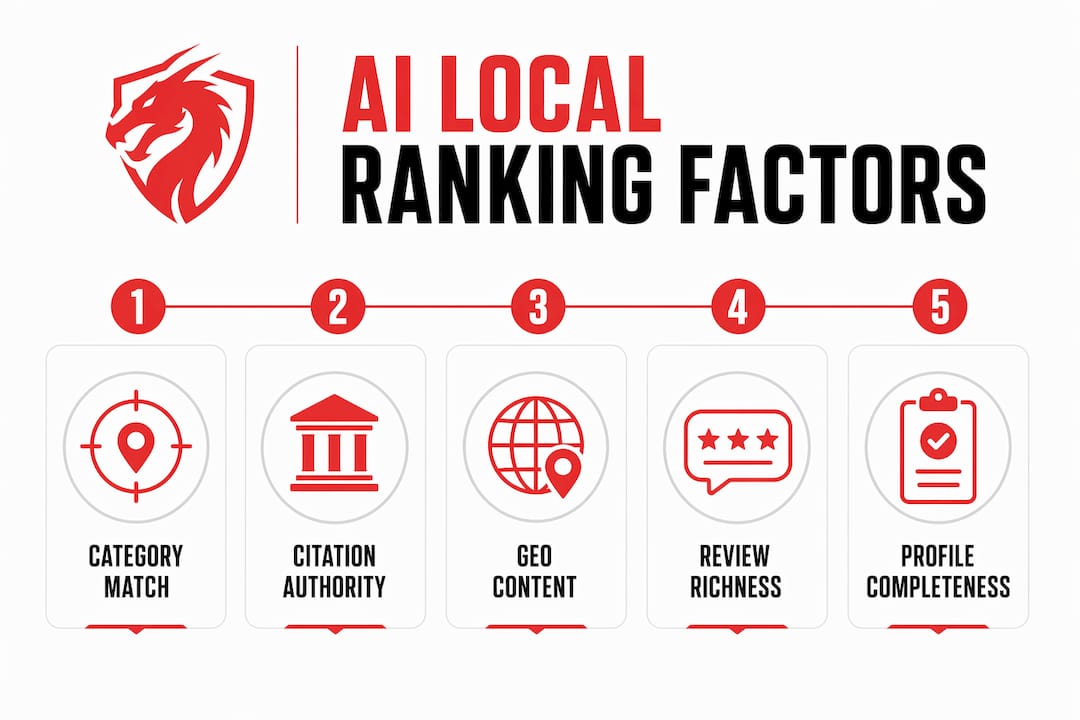
GBP primary category match accounts for about 14% of local business visibility weight in AI search in 2026. That makes it the single most powerful lever you control. After category match, the ranking weights break down like this:
- —Proximity to the searcher: 12% weight. AI engines still factor in location, but they favor explicit city-based queries over vague "near me" searches.
- —Review velocity (last 90 days): 10% weight. Fresh reviews signal an active, trusted business. A flood of reviews from two years ago does almost nothing.
- —GBP completeness: 9% weight. Missing hours, no service list, no photos. Each gap costs you visibility.
- —On-page localization: 8% weight. Your website needs to speak the language of your city, not just your trade.
- —Emerging AI citation signals: FAQ schema, LocalBusiness schema, and llms.txt presence are now active ranking inputs for AI Overviews and Ask Maps.
AI engines also prioritize category plus city keyword queries over broad "near me" searches. A query like "emergency plumber in Austin" produces stable, consistent AI recommendations. "Plumber near me" fluctuates with GPS data and produces less reliable results for businesses trying to build AI presence.
Pro Tip: Target your content and GBP categories around specific service plus city combinations. "HVAC repair in Denver" beats "HVAC near me" every time for consistent AI visibility.

How to optimize your Google Business Profile for AI-driven local rankings
Your Google Business Profile is the foundation of your AI local search presence. An incomplete or stale profile is invisible to AI engines, no matter how good your website is.
Follow these steps to build a profile that AI systems can read, trust, and recommend:
- 1.Complete every field. Business name, address, phone, hours, website, and service area must all be filled in. Partial profiles lose the GBP completeness signal entirely.
- 2.Select the right primary category. This is your highest-impact decision. Choose the category that most precisely matches your core service. A general contractor who primarily does roofing should list "Roofing Contractor," not "General Contractor."
- 3.Add secondary categories. If you offer HVAC and plumbing alongside roofing, add those as secondary categories. AI engines use all listed categories to match your profile to relevant queries.
- 4.Build out your service list. List every service you offer with descriptions. AI engines extract this text to match your business to specific user requests.
- 5.Upload photos weekly. Active photo uploads signal a live, engaged business. Profiles with regular photo activity outperform static ones in AI recommendation frequency.
- 6.Post updates at least twice a month. Profiles stale for over 30 days show measurable drops in AI visibility. Seasonal promotions, completed job photos, and service announcements all count.
- 7.Answer every question in Q&A. AI engines read your Q&A section as structured content. Detailed answers that include your service name and city strengthen your relevance signals.
- 8.Respond to every review. Responses show engagement and give you another opportunity to include service-specific and location-specific language naturally.
Pro Tip: When responding to reviews, mention the specific service performed and the neighborhood or city. "Thanks for trusting us with your furnace repair in Scottsdale" does more for your AI visibility than a generic thank-you.
Understanding how AI ranks home service companies in detail helps you prioritize which profile updates to make first.
How do AI citations and reputation across platforms affect your ranking?
Google Maps rank and AI citation visibility are not the same thing. This is the most important distinction home service contractors need to understand right now.
ChatGPT's local recommendations run primarily on Bing's web index, not Google Maps data. A contractor who ranks number one on Google Maps can be completely invisible in ChatGPT if their business has no Bing presence or indexed web content. That is not a hypothetical. It is happening to contractors in every market right now.
Building AI citation authority requires a multi-platform approach:
- —Yelp: ChatGPT and Gemini both pull Yelp data for local business recommendations. An active, well-reviewed Yelp profile is no longer optional for AI visibility.
- —Local blogs and community sites: Mentions in "Best of [City]" lists, neighborhood Facebook groups, and local news sites feed AI recommendation engines directly.
- —Review aggregators: Platforms like Angi, HomeAdvisor, and Houzz contribute citation signals that AI engines use to validate business credibility.
- —NAP consistency: Your name, address, and phone number must match exactly across every platform. Inconsistencies confuse AI systems and reduce recommendation confidence.
Review text richness matters more than star ratings alone. AI engines extract detailed language from reviews to generate high-confidence business suggestions. A review that says "Mike fixed our water heater in under two hours and cleaned up after himself" gives AI far more to work with than "Great service, five stars." Coach your customers to write specific, detailed reviews. The difference in AI visibility is significant.
Strong Google rankings do not guarantee AI visibility. AI-driven engines tap multiple data sources, making a cross-platform approach the only reliable path to consistent AI citation presence.
Creating geo-targeted website content for AI local relevance
Your website is the second pillar of AI local ranking authority. AI engines extract content from your site to validate your relevance for specific service plus city queries. Generic service pages do not cut it.
Here is how to build website content that AI systems can find, read, and cite:
- 1.Create dedicated service plus city pages. A roofing contractor in Phoenix should have separate pages for "roof repair in Scottsdale," "roof replacement in Tempe," and "emergency roofing in Mesa." Each page targets a distinct AI query pattern.
- 2.Reference local landmarks and neighborhoods. Geo-targeted content that names neighborhoods, cities, and local landmarks strengthens AI's location association with your business. Mention the specific areas you serve within the body of each page.
- 3.Add LocalBusiness schema markup. Schema tells AI engines exactly what your business does, where it operates, and how to contact you. Without it, AI has to guess, and it often guesses wrong.
- 4.Include FAQ markup on every service page. FAQ schema is one of the top drivers of AI Overview citations. Write questions your customers actually ask, then answer them in plain language.
- 5.Publish fresh content monthly. AI engines favor sites that update regularly. A monthly blog post covering a local topic, a seasonal service tip, or a completed project in a specific neighborhood keeps your site active in AI indexes.
The table below shows how content types map to AI citation impact:
| Content Type | AI Citation Impact |
|---|---|
| Service plus city pages | High: directly matches category plus city query patterns |
| LocalBusiness schema | High: structured data AI engines extract first |
| FAQ schema markup | High: feeds AI Overview answer boxes directly |
| Neighborhood blog posts | Medium: builds location association over time |
| Generic service pages | Low: no city or schema signal for AI to use |
AI-friendly content for home services requires a different structure than traditional SEO content. The goal is extractability, not just keyword density.
Key Takeaways
Generative AI local business ranking requires GBP completeness, multi-platform citation authority, and geo-targeted website content working together to earn consistent AI recommendations.
| Point | Details |
|---|---|
| GBP category match is the top signal | Selecting the precise primary category drives 14% of AI local visibility weight. |
| AI citations differ from Google Maps rank | ChatGPT uses Bing's index, so Google Maps rank alone does not guarantee AI visibility. |
| Review text quality beats star ratings | Detailed, service-specific review language gives AI engines the content they need to recommend you. |
| Schema markup is non-negotiable | LocalBusiness and FAQ schema are among the top factors driving AI Overview citations. |
| Multi-platform presence is required | Yelp, local blogs, and review aggregators all feed AI recommendation engines alongside Google. |
Why I think most contractors are measuring the wrong thing
AI visibility is not about position rankings. It is about citation mentions across neighborhoods, platforms, and query variations. That shift in measurement is the thing most contractors I talk to have not made yet.
I have watched contractors obsess over their Google Maps rank while their competitors quietly get cited in ChatGPT for every "best HVAC company in [city]" query in the market. The Maps rank looks great on a report. The AI citations are where the phone calls come from.
The contractors winning right now are not the ones with the most reviews or the biggest ad budgets. They are the ones who treated their GBP like a living document, built real presence on Yelp and local directories, and published city-specific content before it became obvious. Early movers in AI citation building are compounding their advantage every month. Latecomers will pay more and wait longer for the same results.
My honest advice: stop tracking your Google Maps position as your primary success metric. Start tracking how often your business gets cited in AI-generated answers for your top service plus city queries. That is the number that predicts your phone volume in 2026 and beyond. The how AI chooses local service providers breakdown is a good place to start understanding what those citation signals actually look like.
— Damian
Vaultio puts your business in front of AI-powered local search
Home service contractors who want to show up in ChatGPT, Google AI Overviews, and Perplexity need more than a decent website. They need a system built specifically for AI-driven local visibility.
Vaultio builds and manages that system for you. From Google Maps and AI search optimization to pay-per-lead Local Service Ads, every piece is designed to put your business in front of customers the moment they are ready to book. Vaultio also captures every inbound lead within seconds using AI-powered response tools, so you never lose a job to a slow follow-up. The result is a predictable flow of booked jobs, backed by a 30-day money-back guarantee. If you are ready to own your local market, Vaultio is how you get there.
FAQ
What is generative AI local business ranking?
Generative AI local business ranking is the process by which AI search engines like ChatGPT, Google AI Overviews, and Perplexity select and recommend specific local businesses in their answers. It relies on signals like GBP completeness, review quality, schema markup, and multi-platform citations rather than traditional keyword rankings alone.
Does ranking on Google Maps guarantee AI search visibility?
No. ChatGPT's local recommendations run on Bing's web index, not Google Maps data, so a top Maps ranking does not translate to AI citation visibility without separate Bing and web presence.
How many local businesses actually get cited by AI search engines?
Only 1.2% of local business locations are recommended in AI search results like ChatGPT and Gemini, based on analysis of over 350,000 locations. That exclusivity makes early optimization a significant competitive advantage.
What type of content helps home service businesses rank in AI search?
Service plus city pages, LocalBusiness schema, and FAQ markup are the highest-impact content types for AI local ranking. Geo-targeted content that references specific neighborhoods and landmarks further strengthens AI location association.
How often should I update my Google Business Profile for AI visibility?
Update your GBP at least every 30 days with new posts, photos, or answered questions. Profiles that go stale beyond 30 days show measurable drops in AI recommendation frequency.
Recommended
Ready to Implement This?
We'll build your complete lead generation system in 72 hours. No contracts. 30-day money-back guarantee.