How AI Chooses Local Service Providers: 2026 Guide

# How AI Chooses Local Service Providers: 2026 Guide
AI selects local service providers through a structured hierarchy of trust signals, not by proximity or paid placement. Understanding how AI chooses local service providers matters because the results you see from ChatGPT or Perplexity are far more curated than a standard Google search. These platforms evaluate reputation, content clarity, cross-platform consistency, and verifiable operational data before naming any provider. The pool of recommended businesses is small by design. AI algorithms for local services are built to recommend confidently, not comprehensively, which means quality assurance is baked into the selection process from the start.
How AI chooses local service providers: trust signals explained
AI recommendation engines apply a structured decision process before surfacing any provider. According to research on AI answer engine behavior, AI models use a three-stage logic: decision framing, elimination filtering, and final ranking based on trust metrics. Cost transparency, content freshness, expertise signals, and brand authority all factor into that ranking. A provider missing any of these layers gets filtered out before ranking even begins.
The most powerful trust signal is content depth. Businesses with rich, explanatory content earn 5.3 times more AI citations than those with minimal content. That gap is not marginal. It means a plumber with a detailed FAQ page and service descriptions will consistently outrank a competitor with a one-page brochure site, even if the competitor has more years in business.

Cross-platform consistency also carries significant weight. AI engines pull data from multiple sources simultaneously: Google Business Profile, Yelp, industry directories, news mentions, and the provider's own website. When those sources agree on the same name, address, phone number, and service scope, the AI assigns higher confidence to that entity. Inconsistencies across sources trigger elimination filters.
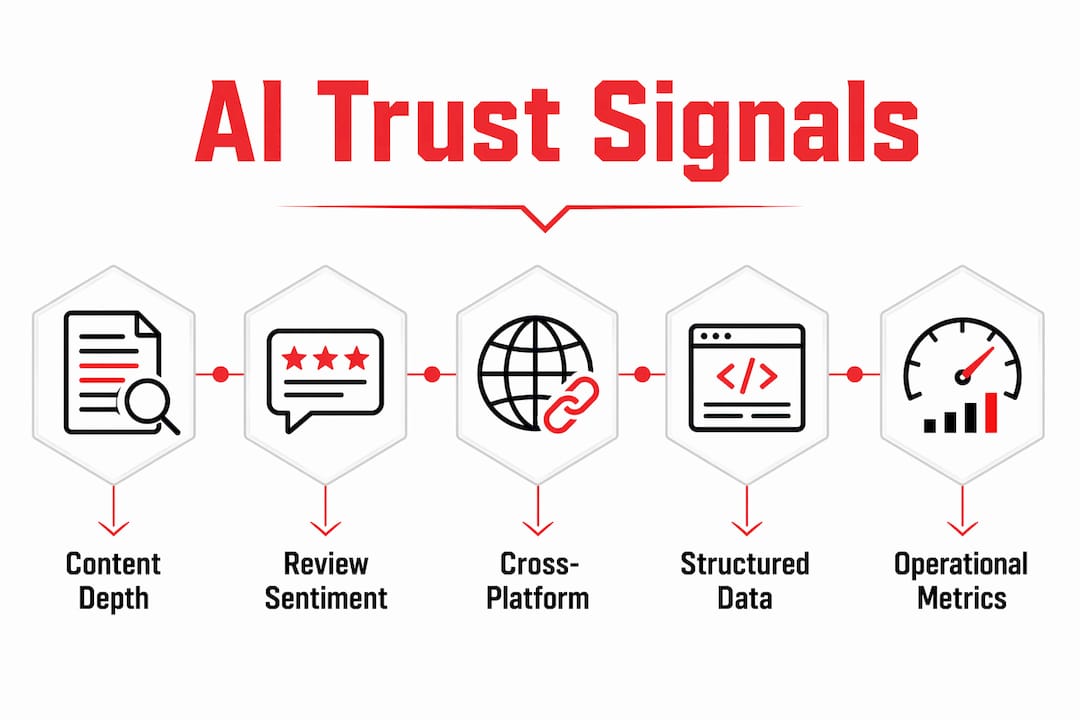
Structured data, specifically schema markup and FAQ schema, makes content machine-readable. AI models treat structured data as a direct signal of professionalism and reliability. Providers who optimize content for AI with proper schema markup give AI engines a clear, parseable profile to cite with confidence.
| Trust signal | What AI evaluates | Why it matters |
|---|---|---|
| Review sentiment | Volume, recency, and tone of reviews | Signals real-world reputation and reliability |
| Content richness | Depth of service descriptions and FAQs | Determines citation frequency and confidence |
| Cross-source consistency | Name, address, and phone across directories | Confirms entity identity and reduces ambiguity |
| Schema markup | Structured data on the provider's website | Makes content directly readable by AI models |
| Brand authority | Third-party mentions and press coverage | Signals credibility beyond self-reported claims |
Why does AI recommend so few local providers?
AI platforms recommend a dramatically smaller set of businesses than traditional search. ChatGPT recommends only 1.2% of local businesses in any given category. Gemini surfaces 11%, and Perplexity reaches 7.4%. Google's local 3-pack, by comparison, surfaces 35.9% of businesses. That difference reflects a fundamentally different selection philosophy.
Traditional search ranks by relevance and proximity. AI recommendation engines rank by confidence. If an AI model cannot verify a provider's credibility through multiple independent signals, it will simply decline to recommend that business at all. Claude, for example, often declines to name providers unless strong structured data exists. That conservative approach protects consumers from unreliable referrals, but it also means the majority of local businesses are invisible to AI-driven queries.
The disagreement between platforms is equally striking. Across 600 queries, only 23 out of 1,571 unique businesses appeared on all four major AI engines simultaneously. That is 1.5% consensus across platforms. The divergence happens because each AI engine accesses different data sources and applies different weighting to trust signals.
The practical takeaway for consumers:
- —A provider recommended by one AI platform may not appear on another at all.
- —Absence from AI results does not mean a provider is low quality. It often means their digital profile lacks the signals AI requires.
- —AI recommendations skew toward larger, more established businesses with stronger online footprints.
- —Independent operators face a structural disadvantage that has nothing to do with their actual service quality.
How do operational metrics affect AI provider recommendations?
AI engines favor providers who publish verifiable, specific operational data. A business that states "completed 3,100 jobs last year" with verified third-party sources becomes what researchers call "legible" to AI models. Providers publishing specific, measurable proof gain legibility to AI models and are recommended more frequently. Legibility means the AI can cite the provider with confidence rather than uncertainty.
The metrics that matter most to AI selection include:
- 1.Job volume: Total completed jobs per year, ideally verified through a third-party platform or review aggregator.
- 2.Repeat customer rate: A high repeat rate signals reliability and customer satisfaction beyond a single transaction.
- 3.Response time: Documented average response times signal operational discipline and professionalism.
- 4.Licensing and certification: Verified credentials published on the website and in directories confirm legitimacy.
- 5.Warranty and guarantee terms: Specific, published guarantee terms reduce perceived risk and increase AI confidence.
This transparency benefits consumers directly. When AI recommends a provider based on verified operational data, the recommendation carries more weight than a proximity-based result. You are not just getting the closest option. You are getting a provider whose performance record has been cross-referenced across multiple data points.
Pro Tip: If you are evaluating a home service provider, search their name alongside specific metrics like "jobs completed" or "years in business" to see whether their claims appear consistently across independent sources. Consistent data across sources is the same signal AI uses to build confidence.
AI also handles recommendation queries differently from informational queries. A question like "how do I fix a leaky faucet" triggers an informational response. A question like "best plumber near me" triggers an entity-based recommendation response. Providers who treat all search queries the same and fail to build entity-specific signals miss the AI recommendation window entirely.
How should you interpret AI recommendations vs. traditional local search?
AI-driven service provider choices and traditional local search results answer different questions. Traditional search asks: "What is nearby and relevant?" AI asks: "What can I confidently recommend based on verified trust?" Those are not the same question, and the results reflect that difference.
AI-driven local discovery rewards different signals than traditional local SEO. Proximity matters far less. A provider 15 miles away with strong brand authority and rich content will outrank a provider two blocks away with a thin profile. For consumers, this is generally a positive shift. You are more likely to get a vetted recommendation than a random proximity result.
The gaps in AI recommendations are real, though. 78% of independent businesses received effectively zero AI citations as of early 2026. That means a large portion of the local service market, including many skilled independent operators, is structurally excluded from AI results. Consumers who rely exclusively on AI recommendations may miss excellent local providers who simply lack the digital infrastructure to appear.
"AI recommendations are a quality filter, not a complete directory. Use them as a starting point, then verify through direct research, referrals, and multi-platform checks before making a hiring decision."
The smartest approach combines AI recommendations with traditional research:
- —Use AI to identify providers with strong, verified reputations.
- —Cross-check those providers on Google Reviews, the Better Business Bureau, and local community forums.
- —Ask neighbors and local community groups for referrals, which surface independent operators AI often misses.
- —Request proof of licensing, insurance, and specific job history directly from any provider before hiring.
Key Takeaways
AI selects local service providers through a confidence-based filtering process that rewards verified reputation, content depth, and cross-platform consistency over proximity or ad spend.
| Point | Details |
|---|---|
| AI recommends very few businesses | ChatGPT surfaces only 1.2% of local businesses, far fewer than traditional search results. |
| Content depth drives citations | Businesses with rich, explanatory content earn 5.3 times more AI citations than minimal-content competitors. |
| Platform consensus is rare | Only 1.5% of businesses appear across all four major AI engines, so multi-platform research matters. |
| Operational metrics build legibility | Verified data like job volume and repeat rates make providers trustworthy and citable by AI models. |
| Independent operators face gaps | 78% of independent businesses received near-zero AI citations, so AI results alone miss much of the market. |
What AI's selectivity actually means for you
I have spent years watching local search evolve, and the shift to AI-driven recommendations is the most consequential change I have seen for consumers. Here is the part most articles skip: AI's conservatism is actually a feature, not a bug.
When ChatGPT declines to name a plumber because the data is thin, that is the system working correctly. You do not want a recommendation built on weak signals. The problem is that "weak signals" often describes perfectly competent small operators who simply never invested in their digital presence. That creates a real blind spot for consumers who treat AI results as complete.
My honest advice: use AI recommendations to build your shortlist, not to close it. The providers AI surfaces have cleared a meaningful credibility bar. But the best contractor in your zip code might be invisible to every AI engine on the market. The Vaultio marketing blog covers this gap in depth, including how providers can build the kind of digital presence AI actually reads. For consumers, the lesson is the same: AI is a powerful filter, but it is not a complete market map. Pair it with referrals and direct verification, and you will make better hiring decisions than anyone relying on a single source.
— Damian
Vaultio helps home service providers get found by AI
If you are a home service contractor, the data in this article tells a clear story. AI engines are recommending a tiny fraction of local businesses, and the ones they recommend have built the right signals. Vaultio is built specifically to put contractors inside that recommended pool.
Vaultio builds the structured content, reputation signals, and cross-platform consistency that AI engines require to recommend your business with confidence. From schema markup to review management to AI-optimized local SEO, every piece of the system targets the exact signals covered in this article. The result is more AI citations, more Google visibility, and a predictable flow of booked jobs. Contractors working with Vaultio see 10–15 additional jobs per month. If you are ready to become the provider AI recommends first, see what Vaultio delivers.
FAQ
How does AI decide which local service providers to recommend?
AI engines evaluate trust signals including review sentiment, content depth, cross-platform consistency, and verified operational data. Providers who score well across all these signals get recommended; those who do not are filtered out before ranking begins.
Why does ChatGPT recommend so few local businesses?
ChatGPT recommends only 1.2% of local businesses because it applies a confidence-based filter. If the available data on a provider is thin or inconsistent, the model declines to recommend rather than risk a low-quality referral.
Do all AI platforms recommend the same providers?
No. Only 1.5% of businesses appear across all four major AI engines simultaneously. Each platform uses different data sources and signal weighting, which produces significantly different recommendation sets.
Are AI recommendations better than traditional local search for finding home services?
AI recommendations are more curated and reputation-focused than traditional search, which favors proximity. However, 78% of independent businesses receive near-zero AI citations, so AI results miss a large portion of the local market.
What can consumers do if AI recommendations seem limited?
Cross-check AI recommendations on Google Reviews and the Better Business Bureau, ask for referrals from neighbors, and request proof of licensing and job history directly from any provider before hiring.
Recommended
- —Home Service Marketing Blog | Strategies, Tips & Tactics | Vaultio
- —Done-For-You Marketing Services | Full Stack for Contractors | Vaultio
- —Vaultio SaaS Tools | AI-Powered Growth Tools for Home Service Businesses | Vaultio
- —Local SEO That Works Everywhere | Google Maps + ChatGPT Recommendations | Vaultio
Ready to Implement This?
We'll build your complete lead generation system in 72 hours. No contracts. 30-day money-back guarantee.