Home Services Visibility on AI Platforms: 2026 Guide
# Home Services Visibility on AI Platforms: 2026 Guide
Home services visibility on AI platforms is defined as your business appearing as a cited, recommended result when AI assistants like ChatGPT, Google AI Overviews, and Gemini answer local service queries. This is not traditional SEO. AI systems pull from a completely different proof stack than Google's blue links, and up to 60% of AI citations for home service queries point to third-party lead-gen platforms, not contractor websites. The good news: contractors who understand this shift and act on it gain a serious edge. AI-driven leads convert 4 to 23 times higher than traditional search leads. That is not a small difference. That is the difference between a slow month and a fully booked schedule.
What drives home services visibility on AI platforms?
AI visibility is less about ranking and more about comprehensive proof that convinces AI systems you are the most evaluable, trustworthy option in your area. AI does not select the fanciest company. It selects the one whose operational truth is verifiable by machines and third parties.
The core signals AI systems rely on form what researchers call a proof stack:
- —Location pages: Dedicated, city-specific service pages with accurate addresses, service areas, and local context.
- —Google Business Profile: Complete, consistent, and actively managed. Google Business Profile remains the primary local identity surface for AI recommendations.
- —Job-specific reviews: Reviews that mention the actual service performed ("replaced our water heater," "fixed the AC unit") carry far more weight than generic five-star praise.
- —Third-party citations: Listings on Yelp, Angi, BBB, and HomeAdvisor that match your website data exactly.
- —Structured data: Schema markup that tells AI systems what you do, where you do it, and how customers rate you.
Beyond content signals, AI systems also evaluate verified operational metrics like job volume, repeat customer rate, and average ticket size. Most contractors never publish this data in any machine-readable format. That gap is exactly where you can pull ahead. Publishing operational metrics in open, structured formats changes how AI perceives your business compared to a competitor with only a star rating.
Generic, duplicate, or incomplete content actively hurts your AI visibility. If your "service area" page is a copy-paste of your homepage with a city name swapped in, AI systems treat it as low-value content and skip it.

Pro Tip: Run a quick search for your business name on ChatGPT and Gemini right now. If AI describes you inaccurately or not at all, your proof stack has gaps that need fixing before a competitor fills that space.
How to implement schema markup for AI search
Structured data is the fastest technical lever you can pull to improve AI-driven service visibility. Schema markup implementation using LocalBusiness, Service, Review, and FAQPage types boosts AI visibility by 30–40%. That is not a marginal gain. That is the difference between being cited and being invisible.
Follow this checklist to get your schema right:
- 1.Choose the correct LocalBusiness subtype. Plumbers use `Plumber`, HVAC contractors use `HVACBusiness`, electricians use `Electrician`. Generic `LocalBusiness` schema leaves signal quality on the table.
- 2.Add Service schema to every service page. Each page covering a distinct service (water heater installation, drain cleaning, AC tune-up) needs its own `Service` schema block with a clear name, description, and area served.
- 3.Embed Review schema. Pull real customer reviews into structured markup so AI systems can read sentiment and job-specific language directly from your site.
- 4.Add FAQPage schema. Answer the exact questions customers ask AI assistants. "How much does a water heater replacement cost in [city]?" is a real query. Your FAQ page should answer it, and your schema should mark it up.
- 5.Validate everything. Use Google's Rich Results Test to confirm your JSON-LD is error-free before publishing.
Pro Tip: Never use auto-generated schema plugins without auditing the output. Plugins often produce incomplete or inaccurate markup that confuses AI systems rather than helping them. Review every field manually.
Here is a quick audit table for your Google Business Profile, which feeds directly into AI recommendation signals:
| Profile Field | AI Signal It Sends | Status to Check |
|---|---|---|
| Business category | Service type match | Primary + secondary categories set |
| Service area | Geographic relevance | All cities listed accurately |
| Hours of operation | Operational reliability | Current and updated |
| Photos | Trust and legitimacy | Recent, labeled job photos |
| Q&A section | FAQ content for AI | Answered by owner |
| Reviews | Social proof quality | Job-specific language present |
Every incomplete field is a missed signal. AI systems read your Google Business Profile the same way a customer reads a resume. Gaps raise doubt.
Why third-party citations determine who AI recommends
Third-party platforms dominate AI citations for home services. Lead-gen platforms and review sites produce roughly 10,000 times more content about contractors than contractor websites do. AI systems trained on the web reflect that imbalance directly. Fighting this reality wastes time. Feeding these platforms wins.
Your citation strategy needs to cover several key areas:
- —Core directories: Yelp, Angi, BBB, and HomeAdvisor are non-negotiable. These platforms appear in AI citations consistently across service categories and geographies.
- —NAP consistency: Your Name, Address, and Phone number must match exactly across every platform. Even minor variations ("St." vs. "Street") create conflicting signals that reduce AI confidence in your data.
- —Review freshness: AI systems weight recent reviews more heavily than old ones. A contractor with 200 reviews from three years ago loses ground to one with 40 reviews from the past six months.
- —Job-specific language in reviews: Coach customers to mention the actual service in their review. "They replaced my furnace and had heat back on in four hours" gives AI systems rich, specific language to cite. "Great service!" gives them nothing.
- —Owner responses: Responding to reviews signals active management. AI systems interpret engaged profiles as more reliable than abandoned ones.
- —Local media mentions: A single mention in a local news article or neighborhood blog carries authority that no directory listing can match. Sponsor a local event. Offer a quote to a local reporter. These mentions build the kind of third-party credibility that AI systems trust most.
28.3% of pages cited by ChatGPT have zero traditional search visibility. That means AI is pulling from sources Google does not even rank. Your citation footprint needs to be wide, not just deep.
How to track and audit your AI visibility
Tracking your AI presence requires a different approach than traditional rank tracking. Standard SEO tools do not measure whether ChatGPT or Perplexity mentions your business. You need to build a manual and technical monitoring routine.
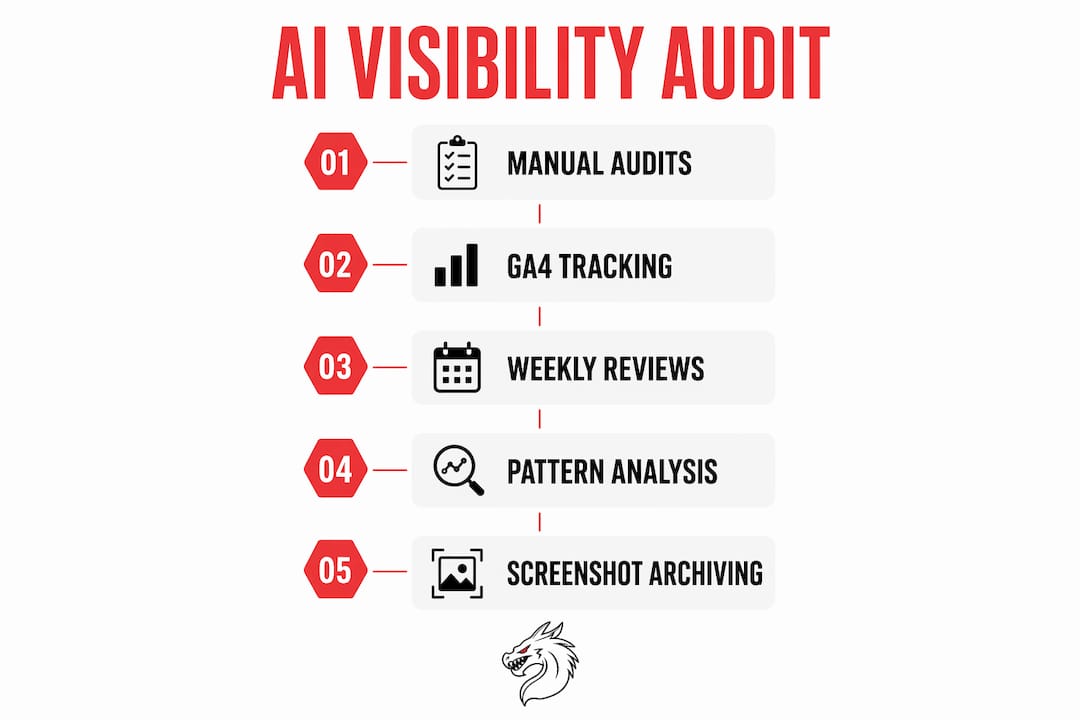
- 1.Run manual prompt audits weekly. Search for queries your customers actually use: "best plumber in [city]," "HVAC repair near [neighborhood]," "who fixes water heaters in [city]?" Run these on ChatGPT, Gemini, and Perplexity. Note who appears and who does not.
- 2.Set up GA4 referral segments for AI domains. Create custom segments in Google Analytics 4 that capture traffic from domains like chat.openai.com, perplexity.ai, and gemini.google.com. This shows you which AI platforms are already sending visitors.
- 3.Audit your robots.txt file. Blocking AI bots like GPTBot, ClaudeBot, and Googlebot in your robots.txt file cuts AI systems off from your content entirely. Check this file and remove any blocks on AI crawlers.
- 4.Monitor branded prompt accuracy. When AI mentions your business, does it describe your services correctly? Wrong service areas or outdated phone numbers in AI responses cost you real calls.
- 5.Audit by service and location. Run separate audits for each service you offer and each city you serve. Visibility gaps are often service-specific or geography-specific, not universal.
Manual AI prompt audits combined with GA4 referral tracking give you the clearest picture of where AI sends customers and where your business is missing. Use an AI search audit tool to speed up the gap analysis and identify which signals need attention first.
Pro Tip: Screenshot your AI audit results each week and save them in a folder by date. Patterns become visible over four to six weeks. You will see exactly which platforms cite you and which ones ignore you, giving you a clear priority list for your next content push.
Here is a quick comparison of tracking methods by effort and insight quality:
| Method | Effort Level | Insight Quality |
|---|---|---|
| Manual prompt audits | Low | High |
| GA4 AI referral segments | Medium | High |
| robots.txt audit | Low | Critical |
| Branded prompt monitoring | Low | Medium |
| Schema validation tools | Medium | High |
Key Takeaways
Home services contractors who build a verified, multi-layered proof stack across structured data, Google Business Profile, and third-party citations consistently win AI recommendations over competitors who rely on website quality alone.
| Point | Details |
|---|---|
| AI proof stack is non-negotiable | Location pages, Google Business Profile, job-specific reviews, and schema markup all work together. |
| Schema markup drives measurable gains | LocalBusiness, Service, Review, and FAQPage schema boost AI visibility by 30–40%. |
| Third-party platforms dominate AI citations | Feed Yelp, Angi, BBB, and HomeAdvisor consistently. Fighting them costs you citations. |
| Operational data separates top contractors | Publishing job volume and repeat customer rates in structured formats gives AI systems verifiable proof. |
| Audit AI visibility weekly | Manual prompt audits and GA4 referral segments reveal gaps that standard SEO tools miss entirely. |
What I've learned watching AI reshape home service search
AI search changes the speed of customer decisions. A homeowner asking ChatGPT "who should I call for a burst pipe in [city]?" is not browsing. They are ready to book. The contractor AI recommends gets that call. Everyone else gets nothing.
What surprises most contractors I talk to is how little their website quality matters compared to their citation footprint. A contractor with a basic website but 80 fresh, job-specific reviews on Yelp and a fully completed Google Business Profile will beat a contractor with a beautiful custom site and zero third-party presence. AI systems are not impressed by design. They are impressed by verifiable proof.
The other thing I have seen consistently: contractors who treat AI visibility as a one-time fix lose ground fast. AI systems update their training data and retrieval patterns regularly. A citation profile that was strong six months ago can go stale. The contractors who stay on top run monthly audits, push for new reviews after every job, and keep their schema current. That discipline compounds over time.
The AI-driven search shift also raises the quality bar for leads. Customers who find you through an AI recommendation have already been pre-qualified by the AI's reasoning process. They are not clicking through a list of ten options. They are calling the one name the AI gave them. That is a fundamentally different lead, and it deserves a fundamentally different level of preparation to capture it.
— Damian
How Vaultio helps contractors win in AI search
Contractors who want to capture AI-driven leads without spending months figuring out schema, citation management, and prompt monitoring need a system that handles all of it.
Vaultio builds and manages the full AI visibility stack for home service contractors: schema implementation, Google Business Profile management, review strategy, citation building, and ongoing prompt audits. The result is your business appearing first when AI recommends local services in your area. Vaultio's done-for-you marketing services cover every layer of AI and local SEO, from technical setup to lead capture. Contractors in competitive markets like Goleta, CA use Vaultio to stay ahead of the AI visibility curve and keep their schedules full. If you are ready to be the contractor AI recommends, Vaultio is where you start.
FAQ
What is AI visibility for home service contractors?
AI visibility is your business appearing as a cited recommendation when AI assistants like ChatGPT, Gemini, or Perplexity answer local service queries. It depends on structured data, third-party citations, and verified operational signals, not just website quality.
How does schema markup improve AI search visibility?
Implementing LocalBusiness, Service, Review, and FAQPage schema gives AI systems machine-readable proof of what you do and where. This structured data approach boosts AI visibility by 30–40% compared to sites without it.
Why do third-party platforms matter more than my website for AI citations?
AI systems cite third-party platforms like Yelp, Angi, and BBB far more often than contractor websites because those platforms produce vastly more content about local businesses. Keeping your profiles on these platforms complete and current is a core part of any home services AI search strategy.
How do I check if AI platforms are recommending my business?
Run manual prompt audits on ChatGPT, Gemini, and Perplexity using the exact queries your customers type. Also set up GA4 referral segments to track traffic arriving from AI platform domains like chat.openai.com and perplexity.ai.
Can blocking bots in my robots.txt file hurt my AI visibility?
Yes. Blocking AI crawlers like GPTBot or ClaudeBot in your robots.txt file prevents AI systems from reading your website content entirely. Audit your robots.txt file and remove any rules that block AI bots to restore full crawl access.
Recommended
Ready to Implement This?
We'll build your complete lead generation system in 72 hours. No contracts. 30-day money-back guarantee.