Local SEO for Plumbers: The 2026 Domination Guide

# Local SEO for Plumbers: The 2026 Domination Guide
Local SEO for plumbers is the practice of optimizing your plumbing business's online presence so you appear at the top of Google Maps, the Local Pack, and AI-powered search results when nearby customers need a plumber right now. It is not general SEO. It is hyper-local, proximity-driven, and built around one reality: plumbing customers are not browsing. They are ready to book.
Here is what local SEO for plumbers actually covers:
- —Google Business Profile (GBP) optimization — your single highest-impact lever for Map Pack visibility
- —Online reviews — quantity, recency, and velocity all influence where you rank; in major cities, sustaining 20–25 new reviews monthly is typically needed to stay in the Map Pack
- —NAP consistency — your Name, Address, and Phone must match across every directory
- —Local citations — listings on Yelp, Angi, BBB, Bing Places, and Apple Maps
- —On-page SEO — city-specific service pages with localized content and schema markup
- —Technical SEO — mobile speed, HTTPS, structured data, and site architecture
- —Link building — locally relevant backlinks from chambers of commerce, suppliers, and local press
- —Content marketing — problem-solving content that captures homeowner searches and AI recommendations
Done right, local SEO delivers a compounding flow of inbound calls without ongoing ad spend. Every review, every citation, every optimized service page builds on the last. The plumbers who own their local market in 2026 are not those with the biggest trucks. They are the ones Google trusts most.
*
Table of Contents
- —Why local SEO for plumbers is different from general SEO
- —How to fully optimize your Google Business Profile
- —Why online reviews make or break your Map Pack ranking
- —How NAP consistency and local citations strengthen your ranking foundation
- —Effective on-page SEO strategies for your plumbing website
- —Technical SEO essentials your plumbing website cannot skip
- —Building authority through link building for your plumbing business
- —Creating content that attracts and converts plumbing customers
- —Preparing your plumbing business for voice search
- —Tracking and measuring your local SEO performance
- —Common local SEO mistakes plumbers make (and how to fix them)
- —Advanced local SEO tactics that separate top plumbers from the rest
- —Your step-by-step local SEO action plan for plumbing businesses
- —Key Takeaways
- —Vaultio puts your plumbing business at the top and keeps it there
Why local SEO for plumbers is different from general SEO
General SEO chases national rankings. Local SEO for plumbing businesses chases the customer three blocks away who just discovered a burst pipe. That distinction changes everything about how you optimize.
Plumbing is one of the most proximity-sensitive service categories on Google. Your ranking for "emergency plumber near me" can shift dramatically between two ZIP codes in the same city. A competitor based five miles closer to a searcher may outrank you for that query even if your website is stronger. Google's local algorithm weighs relevance, distance, and prominence as its three core signals, and distance is the one you cannot fake.
Key differences that define local plumbing SEO:
- —Service-area specificity — you need visibility in the exact neighborhoods where you want jobs, not just your city at large
- —High-intent queries — searches like "24-hour plumber" or "water heater replacement cost" signal immediate buying intent, making local rankings worth far more per click than broad organic traffic
- —Google Business Profile as the primary battleground — GBP signals account for 32% of Map Pack ranking factors, more than any other single element
- —Emergency availability signals — turning on emergency hours in GBP directly affects which high-intent searches you appear for
- —Service-area pages — a plumber based in one city who wants jobs in surrounding towns needs individual location pages, not one generic homepage
The benefits of local search visibility for plumbers compound over time. Paid ads stop the moment you stop paying, but Local SEO keeps working.
*

How to fully optimize your Google Business Profile
Your GBP is not a listing. It is your most powerful sales asset. An incomplete or neglected profile is costing you calls every single day.
Start with the fundamentals:
- —Primary category: Set it to "Plumber," not "Plumbing Contractor." That single change affects which high-intent searches trigger your listing.
- —Secondary categories: Add relevant options like "Water Heater Installation Service," "Drainage Service," and "Emergency Plumber" to capture specialty searches.
- —Services: Every service you offer needs its own entry with a 2–3 sentence description. Compare your website's service list to your GBP and close every gap.
- —Business description: You get 750 characters. Write three versions — one keyword-focused, one conversion-focused, one balanced — and use the strongest. It does not directly affect ranking, but it drives clicks.
- —Hours and emergency availability: Update these accurately. Turning on emergency hours puts you in front of one of the highest-intent query classes in plumbing.
- —Google Posts: Posts do not move rankings directly, but they lift click-through rates. Publish consistently — eight weeks of post copy is a manageable starting target.
- —Q&A: Seed your own questions and answers covering common homeowner concerns. This content feeds AI Overviews and voice search results.
- —Photos: This is where most plumbers leave serious money on the table.
Profiles with a large number of photos receive many more calls and direction requests than profiles with few images. Real job-site photos uploaded weekly outperform generic stock shots by a wide margin. Build an eight-week upload plan focused on before-and-after work, your team on the job, and the specific services you want to rank for.
Pro Tip: Set a weekly calendar reminder to upload two to three fresh job-site photos. Consistency signals active business status to Google and keeps your profile performing above competitors who upload in bursts and then go quiet.
*
Why online reviews make or break your Map Pack ranking
Reviews are a key factor in Map Pack ranking and are the first thing a customer reads before deciding whether to call you.
What actually moves the needle:
- —Review velocity beats total count. Consistent monthly review acquisition outranks a business sitting on a large pile of old reviews. Google treats recency as a freshness signal.
- —Competitive benchmarks are real. In large metro markets, holding a Map Pack position typically requires 40–80 reviews above 4.5 stars and 20–25 new reviews monthly.
- —Review content matters. Encourage customers to mention the specific service performed and the neighborhood. "Fixed our water heater in Riverside Heights" is a stronger relevance signal than "Great service!"
- —Respond to every review. Professionally responding to negative reviews builds trust and shows Google your profile is actively managed. Ignoring them is a visible signal to both the algorithm and future customers.
- —Go beyond Google. AI search engines like ChatGPT and Perplexity cross-reference reviews on Yelp, Angi, and BBB when recommending local businesses. A strong Google profile with weak off-platform presence leaves you invisible in AI-generated recommendations.
For each rating band — five stars, four stars, three and below — write a keyword-rich response template you can adapt quickly. That way, responding never becomes a bottleneck.
*
How NAP consistency and local citations strengthen your ranking foundation
Google needs to trust that your business is real, located where you say it is, and reachable at the number you list. Citations are how it verifies that. Inconsistencies — even something as minor as "St." versus "Street" — create conflicting signals that suppress your Local Pack ranking.
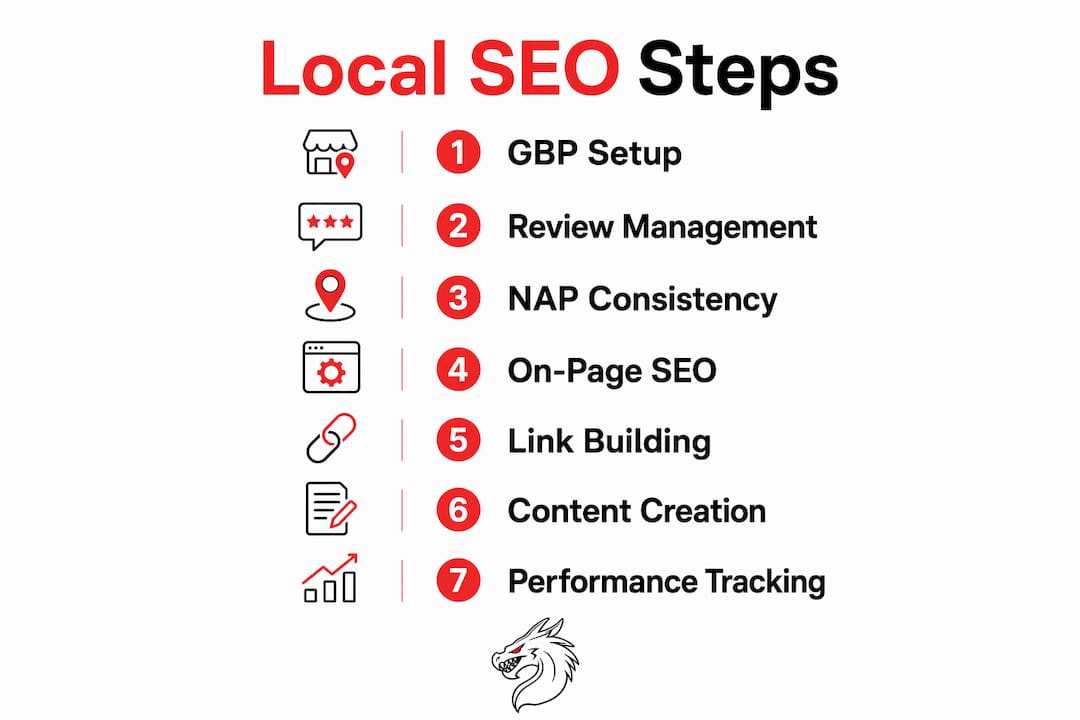
Consistent NAP data significantly increases the likelihood a business appears in the local pack. It is the difference between page one and invisible.
Priority citation sources for plumbing businesses:
- —Google Business Profile — the anchor; everything else should match it exactly
- —Yelp — heavily weighted by AI search engines for local recommendations
- —Angi and HomeAdvisor — high-traffic directories specific to home services
- —BBB (Better Business Bureau) — trust signal for both Google and AI tools
- —Bing Places — often overlooked, but Bing feeds Cortana and some AI assistants
- —Apple Maps — captures iPhone users who never open Google
- —Facebook Business — cross-referenced by multiple AI recommendation engines
- —Yellow Pages and local Chamber of Commerce directories — older but still counted
AI tools cross-reference these platforms constantly. If your phone number is wrong on Angi but correct on Google, ChatGPT may not trust either listing and exclude you from recommendations entirely. Run a citation audit using tools like BrightLocal or Whitespark, correct every mismatch, and then monitor quarterly. One-time cleanup is not enough.
*
Effective on-page SEO strategies for your plumbing website
Your GBP gets you into the Map Pack. Your website's on-page SEO gets you into organic results and keeps you there. Both matter. Neither replaces the other.
The core framework for plumbing service pages is one page per city-and-service combination, running 600–1,200 words, with the city and service in the URL, H1 heading, title tag, and meta description.
What each page needs:
- —City-specific H1 — "Emergency Plumber in Austin, TX" not "Emergency Plumbing Services"
- —Localized content — mention local neighborhoods, common local pipe issues, response time to that area
- —Pricing ranges and response times — customers want specifics; pages that answer real questions convert better
- —Embedded Google Map — reinforces geographic relevance to Google and helps users confirm you serve their area
- —FAQ schema — locally relevant questions and answers improve AI Overview visibility and voice search discovery
- —Clear call-to-action above the fold — a phone number and booking button that are impossible to miss on mobile
- —LocalBusiness schema markup — machine-readable data that helps both Google and AI engines understand your business
Pro Tip: Do not try to build pages for every city in your state. Prioritize your 10–15 highest-revenue city-and-service combinations first. A tight set of well-optimized pages outperforms 50 thin ones every time.
Hyper-local pages targeting distinct neighborhoods rather than broad city-level language consistently deliver stronger visibility gains. "Plumber in Oak Cliff, Dallas" will outperform "Dallas Plumber" for searchers in that neighborhood.

*
Technical SEO essentials your plumbing website cannot skip
A technically broken website undermines every other local SEO effort. Google cannot rank what it cannot properly crawl, and customers will not call from a site that loads slowly on their phone.
Over 60% of plumbing searches happen on smartphones, often during emergencies. Google uses mobile-first indexing, meaning it ranks your mobile experience, not your desktop version.
Technical priorities for plumbing websites:
- —Mobile-first design — fast, responsive, and easy to navigate with one thumb during a stressful moment
- —Page speed — aim for under three seconds on mobile; use Google PageSpeed Insights to identify specific bottlenecks
- —HTTPS — a non-negotiable baseline; an insecure site signals untrustworthiness to both Google and visitors
- —Clear site architecture — service pages and location pages should be reachable within two clicks from the homepage
- —LocalBusiness schema markup — implement this on your homepage and every service and location page; tools like Rabbit SEO or SEObolt can audit and generate this markup automatically
- —Crawlability — verify Google Search Console shows no indexing errors on your key pages
- —Structured data for AI search — schema markup helps ChatGPT, Perplexity, and Google AI Overviews interpret your business correctly and include you in recommendations
Schema markup is no longer optional for plumbers who want AI search visibility. It is the machine-readable layer that tells AI engines exactly what you do, where you do it, and how to reach you.
*
Building authority through link building for your plumbing business
Links from other websites tell Google your business is credible and prominent. For plumbers, local relevance matters far more than raw domain authority. A link from your city's Chamber of Commerce is worth more than a link from a generic national directory.
Where to focus your link-building efforts:
- —Local chambers of commerce — membership usually includes a directory listing and a backlink
- —Local news sites — sponsor a community event or offer expert commentary on a local water issue; journalists often link to sources
- —Supplier and manufacturer websites — if you are a certified installer for a water heater or filtration brand, ask for a dealer listing with a link
- —Local sponsorships — youth sports teams, school events, and neighborhood associations often post sponsor pages with links
- —Home service aggregators — Angi, Thumbtack, and Houzz profiles carry link equity alongside citation value
- —Real estate and property management companies — ongoing referral relationships often lead to natural mentions and links
Avoid buying links from link farms or irrelevant directories. Google's local algorithm penalizes manipulative link patterns, and the short-term gain is never worth the long-term risk. Consistent outreach for five to ten quality local links per year compounds into real ranking authority. You can also check out AI-driven SEO tactics that help identify high-probability link prospects in your specific market.
*
Creating content that attracts and converts plumbing customers
Content marketing for plumbers is not about blogging for its own sake. It is about owning the searches your customers make before they pick up the phone.
The most effective plumbing content targets specific problems with local context:
- —Local pricing guides — "How Much Does a Water Heater Replacement Cost in Phoenix?" answers a real question and captures high-intent traffic
- —Neighborhood-specific service pages — "Blocked Drain Repair in Midtown Atlanta" targets searchers who already know their location
- —Emergency plumbing guides — "What to Do When a Pipe Bursts" captures panicked homeowners and positions you as the expert to call
- —FAQ sections on service pages — structured Q&A with FAQ schema feeds AI Overviews and voice search results directly
- —Seasonal content — "How to Winterize Your Pipes in Chicago" captures searches that spike every fall
Content also powers Generative Engine Optimization (GEO), the practice of structuring your content so AI engines like ChatGPT and Perplexity cite your business when answering local plumbing questions. AI engines favor businesses with consistent, authoritative content across multiple platforms. A blog post that answers a specific local question, combined with matching FAQ schema on your service page, creates two reinforcing signals that increase your chances of appearing in AI-generated recommendations.
Combine blog posts with your service and location pages for comprehensive coverage. A blog post on "signs your water heater needs replacing" should link to your water heater service page. Every piece of content should have a clear path to a conversion.
*
Preparing your plumbing business for voice search
Voice search queries are longer, more conversational, and almost always location-specific. "Hey Google, find a 24-hour plumber near me" is a fundamentally different query structure than typing "plumber Austin TX," and it requires a different optimization approach.
How to capture voice search traffic:
- —Write FAQ content in natural language — mirror how customers actually speak, not how you would write a formal service description
- —Include locally relevant answers — "We serve the North Dallas area including Plano, Richardson, and Garland" is more voice-search-friendly than a generic service area statement
- —Prioritize mobile speed — voice search users are almost always on mobile and expect instant results; a slow site means they move to the next result
- —Use conversational keywords throughout your content — phrases like "who fixes burst pipes in [city]" and "how much does a plumber cost in [neighborhood]" match voice query patterns
- —Leverage schema markup — structured data makes your content machine-readable, which is exactly what voice assistants need to pull accurate answers
Voice search and AI search are converging. The same FAQ schema that helps Google Assistant answer a voice query also helps ChatGPT recommend your business when someone asks for a plumber in your city. Optimizing for one effectively optimizes for both.
*
Tracking and measuring your local SEO performance
You cannot improve what you do not measure. Most plumbers track the wrong things — or nothing at all.
The metrics that actually tell you whether your local SEO is working:
- —Geo-grid rank tracking — a geo-grid rank tracker measures your Map Pack position at multiple GPS coordinates across your service area, revealing the invisible zones where competitors are capturing your potential customers
- —GBP insights — monitor calls, direction requests, and website clicks from your profile monthly; these are direct indicators of lead flow from local search
- —Review velocity — track how many new reviews you receive each month and compare it to your top Map Pack competitor; closing that gap is often the fastest path to a ranking jump
- —Website traffic by page — use Google Analytics 4 to identify which service and location pages drive the most sessions and conversions
- —Conversion rate on service pages — traffic without calls is a content or UX problem; track form submissions and phone clicks separately for each key page
- —Citation consistency score — run quarterly audits with BrightLocal or Whitespark to catch new inconsistencies before they suppress rankings
Most plumbers assume their rank is the same across their entire city. It is not. Proximity causes rankings to vary by small distances, sometimes dramatically. A geo-grid report shows you exactly where you are winning and where you are losing, so you can focus your effort where it counts.
*
Common local SEO mistakes plumbers make (and how to fix them)
These are the mistakes that keep good plumbing businesses invisible. Most are fixable in a weekend.
- —Wrong primary GBP category — "Plumbing Contractor" instead of "Plumber" misses the highest-intent searches; change it immediately
- —Incomplete GBP services list — if a service is not listed on your profile, Google cannot match you to searches for it
- —Inconsistent NAP data — one wrong phone number on Angi can suppress your ranking and exclude you from AI recommendations; audit and fix every directory
- —No review acquisition process — waiting for customers to leave reviews voluntarily produces a trickle; a systematic follow-up process produces a flood
- —Ignoring negative reviews — an unanswered one-star review signals to future customers and to Google that you are not engaged
- —Generic city-level pages instead of neighborhood pages — "Dallas Plumber" pages compete against every plumber in the metro; "Plumber in Deep Ellum, Dallas" pages compete against far fewer
- —Missing LocalBusiness schema — without structured data, AI engines cannot reliably interpret your business information
- —Slow mobile site — a site that takes five seconds to load on a phone loses the customer before they ever see your phone number
- —No geo-grid tracking — assuming you rank well everywhere in your city is almost always wrong; you need data to know where you are actually visible
Fix the GBP category and services first. Then clean up citations. Then build a review process. In that order, those three actions deliver the fastest visible ranking improvement for most plumbing businesses.
*
Advanced local SEO tactics that separate top plumbers from the rest
Once the fundamentals are locked in, these tactics push you from competitive to dominant.
AI search optimization (GEO): AI engines like ChatGPT, Perplexity, and Google AI Overviews are now answering local service queries directly. Building authoritative signals on platforms these engines trust — Yelp, Nextdoor, Angi, BBB — increases the likelihood they recommend your business. Run 20 prompts a plumber's customer might ask across multiple AI engines and identify exactly which queries you are missing from.
Hyper-local FAQ schema: Create FAQ schema blocks that answer neighborhood-specific questions. "Do you offer same-day service in Buckhead?" is a more powerful AI citation trigger than a generic FAQ about your response time.
Competitive review velocity analysis: Calculate the gap between your monthly review rate and your top Map Pack competitor's. In most mid-size markets, closing a gap of 5–15 reviews per month is enough to shift rankings. That is a solvable problem, not a permanent disadvantage.
Local sponsorships for link equity: Sponsor a local little league team, a neighborhood association event, or a school fundraiser. These sponsorships often generate backlinks from local .org and .edu domains that carry disproportionate local ranking weight.
Hiding your address may be hurting you: Many service-area businesses hide their address in GBP to avoid showing a home address. Data from an 8,186-business study by Sterling Sky shows that hiding your address correlates with rank loss. If you can display a commercial address, do it.
For plumbers ready to go deeper on home services SEO tactics, the combination of GEO optimization and geo-grid tracking is where the biggest competitive gaps exist in 2026.
*
Your step-by-step local SEO action plan for plumbing businesses
Stop reading. Start doing. Here is the sequence that produces results fastest.
Week 1: GBP audit and optimization
- —Confirm your primary category is "Plumber"
- —Add every service with a 2–3 sentence description
- —Upload 10 real job-site photos immediately; schedule weekly uploads going forward
- —Turn on emergency hours if you offer emergency service
- —Write and publish your business description
Week 2: Citation cleanup
- —Run a citation audit using BrightLocal or Whitespark
- —Correct every NAP inconsistency, starting with Yelp, Angi, BBB, and Bing Places
- —Claim any unclaimed profiles on major directories
Week 3: Review acquisition process
- —Build a simple follow-up sequence: text or email customers within 24 hours of job completion with a direct link to your Google review page
- —Write response templates for each rating band
- —Respond to every existing unanswered review this week
Week 4: On-page SEO
- —Identify your 10–15 highest-revenue city-and-service combinations
- —Audit existing pages against the framework: city in URL, H1, title tag, meta description; embedded map; FAQ schema; LocalBusiness schema
- —Create or refresh pages that are missing or thin
Month 2: Technical health and link building
- —Run a mobile speed test on Google PageSpeed Insights and fix the top three issues
- —Verify HTTPS is active and no indexing errors exist in Google Search Console
- —Identify five local link prospects: chamber of commerce, local news, suppliers, sponsorships
- —Send outreach emails for each
Month 3 and beyond: Track, measure, adjust
- —Set up geo-grid rank tracking to identify your weakest visibility zones
- —Monitor GBP insights monthly: calls, direction requests, website clicks
- —Track review velocity weekly and compare to your top competitor
- —Publish one new piece of locally relevant content per month
- —Repeat the citation audit quarterly
The benefits of AI in local SEO compound fastest when you execute this sequence in order. Skipping to content marketing before fixing your GBP and citations is building on a cracked foundation.
*
Key Takeaways
Local SEO for plumbers delivers compounding, long-term lead flow when GBP optimization, review velocity, NAP consistency, and hyper-local service pages work together as a system.
| Point | Details |
|---|---|
| GBP is your biggest lever | GBP signals are a major factor in Map Pack ranking — optimize it before anything else. |
| Review velocity beats volume | Consistent monthly reviews outrank large outdated counts; top metros require 20–25 new reviews monthly. |
| NAP consistency drives trust | Consistent citation data significantly increases the likelihood a business appears in the local pack. |
| Hyper-local pages win neighborhoods | One page per city-and-service combination, 600–1,200 words, with local content and schema markup. |
| Vaultio accelerates the whole system | Vaultio combines #1 local search rankings with instant lead response to deliver 10–15 extra booked jobs per month. |
*
Vaultio puts your plumbing business at the top and keeps it there
Ranking #1 on Google Maps is only half the battle. The plumbers who dominate their market in 2026 are the ones who capture every lead the moment it comes in, not the ones who rank well but respond slowly.
Vaultio is built for exactly this. While you are running jobs, Vaultio handles your local search rankings across Google, ChatGPT, AI Overviews, and every platform your customers use to find a plumber. Your business becomes the first name they see. Then, the moment a new lead comes in, Vaultio engages them within seconds so you never lose a customer to a competitor who picked up faster.
The result is predictable: 10–15 extra booked jobs every month, a growing review base, and a local presence that compounds instead of fading. No long-term contracts. No wasted ad spend. Just measurable growth backed by a 30-day money-back guarantee.
If you are ready to stop losing jobs to plumbers who are simply more visible than you, get your local SEO ranking locked in with Vaultio. Your market is waiting. Your competitors are already moving.
Recommended
Ready to Implement This?
We'll build your complete lead generation system in 72 hours. No contracts. 30-day money-back guarantee.