Urgency in HVAC Sales: Close More Jobs Every Day
# Urgency in HVAC Sales: Close More Jobs Every Day
Urgency in HVAC sales is the buyer's time-sensitive reason to act now, not the seller's pressure to hit a quota. When you capture that buyer-owned urgency, close rates climb, average tickets grow, and "I'll think about it" responses drop. A significant portion of pipeline deals end in no decision when urgency is absent. Three things you can do today to change that:
- —Add two timeline questions to every first call: "What happens if this isn't fixed in the next 30 days?" and "Is there a date by which you need this resolved?"
- —Set a lead acknowledgement SLA of under 60 seconds with a human follow-up target under 15 minutes.
- —Publish one real, time-bound trigger on your lead-capture landing page, such as an expiring manufacturer rebate or a confirmed crew opening.
These three moves cost nothing to implement. They do require systems, which is what the rest of this guide covers.
*
Table of Contents
- —What "urgency" means in HVAC sales and how it differs from pressure
- —Why urgency changes outcomes for HVAC contractors
- —How to uncover real buyer urgency on the first call
- —Legitimate urgency triggers your HVAC team can use right now
- —What to avoid: fake scarcity and the reputation cost
- —How to operationalize urgency capture: response, AI, and scheduling
- —What to measure and how to test whether it's working
- —Before and after: what ethical urgency capture looks like in practice
- —Key Takeaways
- —The part most HVAC owners get wrong about urgency
- —Vaultio turns urgency into booked jobs, not missed calls
- —Selected research and further reading
What "urgency" means in HVAC sales and how it differs from pressure
Real urgency does not come from pressure. It comes from helping the buyer understand why the problem matters now. That distinction separates contractors who close consistently from those who rely on tactics that backfire.

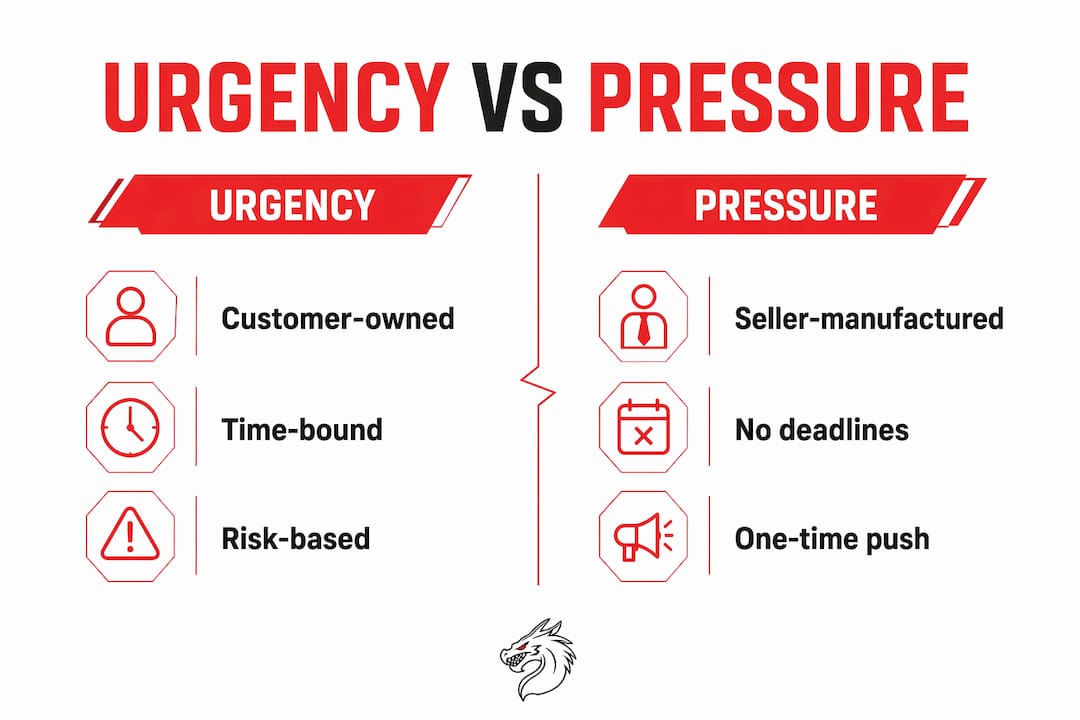
Urgency is a time-bound reason that exists in the customer's world: a failing heat exchanger, an expiring rebate, a summer heat wave arriving in two weeks. Pressure is a time-bound reason that exists in the seller's world: end-of-month quotas, invented scarcity, artificial deadlines.
| Dimension | Urgency (buyer-owned) | Pressure (seller-manufactured) |
|---|---|---|
| Source | Customer's risk, deadline, or cost of delay | Seller's quota or invented constraint |
| Trust impact | Builds trust; customer feels understood | Erodes trust; customer feels manipulated |
| Persistence after the call | Self-sustaining; buyer keeps raising it internally | Evaporates quickly once the rep leaves |
| Long-term reputation | Referrals and repeat business | Cancellations and negative reviews |
Pressure might close one job. Urgency closes the next ten.
*
Why urgency changes outcomes for HVAC contractors
Authentic urgency increases conversion, raises average ticket, and cuts no-decision loss. The mechanism is straightforward: when a buyer owns a deadline, they reduce internal friction, move faster through approvals, and are less likely to shop three more bids.
Manufactured urgency decays the moment your tech drives away. Buyer-owned urgency is self-sustaining because the homeowner keeps raising it internally. That is the difference between a 30% close rate and a 55% close rate on the same lead volume.
The metrics that move when urgency capture is working:
- —Lead response time (target: under 60 seconds for acknowledgement)
- —Booking rate from urgent-labeled leads vs. general inquiries
- —Conversion to estimate from first call
- —Average ticket on urgent vs. non-urgent jobs
- —Time-to-close from first contact to signed agreement
- —Percent no-decision across all estimates
Track these six numbers for 30 days before changing anything. They are your baseline.
*
How to uncover real buyer urgency on the first call
You cannot create urgency; you can only uncover it by asking the right discovery questions and adding real, buyer-specific value. Ask these in order on the first call or visit:
- 1.Timeline question: "Is there a date by which you need this resolved?"
- 2.Consequence question: "What happens to your family's comfort — or your utility bill — if this isn't fixed in the next 30 days?"
- 3.Safety question: "Has anyone in the home noticed unusual smells, sounds, or higher-than-normal CO detector readings?" (A genuine concern posture, per Close It Now, causes homeowners to mirror that urgency naturally.)
- 4.Stakeholder question: "Is there anyone else who needs to weigh in before you move forward?"
- 5.Budget-window question: "Are you aware there's a manufacturer rebate expiring this month that could save you several hundred dollars?"
After the call, triage every lead into one of four buckets:
- —Immediate (safety risk, no heat/cooling, rebate expiring within 7 days)
- —30-day (unit failing, seasonal window closing, confirmed budget)
- —90-day (planning stage, no immediate pain)
- —Disqualify or nurture (no timeline, no budget signal, no consequence identified)
This triage feeds directly into your contractor sales pipeline, so your best crew slots go to the leads most likely to close this week.
*
Legitimate urgency triggers your HVAC team can use right now
Urgency must tie to a compelling event to persist after the rep leaves. Here are the triggers that hold up under scrutiny, plus what to show the customer as proof.
| Trigger | Why it's valid | Customer proof to present |
|---|---|---|
| Expiring manufacturer rebate | Hard deadline set by the manufacturer | Screenshot of rebate portal with expiry date |
| Seasonal temperature window | Installs take 1–2 days; heat/cold arrives in days | Local 10-day forecast on your phone |
| Long equipment lead times | Certain models are 3 weeks out from distributors | Distributor email or inventory screen |
| Confirmed crew opening | Your next available slot is specific and real | Your scheduling calendar, shown on-site |
| Safety risk (CO, cracked heat exchanger) | Documented inspection finding | Photo from the inspection, written report |
Pro Tip: Co-create a Mutual Action Plan with the homeowner. Write down the rebate deadline, your next crew opening, and their stated timeline. When the homeowner holds the pen, the urgency belongs to them, not you.
Seasonal planning behavior also plays a role here. Homeowners who are already thinking about smart renovation timing are primed to act on a legitimate scheduling constraint. Meet them where they are.
*
What to avoid: fake scarcity and the reputation cost
Fake scarcity creates short-term lifts but long-term reputation damage. Never use these tactics:
- —Invented deadlines ("This price is only good until midnight tonight" when it isn't)
- —Fake inventory claims ("We only have one unit left" when you have twelve)
- —Misleading rebate promises (citing a rebate that has already expired)
- —Safety exaggerations (implying imminent danger without documented evidence)
- —Pressure language that threatens consequences you cannot verify
U.S. consumer protection law, enforced by the FTC, prohibits deceptive advertising claims. A single viral negative review citing manipulative tactics can cost more in lost referrals than a year of closed deals. Present true constraints transparently: show the rebate portal, show the calendar, show the inspection photo. When the constraint is real, you never have to oversell it.
This article is general information, not legal advice. Confirm your advertising practices with a qualified attorney for your specific situation.
*
How to operationalize urgency capture: response, AI, and scheduling
Urgency decays fast. If it ties only to seller pressure, it evaporates the moment the call ends. Your ops must move faster than the buyer's hesitation.
Ops checklist for urgency capture:
- —Under 60 seconds: AI chat or automated SMS acknowledges the inquiry and confirms receipt.
- —Under 15 minutes: A human team member calls or texts with a specific next step.
- —Same call: Offer two booking slots, not an open-ended "we'll call you back."
- —Calendar hold: Lock the slot before ending the call; send a confirmation immediately.
- —Urgent-lead routing: AI triage flags Immediate and 30-day leads for priority dispatch.
Vaultio's combined local SEO and AI lead-capture system is built around exactly this workflow. When an urgent search hits your Google listing at 9 PM, the AI engages within seconds, qualifies the lead, and routes it into a priority booking path. Pair that with after-hours lead capture and you stop losing the jobs your competitors pick up while you're asleep.
AI-generated buyer-specific insights — competitive context, cost-of-inaction math, budget windows — also help reps add immediate value on the first call, which surfaces urgency faster than any script alone.
*
What to measure and how to test whether it's working
Primary KPIs to track:
- —Lead response time (target: under 60 seconds)
- —Percent of leads with an identified timeline (target: 70%+)
- —Booking rate from urgent-labeled leads vs. general pool
- —Average ticket: urgent vs. non-urgent jobs
- —Time-to-close from first contact to signed agreement
- —Percent no-decision across all estimates
Simple 30-day test design:
- 1.Establish a 30-day baseline using your current process. Record all six KPIs.
- 2.In month two, implement the discovery script and the 60-second/15-minute SLA on one crew or route.
- 3.Compare booking rate and average ticket between the two periods.
- 4.Watch for seasonal confounders: a cold snap in month two will inflate urgent-lead volume regardless of your script. Note weather events in your log.
A sample size of 30–50 estimates per period gives you enough signal to see real movement in booking rate. Fewer than 20 estimates and the variance will mask the effect.
*
Before and after: what ethical urgency capture looks like in practice
Before: A homeowner calls at 7 PM about a struggling AC unit. The office is closed. No AI chat. No after-hours routing. The lead sits in a voicemail until 9 AM. By then, the homeowner has booked a competitor. With around 40% of deals ending in no decision when urgency is absent, a slow response turns a hot lead cold in hours.
After: The same call hits an AI chat that acknowledges within 30 seconds, asks two timeline questions, flags the lead as Immediate, and texts the on-call tech. The tech calls back in 12 minutes, confirms a crew slot for the next morning, and mentions an expiring rebate. The job is booked before the homeowner checks a second option. Booking rate from urgent leads climbs. Average ticket rises because the rebate conversation opens a system-upgrade discussion. Contractors running this playbook with Vaultio's AI lead generation system report 10–15 extra booked jobs per month.
*
Key Takeaways
Ethical urgency capture, backed by fast lead response and real buyer-owned triggers, is the single highest-leverage change an HVAC contractor can make to close rate and average ticket.
| Point | Details |
|---|---|
| Urgency is buyer-owned | It must come from the customer's risk or deadline, not the seller's quota. |
| Response speed is the multiplier | Under-60-second acknowledgement and under-15-minute human follow-up preserve urgency before it decays. |
| Real triggers outperform fake ones | Rebates, crew slots, and safety findings are documentable; invented scarcity destroys trust permanently. |
| Measure six KPIs | Track response time, booking rate, avg ticket, time-to-close, timeline capture rate, and % no-decision. |
| Vaultio closes the ops gap | Vaultio's AI lead-capture and local SEO system delivers 10–15 extra jobs/month with a 30-day money-back guarantee. |
*
The part most HVAC owners get wrong about urgency
Most urgency advice focuses on what to say. The real problem is what happens after you say it.
You can run the perfect discovery call, surface a genuine safety risk, and quote a real rebate deadline. Then the homeowner says "let me think about it," and your follow-up lands 48 hours later. The urgency you uncovered is gone. Not because the risk disappeared, but because your ops didn't match the moment.
The contractors who win on urgency are not the smoothest talkers. They are the ones who built a system where the moment a lead comes in, something happens immediately. The AI responds. The human follows up. The slot gets held. That sequence is what converts urgency into a booked job. Without it, even the best discovery script is just a conversation.
The other thing owners underestimate: urgency compounds. A homeowner who books fast, gets great service, and sees the rebate applied becomes a referral source who tells neighbors about the experience. That is how urgency tactics in HVAC become a long-term growth engine, not just a close-rate trick.
*
Vaultio turns urgency into booked jobs, not missed calls
10–15 extra jobs per month. That is what HVAC contractors get when they combine top Google rankings with a lead-response system that never sleeps. Vaultio handles the full stack: local SEO that puts you first when a homeowner searches at 10 PM, AI chat that engages within seconds, and a booking workflow that locks the slot before the lead goes cold.
Every audit starts with a rapid lead-capture review: Vaultio identifies your current response gaps, recommends SLA targets, and maps the legitimate urgency triggers you should be publishing on your landing pages. You see exactly where jobs are slipping and what to fix first. The first 30 days come with a money-back guarantee. If you don't see measurable improvement, you pay nothing.
Get your lead-capture audit and find out how many jobs you're losing to a slow response right now.
*
Selected research and further reading
- —Modern Sales Training — Foundational framework for buyer-owned urgency and ethical discovery questions; cited throughout the definition and discovery sections.
- —JB Sales — Practical guidance on adding value to surface urgency and using AI to generate buyer-specific insights.
- —The Idea Hunters — HVAC-specific scripts and the compelling-event framework for preserving urgency after the call.
- —Close It Now — Posture-based urgency for furnace and HVAC sales; safety-concern framing that converts naturally.
- —Alex Berman — No-decision pipeline analysis and cost-of-delay framing.
- —SmartService — Warning against fake scarcity; grounds urgency in real, verifiable constraints.
- —Vaultio Blog — Implementation examples for HVAC lead capture, local SEO, and AI-driven booking workflows.
- —Vaultio After-Hours Lead Capture — Tactical guide to routing urgent after-hours HVAC inquiries into your SLA-driven booking system.
Recommended
Ready to Implement This?
We'll build your complete lead generation system in 72 hours. No contracts. 30-day money-back guarantee.