Contractor Sales Pipeline Management: 2026 Guide

# Contractor Sales Pipeline Management: 2026 Guide
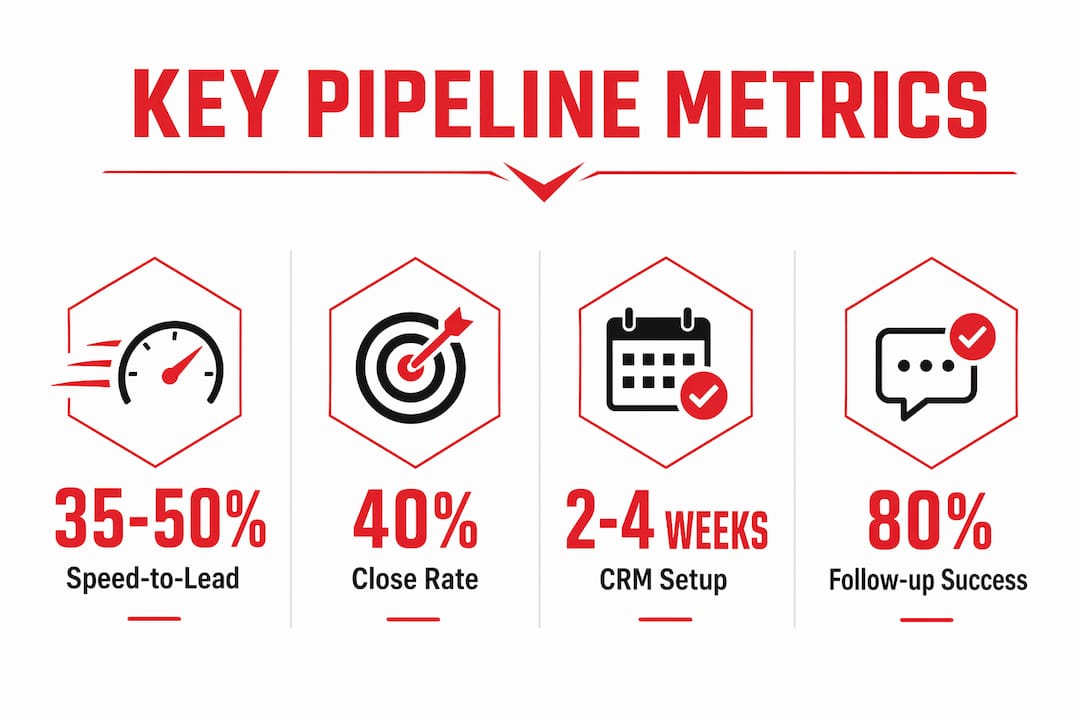
Contractor sales pipeline management is the systematic process of moving leads through defined sales stages to maximize job conversions and revenue. Without it, you are running your business on gut feel, and gut feel does not pay payroll. The best home service contractors treat their sales pipeline as a revenue control system, not a spreadsheet of names. Contractors who respond to new leads within 1 hour secure the job 35–50% more often than those who respond later. That single metric tells you everything about where most contractors lose money.
What are the key stages of a contractor sales pipeline?
A contractor sales pipeline is only as strong as its stage definitions. Vague stages produce vague forecasts. Clear stages produce predictable revenue.
The standard pipeline for home service contractors runs through seven stages:
- —Lead generation: A prospect contacts you or fills out a form.
- —Qualification: You confirm budget, timeline, and project scope.
- —Initial engagement: You make first contact and set an appointment.
- —Estimate presentation: You present pricing, ideally in person.
- —Follow-up: You pursue the prospect after the estimate.
- —Negotiation: You handle objections and adjust scope if needed.
- —Contract closure: The prospect signs and pays a deposit.
Each stage needs an exit criterion. An exit criterion is the specific action that must happen before a lead moves forward. Without exit criteria, pipelines become loose opportunity lists, and your sales forecasting falls apart. For example, a lead does not leave the "Qualification" stage until you have confirmed a real budget and a real timeline. If you skip that check, you waste hours estimating for someone who was never going to buy.
The table below shows how exit criteria work in practice for home service contractors.
| Stage | Exit criterion |
|---|---|
| Lead generation | Contact info captured and inquiry logged in CRM |
| Qualification | Budget, timeline, and scope confirmed via call or form |
| Estimate presentation | Estimate delivered and prospect response recorded |
| Follow-up | At least three contact attempts made with dates logged |
| Contract closure | Signed contract and deposit received |
Stage discipline is what separates contractors who close 40% of their estimates from those who close 15%. The difference is not charm. It is process.
How to set up your sales pipeline for contractor work
Map your actual sales stages before you touch any software. This is the step most contractors skip, and it is why so many CRM setups fail within 90 days. Generic CRM templates are built for software salespeople, not HVAC technicians or roofing crews. Customizing your CRM to match your real operational workflow is what drives team adoption and accurate pipeline data.
When selecting a tool, look for these features specifically:
- —Automated follow-up sequences triggered at set intervals after an estimate
- —Lead source tracking so you know which marketing channel produced each job
- —Pipeline visibility with a clear view of how many leads sit at each stage
- —Mobile access so field staff can update records from the job site
- —Estimate and proposal integration to keep documents inside the same system
A realistic CRM setup, including workflow mapping, automations, data import, and team training, takes 2 to 4 weeks. Contractors who rush this process end up with a system their team ignores. The result is a shadow system of sticky notes and text messages that makes pipeline tracking impossible.
Pro Tip: Automate your follow-up sequences the moment your CRM goes live. Set triggers at 48 hours, 7 days, and 14 days post-estimate. Automated sequences eliminate the human error of forgetting to call back, which is the single most common cause of pipeline leakage for home service contractors.

The right setup pays for itself fast. When your pipeline reflects reality, you can forecast revenue, manage crew capacity, and make marketing decisions based on actual data instead of memory.
Step-by-step guide to managing leads from capture to close
Effective pipeline management for contractors is a daily discipline, not a monthly review. Here is the process that consistently produces higher conversion rates.
- 1.Respond within 1 hour. Contractors who respond within 1 hour book jobs at 35–50% higher rates. Set up an AI chatbot or live answering service to cover hours when you are on a job site.
2. Qualify every lead with a script. Ask about budget range, project timeline, property ownership, and decision-making authority. A 5-minute qualification call saves 2 hours of wasted estimating time.
3. Schedule an in-person estimate. In-person estimate presentations close jobs at 2–3 times the rate of emailed PDF quotes. Face-to-face meetings let you handle objections in real time and build trust faster.
4. Present and attempt to close at the appointment. Closing at the first appointment yields 2–3 times higher conversion rates than follow-up attempts. Bring a contract and a way to take a deposit on the spot.
5. Log the outcome immediately. Update your CRM before you leave the driveway. Record the prospect's objections, their timeline, and your next scheduled contact.
6. Run a follow-up sprint. Contact the prospect at 48 hours, 7 days, and 14 days if they did not sign. 80% of sales happen after the 5th contact. Most contractors quit after the first or second attempt and hand the job to a competitor.
7. Track your conversion rates weekly. Measure lead-to-estimate rate and estimate-to-job rate separately. These two numbers tell you exactly where your pipeline is leaking.
Pro Tip: Create a "follow-up sprint" folder in your CRM. Every unsold estimate goes in automatically. Each morning, your first task is to work through that folder. Contractors who treat follow-up as a scheduled job, not an afterthought, consistently outperform those who rely on memory.
Common mistakes in contractor sales pipeline management
Most contractors misdiagnose their sales problems. They assume they need more leads when the real issue is poor follow-up causing leakage at the estimate stage. More leads fed into a broken pipeline just means more wasted time.
The most damaging mistakes are:
- —No follow-up schedule. Sending one email after an estimate and waiting is not a follow-up strategy. It is a hope strategy. Disciplined follow-up at 48 hours, 7 days, and 14 days drastically improves conversion.
- —Using a generic CRM template. A template built for retail or software sales does not include stages like "site visit scheduled" or "permit pulled." Forcing your workflow into the wrong template means your pipeline data is always wrong.
- —Missing stage exit criteria. Without clear exit criteria, leads sit in "In Progress" forever. You cannot forecast revenue from a pipeline full of ambiguous statuses.
- —Ignoring response time. Every hour you delay responding to a new inquiry, your odds of booking that job drop. Competitors who respond first win the job, even if your price is lower.
- —Skipping metrics tracking. If you do not measure your lead-to-estimate and estimate-to-job rates, you cannot identify where the problem is. You are flying blind.
The fix for most of these mistakes is the same: build the process into your system so it happens automatically, not when you remember to do it.
How do you measure and improve pipeline performance over time?
Sales tracking for contractors requires three core metrics reviewed on a weekly basis. Those metrics are lead-to-estimate conversion rate, estimate-to-job conversion rate, and average job value by lead source.
Your CRM dashboard should show all three in real time. If it does not, your tool is not configured correctly. Tracking paid revenue by lead source lets you identify which marketing channels produce the highest-margin jobs, not just the most leads. Referrals typically produce better conversion rates and higher ticket sizes than generic ad traffic. That insight alone can redirect your marketing budget toward channels that actually pay.
| Metric | What it tells you |
|---|---|
| Lead-to-estimate rate | How well you qualify and engage new inquiries |
| Estimate-to-job rate | How effective your presentation and follow-up are |
| Average job value by source | Which lead channels produce the most profitable work |
| Sales cycle length | How long it takes from first contact to signed contract |
Run a win/loss review every month. For every lost job, record the reason. Price objections, timing issues, and competitor wins each point to a different fix. Price objections suggest a presentation problem. Timing issues suggest a follow-up problem. Competitor wins suggest a speed-to-lead problem. The data tells you exactly where to focus.
Key Takeaways
Effective contractor sales pipeline management requires defined stages, disciplined follow-up, and weekly metric reviews to convert more leads into booked jobs.
| Point | Details |
|---|---|
| Speed-to-lead is critical | Responding within 1 hour increases booking rates by 35–50% compared to slower responses. |
| Stage exit criteria prevent leakage | Every pipeline stage needs a specific action completed before a lead advances. |
| In-person estimates outperform email | Face-to-face estimate presentations close at 2–3 times the rate of emailed quotes. |
| Follow-up discipline wins jobs | 80% of sales happen after the 5th contact; automate sequences at 48 hours, 7 days, and 14 days. |
| Track revenue by lead source | Linking job revenue to its source reveals which marketing channels produce the highest-margin work. |
Why pipeline discipline is the real competitive edge for contractors
I have worked with enough home service contractors to know that the ones who struggle are rarely struggling because of bad workmanship or bad pricing. They are struggling because their sales process is invisible to them. They cannot tell you how many leads they got last month, how many estimates they ran, or what percentage of those estimates turned into jobs. That is not a marketing problem. It is a control problem.
The contractors who grow predictably treat their pipeline the way a good project manager treats a job schedule. Every task has a status. Every status has a next action. Nothing sits in limbo. When I see a contractor adopt that mindset, the change in their business is immediate. They stop chasing work and start managing it.
The hardest part is not the technology. Any decent CRM will do the job if it is set up correctly. The hardest part is the mindset shift from "I will follow up when I get a chance" to "follow-up is a scheduled task that happens whether I feel like it or not." That shift is worth more than any marketing campaign you will ever run. Build the system, work the system, and the revenue follows.
— Damian
Vaultio gives contractors a full pipeline from first click to signed contract
Your pipeline only works if it is full. Vaultio fills it with high-intent leads from AI-powered local SEO and Google Local Service Ads, putting your business in front of customers the moment they search. Every new inquiry gets engaged within seconds through Vaultio's AI chatbot and AI receptionist, so you never lose a lead to slow response time. Vaultio's AI lead scoring then prioritizes the highest-value prospects so your time goes to the jobs worth winning. The result is a steady, predictable flow of booked jobs backed by a 30-day money-back guarantee.
FAQ
What is contractor sales pipeline management?
Contractor sales pipeline management is the process of tracking leads through defined stages, from first inquiry to signed contract, using exit criteria and follow-up schedules to maximize job conversions.
How fast should a contractor respond to a new lead?
Contractors who respond within 1 hour book jobs at 35–50% higher rates than those who respond later. Use an AI chatbot or answering service to cover response during job site hours.
How many follow-up attempts should a contractor make?
Make at least five contact attempts before marking a lead as lost. Research shows 80% of sales happen after the 5th contact, so a follow-up sprint at 48 hours, 7 days, and 14 days is the minimum standard.
What metrics should contractors track in their sales pipeline?
Track lead-to-estimate rate, estimate-to-job rate, average job value by lead source, and sales cycle length. These four metrics identify exactly where your pipeline is leaking revenue.
How long does it take to set up a contractor CRM properly?
A proper CRM setup, including workflow mapping, automations, and team training, takes 2 to 4 weeks. Rushing the setup produces a system your team ignores and data you cannot trust.
Recommended
- —Website Design for Home Service Contractors | Conversion-Optimized, Mobile-First Sites | Vaultio
- —Home Service Marketing Blog | Strategies, Tips & Tactics | Vaultio
- —Roofing Marketing | Roof Replacement & Storm Damage Leads | Vaultio
- —B2B Lead Generation & Sales Automation | AI Cold Outreach | Vaultio
Ready to Implement This?
We'll build your complete lead generation system in 72 hours. No contracts. 30-day money-back guarantee.