Brand Mentions in AI Search: What Actually Drives Visibility
# Brand Mentions in AI Search: What Actually Drives Visibility
Brand mentions are a primary entity signal AI systems use to decide which brands to name in generated answers. Not backlinks. Not domain authority scores. Contextual, third-party mentions that teach models like ChatGPT, Google AI Overviews, Perplexity, and Gemini what your brand stands for and which category it belongs to. If your brand isn't being named in the right context across credible sources, it won't show up when AI answers the questions your customers are asking.
Three actions to take right now:
- —Build a prompt test set. Identify 10–20 queries your customers actually type into ChatGPT or Perplexity, covering local intent, category comparisons, and solution-oriented searches.
- —Map your high-impact third-party sources. Identify which directories, review platforms, industry publications, and community forums already mention your brand, and which ones should.
- —Start tracking attribute proximity. Monitor how often your brand name appears within 5–10 words of your core category term. That proximity is a stronger predictor of AI inclusion than raw mention volume.
This article covers the full picture: what brand mentions in AI search actually are, how tracking them differs from traditional monitoring, the challenges you'll face, a step-by-step workflow, the tools that help, and the tactics that move the needle.
Table of Contents
- —What brand mentions in AI search actually are
- —How tracking brand mentions for AI search differs from traditional monitoring
- —Practical tracking challenges you need to plan around
- —A step-by-step workflow to track brand mentions in AI search
- —Which tools actually help with AI brand monitoring
- —Tactical ways to improve your brand visibility in AI search
- —What the data shows about brand mentions and AI visibility
- —Key Takeaways
- —The angle most marketers are missing on brand mentions
- —Vaultio gets contractors into AI search answers, not just Google rankings
- —Useful sources and further reading
What brand mentions in AI search actually are
In traditional SEO, a brand mention meant someone referenced your company online, with or without a link. In AI search, the definition expands. A brand mention in AI search is any textual reference to your brand that an AI model reads during training or retrieves at inference time, then reproduces in a generated answer. That includes unlinked text on a blog post, a Reddit thread, a review on a local directory, or a line in an industry roundup.
Industry analysts note that the shift in 2026 is from link-based authority to entity-based authority, where unlinked mentions function as implied links that teach LLMs brand associations. Your brand becomes an entity the model recognizes, not just a URL it can crawl.
The four platforms where this plays out most visibly:
- —ChatGPT surfaces brands in conversational recommendations, often without source links, drawing on training data and (increasingly) live retrieval.
- —Google AI Overviews pulls named brands into summarized answers at the top of search results, with citations that link to source pages.
- —Perplexity operates as a retrieval-augmented system, naming brands and citing sources in a format closer to a research assistant than a chatbot.
- —Gemini integrates brand mentions into structured answers and shopping-style results, with Google's Knowledge Graph as a strong underlying signal.
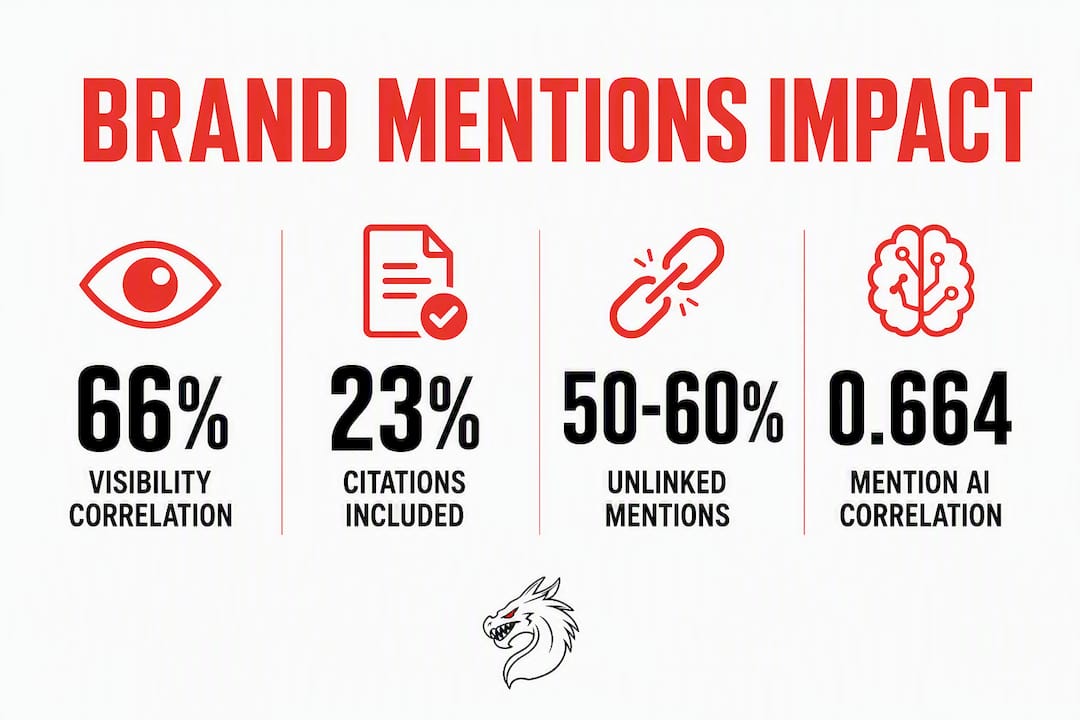
The distinction between a mention and a citation matters. Only 23.1% of brand mentions in AI responses include a citation; conversely, 69.9% of citations include the brand name. That gap means you can be named frequently without ever getting a source link, and you can earn citations that drive traffic even when your brand isn't the headline. Track them separately. They require different tactics.
| Dimension | Traditional brand mention | AI search brand mention |
|---|---|---|
| Format | Linked or unlinked text on web pages | Named reference in a generated AI answer |
| Signal type | Link equity, referral traffic | Entity association, semantic context |
| Where it appears | SERPs, social, news | ChatGPT, AI Overviews, Perplexity, Gemini |
| Citation included? | Usually (backlink) | Rarely |
| Measurement tool | Ahrefs, Google Search Console | Prompt testing, API sampling |
How tracking brand mentions for AI search differs from traditional monitoring
Traditional brand monitoring tracks where your name appears and whether it links back to you. AI monitoring asks a different question: when someone prompts an AI with a category or solution query, does your brand get named?
Text-only, unlinked mentions make up roughly 50–60% of the third-party footprint for brands that appear consistently in AI answers; hyperlinked mentions are about 25–35%. That ratio flips the traditional SEO assumption that links are the primary signal. For AI visibility, the semantic context surrounding your brand name matters more than whether a link was attached.

The practical differences show up in four areas:
| Dimension | Traditional monitoring | AI search monitoring |
|---|---|---|
| Primary input | Backlinks, mentions with URLs | Prompt-based sampling, entity co-occurrence |
| Primary output | Mention count, link count, referral traffic | Inclusion rate, mention position, citation rate |
| KPIs | Domain authority, share of voice in SERPs | Share of LLM mentions, attribute proximity score |
| Tools | Ahrefs, Google Alerts, Semrush | Manual prompt testing, API sampling, Semrush AI features |
Prompt-responsiveness is the biggest behavioral shift. A brand's inclusion in AI answers can change based on how a query is phrased, the geographic intent embedded in it, and even the time of day the model is queried. A deterministic rank check tells you your position for a fixed keyword. A prompt-based test tells you whether your brand gets named when someone asks "best HVAC contractor near me" versus "who should I call for emergency AC repair."
Practitioners advise prompt-based testing as the core of any AI monitoring workflow because brand inclusion is dynamic and prompt-dependent. You need a fixed prompt set to measure change over time, not a one-time snapshot.
Pro Tip: Run the same prompt set across ChatGPT, Perplexity, and Gemini on the same day each week. Differences in inclusion across platforms reveal which sources each model weights most, which tells you where to focus your PR and content efforts.
Practical tracking challenges you need to plan around
AI brand monitoring is harder than it looks. Before you build a workflow, know what you're up against.
- —Ephemeral outputs. AI answers are not stored or indexed. Unless you capture the response at the moment of testing, it's gone. Manual testing requires screenshots or structured logging; API-based testing requires output capture pipelines.
- —Nondeterminism. The same prompt can produce different answers on consecutive runs. A brand named in one response may not appear in the next. This means single-point tests are unreliable; you need repeated sampling to establish a stable inclusion rate.
- —Training data lag vs. live retrieval. Some models (ChatGPT without browsing) draw on training data with a knowledge cutoff. Others (Perplexity, Google AI Overviews) retrieve live content. Your monitoring strategy needs to account for both, because a PR win today may not appear in a training-data-dependent model for months.
- —No stable citation structure. Unlike a backlink you can verify in Ahrefs, AI citations appear inconsistently and in varying formats. A source URL cited in one answer may not appear in the next, even for the same prompt.
- —Volume vs. signal quality. Monitoring hundreds of prompts generates noise. Most of those prompts won't drive customer decisions. Focus on the queries that reflect real purchase intent.
The breadth-vs.-depth tradeoff is real. A broad prompt sweep gives you coverage but dilutes signal. A tight set of 15–25 high-impact prompts, run consistently, gives you a trend line you can actually act on. Prioritize solution-oriented, local-intent prompts first: "best [service] contractor in [city]," "[problem] repair near me," and comparison queries like "[service] vs. [service] for [use case]."
Pro Tip: Use attribute proximity as a high-signal filter. If your brand name appears within 5–10 words of your core category term (e.g., "Acme Plumbing" and "emergency pipe repair" in the same sentence), that co-occurrence is a stronger predictor of consistent AI inclusion than a mention where the brand and category are paragraphs apart.
A step-by-step workflow to track brand mentions in AI search
This is the repeatable playbook. Run it once to establish a baseline, then maintain it on a weekly/monthly cadence.
- 1.Assemble your prompt matrix. Build a spreadsheet with four prompt types: local-intent queries ("best [service] in [city]"), category queries ("[service type] contractor"), comparison queries ("[your brand] vs. [category]"), and brand-aware queries ("[your brand name] reviews"). Aim for 15–25 prompts total. Prioritize the ones that reflect real customer decision points.
2. Select platforms and set your cadence. Run high-impact prompts weekly across ChatGPT, Google AI Overviews, Perplexity, and Gemini. Run a broader sweep monthly. Note that Google AI Overviews requires a live browser session; use a headless browser or manual testing with screenshots. Perplexity and ChatGPT both offer API access for automated sampling.
3. Execute and normalize outputs. For each prompt, record the full response text. Strip formatting differences between platforms so you can compare inclusion consistently. Flag any source URLs cited. Note where in the answer your brand appears (first mention, second mention, not mentioned).
4. Capture structured data. For every test run, log these fields:
| Column | What to record |
|---|---|
| Prompt | Exact query text |
| Timestamp | Date and time of test |
| Platform | ChatGPT / AI Overviews / Perplexity / Gemini |
| Mention (Y/N) | Was the brand named? |
| Mention position | First, second, third, or not present |
| Citation URL(s) | Any source links included |
| Snippet | 1–2 sentences surrounding the brand name |
| Attribute proximity | Brand + category term within 5–10 words? (Y/N) |
| Sentiment | Positive, neutral, or negative framing |
| Conversion proxy | Did the session lead to a site visit or contact? |
5. Set alerts and escalation triggers. Define thresholds: if your inclusion rate drops more than 15 percentage points week-over-week, escalate to your PR or content team. If a competitor's mention share jumps sharply in your prompt set, investigate which sources are driving it. If citation rate diverges from mention rate, that's a signal to build more linkable assets.
Sample prompt matrix rows:
| Prompt type | Example prompt | Platform priority |
|---|---|---|
| Local intent | "Best HVAC contractor in [city]" | All four |
| Category | "Emergency plumber near me" | ChatGPT, Perplexity |
| Comparison | "Who do I call for roof repair vs. replacement?" | Perplexity, Gemini |
| Brand-aware | "[Brand name] reviews and ratings" | ChatGPT, AI Overviews |
Which tools actually help with AI brand monitoring
No single platform covers everything. The right stack depends on your budget, technical capacity, and how many prompts you need to run.
Manual prompt testing is the baseline. It costs nothing beyond time, works across all four platforms, and gives you direct visibility into answer quality and framing. The limitation is scale: manual testing caps out at a few dozen prompts per week before it becomes unmanageable.
Brand monitoring platforms with AI awareness extend your reach. Semrush's brand monitoring features track unlinked mentions across the web and flag new references in near real time, giving you the raw mention data that feeds AI models over time. These platforms are strong for identifying which third-party sources are picking up your brand and whether those sources are the credible, high-context ones that matter for AI visibility.
Retrieval-augmented platforms like Perplexity double as monitoring tools. Run your prompt set directly in Perplexity and note which sources it cites. Those citations tell you which pages the model currently trusts for your category, which is a direct signal about where you need a presence.
Custom API sampling is the enterprise approach. Using the OpenAI API or Perplexity's API, you can automate prompt runs, capture outputs in structured JSON, and pipe results into a reporting dashboard. The upside is consistency and scale. The downside is engineering overhead and the fact that API responses can differ from the consumer-facing product.
Evaluation criteria to apply when choosing your stack:
- —Platform coverage: Does it test ChatGPT, Google AI Overviews, Perplexity, and Gemini, or only a subset?
- —API access: Can you automate sampling, or are you limited to manual runs?
- —Output normalization: Does it strip formatting noise so you can compare inclusion rates across platforms?
- —Citation detection: Does it identify and log source URLs from AI responses?
- —Integration: Does it connect to your PR or SEO dashboards for unified reporting?
- —Sampling cadence controls: Can you set weekly vs. monthly sweep schedules?
For local service businesses, listing your brand on credible local directories and niche industry platforms (including partner marketplaces like Workily) creates the kind of high-context, third-party mentions that AI models read and reproduce. These aren't just citation sources; they're entity signals.
Pro Tip: Prioritize tools and workflows that record attribute proximity and snippet context, not just raw mention count. A tool that tells you "your brand was mentioned 47 times" is less useful than one that tells you "your brand appeared within 8 words of 'emergency HVAC repair' in 31 of those mentions."
Tactical ways to improve your brand visibility in AI search
Getting mentioned more often in AI answers requires two things: more high-quality third-party mentions, and tighter attribute proximity between your brand name and your core category terms.

Brands in the top 25% for online mentions appear in AI reviews over 10 times more often than brands with fewer references. Volume matters, but context matters more. A mention in a credible industry publication that names your brand alongside your service category is worth more than ten mentions on low-authority sites.
Content and PR tactics that move the needle:
- —Publish original research or proprietary data. Studies show original research creates a strong citation multiplier, earning both mentions and backlinks from sources that AI models weight heavily.
- —Write guest contributions for category-relevant publications. A byline in a trade publication that names your brand in the context of your service category builds the semantic association AI models need.
- —Engage authentically in forums and communities. Forum and community mentions on platforms like Reddit carry outsized weight in many LLM training corpora, making them high-impact signal sources when used genuinely.
- —Syndicate consistent descriptive phrases. Use the same one-sentence brand description across your website, directory listings, press releases, and partner pages. Consistency reinforces entity recognition.
- —Prioritize solution-oriented page titles and headlines. Pages that answer a specific problem ("Emergency HVAC Repair in [City]: What to Do First") create the contextual association AI models need to name you in solution-oriented queries.
Structured data and knowledge panel hygiene matter, but with realistic expectations. Implementing Organization, LocalBusiness, and Service schema from schema.org helps search engines and AI systems parse your entity attributes. Keeping your Google Business Profile complete and consistent reinforces the same signals. Neither guarantees AI inclusion, but both reduce ambiguity about what your brand is and what it does.
Research shows brand mentions correlate with AI Overview visibility at approximately 0.664, while backlinks show a much lower correlation of approximately 0.218 in the same dataset. That gap is significant, but it's a correlation, not a causal mechanism. Build mentions because they create genuine brand awareness and entity signals, not because you've reverse-engineered a ranking formula.
Pro Tip: Craft one concise, attribute-rich sentence about your brand and place it on every owned and partner page: "Acme Plumbing provides emergency pipe repair and water heater installation in [City]." That sentence, repeated consistently across credible sources, increases the probability that an LLM quotes it verbatim when answering a local service query.
For a deeper look at AI-friendly content for home services, Vaultio's 2026 guide covers the specific content structures that perform best in AI-generated answers for contractors.
What the data shows about brand mentions and AI visibility
Brands ranking on page 1 of Google show a correlation of approximately 0.65 with mentions in LLM answers, while Bing rankings correlate at approximately 0.5 to 0.6. That finding matters because it confirms that traditional search visibility and AI visibility are not independent. Earning page-1 rankings still creates conditions that favor AI inclusion, even if the mechanism is entity association rather than direct ranking signals.
Vaultio observes a pattern where brands that build consistent, contextual third-party mentions alongside strong local search rankings see higher inclusion rates in AI-generated answers for local service queries. The monitoring dashboard Vaultio uses for client accounts captures:
- —Inclusion rate: percentage of prompt runs where the brand is named
- —Mention position: first, second, or third mention in the answer
- —Citation rate: percentage of mentions that include a source URL
- —Attribute proximity score: percentage of mentions where brand + category term appear within 10 words
- —Share of LLM mentions: brand's inclusion rate relative to the top three competitors in the same prompt set
Sample dashboard metrics for a contractor client (anonymized):
| Metric | Baseline (Month 1) | After PR + proximity work (Month 4) |
|---|---|---|
| Inclusion rate (local prompts) | 18% | — |
| Citation rate | 8% | — |
The shift came from two actions: targeted PR placements in local home improvement publications that named the contractor alongside specific service categories, and a content update that embedded consistent, attribute-rich sentences across the contractor's website, Google Business Profile, and directory listings. No new backlinks were built during this period. The mention and proximity work drove the change.
Original research and proprietary data amplify this effect. When a contractor publishes something genuinely useful (a local cost guide, a seasonal maintenance checklist with real data), that content earns citations from sources AI models trust, which compounds the entity signal over time. For a detailed breakdown of how AI ranks home service companies, Vaultio's analysis covers the specific signals that drive local AI inclusion.
Key Takeaways
Brand mentions are the primary entity signal driving AI search visibility in 2026, and the gap between mention rate and citation rate means you need separate tracking and separate tactics for each.
| Point | Details |
|---|---|
| Mentions outperform backlinks | Brand mentions correlate with AI Overview visibility at approximately 0.664, while backlinks show a much lower correlation of approximately 0.218 in the same dataset. |
| Proximity beats volume | Brand name within 5–10 words of a category term is a stronger predictor of AI inclusion than raw mention count. |
| Track mentions and citations separately | Only 23.1% of AI brand mentions include a citation; each requires different optimization tactics. |
| Prompt-based testing is the core workflow | Run a fixed set of 15–25 prompts weekly across ChatGPT, Perplexity, Gemini, and AI Overviews to measure inclusion rate over time. |
| Vaultio's approach | Vaultio integrates mention monitoring, PR outreach, and attribute proximity work into managed local SEO for contractors, with measurable inclusion rate gains tracked monthly. |
The angle most marketers are missing on brand mentions
Most SEO professionals treating AI visibility as a new backlink game are going to waste months chasing the wrong signal. The instinct to build more links when AI inclusion drops is understandable. It's what the industry trained everyone to do. But the data points somewhere different.
The brands that appear consistently in ChatGPT and Perplexity answers for local service queries aren't necessarily the ones with the most authoritative backlink profiles. They're the ones whose names appear in the right sentence structure, in the right sources, often enough that the model has a confident association between the brand and the category. That's an entity problem, not a link problem.
What I find most practitioners underestimate is the compounding effect of consistent descriptive language. A brand that uses the same one-sentence description across 40 credible sources, with the category term adjacent to the brand name every time, is giving the model exactly what it needs to reproduce that association in a generated answer. A brand that has 200 backlinks but inconsistent descriptions across those sources is giving the model noise.
The other underestimated lever is forum and community content. Reddit threads, Q&A communities, and niche forums are heavily represented in LLM training data. A genuine, helpful answer in a relevant community that names your brand in context can carry more entity weight than a press release on a mid-tier news wire. Most brands ignore this channel entirely because it doesn't show up in a backlink report.
The measurement discipline matters as much as the tactics. Correlation between mentions and AI inclusion is real and documented. But correlation is not a formula. Track your inclusion rate, run your prompt set consistently, and iterate based on what actually changes in the data. The brands that win in AI search in 2026 are the ones treating it as a measurement problem, not a content volume problem.
Vaultio gets contractors into AI search answers, not just Google rankings
Ranking on page 1 of Google is table stakes. The contractors winning in 2026 are the ones showing up by name when a homeowner asks ChatGPT or Perplexity who to call. Vaultio delivers exactly that: a managed program that builds the entity signals, third-party mentions, and AI-ready content that put your business in the answer, not just the index.
Here's what Vaultio does for contractors who want to dominate AI search:
- —Mention and proximity monitoring: Vaultio runs your prompt set weekly across ChatGPT, Google AI Overviews, Perplexity, and Gemini, tracking inclusion rate, citation rate, and attribute proximity so you always know where you stand.
- —PR and content placement: Targeted outreach to local directories, industry publications, and community platforms that build the high-context third-party mentions AI models weight most.
- —AI-ready website content: Every page structured with consistent, attribute-rich language that increases the probability of verbatim reproduction in AI-generated answers.
- —Lead response automation: Every inquiry captured and engaged within seconds, so the visibility Vaultio builds converts into booked jobs, not missed calls.
Backed by a 30-day money-back guarantee. No wasted spend. Just measurable growth. If you're ready to own your market, see what Vaultio's local SEO program delivers for contractors in your area.
Useful sources and further reading
For immediate monitoring setup, start with the Adobe and BuzzStream resources. For strategy and PR, the Seer Interactive and Serps.io analyses give you the strongest data. For technical implementation, schema.org is the primary reference.
- —Brand Mentions and AI Search — Contently
- —Track Brand Mentions in AI Search — Adobe Business Blog
- —Do Brand Mentions Influence AI Visibility? — BrandMentions
- —Schema.org — Structured Data Reference
Recommended
Ready to Implement This?
We'll build your complete lead generation system in 72 hours. No contracts. 30-day money-back guarantee.