Reply Faster: Positive Review Templates for Contractors
# Reply Faster: Positive Review Templates for Contractors
Use short, specific replies. Below is a categorized bank of ready-to-post templates for positive reviews, plus the best practices and platform rules that keep those replies working for you instead of against you. Skim the scenario that matches your review, swap in the placeholders, and post it today.
*
TL;DR: - Responding to positive reviews within 24 to 48 hours enhances trust and shows appreciation, especially when referencing specific details from the review. - Personalizing replies by including the reviewer’s name and a particular service, product, or employee detail makes responses more authentic and memorable. - Using a concise, two-sentence structure with a thank you, a specific reference, and an invitation encourages future engagement without sounding automated. - Handling high review volume effectively involves rotating template variants, inserting personalized details, and escalating negative reviews to human responders. - Avoid replying publicly to comments that are purely hostile, false, or vague, and do not disclose private customer information to prevent legal or privacy risks.
*
Table of Contents
- —Positive Review Reply Examples by Scenario
- —How Do You Write a Good Positive Review Reply?
- —What Are Google's Rules for Replying to Reviews?
- —Same Review, Three Different Tones
- —Scaling Review Replies Without Losing the Personal Touch
- —How Should You Respond to Negative and Neutral Reviews?
- —When Should You Not Respond to a Review?
- —What Legal and Ethical Rules Apply to Review Replies?
- —What I've Learned Reviewing Thousands of Business Replies
- —Want Your Reviews Answered Without Doing It Yourself?
- —Sources
- —FAQ
Positive Review Reply Examples by Scenario
A review with no reply is a missed opportunity. Consumer behavior research backs this up hard: 93% of consumers say online reviews influence their buying decisions, which means the reply you post to a five-star review is doing marketing work for every future customer who reads it, not just the one who left it.
Here's the template bank, organized by the situation you're actually facing. Grab what fits, swap the brackets, and post.
General 5-star review (no specific detail mentioned)
- 1.Concise (social): "Thanks so much, [Name]! We're glad you had a great experience. See you again soon."
- 2.Standard (Google): "Thank you for the five-star review, [Name]. Our team works hard to deliver this kind of experience, and it means a lot to hear it landed. We'd love to see you again."
- 3.Slightly promotional: "We appreciate this, [Name]! If you ever need [service] again, we're just a call away. Thanks for trusting us."
Product praise
- 1.Concise: "So glad you're loving the [product], [Name]! Thanks for the shoutout."
- 2.Standard: "Thanks, [Name]! We put a lot into getting [product] right, so hearing it's working well for you is exactly what we hoped for."
- 3.Promotional: "Thanks for the kind words, [Name]. Since you liked [product], you might also want to check out [related item] next time you're in."
Service quality
- 1.Concise: "Thank you, [Name]! Happy we could take care of [service] for you."
- 2.Standard: "We appreciate this review, [Name]. Getting [service] done right the first time is our goal every visit, so thank you for noticing and for taking the time to write this."
- 3.Promotional: "Thanks so much, [Name]! We're here whenever [service] comes up again, no need to shop around."
Team or employee praise
- 1.Concise: "Thank you, [Name]! We'll make sure [Employee] sees this."
- 2.Standard: "This made our day, [Name]. [Employee] takes real pride in their work, and reviews like this are exactly why. Thanks for calling it out."
- 3.Formal: "We're grateful you took the time to recognize [Employee], [Name]. Feedback like this helps our whole team keep raising the bar."
No-text 5-star rating
- 1."Thanks for the five stars, [Name]! We appreciate you taking the time."
- 2."Thank you for the great rating, [Name]. We hope to see you again at [location]."
A no-text rating still deserves a reply. It's shorter by necessity, one line is enough, but skipping it entirely wastes a visible, public trust signal.
4-star with a minor note
- 1.Concise: "Thanks, [Name]! We're glad most of it hit the mark, and we're already looking at [minor issue] to make it even better next time."
- 2.Standard: "Appreciate the honest feedback, [Name]. Thrilled you liked [what worked], and noted on [minor issue], we're on it. Hope to earn that fifth star next visit."
First-time buyer
- 1.Concise: "Welcome, [Name], and thanks for the review! Glad your first visit went well."
- 2.Standard: "Thanks for giving us a shot, [Name]. First impressions matter to us, and we're glad we delivered. Looking forward to your next visit to [location]."
Loyal customer
- 1.Concise: "Thank you, [Name]! Always a pleasure having you back."
- 2.Standard: "We've lost count of how many times you've trusted us with [service], [Name], and it never stops meaning something. Thank you for the continued support."
B2B or formal review
- 1."Thank you for the review, [Name]. We value the partnership with [Company] and look forward to continuing to support your team."
- 2."We appreciate the feedback, [Name]. Reviews from partners like [Company] help us keep improving how we serve businesses like yours."
Keep every reply in the 1 to 2 sentence range unless the review itself is long and detailed. A reply that matches the reviewer's effort reads as sincere; a reply that's three times longer than the review reads as scripted.
How Do You Write a Good Positive Review Reply?
A strong reply does four things in under 40 words: it thanks the customer by name, references something specific from their review, reinforces why that detail matters to your business, and invites them back. Skip any one of those and the reply starts to feel like a form letter, which is exactly what you're trying to avoid.
Best practices that separate a good reply from a generic one:
- —Use the customer's first name, not "valued customer" or "dear guest."
- —Reference at least one specific detail from their review, the technician's name, the service performed, the product they bought.
- —Reinforce the positive in your own words instead of just repeating "thank you."
- —Invite a return visit or future interaction, it's a soft nudge, not a hard sell.
- —Sign off with a real name and role ("Maria, Owner" or "The [Business] Team") instead of a blank corporate voice.
- —Keep it to one or two sentences unless the original review earns more.
Timing matters almost as much as wording. Industry guidance points to a 24 to 48 hour window as the target for replying to reviews, with same-day turnaround ideal when a review touches on service problems or safety. If you're getting more reviews than you can personally handle every day, triage: negative and neutral reviews jump the queue first, then loyal or repeat customers, then general five-star praise last, since it carries the lowest risk if it waits a day.
The Thank, Reference, Reinforce, Invite framework gives you a repeatable structure without sounding robotic:
- 1.Thank the customer by name.
- 2.Reference a specific detail from their review.
- 3.Reinforce why that detail matters to you.
- 4.Invite them back or point to what's next.
Example in one sentence: "Thanks, [Name] (Thank), for the kind words about our repair speed (Reference), quick turnaround is something we train every technician on (Reinforce), so we hope to see you again next time something needs fixing (Invite)."
Pro Tip: Write your sign-off once as a saved snippet ("Thanks again, [Name] Owner") and reuse it across every platform. Consistency there builds recognition faster than most business owners expect.
What Are Google's Rules for Replying to Reviews?
Google Business Profile replies are public and permanent. The moment you respond, the reviewer gets notified, which means your reply isn't just marketing copy for future readers, it's a direct message to the person who wrote it.
Google typically posts replies within about 10 minutes, though longer delays happen occasionally when a reply gets flagged for review. Google disallows replies that contain profanity, personal attacks, spam links, or any content unrelated to the customer's actual experience, so keep the reply focused on the transaction itself.
If a review looks fake or violates Google's policies (a competitor posing as a customer, a review with no connection to an actual purchase), you can flag it for removal. While that flag is processing, a short, neutral public reply still helps: something like "We were unable to locate a record of this visit and have flagged this review for Google's review team." That protects your rating without escalating a fight in public.
- —Yelp: Business owners can respond publicly or send a private message; Yelp tends to favor a slightly more conversational, less promotional tone.
- —Facebook: Replies show up as public comments under the review with no meaningful character limit, but Facebook's audience skews toward casual language, so overly formal replies stand out for the wrong reasons.
- —General rule: Whatever the platform, the reply should never contradict information the customer can verify. Consistency protects your credibility more than clever wording does.
Same Review, Three Different Tones
Take a base review: "Great experience, the plumber showed up on time and fixed the leak fast." Here's how the same reply flexes across formats.
- —Short (social, one line): "Thanks, [Name]! Glad we could get that leak handled fast."
- —Medium (Google, two sentences): "Thank you, [Name]! On-time service and a fast fix are exactly what we aim for every job, appreciate you taking the time to share this."
- —Long (email or follow-up): "Thanks again for the review, [Name]. We know a leak isn't something you want to wait around for, so we're glad our team got to you quickly and solved it right the first time. If anything else comes up around the house, we'd love to help, just reply to this email or give us a call."
Notice the long version does something the others don't: it opens the door to a private follow-up. That's the right move when a review hints at a bigger job, a maintenance plan, or a referral opportunity, move the conversation offline through email or a direct message rather than turning the public reply into a sales pitch. The email version above also works as a gentle cross-sell (mentioning "anything else around the house") without sounding like an ad bolted onto a thank-you note.
Scaling Review Replies Without Losing the Personal Touch
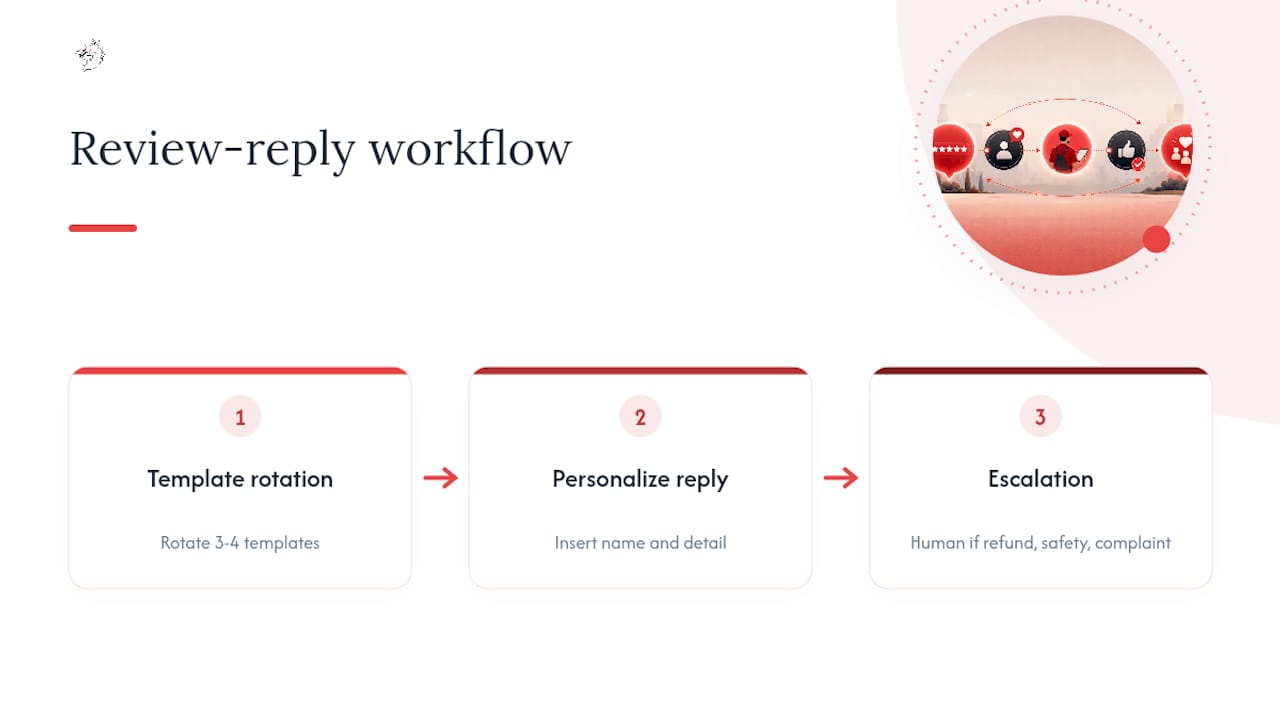
Once you're getting more than 10 to 15 reviews a week, replying one by one starts eating hours you don't have. That's the point where template rotation and placeholder variables (name, service, location) start doing real work, letting you post fast without every reply reading identical to the last one.
The trade-off is real: automation buys speed, but it needs guardrails. Rotate three or four template variants per scenario, always insert the customer's name and one specific detail, and set an escalation rule that routes any review mentioning a refund, safety issue, or complaint straight to a human, never an automated reply. Vaultio's own guidance on AI lead response speed treats that human escalation checkpoint as non-negotiable at scale, since a fast reply to the wrong review does more damage than a slow one.
Pro Tip: Keep a running log of which template variant gets used most. If one version keeps getting reused for the same scenario, that's a sign it's time to write a fresh alternative before it starts sounding copy-pasted to repeat reviewers.
How Should You Respond to Negative and Neutral Reviews?
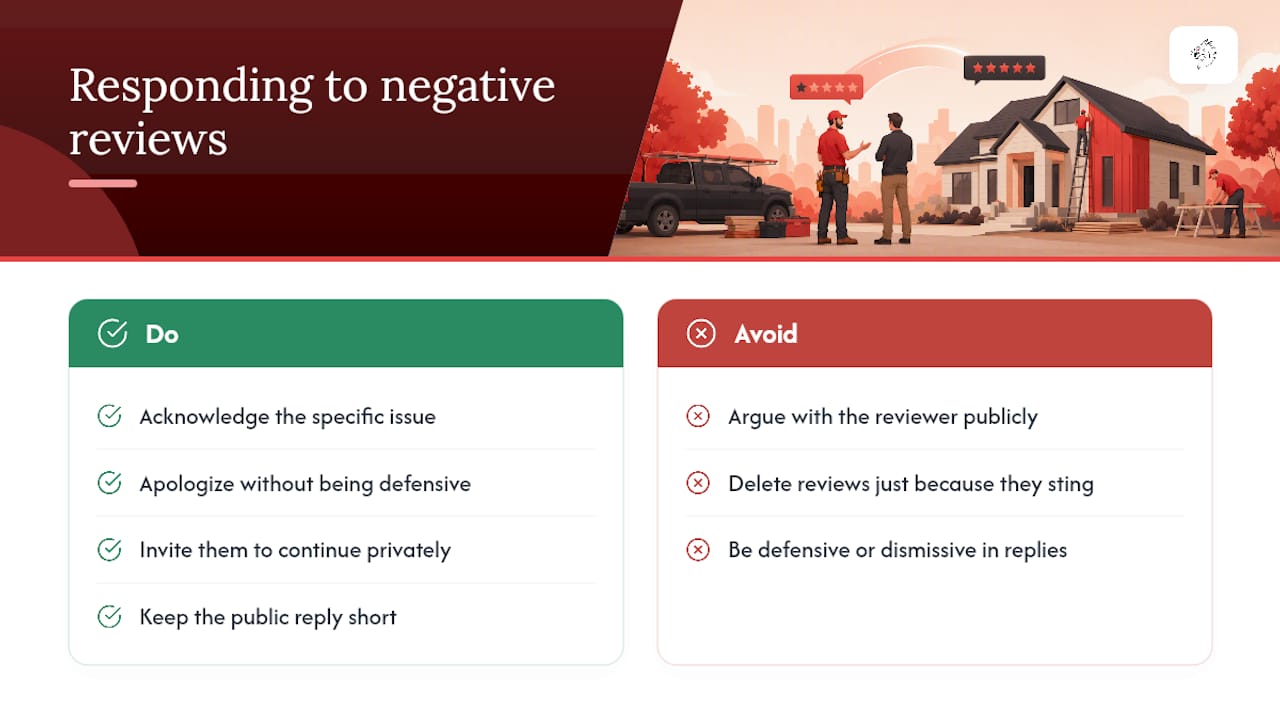
Negative and neutral reviews need a different structure than positive ones: acknowledge, apologize where appropriate, and move the resolution offline. A neutral three-star review that mentions a slow wait time might get: "Thanks for the honest feedback, [Name]. Sorry the wait ran longer than it should have, we're working on staffing during peak hours. Appreciate you giving us a shot."
For a genuinely negative review, resist the urge to argue publicly. A structured approach like the one Medallia recommends, acknowledge specifically, apologize without being defensive, and invite the person to continue the conversation privately, keeps the public reply short while showing every future reader that you take problems seriously. Example: "We're sorry to hear about [specific issue], [Name]. That's not the standard we hold ourselves to. Please reach out to us directly at [contact] so we can make this right."
One-star reviews with no detail ("worst service ever") are trickier. Reply with a calm, non-defensive line inviting specifics: "We're sorry to hear this, [Name]. We'd like to understand what happened, please reach out at [contact] so we can look into it." That protects you from looking combative while still showing you're responsive, even when the reviewer never follows up.
Never delete a negative review just because it stings. Deleting only works when the review violates platform policy, not when it's simply unflattering.
When Should You Not Respond to a Review?
Not every review needs a public reply, and knowing when to hold back protects you from making a bad situation worse. Skip a public response when the review is clearly a rant with no factual basis you can verify, when the reviewer is actively hostile and looking for a fight rather than a resolution, or when a legal or HR matter is already in motion, in that case, let counsel guide the response instead of posting on impulse.
Reviews that name a specific employee in a negative light deserve care too. Responding publicly with details about that employee, even in their defense, can create HR or privacy complications. A general, calm reply that avoids naming names and moves the conversation offline is almost always the safer route.
Extremely old reviews (two or three years stale) sometimes aren't worth resurrecting with a reply, especially if the business has since changed hands, staff, or location. A fresh reply on an ancient complaint can look like you're only now getting around to it, which reads worse than no reply at all.
And if a review is under active dispute with the platform (flagged as fake, pending removal), wait for that process before crafting a detailed rebuttal. A short, neutral holding statement is enough until the flag resolves.
What Legal and Ethical Rules Apply to Review Replies?
Never disclose private customer information in a public reply, no account numbers, no medical or financial details, no confirmation of a transaction the reviewer didn't already mention themselves. Even confirming "yes, you were our customer" can cross a privacy line depending on what the review already revealed.
Defamation risk runs both directions. Calling a reviewer a liar, accusing them of extortion, or suggesting their a competitor in a public reply can expose the business to legal risk if the accusation turns out to be wrong, even when your suspicion is correct. Stick to facts you can document.
Fake or incentivized reviews (offering discounts in exchange for positive reviews, posting reviews of your own business) violate most platform policies and, in some cases, consumer protection rules. If you discover a competitor or a bad actor posting fake reviews about your business, flag them through the platform rather than accusing them by name in a public reply.
Transparency also matters when responding to reviews from employees, family members, or anyone with an undisclosed connection to the business. Ethically, replies should read the same whether the reviewer is a stranger or someone you know personally, favoritism in tone is noticeable and erodes trust in every other reply on your profile.
What I've Learned Reviewing Thousands of Business Replies
The biggest mistake businesses make with positive reviews isn't writing a bad reply, it's writing no reply at all. Owners assume a five-star review speaks for itself. It doesn't. An unanswered five-star sits next to a competitor's fully personalized response, and the comparison isn't flattering.
The second mistake is treating every reply like a form letter. Readers scanning a review section can spot a copy-pasted "Thank you for your business!" from a mile away, and it undercuts the ten other replies you wrote well.
Here's the six-step checklist I run through for every reply:
- 1.Scan the review for one specific, quotable detail.
- 2.Personalize with the customer's name and that detail.
- 3.Sign with a real name and role.
- 4.Invite a return visit or next step.
- 5.Log the review for internal follow-up if it mentions a specific employee or service.
- 6.Track response time, aim under 48 hours, and audit weekly if volume is high.
— Damian
Want Your Reviews Answered Without Doing It Yourself?
Templates work, but they still require someone on your team to check reviews daily, pick the right variant, and hit post. An AI Review Response Bot can handle that entire loop, personalizing replies at the speed reviews actually come in, so a five-star review posted at 11 p.m. can get a thoughtful reply before morning instead of three days later.
For home service contractors specifically, that speed compounds. Vaultio pairs review response automation with AI-powered lead response that engages new inquiries within seconds, so the same system protecting your reputation is also catching the leads competitors are still letting sit in an inbox. If you'd rather template and post everything by hand, that's a legitimate path. If you'd rather have it handled, see how Vaultio's done-for-you services work and request a walkthrough for your business.
Sources
A few sources are worth bookmarking if you want to go deeper than templates:
- —Peer-reviewed study in International Journal of Internet Marketing and Advertising (PMC)
- —Manage customer reviews - Google Business Profile Help
- —Shopify guide: Review response templates and best practices
- —Medallia: How to properly respond to negative online reviews
FAQ
What is a good example of responding to a review?
A good reply thanks the customer by name, references a specific detail from their review, and invites them back, all in one or two sentences. Example: "Thanks, Sarah! Glad our team got that AC fixed same-day. We'd love to help again whenever you need us."
How do you reply to reviews?
Reply within 24 to 48 hours using a short structure: thank the reviewer, reference something specific, reinforce why it matters, and invite a return visit. For Google Business Profile, remember the reviewer is notified the moment you post, so keep the tone genuine rather than templated.
How do you write positive review response examples?
Start with the customer's name, pull one concrete detail from their review (a product, service, or employee they mentioned), and close with an invitation to return. Keeping it to one or two sentences, as Shopify's review response guide recommends, keeps the reply from sounding scripted.
What are some positive responses?
"Thank you, [Name]! We're thrilled [detail] worked out well for you." and "Appreciate the kind words, [Name], means a lot coming from a returning customer" are both strong starting points you can adapt with your own service and customer name. Businesses handling high review volume sometimes use tools like Vaultio's AI Review Response Bot to personalize replies like these automatically at scale.
Recommended
Ready to Implement This?
We'll build your complete lead generation system in 72 hours. No contracts. 30-day money-back guarantee.