Email Automation for Leads: A Contractor's 2026 Guide

# Email Automation for Leads: A Contractor's 2026 Guide
Email automation is the process of sending personalized, behavior-triggered emails to capture and nurture leads without manual effort. For home service contractors, the role of email automation in leads is direct: it keeps your business in front of prospects at exactly the right moment, turning inquiries into booked jobs. Triggered emails achieve 76% higher open rates and 152% higher click-through rates than standard campaigns. That gap means contractors who automate their outreach win more jobs than those who rely on manual follow-up alone.
How does email automation improve the lead generation process for contractors?
Email automation replaces the manual work of following up with every lead by using behavioral triggers and list segmentation to send the right message at the right time. A homeowner who fills out a quote request form gets an immediate response. One who opens your HVAC maintenance email but does not click gets a follow-up two days later with a stronger offer. The system works while you are on the job site.

The benefits of email automation for contractors go beyond convenience. Automated workflows handle demand creation, lead capture, and pipeline acceleration by adjusting content based on what each subscriber does. You do not need to hire extra office staff to scale your outreach. The system does it for you.
Here is what a basic contractor automation workflow looks like in practice:
- —Inquiry trigger: A lead submits a contact form. An automated welcome email goes out within minutes, confirming receipt and setting expectations.
- —Drip sequence: Over the next 7–14 days, the lead receives educational emails covering your services, customer reviews, and a limited-time offer.
- —Behavioral branch: If the lead clicks your pricing page, the system flags them as high intent and sends a direct call-to-action email.
- —Re-engagement: Leads who go cold after 30 days receive a win-back email with a seasonal promotion.
Pro Tip: Set your first automated email to send within five minutes of a form submission. Speed signals professionalism and dramatically improves your chances of booking the job before a competitor calls back.
This kind of email marketing for lead generation works because it mirrors how customers actually make decisions. They research, compare, and delay. Automation keeps you present through every stage of that process.
What are the critical technical components of successful email automation?
Most contractors focus on what their emails say. The bigger risk is whether those emails arrive at all. SPF, DKIM, and DMARC authentication are the three protocols that prove to inbox providers your emails are legitimate. Without them, your messages land in spam, and your leads never see them.
Getting the technical foundation right requires four non-negotiable steps:
- 1.Authenticate your sending domain. Configure SPF, DKIM, and DMARC records through your domain host. This tells Gmail, Outlook, and other providers that your emails are authorized.
- 2.Warm your domain gradually. A new sending domain needs a 45–60 day warmup period before you send at full volume. Sending too many emails too fast destroys your sender reputation before you even start.
- 3.Integrate your CRM. CRM integration creates a single source of truth for your leads. Sales and marketing data stay aligned, so you know exactly where each lead stands in your pipeline.
- 4.Validate your list before every campaign. Automated list validation removes bad addresses before they generate bounces. High bounce rates damage your sender score and reduce inbox placement across your entire list.
Pro Tip: Never buy email lists. Every address you did not earn through your own website or referral network is a liability. Purchased lists spike your bounce rate and can get your domain blacklisted within weeks.
Contractors who skip these steps often wonder why their email campaigns produce no results. The answer is almost always deliverability. Your message never reached the inbox.
What types of automated email sequences work best for contractors?
The most effective automated email sequences for home service contractors follow the customer's decision timeline. Each sequence has a specific job to do.
- —Welcome sequence: Sent immediately after a lead opts in or submits a form. Welcome emails sent within the first hour achieve roughly 50% open rates, compared to 20–25% for standard campaigns. Use this sequence to introduce your company, share a customer review, and set the next step.
- —Lead nurturing drip: A 5–7 email series sent over two to four weeks. Each email delivers one piece of useful content: a maintenance tip, a before-and-after project photo, or a seasonal checklist. This builds trust before you ask for the sale. You can pair this with an HVAC emergency checklist as a value-add resource for new leads.
- —Abandoned inquiry follow-up: A lead requested a quote but never responded. An automated sequence sends two to three follow-up emails over five days, each with a slightly different angle. Many contractors book jobs from this sequence alone.
- —Re-engagement campaign: Contacts who have not opened an email in 60 days get a short series designed to reactivate interest. A strong subject line and a time-sensitive offer are the two levers that work here.
The table below shows how each sequence maps to the contractor sales funnel:
| Sequence type | Funnel stage | Primary goal |
|---|---|---|
| Welcome email | Top of funnel | Build trust, confirm interest |
| Lead nurturing drip | Middle of funnel | Educate, overcome objections |
| Abandoned inquiry follow-up | Middle of funnel | Recover lost opportunities |
| Re-engagement campaign | Cold leads | Reactivate dormant contacts |
Personalized and triggered emails build confidence and move leads through the sales funnel faster than any broadcast campaign. The key is matching the right sequence to the right moment.
How do you measure and optimize email automation performance?
Tracking the right numbers tells you where your automation is working and where it is leaking leads. Four metrics matter most for contractors: open rate, click-through rate, conversion rate, and ROI.
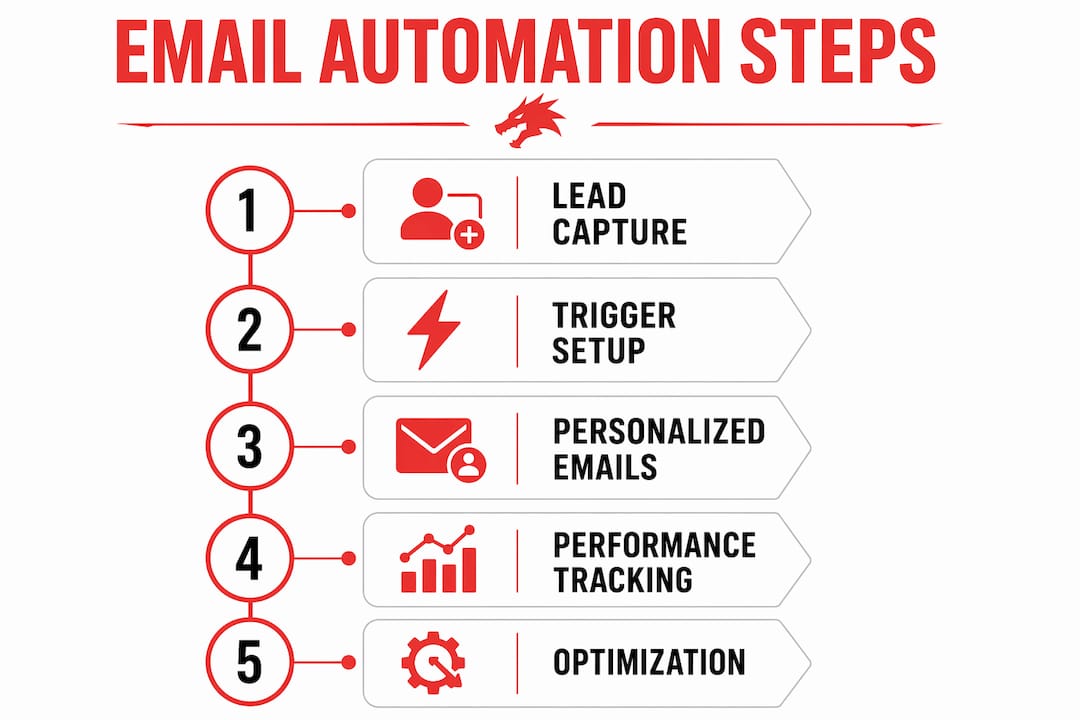
Open rate tells you whether your subject lines are working. Click-through rate tells you whether your content is relevant. Conversion rate tells you whether your calls to action are clear. ROI tells you whether the whole system is worth running. Email automation ROI can reach 4,000%, which means every dollar you put in can return $40. That number only holds if your system is properly configured and continuously maintained.
Pro Tip: Test one variable at a time. Change your subject line for two weeks, measure the result, then move to send time. Changing multiple elements at once makes it impossible to know what actually moved the needle.
Optimization is an ongoing process, not a one-time setup. Run these checks on a monthly basis:
- —Review your bounce rate and remove invalid addresses before the next send.
- —Check your open rates by segment. Leads from your website may behave differently than leads from Google Ads.
- —Audit your drip sequence timing. If leads are dropping off after email three, that email needs a rewrite.
- —Monitor your domain reputation using tools like Google Postmaster Tools. A declining reputation score predicts deliverability problems before they become critical.
The best AI tools for contractors now integrate directly with email platforms to flag performance drops automatically. That kind of real-time monitoring keeps your pipeline healthy without requiring daily manual checks.
Key Takeaways
Email automation is the single most cost-effective system a home service contractor can deploy to capture, nurture, and convert leads at scale without adding headcount.
| Point | Details |
|---|---|
| Triggered emails outperform standard sends | Triggered emails see 76% higher open rates and 152% higher click-through rates than broadcast campaigns. |
| Speed wins the first impression | Welcome emails sent within the first hour achieve roughly 50% open rates. Send within five minutes of a form submission. |
| Deliverability is the foundation | SPF, DKIM, and DMARC authentication must be configured before any campaign goes live or emails land in spam. |
| CRM integration closes the loop | Connecting your email platform to your CRM aligns marketing activity with your sales pipeline and prevents lost leads. |
| Optimization never stops | Monthly list validation, open rate audits, and domain reputation checks keep your automation performing at full capacity. |
Why most contractors are building email automation backwards
I have watched contractors spend weeks crafting the perfect email sequence and then send it from a cold domain with no authentication. The emails never reach the inbox. The sequence never gets a fair test. They conclude that email does not work for their business. That conclusion is wrong. The system failed, not the channel.
Email automation should be treated as infrastructure first and messaging second. The backend, authentication, CRM connection, list hygiene, and domain reputation, determines whether your emails arrive. The copy determines whether they convert. Both matter, but you cannot fix copy problems if your emails are in the spam folder.
The other mistake I see constantly is full automation through the closing stage. Top-of-funnel nurturing can and should be automated. But when a lead shows high-intent behavior, clicking a pricing page, requesting a second quote, or replying to an email, a human needs to take over. High-value home service jobs close on trust and relationship. No automated sequence replaces a direct phone call at that moment.
Build the infrastructure right. Automate the middle. Show up personally at the close. That is the formula that actually produces booked jobs.
— Damian
Vaultio puts your email automation to work from day one
Home service contractors who want consistent leads need more than a well-written email sequence. They need a system that captures every inquiry, responds within seconds, and tracks each lead through the pipeline automatically.
Vaultio combines AI-driven lead management with done-for-you marketing built specifically for contractors. Every new inquiry gets an immediate response. Every lead gets tracked. Every workflow gets monitored so nothing falls through the cracks. Vaultio's full-stack contractor marketing includes email automation setup, CRM integration, and ongoing performance management so you can focus on the job site while the system fills your calendar. If you are ready to stop losing leads to slow follow-up, Vaultio is where you start.
FAQ
What is the role of email automation in leads for contractors?
Email automation captures new leads with immediate triggered responses and nurtures them through personalized sequences until they are ready to book. It replaces manual follow-up and scales outreach without adding staff.
How quickly should a welcome email go out after a lead submits a form?
Send the welcome email within the first hour of form submission. Welcome emails sent within that window achieve roughly 50% open rates, far above the 20–25% average for standard campaigns.
What does SPF, DKIM, and DMARC mean for my email campaigns?
These are authentication protocols that prove to inbox providers your emails are legitimate. Without them, your automated emails land in spam and your leads never see them.
How do I know if my email automation is actually generating leads?
Track open rate, click-through rate, conversion rate, and ROI monthly. If leads are dropping off mid-sequence, audit that specific email for relevance and clarity before changing anything else.
When should automation hand off to a human sales rep?
Automation should hand off when a lead shows high-intent behavior, such as clicking a pricing page or replying to an email. Closing high-value jobs requires personal contact for better conversion rates.
Recommended
Ready to Implement This?
We'll build your complete lead generation system in 72 hours. No contracts. 30-day money-back guarantee.