How AI Handles Inbound Leads for Contractors

# How AI Handles Inbound Leads for Contractors
AI inbound lead handling is the process of automatically qualifying, scoring, and routing new prospects in real time, without a human touching the inquiry first. For home service contractors, this means the gap between a customer submitting a request and your business responding shrinks from hours to seconds. AI-powered systems reduce response times from over 4 hours to under 30 seconds, completing enrichment and scoring in under 5 seconds. That speed is not a luxury. In home services, the contractor who calls back first wins the job. Understanding how AI handles inbound leads is the first step to capturing more of them.
How AI handles inbound leads and why speed wins jobs
Speed is the single biggest factor in home service lead conversion. A prospect searching for an HVAC repair or a plumber is not browsing casually. They have a problem right now, and they will call the first contractor who responds. Response time drops from 4+ hours to under 30 seconds with AI, and that gap directly determines who books the job.
Manual follow-up fails contractors in a predictable way. A lead comes in at 7 p.m. on a Friday. Your office is closed. By monday morning, that customer has already hired someone else. AI for lead management eliminates that window entirely. The system responds within seconds, asks qualifying questions, and either books the appointment or routes the lead to the right person with full context attached.
The efficiency gains extend beyond speed. AI agents replace manual SDR functions, saving 10–15 hours of work per rep each week. For a small contracting business, that is the difference between chasing leads and closing them.
- —Responds to every inbound inquiry within seconds, day or night
- —Qualifies the lead before a human ever picks up the phone
- —Books appointments directly into your calendar without back-and-forth
- —Routes hot leads to the right technician or sales rep instantly
- —Follows up automatically if the prospect does not respond right away
Pro Tip: Set your AI system to respond within 60 seconds of a form submission or missed call. Contractors who respond in under a minute report dramatically higher contact rates than those who wait even 5 minutes.
What scoring frameworks does AI use to qualify leads?
AI qualifies leads using structured scoring frameworks, not gut instinct. The most widely used is the FIT framework, which stands for Fit, Intent, and Timing. Each lead receives a score from 0 to 100 based on how well it matches your ideal customer profile, how strong its buying signals are, and how soon the prospect needs the service.
The FIT scoring framework filters out bad-fit prospects before any human interaction occurs. Scores from 75 to 100 mark a lead as hot and trigger immediate outreach. Scores from 25 to 74 place the lead in a warm nurture sequence. Scores below 25 flag the lead as cold and route it to a low-priority queue or disqualify it automatically.
The table below shows how each tier maps to a sales action.
| Score range | Lead tier | Recommended action |
|---|---|---|
| 75–100 | Hot | Immediate call or booking within 60 seconds |
| 25–74 | Warm | Automated nurture sequence, follow-up in 24 hours |
| 0–24 | Cold | Low-priority queue or disqualification |
Traditional lead scoring uses static rules. A rule might say "if the zip code matches, add 10 points." AI scoring goes further. AI cross-references firmographic and real-time behavioral data to identify buying signals that rule-based systems miss entirely. A prospect who visits your pricing page three times in one day scores higher than one who only filled out a contact form, even if both submitted the same information.
Pro Tip: Build your initial FIT scoring model around your last 20 booked jobs. Look at what those customers had in common, zip code, job type, request timing, and use those patterns as your starting hypothesis.
How does AI interact with leads to book jobs automatically?
AI does not just score leads and hand them off. Modern inbound lead processing AI conducts actual conversations with prospects, asking the right questions and booking appointments without any human involvement. This happens through AI voice agents and chatbots that simulate natural dialogue.

The qualification logic follows the BANT framework: Budget, Authority, Need, and Timing. Effective AI lead handling uses BANT as a logic anchor to keep conversations focused while managing diversions gracefully. An AI agent might ask, "Are you the homeowner?" to confirm authority, then "When do you need this done?" to assess timing, all within a 90-second conversation.
AI places calls within minutes of a lead arriving, qualifies the prospect, and books the meeting in real time. If the prospect does not answer, the system sends a text, then an email, then tries again at a different time. The follow-up logic runs automatically until the lead either books or goes cold.
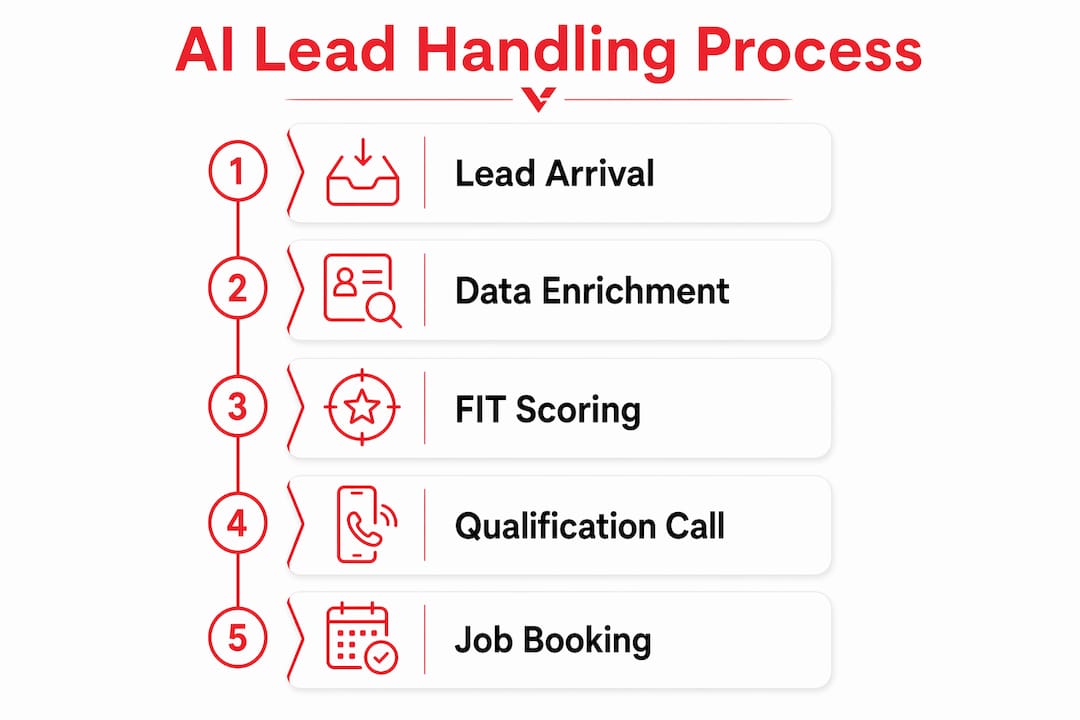
The full triage process runs fast. The four-step chain of deduplication, enrichment, scoring, and routing completes in under five minutes without human intervention. Deduplication takes 5–30 seconds. Enrichment takes 30 seconds to 2 minutes. Scoring finishes in under 30 seconds. Routing completes in under 15 seconds.
- —Deduplication removes duplicate submissions before scoring begins
- —Enrichment fills in missing data from public and third-party sources
- —Scoring assigns a FIT score and flags the lead tier
- —Routing sends the lead to the right rep, territory, or booking flow
Pro Tip: Give your AI agent a clear script for the three most common objections your business hears. "I'm just getting quotes" and "I need to check with my spouse" are predictable. Program responses that keep the conversation moving toward a booking.
How does AI enrich lead data and connect to your CRM?
AI does not work with the information a prospect submits alone. It fills in the gaps automatically using data enrichment, pulling details from sources like LinkedIn, Apollo, and ZoomInfo to build a complete lead record before a human ever sees it. For contractors, this might mean confirming a property address, verifying ownership, or identifying the size of a commercial account.
After enrichment, the AI writes the full record back into your CRM. CRM records must include clear notes and transcripts to avoid rep confusion and distrust. A score alone tells your sales rep nothing. A score plus a call transcript, a flagged budget range, and a confirmed appointment time gives them everything they need to close.
Routing follows enrichment. The system assigns the lead to the right rep based on territory, capacity, and lead tier. A hot lead in your north service zone goes to the technician covering that area, not to whoever happens to check their email first. That precision reduces response lag and prevents leads from falling through the cracks.
Data silos cause the most common AI workflow failures. When AI-generated data sits in one system and your team works in another, the handoff breaks. The fix is straightforward: map every AI output field to a corresponding CRM field before you launch, and test the connection with real leads before going live.
Pro Tip: Attach the AI call transcript directly to the CRM lead record. Reps who read the transcript before calling back close at a higher rate because they already know the prospect's situation.
Best practices for contractors starting AI lead qualification
Starting AI lead qualification does not require a perfect system on day one. Most contractors improve fastest by starting with rough FIT scoring hypotheses and refining them over two weeks while running AI in parallel with their existing manual process. The parallel run reveals where the model scores incorrectly before it costs you a real job.
- 1.Map your CRM fields first. Poorly mapped fields are the leading cause of AI routing failures. Every data point the AI captures needs a home in your CRM before the system goes live.
- 2.Set a grace period for borderline leads. A 24-hour tolerance window allows prospects to update their information or re-engage before the system disqualifies them. This prevents good leads from being dropped too early.
- 3.Track four core metrics from week one. Monitor response time, contact rate, qualification accuracy, and booked jobs per lead. These four numbers tell you whether the system is working or needs adjustment.
- 4.Keep a human in the loop for cold leads. Do not fully automate disqualification at the start. Have a rep review cold-scored leads weekly to catch any scoring errors while the model is still learning.
- 5.Increase automation gradually. Start by automating response and scoring only. Add autonomous booking after two weeks of clean data. Add full routing after four weeks. Rushing the rollout creates gaps that cost you jobs.
The contractors who see the fastest results treat AI as a tool that gets smarter over time, not a switch they flip once and forget.
Key takeaways
AI inbound lead handling cuts response times from hours to seconds, scores every lead automatically, and books jobs without human intervention, giving contractors a measurable edge over competitors who still rely on manual follow-up.
| Point | Details |
|---|---|
| Speed is the deciding factor | AI responds in under 30 seconds, capturing leads before competitors can call back. |
| FIT scoring filters your pipeline | Leads scored 75–100 get immediate outreach; below 25 go to a low-priority queue. |
| BANT keeps AI conversations on track | AI agents use Budget, Authority, Need, and Timing questions to qualify in real time. |
| CRM write-back prevents handoff failures | Attaching transcripts and scores to CRM records gives reps the context to close. |
| Start parallel, then scale | Run AI alongside manual processes for two weeks before removing human review. |
What I've learned watching contractors adopt AI lead handling
The contractors who get the most out of AI are not the ones who automate everything on day one. They are the ones who treat the first month as a learning phase. They watch where the system scores incorrectly, fix the model, and then expand automation into the next stage of the funnel.
The biggest cultural shift I see is reps learning to trust the transcript over their instincts. A rep who reads the AI call summary before dialing already knows the prospect's budget, timeline, and objections. That rep closes faster. The ones who skip the transcript and rely on charm alone consistently underperform.
There is also a real risk of over-automating too fast. I have seen contractors set their cold-lead threshold too aggressively and disqualify prospects who would have booked with one more follow-up. The 24-hour grace period is not optional. It is the difference between a clean pipeline and a leaky one.
The contractors who win with AI are not replacing their sales instincts. They are freeing those instincts to focus on the conversations that actually matter. Let the machine handle the triage. Save your energy for closing.
— Damian
Vaultio turns AI lead handling into booked jobs
Vaultio builds AI lead systems specifically for home service contractors. The AI receptionist answers every call 24/7, qualifies the prospect, and books the job without you lifting a finger. The AI chatbot captures website leads the moment they arrive and routes them through a scoring and booking flow automatically.
Vaultio's AI lead scoring assigns FIT scores to every inbound inquiry and writes the results directly into your CRM with full transcripts attached. You see which leads are hot, which need nurturing, and which to skip. No manual sorting. No missed opportunities. If you are ready to stop losing jobs to slower competitors, Vaultio is built for exactly that.
FAQ
How fast does AI respond to inbound leads?
AI-powered systems respond to inbound leads in under 30 seconds. Enrichment and scoring complete in under 5 seconds, meaning the lead is fully qualified before most contractors even see the notification.
What is FIT scoring in AI lead qualification?
FIT scoring rates each lead from 0 to 100 based on Fit, Intent, and Timing. Scores of 75–100 are hot leads that trigger immediate outreach; scores below 25 are flagged as cold.
Can AI book appointments without human involvement?
Yes. AI voice agents and chatbots conduct qualification conversations using the BANT framework and book appointments directly into your calendar in real time, including automated follow-up if the prospect does not respond immediately.
What happens if AI disqualifies a good lead by mistake?
A 24-hour grace period allows borderline leads to update their information or re-engage before the system finalizes disqualification. Running AI in parallel with manual review for the first two weeks also catches scoring errors before they cost you jobs.
How does AI connect to my existing CRM?
AI writes scores, transcripts, and key signals directly into your CRM after each interaction. The critical step is mapping every AI output field to a CRM field before launch. Unmapped fields create data silos that break the handoff between AI and your sales team.
Recommended
- —Home Service Marketing Blog | Strategies, Tips & Tactics | Vaultio
- —Website Design for Home Service Contractors | Conversion-Optimized, Mobile-First Sites | Vaultio
- —Local SEO That Works Everywhere | Google Maps + ChatGPT Recommendations | Vaultio
- —AI Chatbot & Scheduling | 24/7 Lead Capture & Booking | Vaultio
Ready to Implement This?
We'll build your complete lead generation system in 72 hours. No contracts. 30-day money-back guarantee.