The Role of Follow-Up in Conversions for Contractors
# The Role of Follow-Up in Conversions for Contractors
Follow-up is defined as consistent, strategic outreach to a prospect after their first contact with your business. The role of follow-up in conversions is direct: nearly 80% of sales require multiple attempts to close, yet 48% of salespeople never follow up even once. That gap is where home service contractors lose jobs every single week. For roofers, HVAC techs, plumbers, and landscapers, a lead that goes cold is revenue that walks straight to the next contractor who picked up the phone. Structured follow-up, also called a lead nurturing cadence in sales terminology, is the single most controllable variable in your conversion rate.
Why the role of follow-up in conversions starts with speed
Speed is the first variable that determines whether a lead converts or disappears. Leads contacted within 5 minutes of an inquiry are 21 times more likely to convert than those contacted after 30 minutes. That number is not a rounding error. It reflects how quickly a homeowner's attention shifts to the next contractor in their search results.
The challenge for home service contractors is real. You are on a roof, under a sink, or driving between jobs when a new lead comes in. Stopping to call back immediately is not always possible. That gap in response time costs you the job more often than any pricing issue ever will.
Practical ways to close the speed gap:
- —Automate your first response. A text or email sent within 60 seconds of a form submission keeps you in the conversation while you finish the job. Email automation for leads covers exactly how to set this up for contractor workflows.
- —Use an AI receptionist. A 24/7 answering service qualifies the lead and books a callback before your competitor even sees the notification.
- —Prioritize callbacks by lead source. Paid leads and Google Local Service Ad inquiries decay faster than organic referrals. Call those first.
- —Set a hard rule: no lead waits more than 5 minutes for a first response. Automate that first touch so the rule holds even when you are on a job site.
Pro Tip: Set up a two-step automation: an instant text acknowledging the inquiry, followed by a personal call within the hour. The text buys you time. The call closes the gap.
Responding while lead interest is high directly correlates with connection rates and deal progress. Speed is not a nice-to-have. It is the foundation of every conversion that follows.
Does multi-channel outreach actually outperform single-channel follow-up?
The answer is yes, and the margin is not close. Multi-channel follow-up sequences combining phone, email, text, and social touchpoints outperform single-channel outreach by 287% in response rates. SMS follow-ups alone show 112.6% higher conversion rates than email-only outreach. For contractors, that means a homeowner who ignores your email may respond immediately to a text.

Different customers prefer different channels. Older homeowners often respond better to a phone call. Younger homeowners prefer text or even a direct message on social media. Reaching across multiple channels is not about being aggressive. It is about meeting the customer where they already are.
| Channel | Best use case | Typical response window |
|---|---|---|
| Phone call | High-intent leads, estimates, urgent jobs | Within 1 hour |
| SMS | Quick confirmations, appointment reminders | Within minutes |
| Detailed quotes, project photos, reviews | Within 24 hours | |
| Social media DM | Warm leads from ads or organic posts | Within 24–48 hours |
An effective multi-channel sequence for a home service contractor looks like this:
- —Day 1: Instant automated text acknowledging the inquiry, followed by a phone call within the hour.
- —Day 2: A follow-up email with your quote, photos of similar past work, and a customer review.
- —Day 4: A second text checking whether they have questions.
- —Day 7: A phone call with a specific offer or availability window.
This multichannel approach keeps your name in front of the homeowner at every decision point without feeling like spam. Each touch serves a purpose. None of them are filler.
What does an effective follow-up cadence actually look like?
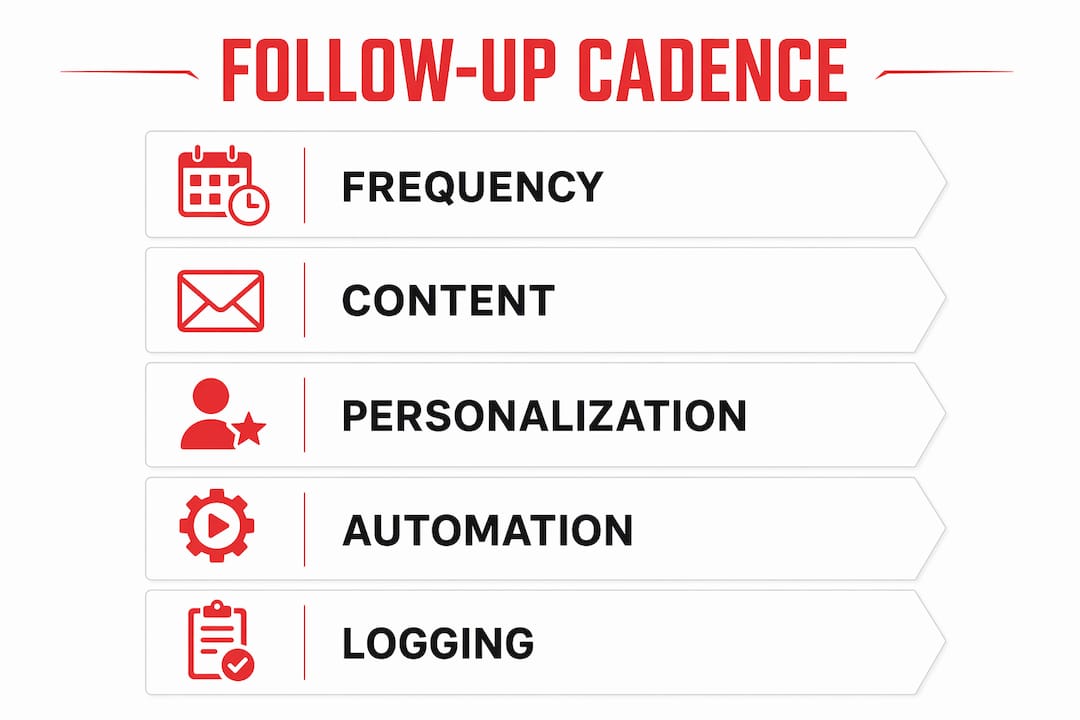
An effective follow-up cadence has three components: frequency, content, and personalization. Get all three right and your close rate climbs. Miss any one of them and the sequence falls flat.
Frequency: how many times should you follow up?
93% of converted leads are reached by the sixth contact attempt. That statistic reframes persistence entirely. Most contractors stop after one or two attempts and assume the lead is dead. The lead is not dead. The contractor just quit too early.
The Rule of 7 is the industry standard in sales: a prospect needs to hear from you at least seven times before they make a buying decision. For home services, five to six structured touches is a realistic and proven target.
- 1.Touch 1 (Day 1): Instant automated acknowledgment plus a live phone call.
- 2.Touch 2 (Day 2): Email with your quote and proof of past work.
- 3.Touch 3 (Day 4): SMS check-in asking if they have questions.
- 4.Touch 4 (Day 7): Phone call with a specific scheduling offer.
- 5.Touch 5 (Day 10): Email with a relevant customer testimonial or case study.
- 6.Touch 6 (Day 14): Final outreach with a clear, low-pressure close.
Content: what you say matters as much as when you say it
Generic "just checking in" messages have a 1% reply rate. That number tells you everything. Every follow-up needs to add something new: a photo of a completed project, a seasonal tip relevant to their home, a financing option, or a customer review that addresses a common concern.
Value-adding content builds trust with every touch. It positions you as the expert, not just another contractor chasing a job.
Personalization: use what you already know
You already have the lead's name, their address, and the service they requested. Use all of it. A text that says "Hi Sarah, following up on your roof inspection request for your home on Maple Street" converts at a far higher rate than a generic message. Follow-up strengthens customer relationships by showing commitment, and personalization is the fastest way to signal that commitment.
Pro Tip: After each touch, log the response in your CRM. Note what they said, what they asked, and what concern they raised. Use that information to make the next touch more specific and more relevant.
What are the most common follow-up mistakes contractors make?
The most common mistake is the single-touch trap: contacting a lead once, getting no response, and moving on. Successful conversion typically requires 5–6 structured touches, so one attempt is not a follow-up strategy. It is a missed opportunity dressed up as effort.
Other pitfalls that cost contractors booked jobs:
- —Inconsistent timing. Following up on day one and then going silent for two weeks lets lead interest decay completely. Homeowners make decisions fast. If you disappear, someone else fills the gap.
- —No defined system. The biggest barrier to effective follow-up is the absence of a defined process. Relying on memory or sticky notes guarantees leads fall through the cracks. A CRM with automated reminders removes that risk entirely.
- —Generic messaging. Sending the same template to every lead signals that you do not care about their specific situation. Homeowners notice. They choose the contractor who feels attentive.
- —Giving up after silence. Silence is not rejection. Proactive communication signals care and reduces lost sales. A homeowner who does not reply to your text may still book after your day-seven phone call.
- —No post-job follow-up. Follow-up does not end at the sale. Checking in after a completed job builds loyalty. A 5% increase in customer loyalty can grow revenue by 25%–95%. That is the compounding power of a relationship built on consistent communication.
Automated, consistent follow-up transforms vague intentions into predictable actions. The contractors who build systems win. The ones who rely on memory lose leads they never knew they had.
Key Takeaways
Consistent, multi-channel follow-up with five to six structured touches is the single most reliable way for home service contractors to convert more leads into booked jobs.
| Point | Details |
|---|---|
| Speed drives conversions | Contact leads within 5 minutes to multiply conversion likelihood by 21 times. |
| Multi-channel beats single-channel | Combining phone, SMS, email, and social outreach increases response rates by 287%. |
| Six touches close most deals | 93% of converted leads are reached by the sixth contact attempt, so persistence pays. |
| Content quality determines replies | Value-adding follow-ups far outperform generic check-ins, which average a 1% reply rate. |
| Systems prevent lost leads | CRM-driven cadences outperform inconsistent individual efforts and ensure no lead is forgotten. |
The follow-up habit that actually separates top contractors
I have watched contractors with average marketing budgets consistently outbook competitors who spend three times more on ads. The difference is almost always follow-up discipline. Not a fancier website. Not better pricing. Just a contractor who calls back, sends the text, and shows up in the inbox one more time than everyone else.
The contractors who struggle with follow-up usually have the same excuse: "I don't have time." I understand that. You are running a crew, managing jobs, and handling everything from scheduling to supply runs. But here is what I have found to be true. The time you spend on follow-up is not a cost. It is the highest-return activity in your business. One recovered lead per week, at an average job value of $1,500, adds up fast.
The other thing I see contractors get wrong is treating follow-up as pressure. It is not. When you send a homeowner a photo of a similar roof you just completed, or a review from a neighbor two streets over, you are giving them something useful. You are making their decision easier. That is not pushy. That is professional.
Build the system first. Automate what you can. Then add the personal touches that no automation can replicate. The HVAC after-hours lead capture model is a good example of how speed and automation work together without removing the human element. Start there, then build outward.
— Damian
How Vaultio turns follow-up into booked jobs
Winning a lead means nothing if your follow-up loses it. Vaultio is built for contractors who want every inquiry to become a booked job, not a missed opportunity.
Vaultio's AI receptionist responds to every new lead within seconds, 24 hours a day, 7 days a week. No lead waits. No inquiry goes unanswered. Combined with Vaultio's done-for-you marketing services, you get automated multi-touch follow-up sequences, CRM integration, and search rankings that put your business in front of buyers the moment they are ready. Contractors using Vaultio see a steady, predictable increase in booked jobs every month. If you are ready to stop losing leads to slower competitors, Vaultio is where you start.
FAQ
How many follow-up attempts does it take to close a lead?
Research shows 93% of converted leads are reached by the sixth contact attempt. Most contractors stop far too early, which is why a structured cadence of five to six touches is the proven standard.
What is the best time to follow up with a new lead?
Contact a new lead within 5 minutes of their inquiry. Leads reached in that window are 21 times more likely to convert than those contacted after 30 minutes.
Does multi-channel follow-up really make a difference?
Multi-channel sequences combining phone, email, SMS, and social outreach outperform single-channel outreach by 287% in response rates. Using more than one channel is not optional if you want to maximize conversions.
What should I say in a follow-up message?
Add something new with every touch: a project photo, a customer review, a seasonal tip, or a specific scheduling offer. Generic "just checking in" messages average a 1% reply rate and waste your time.
How does follow-up affect long-term revenue?
Follow-up builds loyalty, and loyalty compounds. A 5% increase in customer loyalty can grow revenue by 25%–95%. Post-job follow-up turns one-time customers into repeat clients and referral sources.
Recommended
Ready to Implement This?
We'll build your complete lead generation system in 72 hours. No contracts. 30-day money-back guarantee.