Contractors: A 90 Day Local Link Building Plan to Win Local Visibility
# Contractors: A 90 Day Local Link Building Plan to Win Local Visibility
Local link building means earning backlinks from geographically or topically relevant sites: local press, chambers of commerce, nonprofits, and business partners. It directly influences your Local Pack rankings and now shapes what AI tools recommend when someone searches for your service. Before doing anything else, run a quick citation and backlink audit to fix inconsistent NAP data and spot links you've already earned but haven't claimed.
*
TL;DR: - Local backlinks from relevant sites like government, education, and local press carry more weight for rankings than generic domains, especially in the Local Pack. - Ensuring citation consistency and actively reclaiming unlinked mentions significantly boost local prominence signals used by both search engines and AI recommendation systems. - Prioritize high-authority local placements such as news features, chamber memberships, and official directories before expanding to community and partnership links. - Tracking tools should monitor citation accuracy, new editorial links, referral traffic, and conversions to measure the effectiveness of your local link-building efforts. - Combining link building with AI-powered lead response, like Vaultio offers, helps turn increased local authority into actual booked jobs.
*
Table of Contents
- —What Counts as a Local Link Building Strategy?
- —Why Do Local Links Affect Google Rankings and AI Search?
- —What Are the Best Local Link Building Tactics for Contractors?
- —Which Tools Should You Use to Track Local Links?
- —How Do You Pitch for Local Backlinks?
- —Dos and Don'ts for Sustainable Local Link Building
- —How Vaultio Connects Local Links to Booked Jobs
- —Where Should You Focus First?
- —Ready to Turn Local Authority Into Booked Jobs?
- —Sources
- —FAQ
What Counts as a Local Link Building Strategy?
A local backlink comes from a website tied to your city, region, or industry niche, not just any high-authority domain. Think a .gov page listing approved contractors, a local newspaper covering your ribbon-cutting, a .edu trade school linking to employer partners, or a chamber of commerce directory. These carry geographic weight that a generic backlink from an unrelated national blog simply can't match.
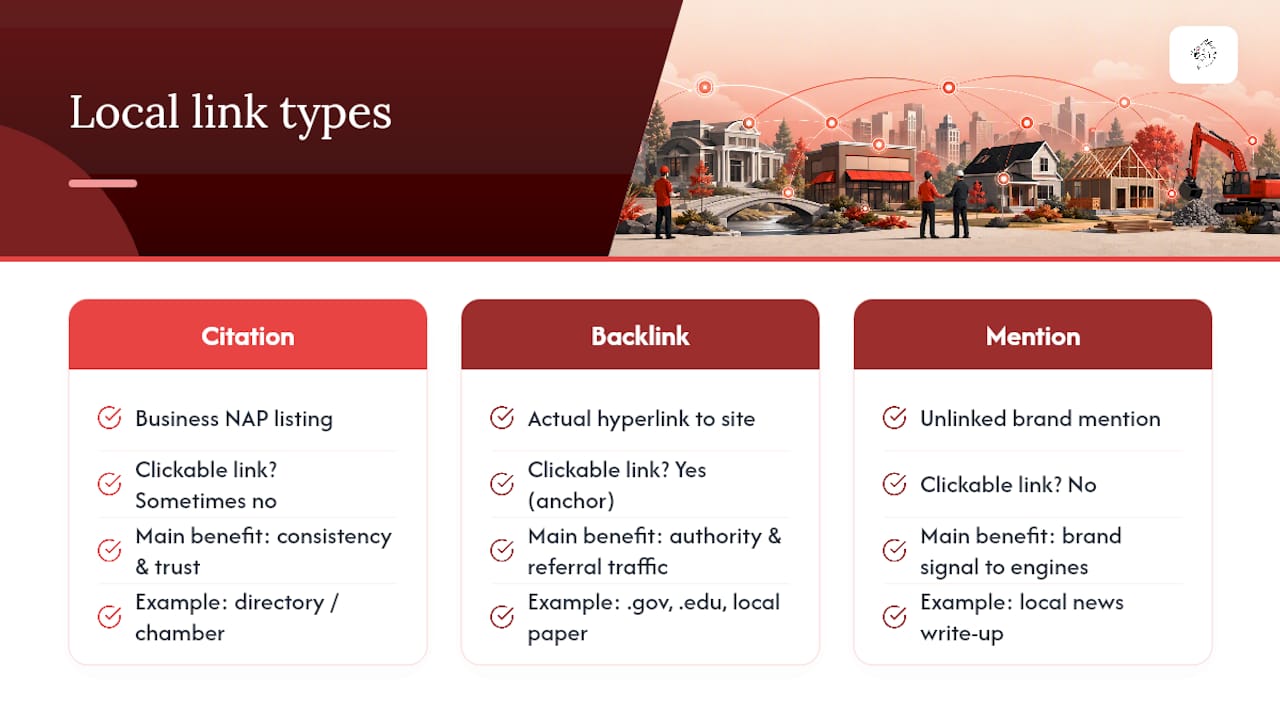
There's a real difference between a citation and a backlink, and contractors mix these up constantly. A citation is your business Name, Address, and Phone number (NAP) listed on a directory, sometimes with no clickable link at all. A backlink includes an actual hyperlink, often anchored to specific text, pointing back to your site. Both matter, but they do different jobs. Citations build consistency and trust signals across the web. Backlinks pass authority and send referral traffic.
Don't dismiss linkless mentions either. When a local news site writes "ABC Plumbing handled the repair" without linking your name, that's still a signal search engines can pick up through brand recognition, and it's a prime candidate for a follow-up email asking them to add a link.
Geographic relevance and topical relevance need to work together. A link from a plumbing supply company in your county beats a link from a random home decor blog three states away, even if that blog has a fancier design. Search engines weigh both proximity and subject match when deciding how much a link should count toward your visibility.
Why Do Local Links Affect Google Rankings and AI Search?
Local search ranking comes down to three core factors: relevance, distance, and prominence. Links feed directly into that third piece. Prominence measures how well known and well referenced your business is, both online and off, and editorial links from real local sources are one of the clearest signals a search engine can use to judge that.
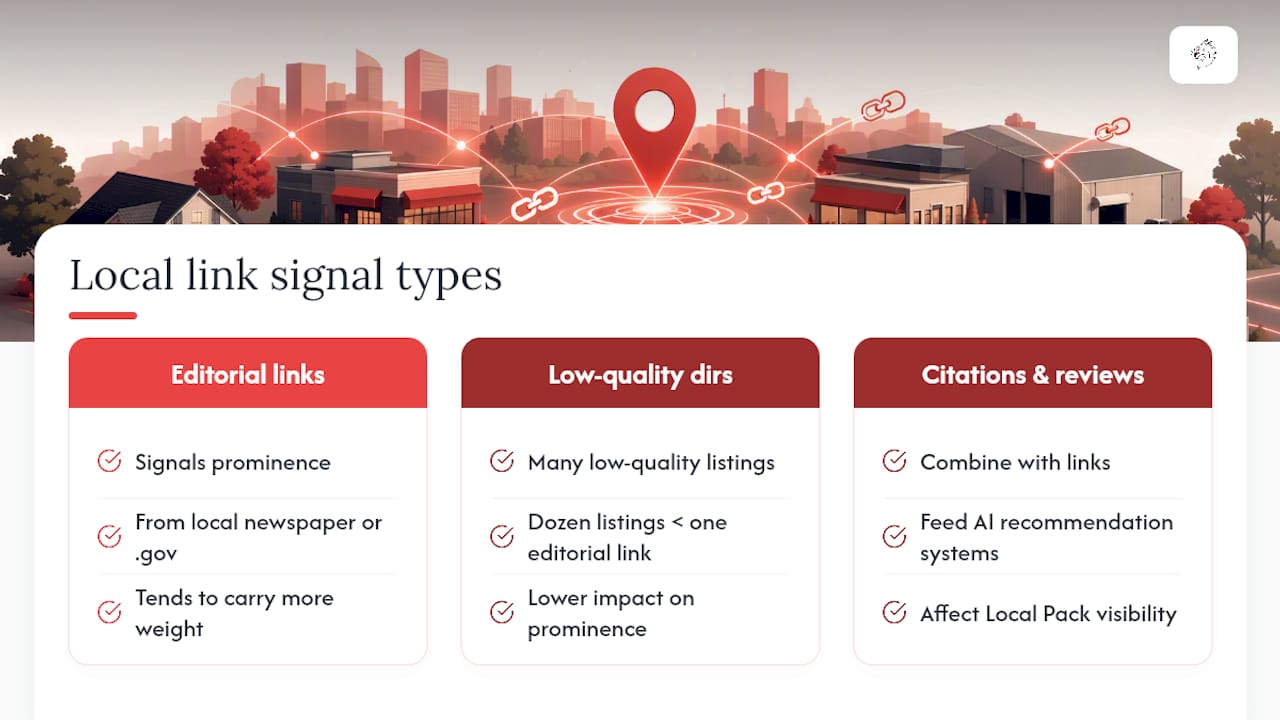
BrightLocal documents that link signals rank among the top factors for local organic results and remain significant for the Local Pack, the map-based results that show up for "near me" searches. A link from your local newspaper or a .gov business directory tends to carry more weight than a dozen low-quality directory listings combined, because search engines treat government and educational domains as inherently trustworthy.
The stat that matters: Editorial local links and consistent citations now feed AI recommendation systems too. BrightLocal's guidance notes that the combination of links, citations, and reviews increasingly determines if a business appears when someone asks an AI assistant for a recommendation in their area.
This is the shift most small business owners haven't caught up to yet. It's not just Google anymore. When someone asks ChatGPT or a similar tool "who's the best HVAC company near me," the answer draws on the same prominence signals that used to matter only for map rankings. A business with thin, inconsistent citations and zero editorial coverage is nearly invisible to both systems.
What Are the Best Local Link Building Tactics for Contractors?
Not all links are worth the same effort. A tiered approach keeps you focused on the placements that move rankings fastest, then fills in volume from there. This structure follows what Link for prioritizing regional editorial and association links over scattershot directory submissions.
Tier 1: high-authority local placements
- 1.Local press coverage. A quote in your regional paper, a feature on a community news site, or a mention in a local business journal. These carry strong prominence signals and often come from a single well-placed pitch.
- 2.Chamber of commerce membership. Most chambers list members with a live link to their site. Annual dues are usually modest, and the placement is durable.
- 3..gov and .edu opportunities. City vendor directories, approved contractor lists, and trade school partnership pages fall here. These domains carry inherent trust.
- 4.Awards and official directories. Local "best of" contests, industry certification boards, and licensing bureau listings.
Tier 2: community and content links
- —Sponsor a Little League team, a school fundraiser, or a community 5K. Many of these organizations post sponsor logos with live links, and Flento's research confirms these placements are frequently dofollow.
- —Get featured on local blogs or podcasts covering home services, small business, or neighborhood news.
- —Publish content local sites naturally want to reference: seasonal maintenance checklists, neighborhood-specific guides, or original data about service calls in your area. Moz's outreach research points to exactly this kind of localized content as a reliable earner.
Tier 3: partnerships and steady volume
- —Vendor and supplier "trusted partner" pages, especially manufacturers who list authorized installers by region.
- —Customer testimonial pages on partner or supplier sites.
- —Local event listing sites and community resource guides.
- —Complementary trade partnerships. A plumber and an electrician who refer jobs to each other can link to each other's sites as trusted partners, similar to how a contractor like Cornelius Wrecking might list demolition partners on a project resources page.
Technical wins you shouldn't skip
Reclaiming lost links and claiming unlinked mentions are some of the highest-return, lowest-effort tactics available. Ahrefs lists these alongside competitor backlink analysis as standard practice: check who links to competitors in your city, and see if those same sites would link to you too.
Pro Tip: Pull your top three local competitors' backlink profiles once a quarter. Any site linking to two or more of them is a near-guaranteed prospect for your own outreach.
A sample 90-day plan
Don't try to run every tactic at once. A focused set works better than a scattered one. Week one through four: fix citations, join your chamber, pitch one local press story. Weeks five through eight: sponsor one community event, publish one localized guide, reach out to three vendor partners. Weeks nine through twelve: reclaim lost links, claim unlinked mentions, and follow up on every pitch that went quiet.
Which Tools Should You Use to Track Local Links?
You don't need an enterprise budget to run this well, but you do need three categories of tools working together.
- —Mention monitoring tools flag every time your business name appears online, linked or not, so you can follow up on unlinked citations.
- —Backlink checkers and crawlers show your current link profile, surface broken links pointing to old pages, and reveal what competitors are earning that you aren't.
- —Citation management platforms keep your NAP data consistent across directories, which matters because Link.Build's research shows that new links built on top of inconsistent citations lose much of their impact.
Adding LocalBusiness structured data to your site rounds this out. It doesn't replace link building, but it helps search engines confirm the same name, address, and service details your links and citations are reinforcing.
| Metric | Why it matters |
|---|---|
| Citation consistency rate | Inconsistent NAP dilutes new link value |
| New editorial links per month | Direct signal of prominence growth |
| Referral traffic from local domains | Shows real people are clicking through |
| Conversions from link referrals | Ties link building to actual booked jobs |
Run this six-step cadence monthly: audit your citations and current links, prospect new targets using competitor analysis, send outreach, follow up on anything unanswered after a week, capture unlinked mentions as you find them, and monitor new links as they go live.
How Do You Pitch for Local Backlinks?
Personalization is what separates a response from a deleted email. Reference a specific event, a recent article the site published, or a neighborhood detail that shows you actually looked at their page before writing.
- 1.Local press pitch: "We just completed [specific project] in [neighborhood], and thought your readers covering local business might find it relevant. Happy to share details or photos."
- 2.Partnership or resource request: "We've referred customers to [business name] for years and would love to add each other to our trusted partners page. Would you be open to the same?"
- 3.Link reclamation outreach: "Thanks for mentioning [business name] in your recent piece. Would you mind adding a link to our site for readers who want to reach us directly?"
Wait about seven to ten days before a first follow-up. If there's still no response after a second follow-up, move on. Chasing a placement past that point rarely converts and eats time better spent on the next prospect.
Dos and Don'ts for Sustainable Local Link Building
- —Do prioritize relevance over volume. Ten links from local, topically related sites beat fifty from unrelated ones.
- —Don't buy low-quality bulk directory links. They add risk without adding prominence.
- —Do treat nofollow links and linkless mentions as valuable. They still contribute to prominence and can drive referral traffic even without passing direct link equity.
- —Don't skip NAP cleanup before starting outreach. New links built on inconsistent citations underperform.
- —Do keep a simple log of every outreach email, placement, and follow-up date.
- —Don't use identical anchor text on every single link. Vary it naturally the way a real business would get mentioned.
Pro Tip: Keep a spreadsheet with columns for site name, contact, pitch sent, follow-up date, and placement status. It sounds basic, but most contractors lose more links to disorganization than to rejection.
How Vaultio Connects Local Links to Booked Jobs
Links alone don't fill a schedule. Vaultio pairs local authority building with AI-powered lead response so the visibility earned from press mentions, chamber listings, and partner pages actually converts into booked work. When a business shows up more often in Google's Local Pack and in AI-generated recommendations, the lead volume tends to rise. What happens next determines whether those leads become jobs. Vaultio's model focuses on catching every inquiry within seconds so it never sits unanswered while a competitor calls back first. Contractors following an integrated approach, covered in Vaultio's guidance for home service businesses, typically see the visibility and response pieces work together rather than as separate line items. Every service is backed by a satisfaction guarantee.
Where Should You Focus First?
If you're running this yourself with limited hours, start with Tier 1: one solid press mention and a chamber listing will outperform a month of low-value directory submissions. Layer in vendor and partner links for steady, ongoing volume once the high-authority pieces are in place. And once your local link program outgrows what a small team can manage on evenings and weekends, that's the point to consider bringing in full-service help like Vaultio rather than letting outreach quietly stall.
— Damian
Ready to Turn Local Authority Into Booked Jobs?
Building your own local link program takes real hours: pitching press, chasing chamber memberships, cleaning up citations across a dozen directories. Vaultio is the alternative to hiring an agency retainer for this work in your market: done-for-you local SEO that combines link and citation building with AI-powered lead response, so every new inquiry gets answered in seconds instead of sitting in a voicemail box.
If you're a contractor in Central California, Vaultio already runs city-specific SEO programs, including for Lompoc, Paso Robles, and Buellton, pairing local link and citation work with the same lead capture system described above. Beyond organic link building, businesses wanting faster short-term volume can also explore Google Local Service Ads as a paid complement while editorial links mature. Request an audit of your current citations and backlink profile, and find out exactly where your business stands before competitors lock up the placements you haven't claimed yet.
Sources
- —How to do local link building the right way — BrightLocal
- —Local outreach and link building — Moz
- —9 Easy Local Link Building Tactics — Ahrefs
FAQ
What Is Local Link Building in SEO?
Local link building is the practice of earning backlinks from geographically or topically relevant websites, such as local press, chambers of commerce, and community partners, to strengthen a business's prominence signals for local search rankings.
How Much Should You Pay for Local Link Building?
Costs vary widely depending on whether you do outreach yourself or hire help; small sponsorships and chamber memberships often run under a few hundred dollars a year, while done-for-you services typically bill as part of a broader monthly SEO package.
What Is Meant by Link Building in General?
Link building refers to any strategy for earning hyperlinks from other websites back to your own, with the goal of building the authority and prominence signals search engines use to rank pages.
Is Local SEO Worth It for Small Businesses?
Local SEO is worth it for most businesses that serve a specific service area, since link signals and citation consistency directly affect whether you appear in the Local Pack and in AI-generated local recommendations.
Recommended
Ready to Implement This?
We'll build your complete lead generation system in 72 hours. No contracts. 30-day money-back guarantee.