AI SEO for Contractors: Win Local Leads in 2026

# AI SEO for Contractors: Win Local Leads in 2026
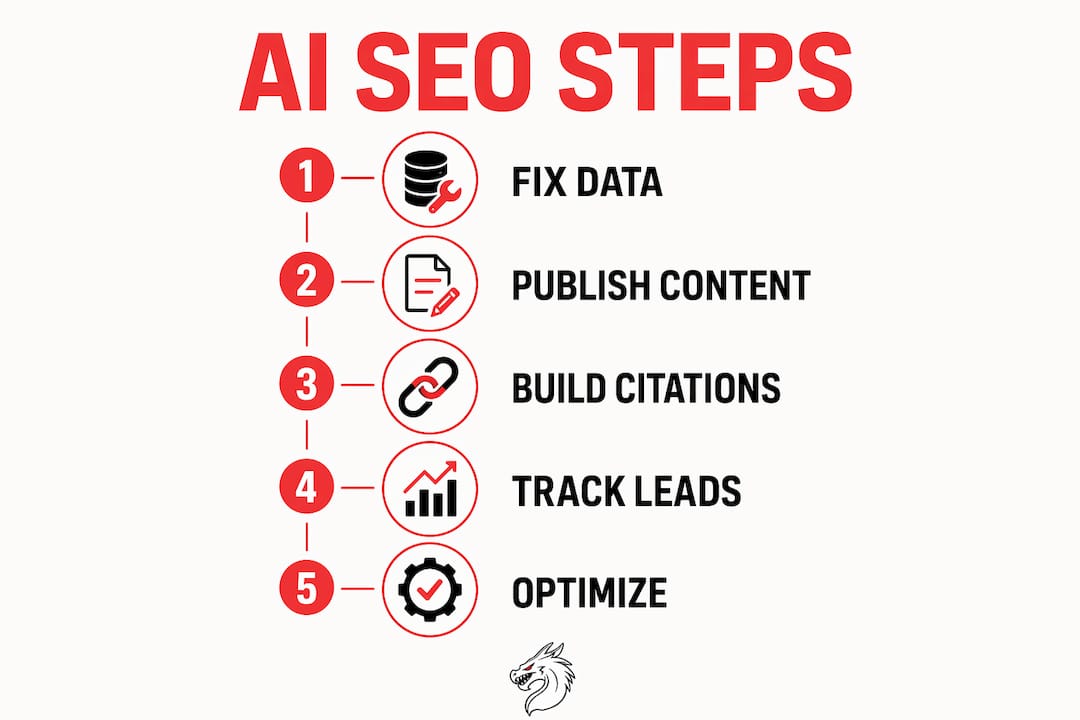
AI SEO for contractors is the practice of optimizing your site, local entity data, and content so AI engines like ChatGPT, Google Gemini, and Perplexity cite your business by name when homeowners ask for local help. The first actions to take are simple and fast:
- —Audit your Google Business Profile (GBP) — fix the name, address, phone, service area, and add at least five recent photos.
- —Publish one service + location page — write a 300–500 word page that opens with a direct two-sentence answer to the homeowner's question.
- —Add FAQ schema to that page — mark up two to three Q&A pairs using FAQ structured data so AI engines can extract your answers directly.
Expect an initial citation lift in 4–6 weeks. Solid, repeatable presence inside AI recommendations typically takes 90–180 days of consistent content and citation work.
Pro Tip: Run five test prompts in ChatGPT and Google Gemini right now — type "best [your trade] in [your city]" and see whether your business name appears. That gap is exactly what this playbook closes.

*
Table of Contents
- —How AI search is changing contractor marketing right now
- —What are the core principles of AI SEO for contractors?
- —What technical checklist do contractors need to complete?
- —How do you write content that AI will actually cite?
- —How do local signals and reputation feed AI recommendations?
- —Which AI and SEO tools should contractors use?
- —What does a 30/60/90-day implementation roadmap look like?
- —How do you measure whether AI SEO is actually working?
- —How Vaultio's approach puts these tactics into practice
- —Key Takeaways
- —What contractors actually get wrong with AI SEO
- —Vaultio puts contractors at the top of AI search
- —Authoritative sources and further reading
How AI search is changing contractor marketing right now
Blue links are no longer the whole game. When a homeowner types "who replaces a roof in Austin" into Google, they often get an AI Overview at the top that names two or three contractors and summarizes why. They may never scroll to the organic results. AI-generated summaries reward businesses that are citable — meaning your content, your GBP data, and your reputation signals must be strong enough for an AI engine to stake its answer on you.

The economics shift in your favor when you get cited. Fewer people click through to compare options; they call the name the AI already vouched for. That means higher-intent leads, shorter sales cycles, and lower cost per booked job compared to chasing clicks on a crowded results page.
What this looks like in practice:
- —A homeowner asks Perplexity "licensed electrician near me for panel upgrade in Denver." Perplexity synthesizes an answer that names a specific contractor, links their GBP, and quotes their review rating.
- —The homeowner calls that contractor directly. No comparison shopping. No clicking three other sites.
- —The contractors who are not cited lose that lead entirely, even if they rank #4 organically.
Your job is to become the business AI engines trust enough to name.
*
What are the core principles of AI SEO for contractors?
Entity-based optimization is the foundation. AI engines build a model of your business from every data point they can find: your GBP, your website, your citations on Yelp, Houzz, and Angi, and the content you publish. When those signals are consistent and specific, the AI treats your business as a known, trustworthy entity. When they conflict, you get excluded.
Three concepts drive everything:
Entity-based optimization means your business name, address, phone, and service area are identical everywhere online. A single inconsistency — "St." vs. "Street," a suite number missing from one directory — can cause AI systems to treat two listings as different businesses.
Topical authority means you publish enough specific, credible content about your trade and your local market that AI engines recognize you as the go-to source. One generic "we do roofing" page does not build authority. Ten pages covering specific services, local permit requirements, and cost ranges do.
E-E-A-T for contractors means demonstrating Experience, Expertise, Authoritativeness, and Trustworthiness through real signals: license numbers on your site, manufacturer certifications, association memberships (NARI, NAHB), and a high volume of detailed reviews.
Trust signals AI engines prefer:
- —Complete GBP with services, hours, service area, and photos
- —Review volume above local competitors, with recent reviews mentioning specific services and locations
- —Consistent NAP (name, address, phone) across Yelp, Houzz, Angi, BBB, and local directories
- —Manufacturer or association citations linking to your business
- —License and insurance details published on your website
*
What technical checklist do contractors need to complete?
Schema markup is where most contractor sites leave easy citations on the table. Adding `LocalBusiness` schema (with the right subtype) tells AI engines exactly what your business is and where it operates.
Priority schema types for contractors:
| Schema Type | When to Use | Core Value |
|---|---|---|
| `LocalBusiness` (subtype) | Every contractor site | Declares entity: name, address, phone, service area |
| `Service` | Each service page | Names the service, area served, and price range |
| `FAQPage` | Pages with Q&A sections | Makes answers directly extractable by AI |
Use the correct `LocalBusiness` subtype: `RoofingContractor`, `Plumber`, `Electrician`, `GeneralContractor`, or `HVACBusiness`. The subtype narrows your entity signal and helps AI engines match you to the right queries.
Site structure checklist (must / should / optional):
- —Must: One dedicated page per service + city combination (e.g., "Roof Replacement in Goleta, CA")
- —Must: Consistent NAP in the footer on every page
- —Must: FAQ section on each service page, marked up with `FAQPage` schema
- —Should: Canonical tags on paginated or filtered pages to prevent duplicate signals
- —Should: Crawlable XML sitemap submitted to Google Search Console
- —Optional: `BreadcrumbList` schema to reinforce site hierarchy for AI crawlers
Pro Tip: Validate your schema using Google's Rich Results Test before publishing. A single syntax error silently breaks the entire markup block.
*
How do you write content that AI will actually cite?
AI engines pull from content that answers a question directly in the first two sentences, then backs it up with specifics. Generic "we've been serving the area for 20 years" copy gets skipped. Declarative, data-backed answers get cited.
Service page skeleton that wins AI citations:
- 1.Opening answer (2 sentences): State what the service is, what it costs in your market, and who needs it. Example: "Roof replacement in Santa Barbara typically costs $8,000–$18,000 for a 2,000 sq ft home, depending on material and pitch. Most jobs take two to three days."
- 2.Process section: Three to five numbered steps explaining what the homeowner should expect.
- 3.Local detail block: Mention local permit requirements, common materials in local housing stock, or neighborhood-specific constraints. This is what makes your page hyper-local and citable.
- 4.Cost range table: A simple two-column table (scope vs. price range) that AI can extract as a data point.
- 5.FAQ section: Three to five Q&A pairs, each answer two to four sentences long.
H2/H3 structure for a service + location page:
- —H1: Roof Replacement in Santa Barbara, CA
- —H2: How much does roof replacement cost in Santa Barbara?
- —H2: What does the roof replacement process look like?
- —H3: Permits required in Santa Barbara County
- —H2: Frequently asked questions about roof replacement
Pro Tip: Write every FAQ answer as if you're speaking directly to the AI engine: start with the answer, add one supporting fact, and close with a local detail. "Roof permits in Santa Barbara County are required for full replacements and cost $150–$400. Your contractor pulls the permit; you don't need to handle it."
For deeper templates, the AI-friendly content guide covers exact FAQ patterns and page structures built for AI extractability.
*
How do local signals and reputation feed AI recommendations?
Your GBP is the single most powerful feed for AI recommendations. Complete GBP fields, frequent posts, service photos, and answered Q&A all increase the chance an AI engine names you. Treat it like a second website.
Priority order for local signal work:
- 1.GBP completeness — every field filled, services listed with descriptions, at least 20 photos, Q&A answered
- 2.Review velocity — aim for at least two new reviews per month, with responses from you within 48 hours
- 3.Citation consistency — identical NAP on Yelp, Houzz, Angi, BBB, and at least ten local directories
- 4.Platform presence — contractor-trusted platforms like Angi, Houzz, and HomeAdvisor increase your chance of being referenced in AI answers
Review request prompt that gets detailed, keyword-rich responses:
Citation audit steps:
- —Search your business name in Google and note every directory listing that appears
- —Check each listing for NAP accuracy; flag any that differ from your GBP
- —Claim and correct listings on Yelp, Houzz, Angi, BBB, and local chamber directories
- —Use a citation management tool to push consistent data across 50+ directories at once
A listing on a trusted directory like Workily demonstrates the kind of structured, authority-signal presence AI engines look for when deciding which contractors to recommend.
*
Which AI and SEO tools should contractors use?
Prompt tracking across ChatGPT, Google Gemini, and Perplexity reveals which local signals trigger named recommendations. Run 100–500 queries weekly if you're a medium or larger contractor; smaller shops can start with 20–30 weekly checks.
Tool categories and when to use them:
| Tool Category | Primary Use | When It Matters Most |
|---|---|---|
| AI prompt monitors | Track whether your brand appears in ChatGPT, Gemini, Perplexity answers | Monthly for small shops; weekly for active campaigns |
| Local rank trackers | Monitor map pack and organic positions by city/zip | Ongoing; weekly reporting |
| Schema validators | Catch markup errors before they break citations | Every time schema is added or changed |
| Citation managers | Push consistent NAP to 50+ directories simultaneously | Initial cleanup and quarterly audits |
| Generative search trackers | Monitor AI Overview appearances in Google | Weekly for competitive markets |
Tools that track generative search or AI Overviews, such as Semrush's Generative Search Tracker, help you see whether your brand is being pulled into AI answers before a competitor locks up that position.
Safe AI content workflow (QA checklist):
- 1.Draft the page outline using an AI tool (ChatGPT or Gemini work fine for structure)
- 2.Insert real local data: permit costs, material prices, neighborhood names, your actual license number
- 3.Have a human editor review for accuracy, tone, and uniqueness before publishing
- 4.Avoid templated, low-value pages — duplicate content across city pages destroys E-E-A-T and can trigger manual penalties
- 5.Cite sources inside the content where relevant (manufacturer specs, local code references)
*
What does a 30/60/90-day implementation roadmap look like?
Most contractors can execute this plan with an owner, an office manager, and one outside web partner.
30 days — Foundation:
- 1.Complete GBP audit and fix all NAP inconsistencies
- 2.Publish two service + location pages with schema markup
- 3.Launch a review request system (text or email after every completed job)
- 4.Submit sitemap to Google Search Console
60 days — Expansion:
- 1.Publish four more service + location pages (one per week)
- 2.Complete citation cleanup across Yelp, Houzz, Angi, BBB, and ten local directories
- 3.Add FAQ schema to all published pages
- 4.Begin weekly AI prompt checks across ChatGPT, Gemini, and Perplexity
90 days — Authority:
- 1.Publish a cost guide for your top service (1,000–1,500 words, with a cost table)
- 2.Reach out to two local associations or suppliers for a citation or mention
- 3.Review Search Console for impression vs. click divergence — a rising impression count with flat clicks is a strong signal that AI Overviews are intercepting your traffic
- 4.Assess leads per month against the 90-day baseline
Typical cost ranges:
| Approach | Monthly Investment | What You Get |
|---|---|---|
| In-house (owner + office manager) | — | Slow execution; high owner time |
| Freelance specialist | — | Faster content; limited strategy |
| Full-service agency | — | Strategy, content, schema, citations, reporting |
*
How do you measure whether AI SEO is actually working?
Measuring AI SEO success requires signals beyond traditional click counts. Impressions rising while clicks stay flat is often the first sign that AI Overviews are intercepting your traffic — that's not a failure, it's a signal to check whether you're being cited.
KPIs that matter:
- —AI citations: Manual checks in ChatGPT, Gemini, and Perplexity for your top 10–20 queries
- —Branded search lift: Rising searches for your business name in Google Search Console
- —Qualified leads per month: Calls and form fills attributed to organic or AI-driven traffic
- —GBP metrics: Direction requests, calls, and website clicks from your GBP listing
- —Impression vs. click ratio: Widening gap signals AI Overview interception
| Metric | What It Indicates | Action |
|---|---|---|
| AI citation count rising | Your entity signals are working | Maintain content cadence |
| Branded search up, clicks flat | AI is surfacing your name without clicks | Add more citable FAQ content |
| Leads up, impressions flat | High-intent traffic converting well | Scale content to more service areas |
| GBP calls increasing | Local entity strength growing | Respond to all reviews; add photos |
Track generative AI visibility monthly and tie every lead back to a source in your CRM. Without that attribution, you can't prove ROI or know which pages to double down on.
*
How Vaultio's approach puts these tactics into practice
Vaultio's methodology follows the same playbook described above, executed as a managed service so contractors don't have to coordinate it themselves.
The process:
- —Entity audit: Every GBP field, citation, and on-site NAP signal checked and corrected in week one
- —Schema engineering: `LocalBusiness`, `Service`, and `FAQPage` markup deployed across all service pages
- —City/service clusters: Dedicated pages built for each service + city combination in your target market
- —Citation building: Consistent NAP pushed to 50+ directories, with priority on contractor-trusted platforms
- —Content publishing cadence: Two to four new AI-citable pages per month, each with local data, cost ranges, and FAQ schema
Success signals Vaultio tracks for every client: review volume growth month over month, citation count and consistency, AI citation appearances in manual prompt checks, and qualified leads per month as the primary business outcome. The local SEO approach is built around these measurable outcomes, not vanity metrics.
*
Key Takeaways
Contractors who fix their entity data, publish AI-citable content, and build consistent local citations can expect their first AI citations within 4–6 weeks and meaningful lead growth within 90–180 days.
| Point | Details |
|---|---|
| Fix entity data first | Consistent GBP, NAP, and citations are the foundation AI engines build recommendations on. |
| Publish one AI-citable page this week | A service + location page with a direct opening answer and FAQ schema is your fastest citation opportunity. |
| Build a review system | Two or more new reviews per month with keyword-rich detail strengthens your local entity signal. |
| Track AI citations manually | Run weekly prompts in ChatGPT, Gemini, and Perplexity to monitor whether your business is being named. |
| Vaultio handles the full roadmap | Vaultio manages entity audits, schema, content clusters, and citation building to deliver 10–15 extra jobs per month. |
*
What contractors actually get wrong with AI SEO
Most contractors I see come into this space chasing the wrong thing. They want to rank for "best roofing contractor" nationally, or they've published 30 city pages that are word-for-word identical except for the city name swapped in. Neither works. AI engines are better at detecting thin, templated content than any manual reviewer, and they simply don't cite it.
The three most common mistakes:
- —Chasing high-volume national keywords when the actual buying intent is hyper-local. "Roof replacement in [your city]" with real local detail beats "best roofing contractor" every time in AI recommendations.
- —Inconsistent GBP data. A suite number missing from one directory, a slightly different business name on Yelp — these gaps cause AI systems to treat your listings as separate or unverified entities.
- —Ignoring FAQs. Contractors skip FAQ sections because they feel repetitive. But a two-to-four sentence direct answer to "how much does a panel upgrade cost in Phoenix?" is exactly what Perplexity pulls into its answer box.
What to expect in months 1–6: the first two months feel slow. You're fixing data, publishing pages, and building citations. By month three, you'll see branded search lift in Search Console and your first manual AI citation appearances. By month six, if the content cadence holds, qualified leads from organic and AI-driven traffic should be measurably higher than your pre-work baseline. Patience plus consistency is the formula.
*
Vaultio puts contractors at the top of AI search
Most contractors spend months trying to piece this together alone — fixing GBP one week, writing a page the next, never quite connecting the dots into a system that compounds. Vaultio does it as one integrated service: entity audit, schema deployment, city/service content clusters, citation building, and AI citation monitoring, all running in parallel from day one.
The result is a steady, predictable flow of qualified local leads — not a spike from one ad campaign, but a compounding presence that grows every month. Contractors in markets like Goleta and Santa Maria are already seeing their names appear inside AI-generated answers while competitors remain invisible. Backed by a 30-day money-back guarantee, Vaultio's AI lead generation service is built for contractors who are ready to own their local market. Get your free assessment and see exactly where your business stands in AI search today.
*
Authoritative sources and further reading
- —AI SEO for Contractors — Emet Digital — Covers entity-based optimization, schema markup, and FAQ content patterns for contractors; one of the most practical contractor-specific AI SEO references available.
- —AI SEO for Contractors: Local AI Search Visibility & Lead Generation — Snezzi — Details citation timelines, prompt tracking methodology, and the role of consistent entity data in AI recommendations.
- —AI Visibility Report: Best SEO Tools for Construction in 2026 — Trakkr — Analysis of 450+ prompts across four AI platforms showing which tool categories construction firms need most.
- —7 SEO Tools for Home Builders 2026 — Ignite Digital — Reviews generative search tracking tools and monitoring capabilities relevant to contractor AI SEO.
- —AI Marketing for General Contractors — Storescribe — Explains safe AI content workflows and the E-E-A-T pitfalls contractors must avoid when scaling content with AI tools.
Recommended
- —SEO for Home Services: Win More Local Jobs in 2026 | Vaultio
- —Local SEO That Works Everywhere | Google Maps + ChatGPT Recommendations | Vaultio
- —Home Service Marketing Blog | Strategies, Tips & Tactics | Vaultio
- —Google Ads for Home Service Contractors | PPC Management for Plumbers, HVAC & More | Vaultio
Ready to Implement This?
We'll build your complete lead generation system in 72 hours. No contracts. 30-day money-back guarantee.