Ship Verifiable LLM Citations: 3 Architectures, Tests, Tactics
# Ship Verifiable LLM Citations: 3 Architectures, Tests, Tactics
An LLM citation is a resolvable reference, whether a link, a title, or an inline marker, that an AI system attaches to a claim in its answer. It's useful for transparency, but it's not proof. A citation can point to a real source that says nothing close to the claim beside it, so the practical work is building and verifying the connection between what's claimed and what's actually supported.
*
TL;DR: - Many AI-generated citations are falsely supported by sources that do not verify the claims, making verification essential before trust. - Retrieval-augmented generation with a refiner pass produces more accurate, audit-ready citations compared to simple pre-hoc methods. - Building a citation pipeline requires detailed chunking, metadata tagging, and an audit trail to ensure source traceability and prevent propagating invalid references. - Verifying citations with automated tools like CiteGuard provides about 68% accuracy, but manual review remains critical in high-stakes settings. - Publishing clear, fact-based content with stable, well-structured data increases the likelihood of being cited accurately by AI systems.
*
Table of Contents
- —What LLM Citations Are and Why the Citation Doesn't Always Match the Claim
- —How Do LLMs Actually Generate Citations?
- —How Do You Build a Pipeline for Resolvable Citations?
- —How Reliable Are LLM Citations, and How Do You Test Them?
- —How Can Publishers Earn More LLM Citations?
- —What Tools and Frameworks Help You Audit Citations?
- —How Should End Users See LLM Citations Presented?
- —What Are the Legal and Ethical Risks of AI-Generated Citations?
- —What Do Real Implementations of LLM Citations Look Like?
- —Why Citations Are the New Battleground for Local Visibility
- —Turn Citation-Ready Content Into Booked Jobs With Vaultio
- —Research and Frameworks Worth Reading Further
- —Sources
- —FAQ
What LLM Citations Are and Why the Citation Doesn't Always Match the Claim
An LLM citation is any attributable marker an AI attaches to a generated statement: a hyperlink, a document title, a footnote number, or a bracketed tag like `[3]`. It tells you where the model says its information came from. That's the whole job of a citation, and it's a narrower job than most people assume.
Here's the part that trips up developers and marketers alike: a citation is not the same thing as support. A model can cite a real, live URL that says nothing close to the claim next to it. This citation vs. support distinction matters because a system can look fully sourced while still being wrong.
Why does this matter beyond academic nitpicking?
- —Transparency: users and reviewers can check the model's work instead of trusting it blindly.
- —Brand visibility: for marketers, being the source an AI system cites in front of a buyer is now a discovery channel worth optimizing for, the same way page-one rankings mattered a decade ago.
- —Liability and trust: in regulated or high-stakes domains, an unresolved or unsupported citation is a legal and reputational risk, not just a UX flaw.
The operational implication is simple: never treat "has a citation" as "is correct." Verification, covered later in this piece, is what closes that gap.
How Do LLMs Actually Generate Citations?
Three architectural patterns dominate how large language models produce citations, and each carries a different reliability profile.
- 1.Pre-hoc citation generation: the model inserts citation tokens directly into its output as it writes, drawing on whatever it "remembers" from training. This is the simplest to build and renders cleanly in a chat UI, but on models without live retrieval it invites serious hallucination risk. The model is essentially guessing at a plausible-looking source, and citation hallucination rates measured across 13 models ranged widely, depending on the model and domain.
- 2.Post-hoc citation generation: the model writes its answer first, then a separate pass extracts each factual claim and matches it against a corpus to find supporting evidence. This is safer because the match happens against real documents, but it lives or dies on the quality of the semantic matching. A weak matcher will happily attach a tangentially related source to a specific claim.
- 3.RAG-first (retrieval-augmented generation): the system retrieves relevant passages before the model writes anything, and the answer is built from that retrieved evidence. This gives you the best shot at resolvable citations because the source material is already in hand when generation starts. It's not immune to failure. Retrieval can pull a marginally relevant chunk, and the model can still misstate what that chunk says.
A fourth pattern is gaining traction fast: generate-then-refine hybrids. The model produces a draft answer, then a refiner pass cross-checks each claim against retrieved passages, adding missing citations and stripping irrelevant ones without rewriting the answer text itself. Research on this pattern shows it produces substantial improvements in citation precision across datasets and models compared to single-pass generation.
Pro Tip: If you're choosing an architecture from scratch, don't default to pre-hoc citations just because it's the easiest UI to ship. RAG-first with a refiner pass costs more in latency and infrastructure, but it's the only combination in this list built to make citations auditable rather than merely present.
How Do You Build a Pipeline for Resolvable Citations?
A resolvable citation pipeline starts long before the model generates a single word. It starts with how you store and structure your source material.
- —Chunk your text and attach canonical metadata. Break documents into passages small enough to cite precisely, and tag each chunk with a title, a canonical URL, and character or token offsets. Without offsets, you can point to a document but not to the specific sentence that supports a claim.
- —Store chunks in a vector database with indexed, retrievable metadata. The embedding gets you semantic search; the metadata is what turns a retrieval hit into a citeable reference. If your metadata isn't indexed alongside the vector, you'll retrieve the right passage and still lose track of where it came from.
- —Design prompts that explicitly request citation tokens. Use a consistent marker format, something like `
`, and include few-shot examples in the prompt that demonstrate the exact format you want enforced. Models are far more consistent about citation syntax when shown examples than when given instructions alone. - —Parse model output to resolve tokens back to source chunks. Every `
` marker needs to map deterministically to a stored chunk ID and offset. If the parser can't resolve a token, that's a signal to flag the citation as broken rather than display it as valid. - —Log every claim-to-source mapping in an audit trail. Store the claim text, the resolved source, and a timestamp. This is what lets you investigate a dispute six months later instead of shrugging.
That audit trail matters more than most teams initially budget for. Invalid citations don't just sit quietly, they propagate: once a hallucinated reference gets copied into a downstream document or another model's training data, it can enter the record and get cited again by something else entirely. GhostCite's large-scale analysis found invalid citation rates rose 80.9% in 2025 compared to prior-year averages, a trend that makes upfront auditability a lot cheaper than after-the-fact cleanup.
Treat each citation marker as metadata, not proof. The mapping from claim to resolved passage to a support verdict is the actual unit of trust your system produces, not the marker itself.
How Reliable Are LLM Citations, and How Do You Test Them?
Citation reliability is measured with a few specific metrics, and the numbers from published research should change how much you trust an unverified system.
- —Citation validity rate: does the cited link or document actually exist and resolve?
- —Claim support rate: does the resolved source actually substantiate the specific claim next to it?
- —Citation precision and recall at the statement level: of all citations attached, how many are correct (precision), and of all claims that needed a citation, how many got one (recall)?
The gap between validity and support is where most systems quietly fail. A SourceCheckup evaluation of medical LLM responses found a large portion of answers were not fully supported by their cited sources, even when the model had retrieval enabled. GPT-4o with RAG showed a moderate level of response-level support in that same evaluation, meaning close to half of its "sourced" medical answers didn't fully hold up under scrutiny.
| Verification approach | What it checks | Best used for |
|---|---|---|
| Automated link resolution | Does the citation resolve to a real, live document? | Catching ghost citations before they reach a user |
| Retrieval-augmented validation (CiteGuard-style) | Would a human author cite this same source for this claim? | Attribution alignment at scale |
| Claim-level semantic matching | Does the resolved passage actually state the claim? | Catching "real source, wrong support" cases |
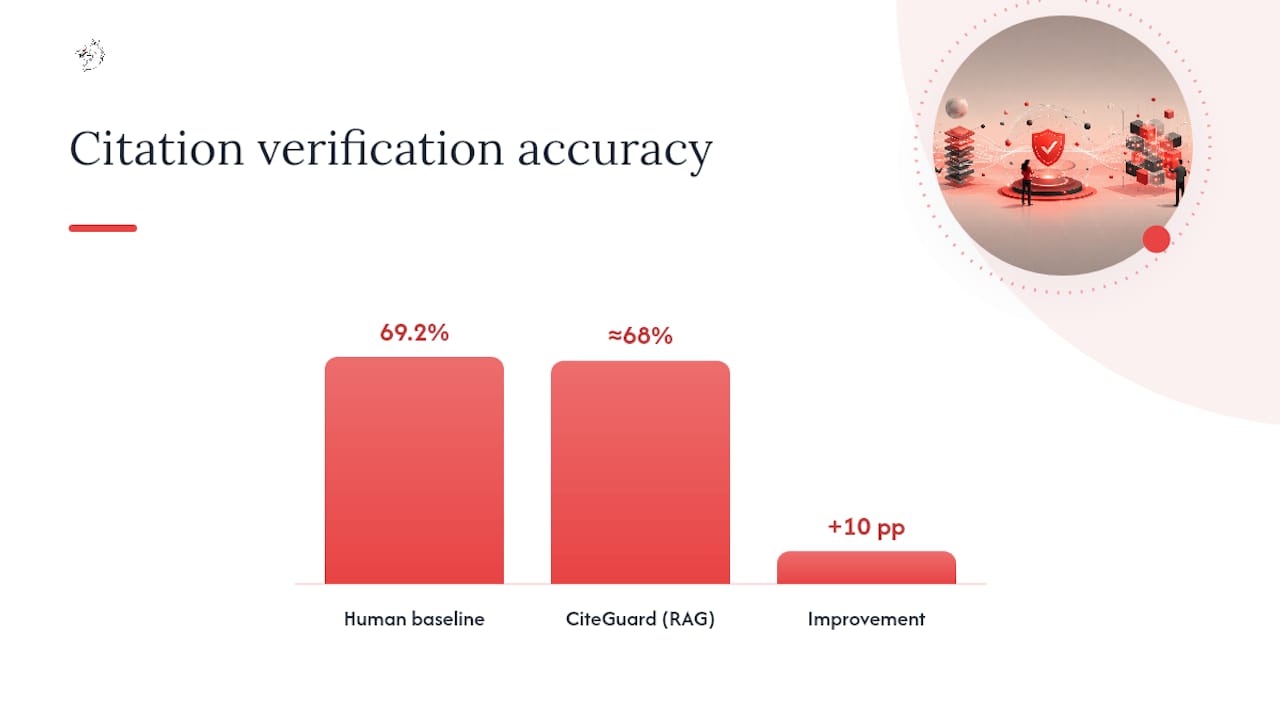
CiteGuard's retrieval-augmented validation approach improved citation attribution accuracy by about 10 percentage points, reaching accuracy close to 68% on the CiteME benchmark against a human baseline of 69.2%. That's close enough to human performance to be genuinely useful as an automated first pass, though not close enough to skip human review in high-stakes domains.
Pro Tip: Don't try to verify every citation your system produces. Sample a fixed percentage of claims per release, segment them by domain (medical, financial, general), and route disputed cases to manual review. Full coverage is rarely worth the cost; a consistent sampling protocol catches drift just as effectively.
How Can Publishers Earn More LLM Citations?
Earning citations from AI systems isn't fundamentally different from earning links from human editors: you need to be the clearest, most retrievable answer to a specific question. The mechanics have just shifted.
- —Write short, fact-dense passages with a clear, standalone claim. A paragraph that states one fact plainly, with a canonical URL attached, retrieves and cites more cleanly than a long narrative buried in context. This is the same discipline that shows up in guidance on AI-friendly content for home service businesses.
- —Keep pages open-access and genuinely crawlable. Content locked behind logins, aggressive paywalls, or JavaScript rendering that blocks simple crawlers won't get retrieved, no matter how good the writing is.
- —Use structured data where it applies. Schema.org markup and clean HTML metadata (clear titles, accurate meta descriptions, semantic headings) give retrieval systems a cleaner signal than plain prose alone.
- —Watch discovery channels outside traditional search. AI systems frequently pull from Reddit, YouTube, and specialist aggregators when forming answers, which means a strong presence on niche forums and video platforms can influence citation likelihood in ways a pure SEO strategy misses.
- —Monitor your citations and update pages when content drifts. If a page's facts change (a price, a service area, a certification) and the cited version goes stale, that's a support failure waiting to happen, and it's on you to fix it before someone else's audit catches it first.
One systemic bias worth knowing: large language models show a measurable preference for highly cited, recent, and concisely titled sources, which reinforces a Matthew effect where already-popular content keeps getting cited more. Newer or niche pages need to work harder on clarity and structure to break into that pattern. Local service businesses trying to break into AI-mediated discovery face this exact dynamic, which is covered in more depth in guidance on generative AI's role in local business ranking.
What Tools and Frameworks Help You Audit Citations?
A handful of frameworks and components have emerged specifically to solve the claim-support gap, and most production pipelines end up combining several of them rather than relying on one.
- —CiteGuard: a retrieval-augmented validation framework that checks whether the source a model cited is one a human author would plausibly cite for the same claim, rather than just checking whether the link resolves.
- —SourceCheckup: an automated evaluation pipeline built for high-stakes domains like medicine, designed to score whether cited sources actually support the adjacent claim at the response level.
- —CiteVerifier-style resolvers: components that specialize in resolving citation tokens back to stored chunks and flagging broken or unresolvable references before they reach a user.
- —Vector database plus metadata index: the storage layer that makes chunk-level citation possible in the first place, pairing embeddings with canonical URLs and offsets.
- —Refiner agent pattern: a post-generation pass that cross-checks claims against retrieved passages, adding, removing, or confirming citations without altering the answer text.
Combining a retriever, a refiner, and an automated link-checker gets most teams most of the way to production-grade citation reliability without building every component from scratch.
How Should End Users See LLM Citations Presented?
There's no single ratified industry standard for displaying LLM citations yet, but a few conventions are converging across major AI products and are worth adopting if you're building your own interface.
Inline numbered markers that link out to a source list, similar to a Wikipedia article or a legal brief's footnote system, are the most common pattern. This mirrors how legal citation formats and academic citation for LLM applications already work: readers expect a consistent, resolvable marker style rather than a wall of embedded URLs.
A few presentation practices consistently improve trust without adding clutter:
- —Show the source title and domain, not just a raw URL. Users scan faster when they see "Mayo Clinic" instead of a long string of characters.
- —Group multiple citations per claim when more than one source supports it. A single citation on a strong claim can look thinner than the evidence actually is.
- —Distinguish resolved citations from unresolved ones visually. If a token failed to resolve during parsing, don't render it as if it were a working link. Flag it or drop it.
- —Let users expand a citation to see the exact supporting passage, not just the destination page. This is where citation management tools built for research workflows have a head start. Zotero and similar reference managers have trained users to expect passage-level context, not just a link.
For technical writing, thesis work, or anything citation-heavy, the expectations get stricter. LLM thesis citations in particular need to resolve to real, checkable sources because academic integrity standards treat a fabricated citation as a serious violation, not a formatting slip. Whatever format you choose, consistency across a document matters as much as the format itself: switching citation styles mid-document erodes trust faster than any single broken link.
What Are the Legal and Ethical Risks of AI-Generated Citations?
A fabricated or unsupported citation carries different weight depending on where it shows up, and treating every context the same is a mistake.
In academic and professional settings, a hallucinated citation isn't a minor error. Multiple documented cases have shown attorneys and researchers submitting AI-generated citations to real courts and journals, only to discover the cited case or paper doesn't exist. That's not a technical bug; it's a professional-conduct problem, and it's why fields with strict citation norms are moving toward mandatory human verification of any AI-assisted work before submission.
For commercial and marketing use, the ethical bar is different but still real. If your product or content displays an AI-generated citation to end users, you're implicitly vouching for it. A user who clicks through to a source and finds it doesn't support the claim next to it loses trust in your product, not just in the underlying model. That's a brand risk as much as a legal one, and it compounds with the transparency point covered earlier: presence without support is worse than no citation at all, because it looks like diligence you didn't do.
The practical guardrails worth adopting regardless of industry: disclose when citations are AI-generated versus human-curated, never present an unresolved citation as if it worked, and keep an audit trail so you can correct or retract a claim if a source turns out not to hold up. None of this requires legal expertise to implement. It requires treating verification as a shipped feature, not an afterthought.
What Do Real Implementations of LLM Citations Look Like?
The clearest working examples of citation systems in production come from search-adjacent AI products that show sourced answers directly in their interface, attaching numbered markers to specific sentences and linking out to the original page.
Academic and research tools tell a more cautionary story. Tools that generate literature reviews or draft citations for researchers have repeatedly run into the same failure mode: a fabricated but plausible-sounding reference slipping past a rushed review. This is precisely why analysis of scientific citation practices in language models matters for anyone building research tools, since the same biases that make models favor well-cited, recent papers also make hallucinated citations look more convincing.
In the medical domain, the pattern is consistent enough to be a case study in itself: RAG-enabled models perform better than non-retrieval models at reducing outright URL hallucination, but the claim-support gap remains wide even with retrieval in place. That's the single most important lesson from real deployments so far. Retrieval fixes the "does this link exist" problem more reliably than it fixes the "does this link actually say that" problem, and any team shipping a citation feature needs to test for both separately rather than assuming one implies the other.
For local service businesses, the practical version of this shows up in how AI systems choose which local providers to surface when someone asks a question like "who's a reliable plumber near me." The businesses that show up aren't just the ones with the most content. They're the ones whose content resolves cleanly when an AI system checks its work.

Why Citations Are the New Battleground for Local Visibility
Every point in this article about citation validity and claim support has a direct business consequence for home service contractors: if an AI system can't resolve your content into a clean, supportable citation, it skips you and cites a competitor instead. Booked jobs increasingly start with an AI-mediated answer, not a ten-blue-links search page.
A managed approach that pairs cite-ready content with fast lead response closes both ends of that funnel: the AI system has clean, structured material to cite, and when a homeowner acts on that citation, the lead gets engaged in seconds instead of hours. That combination is exactly what turns AI visibility into a booked job rather than a missed opportunity.
— Damian
Turn Citation-Ready Content Into Booked Jobs With Vaultio
Building your own retrieval pipeline, refiner agent, and citation audit trail is the right move if you're an engineering team with time to spend. Most contractors don't have that time, and every week spent DIY-ing an AI visibility stack is a week competitors spend capturing the leads you should be getting.
Vaultio's done-for-you services handle the parts that actually move revenue: AI SEO built to produce the clean, fact-dense, structured content that AI systems can resolve and cite, an AI chatbot and scheduling system that engages new leads within seconds instead of hours, and ongoing management so your content doesn't go stale the moment your services or pricing change. Vaultio offers services aimed at increasing the number of booked jobs monthly, backed by a 30-day money-back guarantee. If you're a home service contractor ready to stop losing leads to whoever shows up first in an AI-generated answer, request an audit through the DFYServices page and see where your current visibility actually stands.
Research and Frameworks Worth Reading Further
The claims in this article draw on a small set of primary sources worth reading directly if you're building a citation pipeline of your own:
- —GhostCite's large-scale analysis of citation validity, covering hallucination rates across 13 models and the 2025 spike in invalid citations.
- —The SourceCheckup framework for medical LLM citation support, the basis for the claim-support statistics cited throughout.
- —CiteGuard's retrieval-augmented validation approach, benchmarked against human-level attribution accuracy.
- —Research on generate-then-refine citation methods for teams weighing pre-hoc, post-hoc, and hybrid architectures.
Run a small validation experiment against your own corpus before deploying any citation automation in production. Published benchmarks tell you what's possible, not what your specific data will do.
Sources
- —GhostCite: A Large-Scale Analysis of Citation Validity in the Age of Large Language Models
- —An automated framework for assessing how well LLMs cite relevant medical references
- —CiteGuard: Faithful Citation Attribution for LLMs via Retrieval-Augmented Validation
- —How deep do large language models internalize scientific literature and citation practices?
FAQ
What Are Citations in an LLM?
An LLM citation is a resolvable reference, a link, title, or marker, that an AI model attaches to a claim in its output. It signals where the information supposedly came from, but it doesn't guarantee the source actually supports the claim next to it.
How Do You Get More Reliable LLM Citations?
Use a RAG-first architecture with a generate-then-refine pass, since refiner agents materially improve citation precision without rewriting the answer itself. For publishers, writing short, fact-dense passages with canonical URLs and clean structured data increases the odds of being retrieved and cited accurately in the first place.
Can ChatGPT Give Real Citations?
Yes, when retrieval or browsing is active, ChatGPT can attach real, resolvable links to its answers. Even then, a resolvable link doesn't guarantee the cited source fully supports the specific claim, so treating any AI-generated citation as unverified until checked is the safer default.
Which Tool Is Best for Verifying or Creating Citations?
For engineering teams, retrieval-augmented validation frameworks like CiteGuard offer the strongest published accuracy for checking whether a citation actually matches its claim. For researchers and writers, established citation management tools like Zotero remain the standard for organizing and formatting verified sources rather than generating new ones automatically.
Does Vaultio Help With AI Citation Visibility for Contractors?
Vaultio's AI SEO and done-for-you content services are built to produce the structured, fact-dense pages that AI systems are more likely to retrieve and cite when answering local service queries. Current pricing and package details are available on the DFYServices page.
Recommended
Ready to Implement This?
We'll build your complete lead generation system in 72 hours. No contracts. 30-day money-back guarantee.