Win Map Pack and AI Citations: 3 Entity SEO Fixes for Contractors
# Win Map Pack and AI Citations: 3 Entity SEO Fixes for Contractors
Entity SEO for local businesses means making your company a clearly identifiable "thing" that Google and AI systems recognize, not just a string of keywords. Fix it now with three moves: verify and optimize your Google Business Profile, add LocalBusiness schema with an `@id` and `sameAs` links, and standardize your business name, address, and phone number everywhere they appear. Everything below shows you how to execute those three moves and what to do after.
*
TL;DR: - Ensuring your business name and primary Google Business Profile category align correctly is essential, as mismatched signals can prevent your business from appearing in local searches. - Deploying detailed schema markup with a unique @id and consistent sameAs links to your profiles strengthens your entity recognition for AI and Knowledge Graph systems. - Standardizing your NAP across all online citations and fixing duplicate or outdated listings helps prevent fragmentation of your entity record. - Building dedicated service pages with schema for each offering and securing mentions in local directories or news outlets reinforces clear entity relationships. - Continuous monitoring of your Knowledge Panel, citation consistency, and schema validation is crucial to maintain and improve your business's entity authority over time.
*
Table of Contents
- —What Is Entity SEO Local, and How Is It Different From Keyword SEO?
- —Why Does Entity Clarity Determine Local Search Eligibility?
- —What Are the Core Components of Local Entity Optimization?
- —How Do You Implement Entity SEO Step by Step?
- —What Mistakes Weaken Entity Signals, and How Do You Fix Them?
- —What Metrics Confirm Google Recognizes Your Entity Correctly?
- —What Actually Moves the Needle on Entity Authority?
- —Get Your Entity SEO Handled Without the Guesswork
- —Sources
- —FAQ
What Is Entity SEO Local, and How Is It Different From Keyword SEO?
An entity is a specific, unique thing with defined attributes and relationships to other things. Your plumbing company is an entity. So is the city you serve, the brand of water heater you install, and the trade association you belong to. Google doesn't see your business as a page full of words. It sees a node in a massive relationship map, connected to your location, your category, your reviews, and every mention of your name across the web.
Classic keyword SEO chases phrase matching: "emergency plumber Thousand Oaks" appears on a page, so the page ranks for that phrase. Entity-based SEO works differently. It asks whether Google can confidently answer "what is this business, where does it operate, and what does it do" without ambiguity. That confidence is what entity SEO improves for AI and Knowledge Graph visibility, because large language models retrieve and combine known entities rather than scanning for exact phrases.
Your Google Business Profile functions as the authoritative record Google trusts most for local entity data. It's the primary source Google cross-references against your website, your citations, and your reviews to decide whether your business is a coherent, trustworthy entity worth surfacing.
What separates entity clarity from keyword density:
- —Keyword SEO matches text strings; entity SEO matches identity and relationships.
- —Keyword SEO optimizes a single page; entity optimization touches your GBP, your schema, your citations, and your mentions across the web at once.
- —Keyword rankings shift with content updates; entity trust builds over months as consistent facts accumulate everywhere your business appears.
Why Does Entity Clarity Determine Local Search Eligibility?
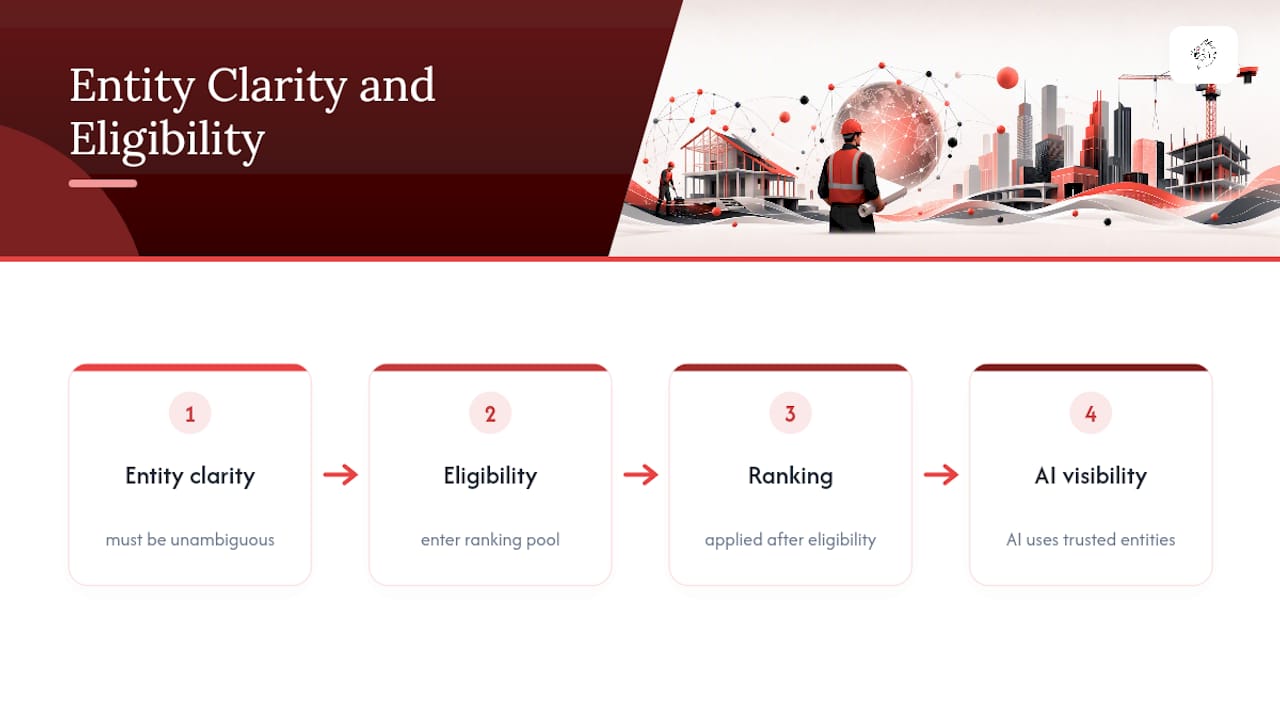
Here's what most contractors get backwards: ranking isn't the first hurdle. Eligibility is. Google evaluates relevance, distance, and prominence for local results, but it can only rank businesses it has already classified as unambiguous entities. Google's local search eligibility depends on entity clarity before any ranking factor gets applied. If Google can't confidently identify what your business is, you may never enter the pool worth ranking.
Fix entity clarity before you spend another dollar chasing reviews or backlinks. Entity signals matter disproportionately for broad-intent map-pack queries, the "near me" searches that drive the most calls. If your business name and primary category send mixed signals, no amount of review generation fixes that ceiling.
Your business name and primary GBP category work as a combined signal. A vague or overly narrow name paired with a mismatched category can quietly exclude you from queries you'd otherwise win. A company named "Thousand Oaks Drain Wizards" filed under "Plumber" competes fine for drain queries but may struggle for general plumbing searches where the entity signal reads narrow.
AI search compounds the stakes. When someone asks ChatGPT or a Google AI Overview to recommend a local HVAC company, the system pulls from entities it already trusts, not keyword-matched pages. A business with weak entity signals is invisible to that retrieval process even if its website ranks fine in classic search. This is the shift reshaping generative AI local business ranking, and it rewards the businesses that fixed their entity data early.
What Are the Core Components of Local Entity Optimization?
Treat this as your audit checklist. Work top to bottom. Each layer reinforces the one above it.
- 1.Google Business Profile. Verify ownership, lock in the correct primary category, list every service you actually perform, fill out every relevant attribute, and upload real photos of your trucks, crews, and completed jobs.
- 2.Structured data. Deploy LocalBusiness, Organization, and Service schema with an `@id` property that uniquely identifies your entity and `sameAs` links pointing to your GBP, Facebook, and industry directory profiles. Schema exist specifically to disambiguate entities for search engines, and `areaServed` plus `openingHours` properties tell Google exactly where and when you operate.
- 3.NAP consistency. Your name, address, and phone number must match character-for-character across your website, GBP, Yelp, Angi, and every industry citation source. One mismatched suite number can fragment your entity into two competing records.
- 4.Service and About pages. Build a dedicated page for each service you offer, not one page trying to rank for everything. Dedicated service pages let Google treat each offering as its own defined entity, linked back to your main business entity through internal links and schema.
- 5.Co-citations and mentions. Get named in supplier directories, local news, trade association rosters, and community sites. Authentic mentions strengthen entity relationships in AI systems even when they don't include a link.
Pro Tip: Search your exact business name in Google right now. If no Knowledge Panel appears on the right side of results, that's your clearest signal that entity recognition is incomplete, no matter how well individual pages rank.
Multi-location contractors need one more layer: each location should carry its own `@id` and its own `sameAs` pointing to its own GBP listing, connected to the parent business through an `Organization` and `subOrganization` relationship. Treating five locations as one blurry entity is a common way multi-branch operators sabotage their own visibility.
How Do You Implement Entity SEO Step by Step?
Run this in four phases. Don't skip the audit to jump to schema, and don't treat governance as optional once you're done.
Phase 1: Audit
- 1.Search your exact business name and check whether a Knowledge Panel appears.
- 2.Run your homepage through a structured-data testing tool and confirm your LocalBusiness schema validates with no errors.
- 3.Pull your top 10 citation sources (GBP, Yelp, Angi, Facebook, Better Business Bureau, industry directories) and list every variation of your name, address, and phone number you find.
- 4.Check for duplicate or unclaimed GBP listings tied to old addresses or previous ownership.
Phase 2: Quick wins (this week)
- —Correct every mismatched field in your GBP: category, hours, service list, service areas.
- —Publish `sameAs` JSON-LD linking your website to your GBP, Facebook, and one or two trusted directory profiles.
- —Standardize NAP formatting across your website footer, contact page, and every citation you control directly.
- —Request removal or merge of any duplicate GBP listing you find.
Phase 3: Mid-term build (this quarter)
- —Build a dedicated page for each core service with its own Service schema and `@id`.
- —If you operate multiple locations, give each one its own LocalBusiness instance tied to a parent Organization.
- —Pitch local news outlets, supplier partner pages, and trade associations for a mention or listing. A single local SEO strategy built around service-page structure illustrates how plumbing companies use this exact sequence to reinforce entity relationships.
- —Monitor branded search volume monthly. Rising searches for your exact name is a leading indicator entity recognition is working.
Phase 4: Governance
Assign one person ownership of your GBP and schema. Keep a simple change log, even a shared spreadsheet, noting every update to hours, categories, or schema fields and when it happened. Schedule a full audit every quarter. Entity authority isn't a project you finish. It's a long-term accumulation of consistent facts across every property tied to your name, and it decays if nobody's watching.
What Mistakes Weaken Entity Signals, and How Do You Fix Them?
Most local businesses don't fail at entity SEO because they skip it entirely. They fail because they execute it inconsistently, which is arguably worse than not trying.
- —Inconsistent NAP formats. "123 Main St, Suite 4" on your website and "123 Main Street #4" on Yelp reads as two different addresses to Google's matching algorithms. Reconcile every citation to one exact format and use a citation-tracking tool to catch drift over time.
- —Missing or malformed schema. A LocalBusiness schema block with no `sameAs` and no `@id` is functionally incomplete. A minimal fix adds `"@id": "https://yoursite.com/#business"` and a `sameAs` array listing your GBP and social profiles as direct URLs.
- —A business name or category that boxes you in. If your name tokenizes into an overly narrow niche, like "Ojai Water Heater Repair," don't just rename the business. Expand your entity boundary through authoritative service pages and behavioral reinforcement, meaning branded clicks and direct visits, rather than gambling everything on a rebrand.
- —Thin, templated area pages. Ten city pages with swapped city names and identical copy read as spam to both Google and readers. Consolidate overlapping service areas into fewer, stronger pages, or expand each one with genuinely local details: neighborhoods served, permit requirements, local supplier partnerships.
Pro Tip: Structured data doesn't rank pages on its own. It speeds up how quickly Google trusts what your business is, which is a prerequisite most contractors underestimate until they see the Knowledge Panel appear.
What Metrics Confirm Google Recognizes Your Entity Correctly?
You need proof entity recognition is actually working, not just a checklist you completed once. Track these signals monthly and treat sudden drops as a citation or schema problem, not a ranking problem.
| Signal | What it tells you | Where to check it |
|---|---|---|
| Knowledge Panel presence | Google has classified you as a distinct entity | Search your exact business name |
| GBP views and clicks | Visibility trend for your verified profile | Google Business Profile Insights |
| Map-pack impressions | How often you appear for local queries | Google Business Profile Insights |
| Branded-query share | Growing recognition of your business name specifically | Search Console query report |
| Citation consistency score | NAP accuracy across the web | A citation-audit tool |
| Schema validity | Whether structured data parses without errors | A structured-data testing tool |
Run the validation loop quarterly: search your exact name and confirm the Knowledge Panel still appears, retest your schema after any website update, and spot-check a handful of citation sources for drift. A rank tracker focused on the local pack rounds this out by showing whether entity fixes are translating into map-pack visibility over time.
What Actually Moves the Needle on Entity Authority?
Most advice on this topic treats entity SEO like a technical checkbox: add the schema, verify the profile, done. That's incomplete, and it's why so many contractors do everything "right" and still don't see a Knowledge Panel appear.
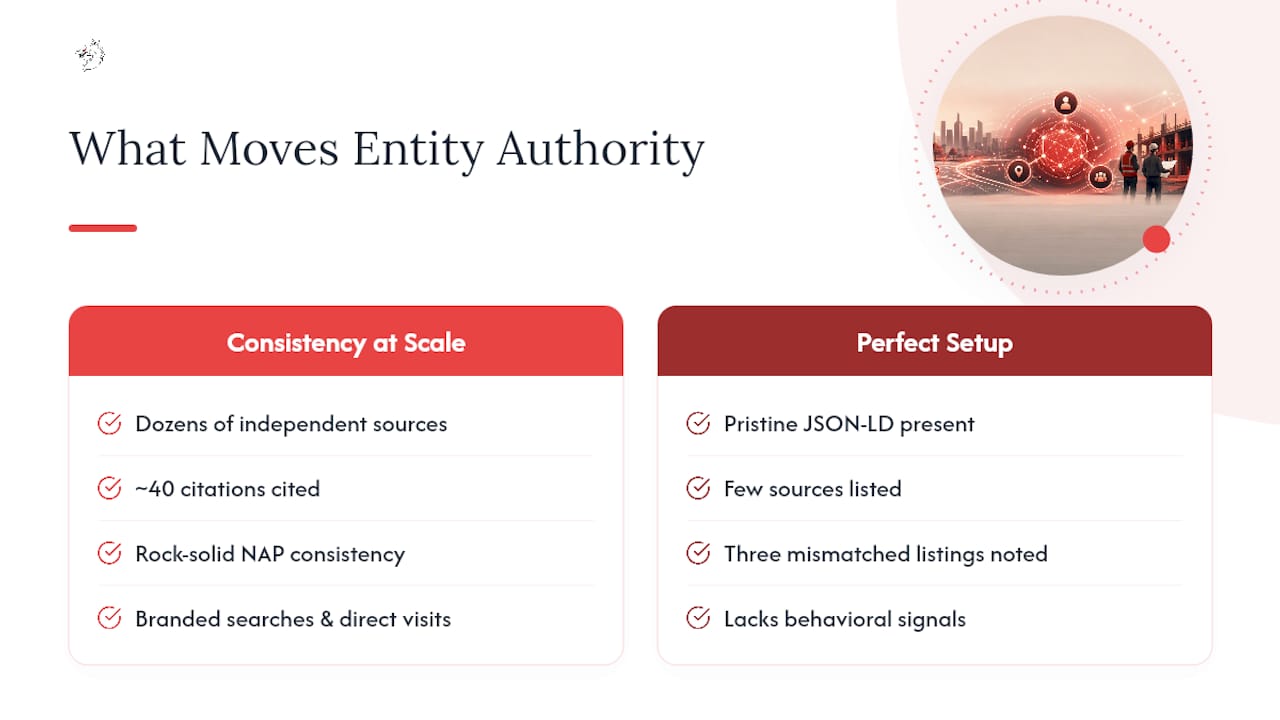
Entity authority accumulates through repetition and consistency, not through a single perfect setup. Google isn't looking for one flawless signal. It's looking for the same facts, name, address, category, services, repeated across dozens of independent sources over months. A contractor with slightly imperfect schema but rock-solid NAP consistency across 40 citations will often out-signal a competitor with pristine JSON-LD and three mismatched directory listings. Consistency at scale beats perfection in isolation.
The other underestimated piece is behavioral reinforcement. Google watches how people search for and interact with your business name, not just what your website says about itself. Branded searches, direct visits, and repeat clicks tell Google your entity is real and trusted in ways no schema markup can fake. That's why service pages and local mentions matter as much as technical fixes. They generate the exact behavioral signals that confirm what your structured data claims.
If there's one thing worth rethinking, it's the instinct to treat entity SEO as a one-time project handed off to a developer. It's closer to an ongoing operational discipline, the same way you'd treat license renewals or insurance audits. The businesses winning AI citations right now aren't the ones with the fanciest schema. They're the ones who never let their name, address, and category drift out of sync anywhere on the web.
— Damian
Get Your Entity SEO Handled Without the Guesswork
Doing entity SEO right takes ongoing attention: schema updates, citation monitoring, service-page builds, and a governance process most contractors don't have time to run alongside actual jobs. Vaultio built its AI SEO service specifically for home service contractors who need entity clarity handled correctly the first time, not patched together from tutorials between service calls.
Some AI-powered marketing services combine entity-focused SEO with lead response that engages inquiries quickly, the difference between capturing a call and losing it to a competitor who answers faster. Contractors working with Vaultio's done-for-you local SEO and lead systems see a steady flow of 10 to 15 extra booked jobs every month, backed by a 30-day money-back guarantee if the results don't show up. Request an entity and schema audit through Vaultio's DFY services page and find out exactly where your business is losing eligibility before your next competitor does.
Sources
The playbook above draws on established guidance for how search engines classify and rank local entities:
- —The local SEO gatekeeper: How Google defines your entity
- —Entity SEO: How to Build Digital Brand Visibility in AI Search
- —What is local SEO?
- —Schema
FAQ
What Is an Entity in SEO?
An entity is a distinct, identifiable thing, a business, person, place, or concept, that search engines and AI systems can map to specific attributes and relationships. In local SEO, your business, its location, and its category together form the entity Google tries to classify before it ranks you for anything.
What Does Local SEO Mean?
Local SEO is the practice of optimizing a business's online presence to appear in geographically relevant search results, primarily through Google Business Profile, local citations, and location-specific content. It has evolved beyond keyword targeting into entity-based signals like schema markup and NAP consistency that help Google confirm exactly what your business is and where it operates.
How Much Should I Pay for Local SEO?
Pricing varies widely depending on whether you're buying software tools or a fully managed service. Vaultio's SaaS tools for DIY local SEO work start from $49 per month, while its done-for-you local SEO and lead generation services run $4500 per month for the Growth plan.
Can I Do Local SEO Myself?
Yes. A business owner can verify their Google Business Profile, add basic LocalBusiness schema, and fix NAP inconsistencies without outside help, and those three moves alone meaningfully improve entity clarity. The tradeoff is time and ongoing monitoring, since entity authority requires consistent upkeep across citations, schema, and service pages rather than a one-time setup.
Recommended
Ready to Implement This?
We'll build your complete lead generation system in 72 hours. No contracts. 30-day money-back guarantee.