Citations for Contractors: The 2026 Local SEO Playbook

# Citations for Contractors: The 2026 Local SEO Playbook
Yes, citations for contractors still move the needle in 2026, but not the way most contractors think. Your first move: pick one exact business name, address, and phone format and lock it in everywhere, starting with your Google Business Profile. From there, the work is prioritization: a core list of universal listings, a handful of trade-specific ones, and a cleanup process that keeps them honest every quarter.
*
TL;DR: - Claim and verify your Google Business Profile and top universal directories like Bing Places and Yelp before focusing on trade-specific listings. - Inconsistent NAP formatting, duplicate profiles, and low-quality directories diminish trust signals and can quietly reduce map-pack visibility. - Prioritize high-authority directories over many low-quality ones, aiming for around 25 universal listings plus 5 to 10 trade-specific directories. - Conduct quarterly audits to correct duplicates and inconsistencies, especially after business changes, to maintain trust and ranking. - Use a combined approach of manual claiming and automation tools like BrightLocal or Moz Local for efficient citation management and ongoing monitoring.
*
Table of Contents
- —What Are Local SEO Citations for Contractors?
- —Do Citations Actually Affect Your Local Rankings?
- —The Citation Mistakes That Quietly Cost Contractors Jobs
- —Which Citation Sites Should Contractors Claim First?
- —Which Trade-Specific Directories Matter Most?
- —Three Ways to Build Citations Without Wasting a Weekend
- —What Do Citation Tools Actually Cost?
- —How to Run a Citation Cleanup Audit
- —Quarterly Citation Maintenance Checklist
- —Your 30/90/180-Day Citation Action Plan
- —Why Most Contractors Get Citations Half Right
- —Get Your Citations Fixed and Turn Visibility Into Booked Jobs
- —Sources
What Are Local SEO Citations for Contractors?
A citation is any online listing of your business name, address, and phone number, often shortened to NAP. Add your website URL and it becomes NAPW. Every directory, map service, and business database that publishes those four details is a citation, whether you asked for it or not.
Citations split into two categories. Structured citations live on directories and map platforms where you control the listing: Google Business Profile, Yelp, Bing Places, industry directories. Unstructured citations show up in press mentions, blog posts, supplier pages, or news articles that reference your business without giving you an edit button.
Structured citations are where contractors should spend their time first. You can claim them, verify them, and fix errors directly. Unstructured citations carry real weight too, especially when a distributor or trade publication links back to you, but you can't submit a form to get one. Ahrefs notes that structured citations are the easier lever to control, while unstructured mentions are worth pursuing only after your core directory presence is solid. Chasing press mentions before your Yelp and BBB profiles are even claimed is backward.
Do Citations Actually Affect Your Local Rankings?
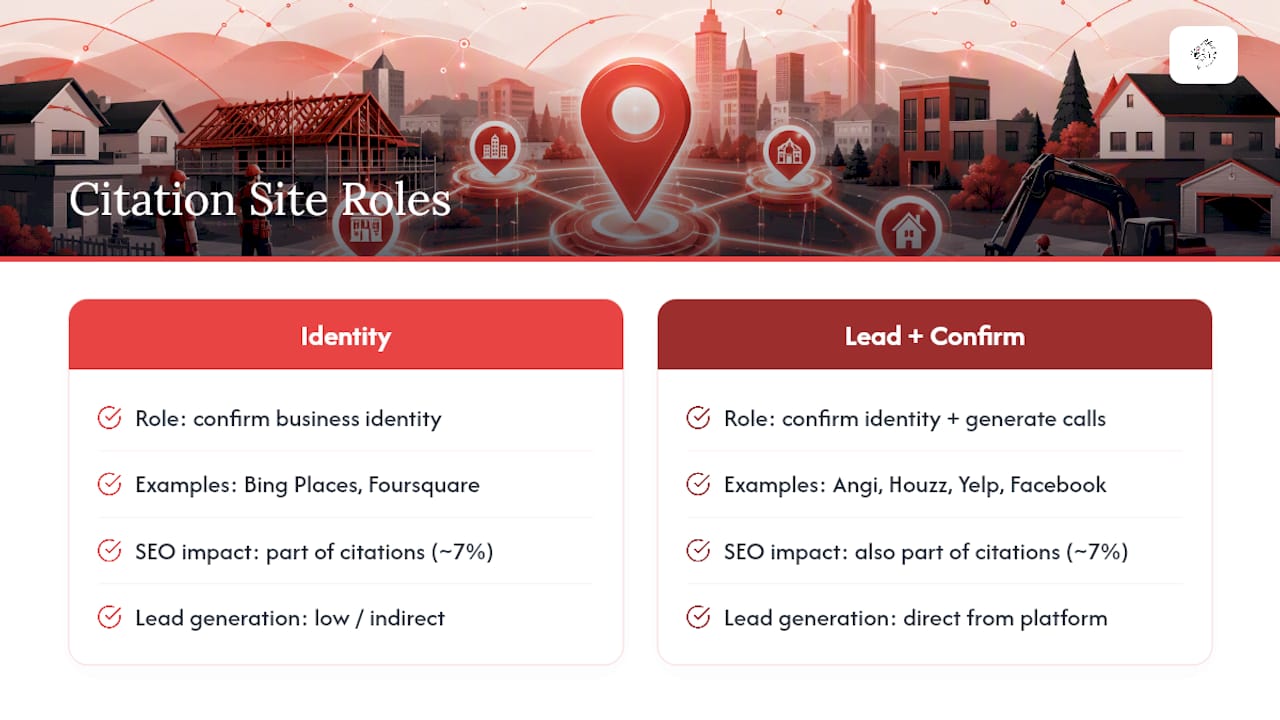
Citations carry a modest direct weight, but their real job is confirmation, not persuasion. Direct citation signals account for roughly 7% of local pack ranking weight, while Google Business Profile signals carry closer to 32%. Citations exist to back up what your GBP already claims.
That's the part contractors miss. When your NAP matches across 25 sites, Google reads that as a consistency check that confirms your GBP is legitimate. When your phone number on Yelp doesn't match the one on your website, that mismatch chips away at trust signals and can quietly suppress your map-pack visibility.

Not every listing does the same job. Some, like Bing Places or Foursquare, exist mostly to confirm identity. Others, like Angi, Houzz, Yelp, and Facebook, confirm identity and generate calls directly from homeowners browsing those platforms. Treat the second group as lead channels first, citations second.
The Citation Mistakes That Quietly Cost Contractors Jobs
Three mistakes show up on almost every contractor's citation profile, and each one is fixable in an afternoon.
Inconsistent NAP formatting. "123 Main St" and "123 Main Street" look identical to a homeowner and different to Google's matching algorithms. Pick one exact format, including suite numbers and abbreviations, and use it everywhere without variation.
Duplicate listings. Multiple GBP entries for the same business, often created after a rebrand, a phone number change, or a franchise transfer, are one of the most common reasons Google suppresses a listing from the map pack. Search your own business name and address to see if a ghost listing is competing with your real one.

Chasing volume over authority. Submitting to 200 low-authority directories doesn't outrank a contractor with 30 clean, high-authority listings. Prioritize the sources with real domain authority before padding your count with sites nobody visits.
Which Citation Sites Should Contractors Claim First?
Start with universal platforms every local business needs, regardless of trade. This is the list that matters most, and it's worth claiming in roughly this order:
- —Google Business Profile — the foundation everything else confirms
- —Bing Places — Microsoft's equivalent, still relevant for search share
- —Apple Business Connect — powers Apple Maps and Siri results
- —Yelp — trust signal and lead generator for home services
- —Better Business Bureau (BBB) — credibility signal homeowners actively check
- —Angi — lead generator, especially for repair and emergency work
- —HomeAdvisor — lead generator with project-matching for contractors
- —Houzz — strong for remodeling, design build, and renovation trades
- —Facebook Business — trust and lead channel, especially for reviews
- —Nextdoor — hyperlocal trust signal homeowners trust for referrals
- —Yellow Pages (YP.com) — legacy directory still crawled and indexed
- —Foursquare — feeds location data to other apps and services
- —MapQuest — smaller footprint but still a live data source
- —Chamber of Commerce (local) — credibility plus a backlink from a trusted domain
- —Manta
- —Thumbtack
- —Porch
- —Buildzoom
- —Superpages
- —Local.com
- —Hotfrog
- —Brownbook
- —EZlocal
- —Cylex
- —CitySquares
Some of these exist purely to confirm your identity to search engines. Others, Yelp, Angi, HomeAdvisor, Houzz, and Facebook specifically, double as lead-generation channels where homeowners actively search for contractors to hire. Treat those five as priority claims even if you deprioritize the rest of the list temporarily.
The pragmatic stop point is 25 universal listings plus 5 to 10 trade-specific directories. Beyond that combined range, the marginal ranking lift drops close to zero. If you've claimed all 25 here and your trade-specific list, you've covered the vast majority of what citations can do for you.
Which Trade-Specific Directories Matter Most?
Generic directories tell Google you're a business. Trade-specific directories tell Google, and homeowners, exactly what kind of business you are. That specificity carries weight a generic listing never will.
For HVAC contractors, claim the ACCA (Air Conditioning Contractors of America) member directory if you're a member, plus manufacturer dealer locators from Carrier, Trane, or Lennox if you're an authorized dealer.
For plumbers, the PHCC (Plumbing-Heating-Cooling Contractors Association) directory and your state plumbing board's public contractor registry both carry weight, since state boards are government sources Google treats as highly authoritative.
For roofers, the NRCA (National Roofing Contractors Association) directory and manufacturer-certified installer pages from GAF or Owens Corning function as both a citation and a trust badge homeowners recognize on sight.
For electricians, NABCEP certification directories (if you hold solar or related certifications) and manufacturer distributor locators serve the same dual purpose.
For general contractors, platforms like BuildZoom aggregate license data and project history, which gives you a citation tied directly to verified licensing.
A quick way to find the right trade lists for your specialty: search "[your trade] + certified contractor directory" and check whether your state licensing board publishes a public searchable registry, since most do. Five well-chosen trade directories tied to real certifications or licenses often move your topical relevance more than 30 generic ones ever will, because they tell Google exactly what you're qualified to do.
Prioritize trade lists over padding out with more generic directories once your core universal listings are claimed. That's where the second wave of effort should go, not into additional low-authority general directories beyond the main set.
Three Ways to Build Citations Without Wasting a Weekend
You've got three real paths here, and each fits a different budget and time commitment.
- 1.Quick wins. Claim Google Business Profile first, then work through the top 10 universal listings by hand. This alone covers the highest-signal, highest-lead-volume platforms and takes a few hours.
- 2.Manual submission. Lock in your canonical NAP format in a spreadsheet, prepare your logo, photos, and business description once, then submit to each remaining directory on your list, recording the live URL for every listing you claim.
- 3.Outsource or use a tool. Services and platforms like BrightLocal, Whitespark, and Moz Local automate submission and monitoring, which makes sense once you're managing citations across multiple locations or don't have the hours to do it manually.
Pro Tip: Getting listed with data aggregators like Data Axle, Localeze, or Foursquare's data feed pushes your NAP out to dozens of smaller directories automatically, which cuts down the manual submission list significantly.
Most single-location contractors do best combining option one and two: claim the highest-value sites yourself, then decide whether the remaining trade directories are worth outsourcing.
What Do Citation Tools Actually Cost?
Budgeting for citations comes down to whether you're paying for a one-time build or ongoing maintenance, and the tools split cleanly along that line.
For auditing your existing listings, the Whitespark Local Citation Finder runs roughly $25 to $100 per month depending on the plan, and it's built specifically to surface duplicates and inconsistencies across your existing footprint.
For building new listings, BrightLocal's citation builder charges around $4 to $5 per citation submitted, which is worth it if you'd rather pay per listing than spend the hours yourself.
For ongoing sync, Moz Local runs about $14 to $33 per month and keeps your NAP consistent across its network automatically, correcting drift before it becomes a ranking problem.
- —Audit: Whitespark, $25 to $100 per month
- —One-time build: BrightLocal, roughly $4 to $5 per citation
- —Ongoing maintenance: Moz Local, $14 to $33 per month
For a single-location contractor, a realistic first-year budget looks like one audit cycle, one build pass through your top 25 to 35 listings, and then a maintenance subscription or a quarterly manual check from there. One-time builds make sense if your listings are already mostly accurate. Subscriptions make more sense if you've moved, rebranded, or changed phone numbers in the past two years.
How to Run a Citation Cleanup Audit
A cleanup audit follows the same five steps whether you run it yourself or hand it to an agency.
- 1.Run the audit. Use Whitespark, BrightLocal, or Moz Local to pull every existing listing tied to your business name, address, and phone number.
- 2.Flag duplicates and inconsistencies. Look for old addresses, outdated phone numbers, or a second GBP listing competing with your primary one.
- 3.Claim, merge, or remove. Claim listings you don't control yet, merge duplicate GBP entries through Google's dispute process, and request removal of listings tied to a business you've closed or rebranded.
- 4.Document proof. Screenshot each corrected listing and log the live URL, since you'll need this record if a directory reverts your edit later.
- 5.Re-submit to aggregators if needed. If duplicates trace back to a data aggregator feed, correct the source record so the error doesn't repopulate across dozens of smaller sites.
Expect the first pass to take 20 to 30 hours for a single-location contractor, mostly because tracking down old duplicates takes longer than fixing them. After that, quarterly maintenance drops to 2 to 3 hours. Success looks like a Google search of your business name turning up one consistent listing per platform, with no competing duplicates in the results.
Quarterly Citation Maintenance Checklist
Citations drift. Phone numbers change, addresses get typo'd during a re-submission, and directories occasionally revert an edit on their own schedule. A quarterly check catches this before it costs you map-pack visibility.
Every quarter, spend time verifying your core universal listings and your trade-specific directories still show the correct NAP. A simple spreadsheet with each listing's URL and last-checked date works fine, no dedicated tool required, though tools like BrightLocal or Moz Local can automate the alerts if you'd rather not check manually.
Set one trigger rule: if you change your business address, phone number, or the call tracking number (CTN) displayed on your website, update your canonical NAP source first, then push that change across every listing within the same week. Waiting even a month creates the exact inconsistency that erodes GBP trust.
Your 30/90/180-Day Citation Action Plan
Here's the sequence that gets you from scattered listings to a clean, trust-confirming citation profile.
- —First 30 days: Lock your canonical NAP format, claim and verify your Google Business Profile, claim the top 10 universal listings, and run a baseline audit.
- —By 90 days: Fix flagged duplicates, claim your trade-specific directories, and set up monitoring, whether that's a spreadsheet or a tool like Moz Local.
- —By 180 days: Run a full audit against your original baseline, measure whether lead volume shifted, and adjust which listings get quarterly attention.
Why Most Contractors Get Citations Half Right
Most contractor citation advice stops at "get listed everywhere," which is exactly the wrong instinct. The contractors who actually see ranking movement are the ones who treat citations as a trust-confirmation layer underneath their Google Business Profile, not a standalone ranking hack. Get the top 25 clean, add your trade directories, and stop there. The fortieth low-authority directory listing isn't doing anything for you.
What convinces me citations still deserve real attention in 2026 isn't the direct ranking weight, it's how often a suppressed map-pack listing traces straight back to a duplicate GBP entry or a mismatched phone number nobody noticed for eight months. That's a fixable problem, not a strategy problem, and it's why we treat citation hygiene as step one before any lead-generation work begins. Vaultio's contractor clients who clean this up alongside Maps optimization and AI-powered lead response typically see 10 to 15 extra booked jobs a month, backed by a 30-day money-back guarantee.
— Damian
Get Your Citations Fixed and Turn Visibility Into Booked Jobs
Cleaning up your own citations gets you partway there, but consistency across 25-plus listings, ongoing monitoring, and turning that visibility into actual phone calls is a full-time job on top of running your business. Vaultio handles the whole stack: citation cleanup, Google Business Profile optimization, and AI-powered lead response that engages every new inquiry within seconds so you're not losing jobs to whichever competitor calls back first.
If you're a home service contractor in California looking to fix your listings and start converting that traffic into booked jobs, Vaultio's Santa Barbara marketing services cover exactly this, citation management, Maps optimization, and lead response, as one done-for-you package backed by a 30-day money-back guarantee. Request a free citation audit and see exactly what's inconsistent, duplicated, or missing before you commit to anything.
Sources
- —Local SEO Citations for Contractors in 2026 - PipelineOn
- —What Is A Local Citation? How They Help SEO | Ahrefs
- —Citation Building for Contractors & Builders
Recommended
Ready to Implement This?
We'll build your complete lead generation system in 72 hours. No contracts. 30-day money-back guarantee.