Contractors: Speed to Lead: Cut Response From Two Days to 5 Minutes
# Contractors: Speed to Lead: Cut Response From Two Days to 5 Minutes
Speed to lead measures the time between a lead entering your system and your team making first substantive contact. The target: under 5 minutes for high-intent leads, under 1 hour as your first milestone if you're currently averaging hours. Leads contacted within 5 minutes convert at roughly 21%, and most contractors never get close. That gap is where deals disappear.
*
TL;DR: - Most delays in response times occur during lead processing, not in individual sales reps, making automation and routing fixes essential. - Responding within five minutes can increase conversion rates to around 21%, whereas waiting over 30 minutes drops conversions to 1-2 percent. - Current median response times are around 42 to 47 hours, so setting tiered targets like under 24 hours or under one hour is a more realistic starting point. - Automating immediate acknowledgment and using AI tools like chatbots and lead scoring can significantly improve response speed and booking rates. - Continuous measurement of response times and accountability, such as dashboards and SLA tracking, are crucial to maintaining speed improvements over time.
*
Table of Contents
- —What Speed to Lead Actually Measures
- —Why Speed to Lead Determines Whether You Win the Job
- —Benchmarks and Realistic Targets by Stage
- —The 30/60/90-Day Speed-to-Lead Playbook
- —Measuring and Governing Your Response Time Over Time
- —How Vaultio Builds Speed to Lead Into a Contractor's System
- —What Contractors Get Wrong About Speed to Lead
- —Get Vaultio's Speed-to-Lead System Working for Your Business
- —Sources
What Speed to Lead Actually Measures
Speed to lead sounds simple. It isn't measured simply, and that's why so many teams get the number wrong.
The clock starts the moment a lead is created, whether that's a form submission, a phone call, a chat message, or a Google Local Service Ad request. It stops at first substantive contact. Not an auto-reply. Not a "thanks, we got your message" text. First substantive contact means a real conversation started: a call answered, a text replied to by a human or a capable AI agent, a booking confirmed.
Auto-generated acknowledgments don't count, and teams that count them are lying to themselves about performance. An instant "we'll be in touch" email feels responsive. It does nothing for the homeowner sitting on their couch trying to decide between three plumbers.
Two clocks matter, not one:
- —Processing time — the gap between lead creation and the moment a rep or system actually gets assigned to it. This is almost always a routing or software problem.
- —Rep response time — the gap between assignment and actual contact. This is a people and workflow problem.
Separating these two numbers matters because they get fixed differently. A LeanData analysis of speed-to-lead bottlenecks found that most delay sits in processing, not in reps dragging their feet. If you only track total time, you'll blame your sales team for a routing failure that has nothing to do with them.
There's a third measurement trap: relying on the average. Mean response time gets skewed badly by outliers, like the lead that sat untouched over a weekend for 40 hours. Track the median instead, and track the 90th percentile (P90). The median tells you what a typical lead experiences. The P90 tells you how bad your worst cases get, and those worst cases are usually where your churned leads live.
Capture four timestamps for every lead: creation, assignment, first contact attempt, and first successful contact. With those four data points, you can diagnose exactly where the delay lives instead of guessing.
Why Speed to Lead Determines Whether You Win the Job
Home service buyers rarely wait around. They fill out three or four contractor forms in the same ten minutes, then book with whoever answers first.
The research backs this up hard. Leads contacted within 5 minutes convert at roughly 21%, compared to about 1 to 2% after 30 minutes. That's not a marginal edge. That's the difference between a business that fills its calendar and one that wonders where all its ad spend went. First responders also tend to win the majority of the deal when multiple contractors are competing for the same job, because most homeowners stop shopping once someone picks up the phone and sounds competent.
By the numbers: Leads contacted within 5 minutes convert at roughly 21%. Leads contacted after 30 minutes convert at roughly 1 to 2%. That's a 20x conversion swing tied entirely to response time, not to price, pitch, or product.
Run the math on a mid-size contractor generating 100 leads a week, leveraging contractor-focused technology to streamline response and improve results. Even accounting for lead quality variance, that's not a small improvement. At an average ticket of $400 for a service call, moving from 2 closed jobs to 12 closed jobs off the same lead volume is an extra $4,000 a week without spending another dollar on ads.
That math is why speed to lead deserves the same budget attention as your ad spend. You can pour more money into Local Service Ads and paid search, but if the leads those campaigns generate sit unanswered for two hours, you're funding your competitor's calendar.
Not every lead deserves the same urgency, and treating them all equally wastes your fastest-response capacity on the wrong inquiries. Prioritize based on intent:
- —Demo or quote requests — highest intent, sub-5-minute target, no exceptions.
- —Pricing page form fills — high intent, someone actively comparing costs right now.
- —Callback requests — the lead already told you they want to talk; treat this like a live phone call waiting to happen.
- —General contact form fills — real interest, but often earlier in the decision process; under-1-hour is a reasonable near-term target.
The mistake most contractors make is spreading urgency evenly across all four categories instead of stacking their fastest resources against the top two.
Benchmarks and Realistic Targets by Stage
Most companies do not meet the 5-minute response standard, which is a challenging benchmark to reach.
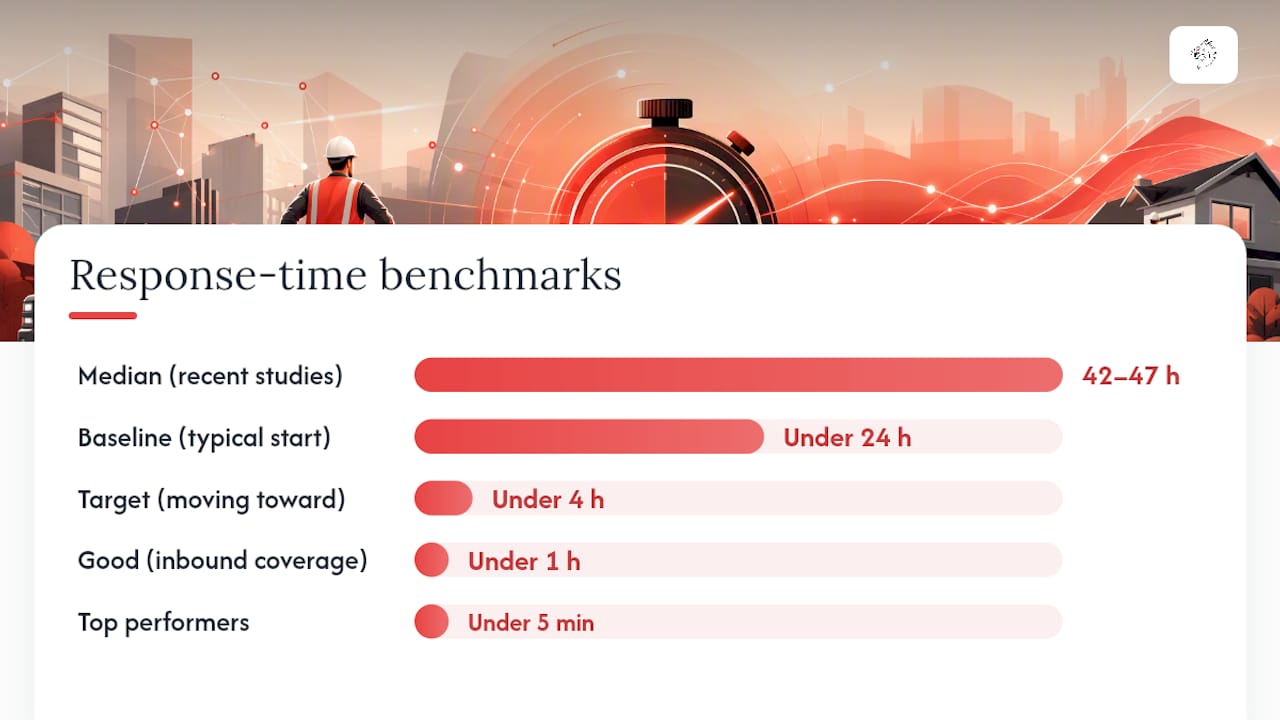
Optifai's 2026 benchmark research puts the median lead response time at 42 to 47 hours across multiple samples. That's not a typo. Nearly two full days pass, on average, before a typical lead hears back from the business it contacted. Meanwhile, some studies find that a large share of companies never respond to a lead at all, which means the no-response rate is often a bigger conversion killer than raw speed.
Benchmark snapshot: Median lead response time sits around 42 to 47 hours across recent studies, while top performers respond in under 5 minutes. The gap between those two numbers is where most of your competitors are losing jobs they should be winning.
Because that gap is so wide, chasing sub-5-minute perfection on day one is the wrong first move for a team currently averaging two days. Set tiered targets instead:
- —Baseline (where most contractors start): Under 24 hours, moving toward under 4 hours. This alone beats a large share of the market.
- —Good: Under 1 hour on all inbound leads, sub-5-minutes on demo, pricing, and callback requests.
- —Best-in-class: Sub-5-minute response on every lead source, with SMS or call fallback triggered automatically if the first attempt goes unanswered.
Industry and source matter here. A roofer fielding storm-damage leads after a hailstorm needs faster coverage than a landscaper handling seasonal quote requests, simply because storm-damage homeowners are calling five contractors in the same hour. Leads from Local Service Ads and Google Business Profile calls tend to carry higher urgency than leads from a blog contact form, and your response tiers should reflect that difference rather than treating every channel identically.
The 30/60/90-Day Speed-to-Lead Playbook
Fixing speed to lead is not a single project. It's a sequence, and the order matters more than most teams realize. Fix routing before you coach reps. Fix coverage gaps before you chase seconds.
Step 1: Run the audit first
Before changing anything, measure what's actually happening. Pull timestamps for every lead over the last 30 days, broken out by source: Google Local Service Ads, website form, phone call, chat. Calculate processing time and rep response time separately for each source. You cannot fix a problem you haven't located, and most teams assume the bottleneck is reps when it's actually a lead sitting unassigned in a shared inbox for six hours.
Step 2: Immediate wins, days 0 through 30
These require little to no new technology spend and should be live within a month.
- 1.Turn on instant auto-acknowledgment with a booking link. This isn't your final response, but it buys time and shows the lead someone's paying attention.
- 2.Set up single-rule round-robin assignment so no lead sits in a shared inbox waiting for someone to notice it. Companies without lead routing average more than 13 hours to first contact, roughly double the time of companies with routing in place.
- 3.Build a fallback escalation rule. If the assigned rep hasn't responded in 15 minutes, the lead automatically reroutes to the next available person.
- 4.Push mobile alerts, not email alerts, for new leads. Email gets buried. A phone buzzing gets answered.
- 5.Write a first-touch script so whoever picks up the lead sounds prepared, not scrambling, in the first ten seconds of the call.
Pro Tip: Test your own lead form on a Saturday at 7 p.m. If nobody calls you back within an hour, that's exactly the experience your actual leads are having right now, minus the fact that you're not shopping three competitors at the same time.
Step 3: Technology moves, days 30 through 60
Once the immediate fixes are live, layer in tools that close the remaining gaps automatically.
6. Add real-time lead enrichment so reps see job type, location, and urgency signals the moment a lead lands, cutting the research time out of the response window. 7. Automate routing based on lead score, not just availability, so your highest-value leads reach your best closers first. 8. Build SMS fallback for missed calls. If a call goes unanswered, an automatic text should go out within seconds, because combining instant calls with SMS fallback is one of the clearest patterns among top-performing teams. 9. Fix your caller ID branding. An unrecognized number gets ignored. A branded business name showing up on a homeowner's phone gets answered. 10. Deploy AI intake or a chatbot for after-hours coverage. A huge share of home service leads come in outside 9-to-5, and a chatbot that qualifies and books while your team sleeps closes the biggest coverage gap most contractors have. Read more on how AI handles inbound leads for contractors.
Step 4: Process and people, days 30 through 90
Speed fixes stall if nobody's accountable for keeping them running.
11. Set tiered SLAs by lead source and intent, matching the priority framework from the benchmarks section above. 12. Build coverage rotations so nights, weekends, and holidays have a named owner instead of a hope that someone checks their phone. 13. Reward speed and quality together, never speed alone, or reps will rush calls just to log a fast response time without booking the job. 14. Publish rep-level dashboards weekly so response time becomes a visible, normal part of performance conversation instead of an occasional audit.
Multi-channel cadence matters here too. A single missed call shouldn't end the attempt sequence; layering email automation behind your call and text attempts catches leads who prefer written follow-up, and consistent follow-up sequencing recovers leads that didn't convert on the first touch.
Quality and compliance can't get skipped in the rush to go faster. SMS outreach requires documented consent under TCPA rules. Call attempts need to respect do-not-call registries. And no matter how good your AI intake system gets, high-complexity or high-dollar leads still need a fast, clean handoff to a human who can answer nuanced questions. Speed without a competent human backstop just gets you a fast, wrong answer.
Measuring and Governing Your Response Time Over Time
Speed-to-lead improvements decay without governance. Teams fix routing, celebrate the win, and six months later the same delays creep back in because nobody's watching the numbers.
Track a small set of KPIs weekly, not quarterly:
- —Median lead response time and P90 by source
- —Percent of leads responded to within SLA, broken out by lead type
- —Contact rate (percent of leads you actually reach)
- —Qualified conversation rate (percent of contacted leads that turn into a real sales conversation)
- —Revenue per lead by source
| Metric | What it reveals | Review cadence |
|---|---|---|
| Median response time | Typical lead experience | Weekly |
| P90 response time | Worst-case delays hiding in the tail | Weekly |
| Percent within SLA by source | Where routing or coverage is failing | Weekly |
| Contact rate | Whether outreach attempts are actually connecting | Biweekly |
| Revenue per lead | Whether speed gains are translating to closed jobs | Monthly |
Instrumentation is the unglamorous part nobody wants to build, but it's what makes the rest of this workable. Log the four timestamps mentioned earlier for every single lead, and calculate processing time and rep response time as separate fields, not a single blended number. Measuring median and P90 rather than mean is what actually reveals whether a subset of your leads is quietly rotting for hours while your average looks fine.
Governance means someone owns the alert when SLA gets breached, and a weekly review catches root causes before they become habits. If Tuesday afternoon leads keep missing SLA, that's a coverage gap, not a coincidence. Build a simple root-cause playbook: routing failure, coverage gap, or rep performance, and route the fix to whichever bucket the data points to.
How Vaultio Builds Speed to Lead Into a Contractor's System
Most contractors don't have a marketing problem. They have a response problem hiding behind a marketing problem, and Vaultio was built around closing that gap end to end.
Vaultio's AI Receptionist answers every call, day or night, so no lead ever sits in a voicemail queue waiting for someone to check messages Monday morning. Behind that, AI lead scoring flags which inbound leads are highest intent so your team's attention lands on the leads worth chasing first. The AI Chatbot & scheduling system engages website visitors the moment they land on a page and books the appointment directly, collapsing the gap between "interested" and "on the calendar" to seconds instead of hours. Local SEO work drives the higher-intent traffic in the first place, which means the leads hitting this fast-response system are already closer to ready to buy.
Contractors report extra booked jobs per month using a fast-response lead system, sometimes backed by a money-back guarantee.
Here's how each playbook step maps to what Vaultio builds and maintains for you, versus what stays on your plate:
- —Instant response: Vaultio's AI Receptionist and chatbot handle first contact around the clock.
- —Lead prioritization: AI scoring ranks leads automatically; you still decide which rep handles top-tier leads.
- —SEO-driven intent capture: Vaultio's local SEO work brings in higher-intent traffic; you still fulfill the jobs.
- —Data hygiene: Vaultio configures the systems; your team still needs to keep contact info and job details accurate.
- —SLA ownership: Vaultio provides the speed; you still own the follow-through once a job is booked.
What Contractors Get Wrong About Speed to Lead
The most common mistake isn't slowness. It's overengineering routing rules before the basics work. Teams build five-layer assignment logic while leads sit unassigned because the trigger never fires correctly. Fix the simple round-robin first.
The second mistake: counting an autoresponder as a response. It isn't. It buys you goodwill for maybe fifteen minutes, not a conversion.
Fix the leads you're dropping entirely before optimizing the ones you're already answering.
My advice for teams starting from scratch: pick one high-intent lead source, prove you can hit under 1 hour consistently for 30 days, then reinvest the win into automating toward sub-5-minutes. Trying to fix everything at once is how most speed-to-lead initiatives quietly die by month two.
— Damian
Get Vaultio's Speed-to-Lead System Working for Your Business
This system is an alternative to hiring a full-time dispatcher or assembling separate call answering, chatbot, and SEO services, designed to help contractors answer leads quickly.
The core stack includes the AI Receptionist for round-the-clock call answering, the AI Chatbot & scheduling tool for instant website engagement and booking, and location-specific SEO like Santa Barbara SEO or San Luis Obispo SEO to drive the high-intent traffic these fast-response systems are built to capture. Every engagement comes with a 30-day money-back guarantee, so you can measure the difference in booked jobs before deciding it's working.
If you're ready to see what a real speed-to-lead system looks like for your business, start with the AI Receptionist and get a walkthrough of how it slots into your current setup.
Sources
The conversion figures cited above come from EmailAnalytics' lead response time research, which substantiates the 5-minute conversion advantage. The 42 to 47 hour median benchmark comes from Optifai's 2026 benchmark study. Routing and processing-time diagnosis draws on LeanData's operational analysis, multichannel tactics from Aloware's 2026 benchmark report, and measurement methodology from Perspective AI's 2026 breakdown.
- —Lead response time — EmailAnalytics
- —Lead Response Time Benchmarks — Optifai
- —Lead response time — LeanData blog
- —Lead response time in 2026 — Perspective AI blog
Recommended
Ready to Implement This?
Your new site live within 8 days. No contracts. Top 3 on Google in 3 months, or we work free until you are.