Roofer SEO Keywords: High-Intent List and Mapping Guide
# Roofer SEO Keywords: High-Intent List and Mapping Guide
The fastest path to booked roofing jobs starts with three keyword buckets: high-intent service terms ("roof replacement cost," "emergency roof repair"), "near me" local queries, and long-tail financing and insurance phrases. Rank for those, and your phone rings. Miss them, and a competitor answers it instead.
Here are your three quick wins for this week:
- —Download the master keyword CSV from 187 SEO Keywords for Roofers (2026 Data), filter by CPC above $8, and you have your first target list.
- —Update your Google Business Profile with your full service list, five recent photos, and a 150-word description that includes your city name plus "roofing contractor."
- —Publish one cost or insurance post targeting a phrase like "does homeowners insurance cover roof replacement" — that single page can generate first-call bookings within 60–90 days.
Assets to grab now:
- —Master keyword CSV (volumes, CPCs, difficulty scores)
- —Page-mapping worksheet (page → primary keyword → intent → CTA)
- —GBP optimization checklist (category, photos, services, review workflow)
Statista data on local business search frequency confirms that a large share of consumers search for local businesses online regularly, which is exactly why GBP and local keyword targeting are not optional for roofers.
*
Key Takeaways
Roofers who dominate local search combine high-intent service keywords, a fully optimized GBP, storm-ready landing pages, and consistent measurement to turn rankings into booked jobs.
| Point | Details |
|---|---|
| Target three keyword buckets first | High-intent service terms, "near me" local queries, and insurance/financing long-tails drive the most bookings. |
| One page, one primary keyword | Assign each keyword to a single page to prevent cannibalization and give Google a clear ranking signal. |
| GBP is your highest-leverage asset | A complete GBP with weekly posts and two-plus new reviews per week consistently outranks competitors in the local 3-pack. |
| Prebuild storm-response pages | A hailstorm can spike local repair searches 400–900%; pages built before the storm capture the surge, not after. |
| Vaultio delivers the full system | Done-for-you local SEO, LSA setup, and AI lead response combine to produce 10–15 extra booked jobs per month for roofing contractors. |
*
Table of Contents
- —What are the best roofer SEO keywords by intent?
- —How to map keywords to the right pages
- —Local SEO and Google Business Profile for roofers
- —Why long-tail and question keywords convert better
- —Seasonal and storm keywords: when to publish and when to surge
- —Tools and data sources for keyword volumes, CPCs, and difficulty
- —How to measure SEO success: rankings, leads, and booked jobs
- —A real example of keyword SEO turning into booked jobs
- —What actually wins in roofer keyword SEO
- —Vaultio turns your keyword strategy into booked jobs
- —Sources
- —FAQ
What are the best roofer SEO keywords by intent?
Not all roofing keywords convert the same way. A homeowner searching "how roofs are made" is curious. One searching "roof replacement near me" has a credit card ready.. Organizing your keyword list by intent is what separates a traffic strategy from a revenue strategy.
The 2026 roofing keyword playbook compiled 187 roofing-specific phrases with verified monthly volumes, CPCs, and difficulty scores. The sample below draws from that dataset.
High-intent service and local keywords
CPCs above $12 signal that advertisers are paying to capture these searches. That means organic rankings for the same phrases carry real dollar value.
Three long-tail keywords that feed service pages:
- —"roof replacement cost for 2,000 sq ft home" (comparison intent, low difficulty)
- —"metal roof vs shingles pros and cons" (comparison intent, blog-ready)
- —"how long does a roof replacement take" (informational, FAQ schema candidate)
Three question keywords that fuel blog and FAQ content:
- —"what does a roof inspection include?"
- —"how do I file a roof insurance claim?"
- —"what is the average cost to replace a roof?"
These question phrases often carry single-digit SEO difficulty scores, yet they pull homeowners who are one phone call away from booking. That gap between difficulty and conversion potential is the opportunity most roofers ignore.
*
How to map keywords to the right pages
One page, one primary keyword. That is the rule that prevents cannibalization and tells Google exactly what each page is about. When two pages target the same phrase, they compete against each other, and neither ranks well.
The mapping workflow
- 1.List every page on your site (homepage, each service page, each location page, blog posts).
- 2.Assign one primary keyword to each page based on intent match: transactional keywords go to service and location pages; informational keywords go to blog posts.
- 3.Add two to four supporting keywords per page — related phrases that reinforce the primary topic without duplicating it.
- 4.Define the CTA for each page (call now, get a free estimate, schedule inspection).
- 5.Check for overlap — if two pages share a primary keyword, merge them or differentiate by geography or service type.
Micro-worksheet example
| Page | Primary Keyword | Supporting Keywords | Intent | CTA |
|---|---|---|---|---|
| Roof Replacement Service | roof replacement near me | roof replacement cost, new roof installation | Transactional | Get a free estimate |
| Storm Damage Page | hail damage roof repair | storm roof repair, insurance roof claim | Transactional | Call now |
| Location: Austin, TX | roofing contractor Austin TX | Austin roof repair, Austin roofer | Local | Schedule inspection |
| Blog: Insurance Guide | does insurance cover roof replacement | roof insurance claim process, storm damage claim | Informational | Download checklist |
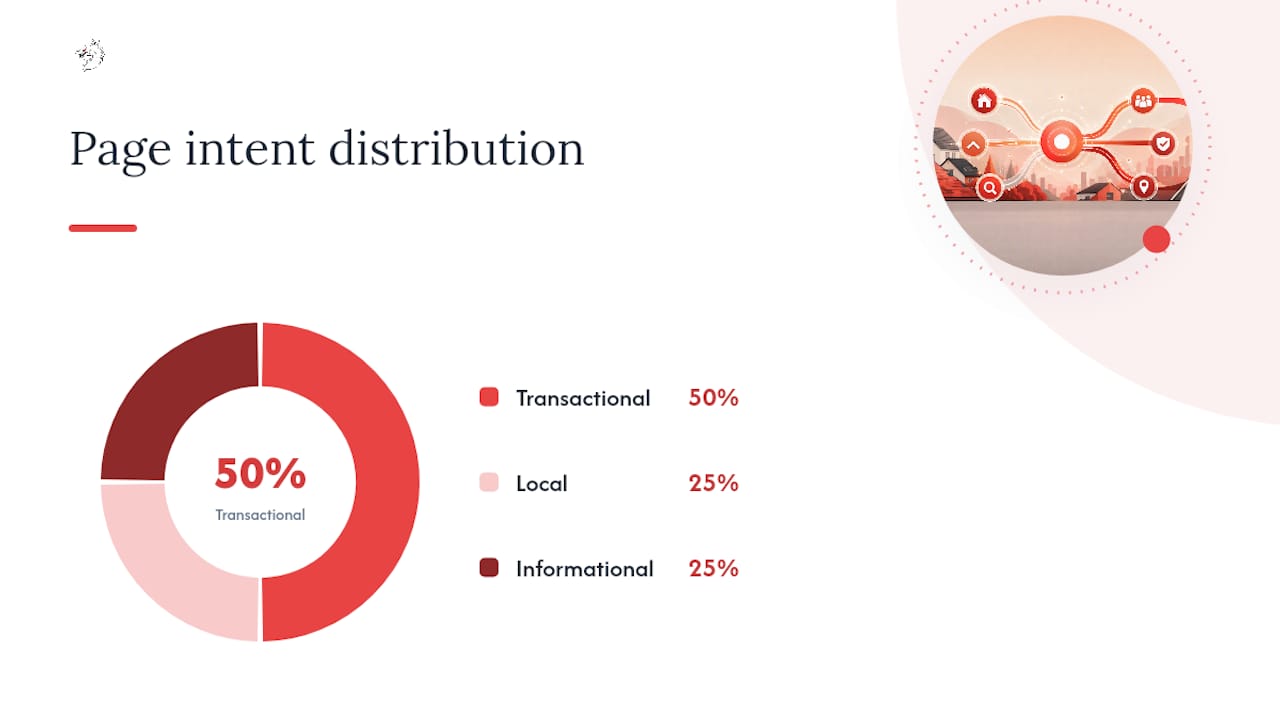
Matching page content to search intent is one of the most consistent ranking factors in roofing SEO. Service pages need commercial intent keywords; blogs need informational ones. Mixing them dilutes both.
On-page micro-templates
Title tag pattern (service page): `[City] Roof Replacement | Free Estimates | [Company Name]`
Meta description pattern: `Need a roof replacement in [City]? [Company Name] offers free estimates, same-day inspections, and works with all insurance carriers. Call [phone].`
H1 pattern (location page): `Roofing Contractor in [City, State] — Repairs, Replacements & Storm Damage`
Keep title tags under 60 characters. Place the primary keyword in the first 60 characters of the meta description. Never repeat the exact title tag phrase as your H1 — vary the wording so each element reinforces the page without sounding robotic.
Pro Tip: Use Google Search Console's "Queries" report to find pages already ranking on page two for a keyword. Those pages need a title tag update and one internal link from a higher-authority page — not a full rewrite.
*
Local SEO and Google Business Profile for roofers
Your GBP listing is the single highest-leverage asset in local roofing SEO. It controls whether you appear in the local 3-pack, which captures a significant share of clicks for "near me" searches. Getting it right takes about two hours of setup and 20 minutes per week to maintain.
GBP optimization checklist
- —Primary category: Set to "Roofing Contractor" — not "General Contractor" or "Home Improvement."
- —Service list: Add every service individually (roof repair, roof replacement, gutter installation, storm damage inspection, flat roof repair).
- —Service area: Define your actual coverage radius — do not claim a 100-mile radius if you only serve five cities.
- —Photos: Upload at least 10 photos (before/after jobs, crew, equipment, completed projects). GBP listings with photos receive more direction requests and website clicks.
- —Business description: Write 150–200 words using your city name, primary service keywords, and a differentiator (licensed, insured, insurance claims specialist).
- —Weekly posts: Publish one GBP post per week — a completed job photo, a seasonal tip, or a storm alert. Posts keep your listing active and signal relevance.
- —Review workflow: Ask every satisfied customer for a review within 24 hours of job completion. Respond to every review, positive or negative, within 48 hours.
"Near me" keyword placement
"Roofers near me" and "roof repair near me" are among the highest-volume local queries in the dataset. These phrases trigger the local 3-pack, not the organic blue links. To capture them, place location-modified phrases in your GBP description, your service-area page copy, and your GMB posts. You do not need to stuff "near me" into your website copy — Google infers proximity from your GBP service area and your NAP (name, address, phone) consistency across the web.
Pro Tip: Aim for at least two new Google reviews per week. Review velocity — how frequently new reviews arrive — is a stronger local ranking signal than total review count alone. A roofer with 40 reviews earned over six months often outranks one with 200 reviews earned over three years.
Local Services Ads (LSA) sit above both paid search ads and organic results. They display your review count, response rate, and Google Guarantee badge, which makes them a trust signal that standard PPC cannot replicate. Setting up LSA alongside your GBP and organic SEO creates three simultaneous visibility layers for the same local searches. For a full breakdown of LSA management for contractors, Vaultio's LSA service page covers the setup and ongoing management process.
*
Why long-tail and question keywords convert better
A homeowner who types "roofing contractor" is browsing. One who types "how much does it cost to replace a 1,500 sq ft roof with architectural shingles" is budgeting. The longer the query, the closer the buyer is to a decision. That is why local SEO for contractors consistently points to long-tail phrases as the highest-conversion content targets for home service businesses.
Four-plus word queries also tend to have lower keyword difficulty scores, which means a newer or smaller roofing site can rank for them faster than for broad head terms.
Six content formats that capture long-tail traffic
- —How-to posts: "How to file a roof insurance claim after a hailstorm" — captures insurance-cycle buyers at the research stage.
- —Cost breakdown pages: "Roof replacement cost by material type" — high commercial intent, easy to rank with a detailed table.
- —Inspection checklists: "What to expect during a roof inspection" — builds trust and positions your company as the expert before the estimate.
- —Material comparisons: "Metal roof vs. asphalt shingles: which lasts longer?" — comparison intent, strong for blog and FAQ schema.
- —Insurance guides: "Does homeowners insurance cover storm damage to a roof?" — one of the highest-converting informational topics in roofing SEO.
- —Financing options: "How to finance a roof replacement with bad credit" — captures buyers who are ready but need a path forward.
FAQ schema and AI-aware formatting
Structure each blog post with a clear question as the H2, then answer it directly in the first sentence of the paragraph below. That answer-first format is what gets roofing content cited in AI Overviews and featured snippets. This approach is increasingly called Generative Engine Optimization (GEO), and it works because AI systems pull the most direct, specific answer available.
Add FAQ schema markup to any page with a question-and-answer section. Google Search Console will show you when a page earns a rich result. For deeper guidance on AI-aware content structure, the AI SEO for contractors guide covers the formatting specifics.
*
Seasonal and storm keywords: when to publish and when to surge
Roofing demand is not flat across the year. It spikes in spring (April through May), again after summer storms, and briefly in fall before winter sets in. Missing those windows means watching competitors book the jobs you could have had.
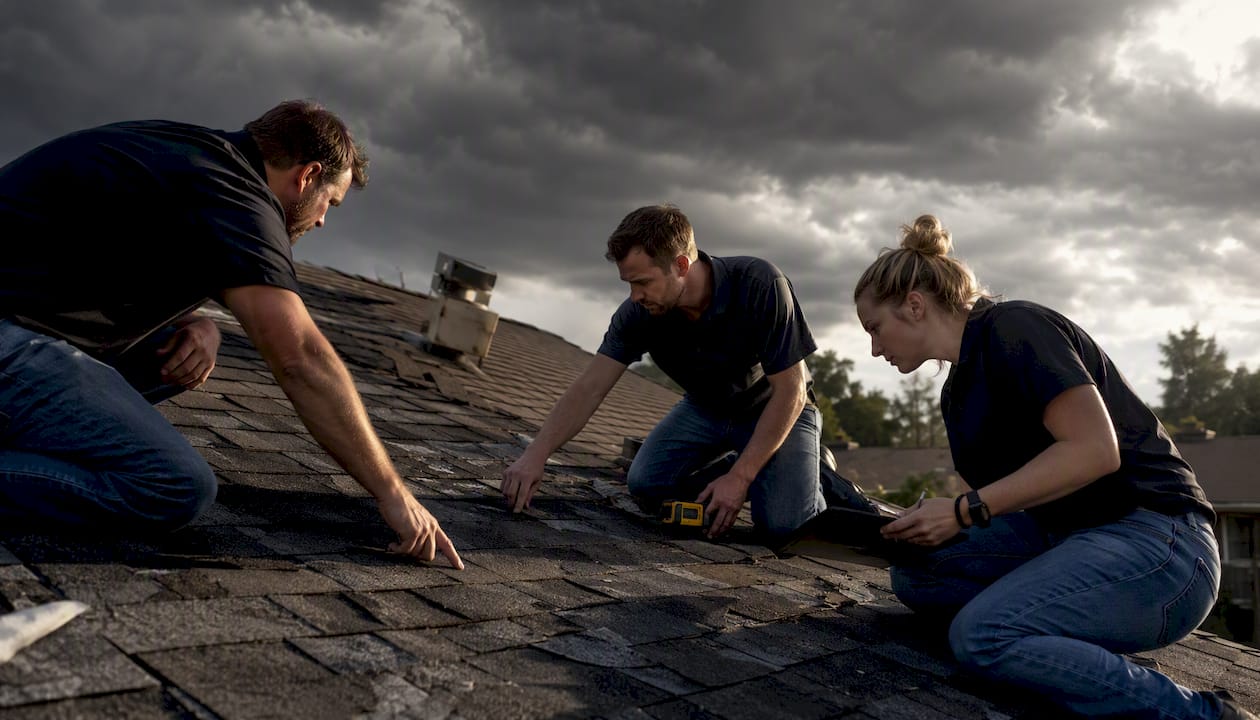
A single hailstorm can push local searches for roof repair 400–900% in affected zip codes for two to six weeks. That window closes fast. Roofers who already have a storm-response landing page live, a GBP post ready to publish, and an LSA campaign paused and waiting capture the surge. Those who scramble to build pages after the storm miss most of it.
Seasonal timing calendar
- —January–February: Publish spring content now. The 2026 keyword playbook recommends planning content 60–90 days ahead of seasonal peaks, which means spring content needs to be live by late February.
- —April–May: Peak season for roof replacement searches. Surge ad spend on replacement and inspection keywords.
- —June–August: Storm season in most markets. Activate storm-response pages and GBP posts within 24–48 hours of a major weather event.
- —September: Second spike for storm-related searches. Keep storm pages live and update them with current-season messaging.
- —October–November: Push financing and insurance content for homeowners trying to close claims before year-end.
Storm-specific keywords to prebuild pages for
- —"hail damage roof repair [city]"
- —"emergency roof tarp service"
- —"roof repair after storm [city]"
- —"insurance claim roof replacement"
- —"free roof inspection after hail"
Build these pages before storm season. When a storm hits, update the page with the storm name or date, publish a GBP post, and activate your LSA campaign. That 24–48 hour response window is where local roofers beat national aggregators every time.
*
Tools and data sources for keyword volumes, CPCs, and difficulty
Keyword research for roofers does not require a $500/month tool stack.
Tool breakdown
- —Google Keyword Planner: Free inside Google Ads. Best for volume ranges and CPC estimates. Use it to validate that a keyword has real search demand before building a page around it.
- —Google Search Console (GSC): Free. Shows you what queries your site already ranks for, which pages get impressions, and where you are losing clicks to competitors on page two. This is your most underused tool.
- —Ahrefs: Paid. Best for keyword difficulty scores, competitor gap analysis, and backlink data. Use it to find which keywords your competitors rank for that you do not.
- —SEMrush: Paid. Strong for position tracking, site audits, and local keyword research. The "Keyword Magic Tool" filters by question-type queries, which speeds up blog content planning.
- —Moz: Paid. Domain Authority scores and local SEO features. Useful for benchmarking your site against local competitors.
- —PageSpeed Insights: Free. Diagnoses page speed and Core Web Vitals issues that hurt rankings and conversion rates on mobile. A slow service page loses both rankings and leads. Run every key page through PageSpeed Insights before launching a keyword campaign.
When to use which tool
| Task | Best Tool |
|---|---|
| Find new keyword ideas with volume estimates | Google Keyword Planner |
| Discover what you already rank for | Google Search Console |
| Analyze competitor keyword gaps | Ahrefs or SEMrush |
| Track weekly rank changes | SEMrush or Ahrefs |
| Fix mobile speed issues hurting rankings | PageSpeed Insights |
| Benchmark domain authority vs. local competitors | Moz |
Building your vetted keyword CSV
- 1.Export keyword ideas from Keyword Planner filtered by roofing terms and your target cities.
- 2.Pull your current ranking queries from GSC and note pages stuck on page two.
- 3.Run a competitor gap report in Ahrefs or SEMrush to find phrases they rank for that you do not.
- 4.Combine all three exports into one spreadsheet, remove duplicates, and add a column for intent (transactional, local, informational, comparison).
- 5.Sort by CPC descending — the highest-CPC keywords are the ones advertisers pay most to capture, which means they convert.
For a broader look at how these tools fit into a full home services SEO strategy, the Vaultio blog covers the full workflow.
*
How to measure SEO success: rankings, leads, and booked jobs
Rankings are a vanity metric until they produce calls. The KPIs that matter to a roofing business owner are the ones that connect to revenue.
KPIs that map to booked jobs
- —Organic traffic to money pages: Track visits to your service pages and location pages separately from blog traffic. Blog traffic is informational; service page traffic converts.
- —GBP impressions, clicks, and queries: GBP Insights shows which search queries triggered your listing. Review this monthly to find new keyword opportunities.
- —LSA lead volume and cost-per-lead: Track how many calls and messages come through LSA each month and what you pay per lead. Compare against your average job value.
- —Phone call tracking: Use a call-tracking number (CallRail or a similar tool) on your website and GBP listing. This tells you which pages and keywords drive actual calls.
- —Quote-to-job conversion rate: If you are getting calls but not booking jobs, the problem is sales process, not SEO. Track this separately.
KPI-to-outcome mapping
| Metric | What It Tells You | Business Outcome |
|---|---|---|
| Organic impressions (GSC) | Keyword visibility is growing | More potential calls incoming |
| GBP click-to-call | Local pack is driving direct calls | Immediate lead capture |
| LSA lead volume | Paid local ads are converting | Booked jobs at known cost-per-lead |
| Service page organic traffic | Money pages are ranking | Pipeline growth |
| Call tracking by source | Which channel drives calls | Budget allocation decisions |
Measurement setup checklist:
- —Connect your site to Google Search Console and verify ownership.
- —Set up a call-tracking number and assign it to your website and GBP listing.
- —Create goal funnels in Google Analytics 4 for form submissions and phone click events.
- —Record your current monthly lead count as a baseline before any changes go live.
- —Review GSC and GBP Insights every two weeks for the first three months.
*
A real example of keyword SEO turning into booked jobs
The process that moves a roofer from invisible to fully booked follows a consistent sequence: keyword audit, page mapping, GBP and LSA setup, content publishing, and measurement. Skip any step and the results stall.
Here is how that plays out in practice. A roofing contractor starts with a site audit to identify which pages have no primary keyword assigned, which keywords are cannibalizing each other, and which GBP fields are incomplete. From there, the team maps high-intent service keywords to existing service pages, creates location pages for each city served, and builds a storm-response page before the next weather event. GBP gets a full optimization pass: category, photos, service list, and a review request workflow. LSA gets set up alongside organic SEO so the business captures leads immediately while organic rankings build.
Vaultio clients in this process have seen a steady flow of 10–15 extra booked jobs per month after the system is fully running. The timeline for organic results is typically three to six months; LSA and GBP improvements can produce calls within the first two to four weeks.
Credibility signals to add in final copy:
- —Damian's credentials and years of experience in contractor SEO
- —Verified case study links with specific before/after metrics
- —Client names or anonymized market examples with permission
For more on the contractor keyword targeting process that drives these results, the Vaultio blog walks through real targeting examples.
*
What actually wins in roofer keyword SEO
Most roofers waste money on broad PPC because it feels like doing something. National aggregators and lead-gen platforms have already cornered that game with budgets no local contractor can match. The roofers who consistently win are the ones who go narrow and deep: one city, one service, one page, optimized completely.
The data backs this up. Local relevance, proximity, and prominence are the three factors Google's local algorithm weighs most heavily. You cannot buy proximity. You cannot fake relevance. But you can build prominence through review volume, GBP discipline, and content that directly answers what homeowners search for in your specific market.
What most guides miss is the compounding effect of getting the boring stuff right. A GBP listing with 60 reviews, weekly posts, and a complete service list does not just rank better. It converts better because homeowners trust it before they ever call. Pair that with a service page that answers the three questions every buyer has (how much, how long, does insurance cover it), and you have a lead machine that runs without ad spend.
The download-first approach in this guide exists for a reason: the keyword list and mapping worksheet are not theory. They are the exact inputs that feed the process. Use them, and you will know within 90 days whether your SEO is working.
*
Vaultio turns your keyword strategy into booked jobs
Knowing the right keywords is step one. Getting them to rank, capturing every lead they generate, and converting those leads into booked jobs before a competitor calls back — that is where most roofing businesses stall.
Vaultio handles the entire system for roofing contractors: done-for-you local SEO, GBP optimization, LSA setup and management, and AI-powered lead response that engages every new inquiry within seconds. You get #1 local search rankings plus a lead capture layer that works around the clock. The result is a predictable pipeline of 10–15 extra jobs per month, backed by a 30-day money-back guarantee.
Ready to see what that looks like for your market? Get your free SEO audit from Vaultio and find out exactly which keywords your competitors are ranking for that you are not.
*
Sources
- —Roofing Company SEO: Storm Chasing, Hyper-Local Rankings, and LSA Strategy
- —Roofing SEO: Benefits, Strategy, Tools, Optimizing for AI & More
- —PageSpeed Insights
- —Online local business search frequency in the U.S. & Canada
*
FAQ
What are the highest-converting roofer SEO keywords? High-intent local phrases like "roof replacement near me," "emergency roof repair [city]," and "hail damage roof repair" convert at the highest rates because they capture buyers who are ready to call. Insurance and financing question keywords ("does homeowners insurance cover roof replacement") convert slightly lower but generate high-quality leads earlier in the buying cycle.
How many keywords should a roofing website target? Target one primary keyword per page. A typical roofing site needs a homepage keyword, one per service page (repair, replacement, storm damage, gutters), one per location page, and one per blog post. A site with 15–20 well-mapped pages can realistically target 15–20 primary keywords without cannibalization.
How do I use roofer SEO keywords in my Google Business Profile? Place your primary city name and service type in your GBP business description (e.g., "licensed roofing contractor serving Austin, TX"). Add every service individually in the Services section. Use location-modified phrases in your weekly GBP posts. Do not stuff keywords unnaturally — Google reads GBP descriptions the same way it reads web pages.
How long does roofing SEO take to produce leads? GBP and LSA improvements can generate calls within two to four weeks. Organic rankings for competitive service keywords typically take three to six months to reach page one. Long-tail blog content targeting low-difficulty question keywords can rank within four to eight weeks on a site with existing authority.
What tools do roofers use for keyword research? Google Keyword Planner and Google Search Console are free and cover most needs. Ahrefs and SEMrush add competitor gap analysis and difficulty scoring for roofers who want to move faster. Moz is useful for benchmarking domain authority against local competitors.
What is keyword cannibalization and how do I fix it? Cannibalization happens when two pages on your site target the same primary keyword. Google cannot decide which page to rank, so neither ranks well. Fix it by merging the weaker page into the stronger one, or by differentiating them clearly (one targets "roof repair Austin TX," the other targets "roof repair Round Rock TX").
Recommended
Ready to Implement This?
We'll build your complete lead generation system in 72 hours. No contracts. 30-day money-back guarantee.