How Content Drives Plumber SEO and Gets You More Calls

# How Content Drives Plumber SEO and Gets You More Calls
Content is the primary lever that converts local search visibility into high-intent calls for plumbers — and when paired with an optimized Google Business Profile and an active review strategy, it produces measurable results within 30–90 days. The role of content in plumber SEO isn't brand-building fluff. It's a lead engine. Here's what to do first:
- 1.Claim and fully optimize your Google Business Profile — complete every field, add real job photos, and post weekly.
- 2.Publish or fix your service pages and service-area pages with city-specific, high-intent content.
- 3.Set up a review request workflow so every completed job feeds your Local Pack ranking.
Do those three things in the next 30 days and you'll see higher Local Pack presence, more phone calls, and more form leads. Everything else in this guide builds on that foundation.
Table of Contents
- —Why does content affect local visibility for plumbers?
- —What content types move the needle fastest for plumbers?
- —How do you optimize content for local search intent?
- —What does a repeatable content workflow look like?
- —How do you measure whether your content is generating leads?
- —What content mistakes are killing your local rankings?
- —Your 30/60/90-day action plan to win local search
- —Key Takeaways
- —What most plumbers get wrong about content strategy
- —Vaultio builds this entire system for you
- —Useful sources
Why does content affect local visibility for plumbers?
Content tells Google exactly what you do and where you do it. That's the whole mechanism. Without it, Google can't confidently rank you for "water heater replacement in [your city]" — no matter how good your work is.
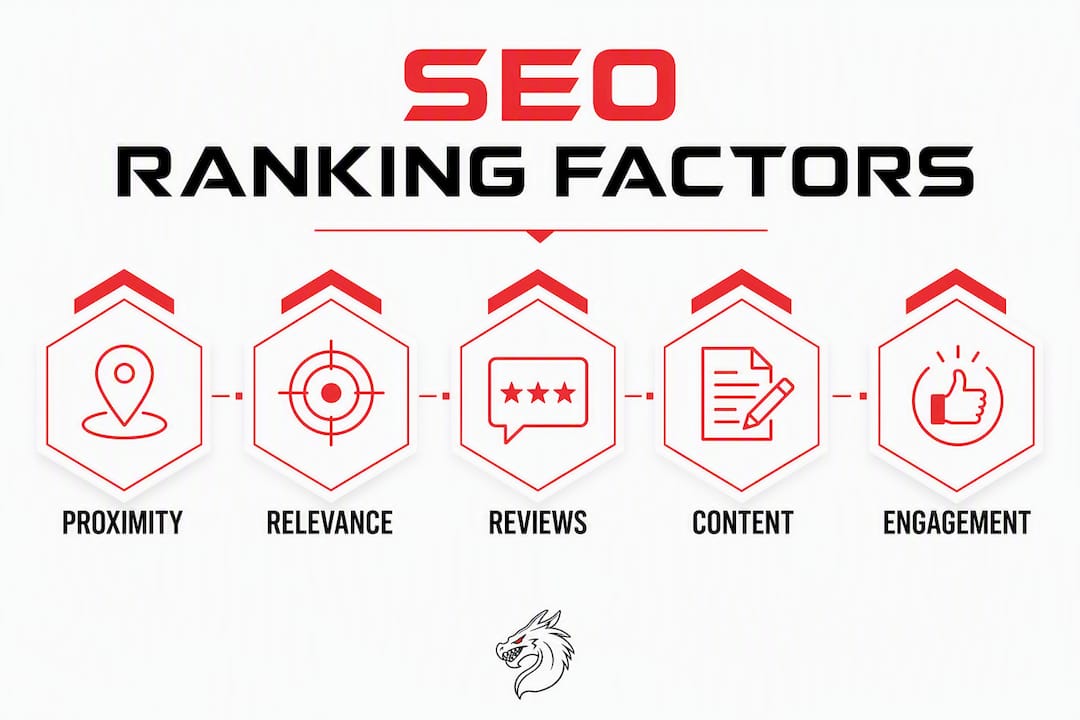
Three local ranking signals determine whether you appear in the Local Pack:
- —Relevance: Your service pages and GBP Services section must match the exact language customers search. "Drain cleaning" and "clogged drain repair" are different queries — both need a page.
- —Proximity: Service-area pages with neighborhood names and local landmarks signal to Google which zip codes you actually serve.
- —Prominence: Reviews, citations, and project case pages build the trust score that pushes you above competitors with similar relevance and proximity.
The conversion path is direct. A homeowner wakes up at 6 AM with a burst pipe. They search "emergency plumber near me." They see three results in the Local Pack. They click the one with photos, recent reviews, and a page titled "Emergency Leak Repair in [City]." They call. If that page doesn't exist on your site, that call goes to someone else.
Reviews sit alongside proximity and relevance as top local ranking signals. Quantity, recency, and how you respond all influence both placement and click-through rate.

What content types move the needle fastest for plumbers?
Service pages plus service-area pages plus a review-harvesting workflow produce the fastest and largest lead lift. Everything else is secondary until those three are solid.
Recommended content types and word counts
| Content Type | Minimum Word Count | Key Elements |
|---|---|---|
| Service page | 1,200 words | City + service H1, symptoms, process, pricing signals, trust signals, CTA |
| Service-area page | 400 words (unique) | Neighborhood names, local landmarks, service list, reviews from that area |
| Emergency page | 400 words | Urgency-first headline, click-to-call CTA above the fold |
| Project/case page | — | Before/after photos, problem description, solution, customer outcome |
| Blog/how-to post | 1,200 words | Target question keyword, step-by-step answer, internal links to service pages |
Service-area pages need at least 400 words of unique, locally relevant content — referencing specific neighborhoods or landmarks — to avoid the thin-page penalty that kills rankings.
Secondary high-impact content assets
- 1.Emergency and "book now" pages with mobile-first CTAs. These convert at the highest rate of any page type because the searcher already has intent.
- 2.Project galleries with real before/after photos from your actual jobs. Stock images don't build trust. Real work does.
- 3.Weekly GBP posts that highlight a recent job, a seasonal tip, or a promotion. Consistent posting keeps your profile active in Google's eyes.
- 4.FAQ sections targeting question-format queries ("How much does it cost to replace a water heater in [city]?"). These capture featured snippets and voice search results.
Pro Tip: Build your emergency page first. It targets the highest-intent, highest-urgency searcher — and a single call from a burst-pipe job can pay for months of content work.
How do you optimize content for local search intent?
Local intent optimization is the set of on-page signals that tell Google you serve a nearby customer right now. Without these signals, even well-written content won't rank for city-specific searches.
On-page checklist for every service and service-area page:
- —Title tag: Include primary keyword + city (e.g., "Drain Cleaning in Austin, TX | [Your Company]")
- —H1: City-specific and service-specific (e.g., "Drain Cleaning Services in Austin")
- —Footer NAP: Business name, address, and phone number — consistent across every page and every directory
- —Embedded Google Map: Confirms your physical location to Google and builds trust with visitors
- —Click-to-call button: Visible above the fold on mobile, with your phone number in plain text
- —Page speed: Under 3 seconds on mobile — slow pages lose calls before they happen
- —LocalBusiness/Plumber schema: Include businessName, serviceArea, openingHours, telephone, and priceRange fields in your structured data
For schema, you don't need to hand-code it. Google Search Central's structured data documentation covers the Plumber schema type specifically. Use a plugin like Yoast SEO or RankMath on WordPress to implement it without touching code.
Pro Tip: On mobile CTAs, lead with a verb and show the number: "Call Now: (555) 123-4567." One tap. No friction. That single change can lift call volume noticeably on high-traffic pages.
What does a repeatable content workflow look like?
A simple, repeatable workflow — topic selection, brief, publish, promote, measure — reduces bottlenecks and keeps ranking gains compounding over time. Without a workflow, content stalls after the first burst of effort.
Here's a 90-day publishing cadence that works for a solo owner or a small team:
- 1.Days 1–30: Optimize GBP fully. Publish your single highest-priority service page (your most-booked service + your primary city). Fix NAP consistency across Google, Yelp, and the top 10 directories.
- 2.Days 31–60: Publish 3 service-area pages (neighboring cities or suburbs you serve). Add 2 emergency pages. Launch your review request workflow — text or email every customer within 24 hours of job completion.
- 3.Days 61–90: Publish 4 how-to blog posts targeting question keywords. Add 5 project pages with real job photos. Review KPIs and double down on what's generating calls.
For each piece of content, use a brief that includes: target keyword, service city, search intent (emergency vs. informational), required CTA, photos needed, any reviews to pull from that area, and publish date. That brief takes 10 minutes to fill out and saves hours of revision.
On photos: upload at least 10 real job photos to your GBP. Every major service page needs at least 3 mobile-optimized CTAs — above the fold, mid-page, and at the bottom.
How do you measure whether your content is generating leads?
Phone calls and booked jobs are the highest-value KPIs for plumbing content. Impressions and clicks matter, but a call that turns into a $1,200 water heater job is the metric that justifies every hour of content work.
| KPI | What It Measures | Where to View | Review Cadence |
|---|---|---|---|
| Local impressions | How often you appear in local search | GBP Insights | Weekly |
| Organic clicks | Traffic from non-paid search results | Google Search Console | Weekly |
| GBP views | Profile visits and actions | GBP Insights | Weekly |
| Phone calls | Calls attributed to content/GBP | Call tracking platform (e.g., CallRail) | Daily |
| Form submissions | Lead form completions | GA4 / CRM | Daily |
| Conversion rate | Calls + forms / total visitors | GA4 | Monthly |
| Revenue per lead | Job value attributed to organic | CRM / job management software | Monthly |
Local Pack dominance is critical for residential plumbing jobs — most new jobs start with a Google search, so tracking Local Pack impressions weekly tells you whether your content is working before the phone rings.
What content mistakes are killing your local rankings?
Most lost local visibility comes from a handful of repeatable mistakes. The good news: most of them are fixable in a day.
- —Unclaimed or incomplete GBP: If your profile is missing hours, photos, or service descriptions, you're invisible to the algorithm and untrustworthy to customers.
- —Inconsistent NAP: Your name, address, and phone number must match exactly across Google, Yelp, Facebook, Angi, and every other directory. One mismatch confuses Google's confidence in your location.
- —Thin service-area pages: A page that says "We serve [City]" with 80 words won't rank. Add 400 unique words with neighborhood references.
- —No review process: Reviews don't happen automatically. You need a system — a text message sent within 24 hours of job completion — or your competitors will outpace you.
- —Stock photos everywhere: Replace them with real job images. Google rewards original visual content, and customers trust it more.
- —Vague "Services" page: One generic page listing every service you offer ranks for nothing. Split it into individual, city-targeted service pages.
Pro Tip: Fix GBP completion and add a visible phone number to your homepage before you write a single blog post. Those two changes drive more calls than any amount of long-form content.
Your 30/60/90-day action plan to win local search
Follow a prioritized 30/60/90 approach: fix GBP and top citations first, then publish priority pages and launch reviews, then build out project pages and iterate on data.
- 1.30 days — Foundation:
2. 60 days — Content push: - Publish your #1 service page (highest-revenue service + primary city) - Publish 3 service-area pages for neighboring cities - Launch review request workflow (text within 24 hours of job completion) - Set up call tracking
3. 90 days — Authority build: - Publish 5 project pages with before/after photos - Publish 4 how-to blog posts targeting question keywords - Review KPIs: Local impressions, calls, and form leads - Identify top-performing pages and build internal links to them
Priority sequence: GBP + NAP first, then emergency pages and booking CTAs, then high-converting service pages, then service-area pages, then project galleries, then measurement setup. That order maximizes early call volume while longer-form content compounds in the background.
For home service SEO strategies that go deeper on each phase, Vaultio's blog covers the full playbook.
Key Takeaways
Content combined with GBP optimization and a consistent review strategy is the fastest path from "my plumbing business is slow" to a predictable flow of local calls.
| Point | Details |
|---|---|
| Content drives calls, not just traffic | Service pages and service-area pages with local keywords convert searchers into phone calls. |
| GBP photos lift engagement | Profiles with photos get 42% more direction requests and 35% more website clicks per Google data. |
| Service-area pages need 400 words | Thin pages don't rank; add unique local content, neighborhood names, and real reviews from each area. |
| Track calls, not just clicks | Phone calls and booked jobs are the KPIs that prove content ROI for plumbers. |
| Vaultio accelerates execution | Vaultio implements content, GBP optimization, and AI lead response to deliver 10–15 extra jobs per month. |
What most plumbers get wrong about content strategy
The conventional wisdom says "just blog more." Publish tips about fixing leaky faucets, write seasonal maintenance guides, and the calls will come. That advice isn't wrong — it's just last in line.
The plumbers who grow fastest in 2026 aren't the ones with the most blog posts. They're the ones whose service pages rank for high-intent queries in the cities they actually serve, whose GBP profiles are photo-rich and review-heavy, and whose emergency pages load fast and show a phone number in the first three seconds on mobile.
Long-form content compounds over 6–12 months. But a fully optimized GBP and three solid service-area pages can move your Local Pack ranking in weeks. The sequence matters more than the volume. Pairing content with outreach to past customers and local referral partners also amplifies content ROI — content becomes the trust layer that makes every offline conversation more credible.
If your business is slow right now, don't start with a blog. Start with your GBP, your top service page, and your review workflow. Get those three right, and the content strategy has a foundation worth building on.
Vaultio builds this entire system for you
Most plumbers don't have time to write service pages, manage GBP posts, chase reviews, and track call attribution every week. That's exactly the gap Vaultio fills.
Vaultio delivers done-for-you local SEO for plumbers — service pages, service-area pages, GBP optimization, and AI-powered lead response that engages every new inquiry within seconds. The result is a predictable flow of 10–15 extra jobs per month, with zero guesswork on your end.
Every engagement includes a 30-day money-back guarantee. You either see measurable growth in local impressions, calls, and booked jobs — or you don't pay. No long-term lock-in required to get started.
Ready to see what a 90-day content and SEO plan looks like for your specific market? Book a free strategy call with Vaultio and get a clear picture of exactly what's holding your rankings back and what to fix first.
Useful sources
- —Google Business Profile Help: The primary reference for setting up, verifying, and optimizing your GBP — start here before touching anything else.
- —Google Search Central — Structured Data: Official documentation for LocalBusiness and Plumber schema implementation; use it to validate your markup.
- —Signpost — Local SEO for Plumbers Guide: — Practical checklist covering GBP, citations, service-area pages, and review strategy for plumbing businesses.
- —Contractor Magazine — Expanding in a Slow Market: Outreach and relationship strategies that pair with content to generate work when organic traffic is still building.
Use these alongside your 90-day plan to verify technical steps, validate schema implementation, and pressure-test your content decisions against real operator experience.
Recommended
Ready to Implement This?
We'll build your complete lead generation system in 72 hours. No contracts. 30-day money-back guarantee.