Pest Control Digital Marketing Company: Win More Jobs
# Pest Control Digital Marketing Company: Win More Jobs
If your phone isn't ringing the way it should, the fastest fix is hiring a specialist pest control digital marketing company that builds one integrated system: Google Local Services Ads, a conversion-first website, and Local SEO working together. Not three separate vendors. One stack, one set of KPIs, one goal — booked treatments and recurring plan signups.
Here's what that gets you immediately:
- —Lower cost per lead. LSA leads for residential pest control accounts generally cost $15–$28 per lead, which is lower than most paid-search campaigns when managed correctly.
- —Faster path to booked jobs. LSA sits above paid search in local results, and a substantial book rate means a significant portion of your leads turn into appointments.
- —Measurable attribution. You track leads per month, booked treatments, and plan conversions — not just clicks.
Request a free site audit and LSA readiness check from Vaultio before you sign anything with any agency. Know your baseline first.
Table of Contents
- —What does a pest control digital marketing company actually do?
- —Why a specialist agency outperforms a generalist for pest control
- —How the onboarding and growth process works month by month
- —What does pest control digital marketing cost, and what's the ROI?
- —How to choose the right pest control digital marketing company
- —What results should you expect? Vaultio's outcomes and proof points
- —Key Takeaways
- —The real reason most pest control marketing fails
- —Vaultio gets your pest control business to the top and keeps it there
What does a pest control digital marketing company actually do?
The deliverables vary by revenue stage, but the core services are consistent across every serious agency.
Table-stakes services (every pest control business needs these):
- —Local Services Ads (LSA) management. Setup, Google Guarantee verification, bid management, and dispute resolution. This is the highest-ROI channel for immediate leads.
- —Google Business Profile (GBP) optimization. Categories, service areas, photo cadence, Q&A, and weekly post management.
- —Local SEO. On-page optimization, citation building, and local citation signals that push you into the Map Pack for "exterminator near me" searches.
- —Conversion-first website design. Fast load times, click-to-call above the fold, service-specific landing pages, and trust signals (reviews, Google Guaranteed badge).
- —Reputation and review systems. Automated post-service review requests via SMS and email, with monitoring and response workflows.
Add-on services (scale in as revenue grows):
- —Paid search (Google Ads). Separate campaigns for emergency keywords ("bed bugs tonight") versus preventative-plan keywords ("quarterly pest control service"). Mixing these burns budget fast.
- —Content and FAQ pages. AI-friendly Q&A content that answers specific consumer questions and increases the chance AI tools like ChatGPT and Perplexity cite your brand.
- —Video and social media. Nextdoor, Facebook, and community platforms where AI models scan for brand mentions and local reputation signals.
- —AI chat and lead response. Automated systems that engage new inquiries within seconds — capturing leads others lose to voicemail.
- —Visitor recovery. Tools that identify anonymous website visitors and convert them into leads, especially valuable for commercial accounts.
Stat: About 97–98% of website traffic leaves without filling out a form or calling. Visitor recovery is not optional at the $2M+ revenue stage.
Revenue-stage prioritization:
- —Under $500K: GBP, LSA, and a review-generation habit.
- —$500K–$2M: Add Google Ads and invest in Local SEO.
- —Over $2M: Add visitor recovery and tighter attribution tied to route density and CRM data.
Reporting should go beyond traffic. Monthly deliverables from any serious agency include lead counts, booked treatments, plan conversion rates, and CRM or field-software integration data.
Why a specialist agency outperforms a generalist for pest control

A generic digital marketing agency sees your business as "home services." A specialist sees it as a seasonality-driven, recurring-revenue model where the math changes everything.
Here's the core difference:
- —Seasonality handling. Mosquito season, termite swarm season, and rodent season each demand different keyword strategies, different creative, and different bid adjustments. A generalist misses these windows.
- —Emergency vs. plan intent. "Roaches in my kitchen now" and "quarterly pest control plan" are different buyers with different CPLs and different lifetime values. Specialists build separate campaigns for each.
- —LTV math. A one-time caller is worth about $225. A recurring plan customer at roughly $45/month is worth approximately $1,620 over three years. That gap changes which channels you fund and how much you're willing to pay per lead.
- —Service-page depth. Termite control, bed bug treatment, mosquito service, and rodent exclusion each need their own optimized page. Generalists build one "pest control" page and wonder why it doesn't rank.
Integrated systems — where Local SEO builds always-on presence and LSA captures urgent demand — consistently outperform single-channel efforts. That's not a theory. It's the operational reality of running pest control marketing at scale.
Stat: LSA commercial leads tend to cost more per lead than residential, but commercial contract values are significantly higher. Specialists know to run separate LSA profiles for residential and commercial to protect bid efficiency.
AI search is also shifting the game. AI overviews can reduce direct website visits, which means being mentioned on third-party platforms matters as much as ranking. Specialists build for both clicks and mentions.
How the onboarding and growth process works month by month

A well-run agency follows a predictable sequence. Here's what that looks like in practice:
| Phase | Timeline | Key Deliverables | Expected Outcome |
|---|---|---|---|
| Discovery & Audit | — | Tech audit, GBP/LSA vetting, competitor gap analysis | Baseline CPL, ranking gaps identified |
| Fixes & LSA Launch | Month 1 | Website conversion fixes, LSA setup, review workflow live | First LSA leads within 2–4 weeks |
| Paid Search + SEO Ramp | Months 2–3 | Google Ads campaigns live, on-page SEO, citation building | Lead volume increasing, CPL stabilizing |
| Scale & Attribution | Months 4–6 | Visitor recovery integration, CRM sync, attribution tightened | Booked treatments tracked to channel |
| Plan Conversion Optimization | Months 6+ | Content for plan keywords, retargeting, route-density reporting | Recurring plan signups growing |
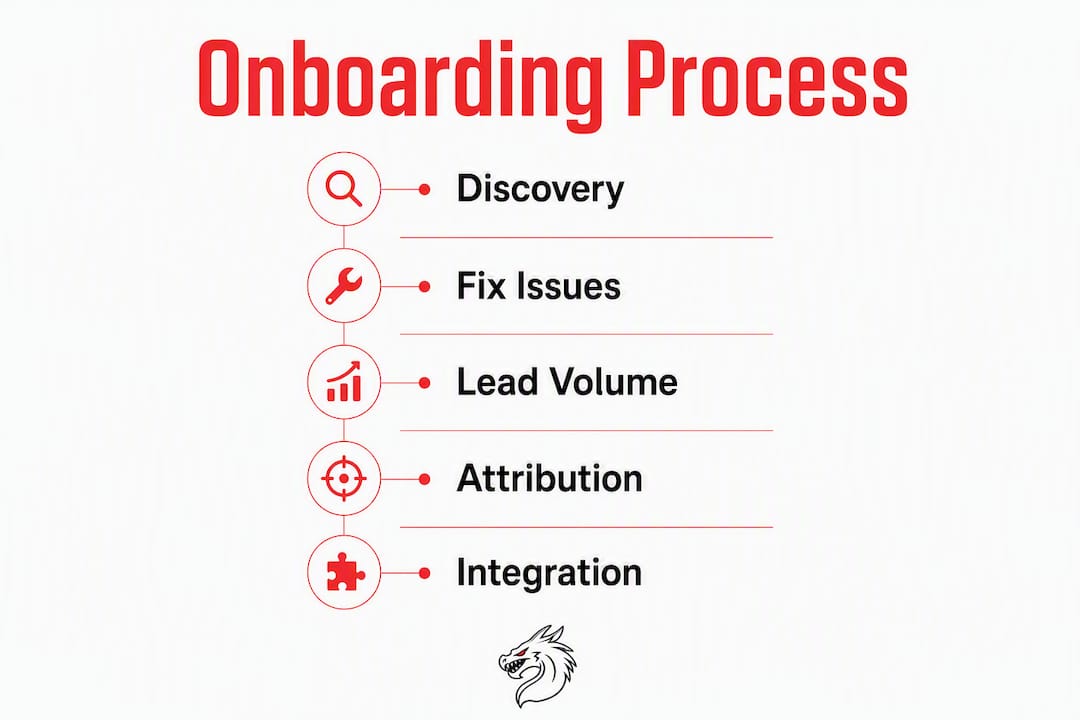
The first month is mostly fixing what's broken. Most pest control websites have slow load times, no click-to-call above the fold, and GBP profiles with missing service categories. These fixes alone lift conversion rates before a single ad dollar is spent.
Months 2–3 are about volume. LSA is live, Google Ads are running, and Local SEO is building. Expect lead counts to climb but CPL to fluctuate while the algorithm learns.
By month 6, you should have clean attribution: which channels produce booked treatments, which produce plan signups, and what your actual CPL is by service type.
Pro Tip: Connect your field-service software (ServiceTitan, Jobber, or similar) to your marketing attribution from day one. Route density — how many jobs you're booking in a specific zip code — is the real measure of whether your Local SEO is working. Traffic without route density improvement is a vanity metric.
What does pest control digital marketing cost, and what's the ROI?
Budget expectations vary by market size, but here are the real numbers:
The ROI math that changes everything:
Average Google Ads CPC in pest control runs about $5.99, with recommended max bids near $8 in competitive markets. At a 10% conversion rate on a landing page, you're paying roughly $60–$80 per lead from paid search. At a 38–45% book rate, that's $133–$210 per booked job.
Now compare that to the LTV math. A one-time customer at $225 barely covers acquisition cost. But convert that same lead to a recurring plan at $45/month, and you're looking at $1,620 over three years. Your break-even CPL for plan customers is dramatically higher than for one-time callers, which means you can outbid competitors who are only optimizing for one-time jobs.
LSA changes the equation further. Residential LSA leads cost $15–$28 per lead, and with a 38–45% book rate, your cost per booked job drops to $33–$74. That's the channel to fund first.
On contracts and commitments: Most reputable agencies require a 3–6 month minimum engagement because SEO and LSA take time to produce consistent results. Avoid agencies that demand 12-month lock-ins with no performance benchmarks. The right agency ties contract renewal to measurable outcomes — leads per month, booked treatments, and plan signups — not just "we're still working on it."
How to choose the right pest control digital marketing company
Use this checklist on every agency call before you sign.
Questions to ask:
- 1.How many pest control or home-service clients are you currently running LSA for?
- 2.Can you show me a sample monthly report with lead counts, booked treatments, and plan conversions?
- 3.Which field-service software do you integrate with (ServiceTitan, Jobber, Housecall Pro)?
- 4.How do you separate emergency-intent campaigns from plan-intent campaigns in Google Ads?
- 5.What's your process when LSA leads are disputed or marked as invalid?
- 6.Do you offer a trial period or performance guarantee?
Trust signals to require:
- —Case studies from pest control clients at a similar revenue stage to yours
- —Transparent reporting with KPIs tied to booked treatments, not just traffic
- —A free site audit before you commit
- —A 30-day money-back guarantee or performance-based renewal
- —References you can actually call
Red flags — walk away if you see these:
- —KPIs defined as "traffic" or "impressions" with no mention of booked jobs
- —No LSA experience or no Google Guarantee verification process
- —Fixed creative fees with no conversion testing
- —12-month contracts with no performance benchmarks
- —One generic "home services" case study covering plumbing, HVAC, and pest control as if they're identical
Simple decision matrix: Score each agency on three dimensions: fit (do they specialize in pest control?), price (does the retainer match your revenue stage?), and proof (do they have real case studies with real numbers?). Any agency that scores low on proof is a risk regardless of price.
What results should you expect? Vaultio's outcomes and proof points
Vaultio clients in home services consistently see a steady flow of 10–15 extra jobs per month once the integrated system is fully live. That's not a projection. That's the outcome of combining #1 search rankings with AI-powered lead response that engages every new inquiry within seconds.
Key metrics Vaultio tracks for pest control clients:
- —Leads per month by channel (LSA, Google Ads, organic, GBP)
- —Booked treatments as the primary conversion event
- —Plan conversion rate — what percentage of one-time callers become recurring customers
- —Route density improvement — are you booking more jobs in the same zip codes?
On the AI visibility front, content structured as explicit Q&A increases the chance AI tools surface your brand as the recommended provider. Vaultio builds this into every content strategy, so your business gets mentioned in ChatGPT and Perplexity responses, not just Google results. That's the shift from clicks to mentions, and it's where local business ranking in AI search is heading fast.
The 30-day money-back guarantee removes the risk of trying. If Vaultio doesn't deliver, you don't pay. That's the only guarantee worth taking seriously in this industry.
Key Takeaways
A specialist pest control digital marketing company that runs LSA, Local SEO, and a conversion-first website as one integrated system produces the lowest cost per booked job and the fastest path to recurring plan revenue.
| Point | Details |
|---|---|
| LSA is the priority channel | Residential leads run $15–$28 with a 38–45% book rate — fund this before Google Ads. |
| LTV math drives channel selection | Recurring plan customers are worth ~$1,620 over three years vs. ~$225 for one-time callers. |
| Integrated systems beat single channels | LSA + GBP + conversion website + visitor recovery outperforms any single-channel approach. |
| Measure booked treatments, not traffic | Route density and plan signups are the real KPIs — traffic without bookings is a vanity metric. |
| Vaultio delivers 10–15 extra jobs/month | Vaultio's integrated system combines search rankings, AI visibility, and fast lead response with a 30-day guarantee. |
The real reason most pest control marketing fails
Most pest control owners don't fail at marketing because they picked the wrong channel. They fail because they hired a generalist agency that treated their business like any other home-services account and measured success in traffic instead of booked jobs.
The pest control market is built on urgency and recurring revenue. Those two dynamics demand a completely different approach than, say, a remodeling company. Urgency means your LSA and GBP need to be flawless at 9 PM on a Saturday when someone finds a termite swarm. Recurring revenue means every campaign decision should be filtered through LTV math, not just CPL.
What I've seen work consistently is the integrated stack: LSA capturing urgent demand, Local SEO building always-on presence, a conversion-first website closing the deal, and AI-powered lead response making sure no inquiry goes cold. Add AI search ranking factors to the mix, and you're building a brand that shows up on Google, ChatGPT, and Perplexity simultaneously. That's not a nice-to-have in 2026. It's the whole game.
Vaultio gets your pest control business to the top and keeps it there
Vaultio is built specifically for home service contractors who want to own their local market — not rent visibility from a generalist agency that doesn't know the difference between termite season and mosquito season.
Here's what you get when you work with Vaultio: LSA management that captures urgent leads the moment someone searches, Local SEO that compounds over time, a conversion-optimized website that turns visitors into booked jobs, and AI-powered lead response that engages every inquiry within seconds. The result is a predictable flow of 10–15 extra jobs per month, backed by a 30-day money-back guarantee.
No long-term lock-in without performance benchmarks. No vague traffic reports. Just leads, booked treatments, and plan signups you can count.
Request your free site audit and LSA readiness check today. Vaultio will show you exactly where your online presence is losing jobs and what it takes to fix it fast.
Recommended
Ready to Implement This?
We'll build your complete lead generation system in 72 hours. No contracts. 30-day money-back guarantee.