Landscaping SEO: Get Local Leads Fast in 2026

# Landscaping SEO: Get Local Leads Fast in 2026
Your three highest-ROI moves for landscaping SEO are a fully optimized Google Business Profile, three targeted service pages (one flagship plus two local or service variations), and an automated review request flow. Do those three things first. Everything else, including content calendars, link building, and technical audits, compounds on top of that foundation. Industry guidance confirms that these assets drive more calls than a generic homepage ever will.
Your 7-day quick-start checklist:
- —Claim and complete your Google Business Profile with accurate categories, service area, hours, and at least 10 photos
- —Build or rewrite your flagship service page (e.g., "Lawn Care in [City]") with a clear H1, scope description, pricing cues, and a call-to-action
- —Create two supporting pages targeting a second service or a neighboring city
- —Set up a post-job text or email asking satisfied customers for a Google review
- —Submit your business to the top five local directories (Google, Yelp, Angi, HomeAdvisor, Houzz) with identical name, address, and phone number
DIY vs. hire verdict: If you serve one city and have time to publish one page per month, DIY is viable for the first 90 days. Once you're targeting multiple cities, need predictable lead volume, or want to compete in a saturated market, hiring a specialist pays for itself fast.
*
Key Takeaways
Landscaping SEO delivers its fastest ROI when you prioritize Google Business Profile, targeted service pages, and a consistent review system before anything else.
| Point | Details |
|---|---|
| Start with GBP and service pages | Optimize your Google Business Profile and build three targeted service pages before any other SEO work. |
| Reviews drive Map Pack rankings | Automate review requests after every job; volume and recency both influence your local ranking position. |
| Organic search is your primary lead channel | Organic search accounts for roughly 53% of traffic, making it the highest-volume discovery channel for local landscapers. |
| Expect results in 90–180 days | Consistent SEO work typically produces regular inbound calls by month three and dominant local rankings by month six. |
| Vaultio delivers the full package | Vaultio combines GBP management, service pages, review automation, and AI lead response, backed by a 30-day money-back guarantee. |
*
Table of Contents
- —Why landscaping SEO is worth prioritizing over paid ads
- —How to do keyword research that actually fills your calendar
- —What your service pages need to rank and convert
- —How to own the Map Pack with Google Business Profile
- —Technical SEO fixes that protect your rankings and reduce lost leads
- —A seasonal content plan that drives calls year-round
- —Link-building tactics that work for local landscaping businesses
- —What SEO results look like on a realistic timeline, and what it costs
- —How to pick an SEO agency that won't waste your money
- —Vaultio results: what home service contractors actually see
- —What most landscapers get wrong about SEO (and what actually works)
- —Vaultio gets landscapers ranked and booked, fast
- —Sources
Why landscaping SEO is worth prioritizing over paid ads
Organic search drives a majority share of all website traffic across industries, and for local service businesses the share of high-intent traffic from organic and map-pack results is even more concentrated. A homeowner searching "lawn care near me" or "landscaping company in [city]" is ready to call. That's not browsing traffic. That's a booked job waiting to happen.
Landscaping has a buying pattern that makes SEO especially powerful. Demand spikes in March through May as homeowners plan spring cleanups, then again in September for fall prep. A page that ranks in February captures calls through the entire season. Paid ads stop the moment you pause the budget. A ranked page keeps generating leads for months or years.
Lead value is the other side of the equation. Because landscaping jobs carry high average ticket prices, you don't need massive traffic volume to see a strong return. Five additional calls per month from a well-ranked service page can represent significant revenue, especially when those customers become recurring maintenance clients.
SEO is evolving in 2026, not disappearing. AI-powered search features and Google's AI Overviews are surfacing vendor recommendations directly in results. Businesses with well-structured local pages and strong GBP signals are the ones getting cited in those AI summaries. That's a new visibility layer, not a replacement for the fundamentals.
*
How to do keyword research that actually fills your calendar
Generic keyword tools give you national search volumes that mean nothing for a local landscaper in a mid-size market. The process below is built for your situation.
- 1.Start with seed keywords. List every service you offer: lawn mowing, landscape design, sod installation, irrigation repair, fall cleanup, snow removal. These are your commercial anchors.
- 2.Add geo modifiers. Pair each service with your city, neighboring cities, and county name. "Lawn care Austin TX," "landscaping company Round Rock," "irrigation repair Travis County." These are your money pages.
- 3.Filter by intent. Transactional keywords ("get a quote," "hire," "cost of") belong on service pages. Informational keywords ("how to," "when to," "best time to") belong in blog content. Never mix them on the same page.
- 4.Check GBP search queries. Inside your Google Business Profile dashboard, the "Search queries" report shows the exact phrases people used to find your listing. These are real local phrases, not modeled estimates. Mine them for page titles and H1 ideas.
- 5.Prioritize by conversion potential, not volume. A keyword with 50 monthly searches and clear transactional intent ("landscaping company near me [city]") beats a keyword with 500 searches and mixed intent ("landscaping ideas").
Pro Tip: Use Google's "People also ask" and autocomplete suggestions for your city to find long-tail phrases competitors haven't built pages for yet. These low-competition queries often convert at higher rates because the searcher is further along in the decision process.
For content keywords, think seasonally. "How to prepare your lawn for winter in [state]" gets searched every October. "Best grass seed for [climate zone]" gets searched in spring. These pages build topical authority and funnel readers toward your estimate form.
*
What your service pages need to rank and convert
A service page that ranks but doesn't convert is just expensive real estate. The pages that do both share a consistent structure.
The high-converting service page template:
- —H1: Service + city (e.g., "Lawn Care Services in Denver, CO")
- —Opening paragraph: What you do, who you serve, and the service area, in plain language
- —Scope section: Bullet list of exactly what's included (and what's not)
- —Pricing cues: A range or starting price, even approximate, reduces bounce and pre-qualifies callers
- —Before/after gallery: Real project photos with descriptive alt text and file names
- —Social proof: Three to five Google reviews embedded or quoted, with star ratings visible
- —FAQ block: Four to six questions that address common objections (timing, contracts, what to expect)
- —CTA: A phone number, a "Get a Free Estimate" button, and a short contact form above the fold
ZenMaid's service-page research confirms that transparent scope, pricing cues, proof, and FAQs are the repeatable formula for local service pages that convert. The same structure applies to landscaping.
For meta titles, follow this pattern: `[Service] in [City] | [Company Name] | Free Estimates`. Keep it under 60 characters. Meta descriptions should include the service, city, a differentiator (licensed, insured, 5-star rated), and a call to action, all within 155 characters.
Schema markup tells Google exactly what your page is about. Add `LocalBusiness` schema to your homepage with your NAP, hours, and service area. Add `Service` schema to each service page. Add `Offer` schema when you include pricing. These don't guarantee rankings, but they improve how Google reads and displays your pages, including in AI Overviews.
Pro Tip: Name your before/after photos descriptively before uploading: "lawn-care-denver-before.jpg" and "lawn-care-denver-after.jpg" instead of "IMG_4821.jpg." Google indexes image file names, and descriptive names reinforce your geo and service relevance.
*
How to own the Map Pack with Google Business Profile
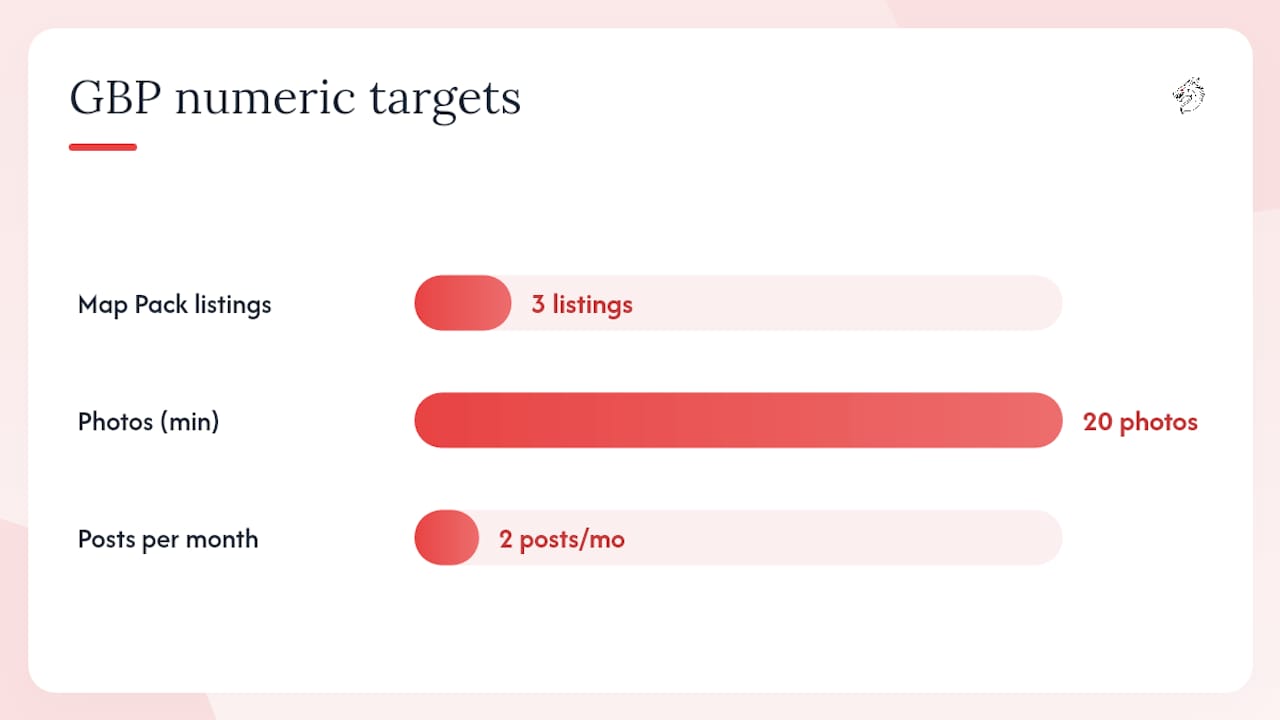
The Map Pack, those three local business listings that appear above organic results, captures a disproportionate share of clicks for "near me" searches. Your GBP is the key to getting there.
GBP audit checklist:
- —Primary category: Set it to "Landscaper" or "Lawn Care Service," not a generic "Home Services" label
- —Secondary categories: Add relevant ones: "Irrigation System Contractor," "Tree Service," "Snow Removal Service"
- —Services: List every service with descriptions; Google uses these for keyword matching
- —Photos: Minimum 20 photos, updated monthly. Include crew photos, equipment, before/after project shots, and your service vehicles
- —Hours: Accurate and updated for holidays and seasonal changes
- —Service area: Set polygons for every city you actively serve, not just your physical address
- —Posts: Publish at least two GBP posts per month with seasonal offers, completed projects, or tips
- —Q&A: Seed your own questions and answers covering pricing, service area, and what to expect
FieldCamp's local SEO research confirms that GBP, consistent NAP citations, and dedicated location landing pages are the highest-impact early moves for any local service business.
Review generation playbook:
Reviews are a direct ranking signal and a conversion driver. The businesses that win the Map Pack consistently are the ones with the most recent, most numerous reviews.
- —Send a review request text within two hours of job completion, when satisfaction is highest
- —Use a short link that goes directly to your Google review form (not your homepage)
- —Script: "Hi [Name], thanks for choosing [Company]. If you're happy with the work, a quick Google review helps us a lot: [link]. Takes 30 seconds."
- —Automate this through your invoicing or field service software so no job slips through
- —Respond to every review, positive and negative, within 48 hours
For citations, prioritize Google Business Profile, Yelp, Angi, HomeAdvisor, Houzz, and your local Chamber of Commerce. Your name, address, and phone number must be identical across all of them. A single inconsistency (abbreviated "St." vs. "Street") can dilute your local authority signal.
*
Technical SEO fixes that protect your rankings and reduce lost leads
A slow site loses leads before they ever read your service page. Page speed and Core Web Vitals directly affect both rankings and user behavior, and landscaping sites are especially vulnerable because of gallery-heavy pages.
Priority technical fixes, ranked by ROI:
- 1.Image optimization. Landscaping sites carry dozens of project photos. Compress every image to WebP format, cap dimensions at 1200px wide for gallery images, and use lazy loading so images below the fold don't block initial page load. A 4MB JPEG gallery page can become a 400KB WebP page with no visible quality loss.
- 2.Mobile rendering. Over 60% of local service searches happen on mobile. Test every service page on a real phone, not just a browser emulator. Check that your phone number is a tap-to-call link and that your estimate form works without pinching or zooming.
- 3.Largest Contentful Paint (LCP). Your LCP element is usually the hero image or the above-the-fold photo. Serve it via a CDN, preload it in your HTML, and compress it aggressively. Target under 2.5 seconds.
- 4.Site architecture. Every service page should be reachable within two clicks from your homepage. A flat, logical structure (Home → Services → [Specific Service]) helps Google crawl and index your pages faster.
- 5.Cumulative Layout Shift (CLS). Fonts and images that load late and push content around hurt both rankings and user experience. Set explicit width and height attributes on all images.
Before/after image optimization example: A typical before/after project photo uploaded straight from a phone is often 3–5MB, saved as a JPEG at full resolution. Converted to WebP, resized to 1200x800px, and delivered via a CDN, the same image drops to under 150KB. Page load time for a gallery page can fall from 8 seconds to under 2 seconds. That's the difference between a visitor who requests an estimate and one who bounces to a competitor.
*
A seasonal content plan that drives calls year-round
Content that matches what homeowners are searching for each season is the most efficient way to build local relevance and capture demand before competitors do.
Quarterly content calendar:
- —Q1 (January–March): "Spring lawn care checklist in [City]," "When to aerate your lawn in [State]," "Best time to plant sod in [Region]"
- —Q2 (April–June): "Landscaping design ideas for [City] homes," "How much does lawn care cost in [City]," "Irrigation system installation near me"
- —Q3 (July–September): "Summer lawn maintenance tips for [Climate Zone]," "Drought-resistant landscaping in [City]," "Lawn disease treatment in [State]"
- —Q4 (October–December): "Fall cleanup services in [City]," "Winterizing your irrigation system," "Snow removal services [City]"
Beyond seasonal posts, build out these page types:
- —Neighborhood pages: "Landscaping in [Neighborhood Name], [City]" targets hyper-local searches and converts at high rates because the intent is extremely specific
- —Pricing explainer pages: "How much does landscaping cost in [City]?" captures high-intent searchers who are actively comparing quotes
- —Before/after case studies: Real project pages with photos, scope, and outcome build trust and rank for long-tail project-specific queries
- —FAQ pages: Cluster common questions by service type; these often appear in Google's "People also ask" and AI Overviews
Every piece of content needs a conversion path. Place your estimate form or phone number within the first screen of every page. Use inline CTAs mid-article ("Ready to schedule your spring cleanup? Get a free estimate here.") rather than relying solely on a footer button. Microconversions like "Download our seasonal lawn care checklist" can capture email addresses from visitors who aren't ready to call yet.
*
Link-building tactics that work for local landscaping businesses
Links from locally relevant, authoritative sites move the needle for local rankings more than generic directory links. The goal is quality and local relevance, not volume.
High-priority link sources:
- —Local suppliers and nurseries: A link from your sod supplier's "preferred installer" page or your local nursery's contractor list carries real local authority
- —Local news and neighborhood blogs: Pitch a seasonal lawn care tip story to your city's newspaper or neighborhood Facebook group blog. One local news mention often outranks dozens of generic directory links
- —Municipal and HOA pages: Many city parks departments and HOA websites maintain contractor referral lists. Getting listed there earns both a link and direct referral traffic
- —Home builder and real estate agent partnerships: New construction landscaping referrals are high-value. A link from a local builder's "preferred vendors" page is both a ranking signal and a lead source
- —Sponsorships: Sponsor a local little league team, community garden, or neighborhood event. Most sponsor pages include a link back to your site
Simple outreach email template:
Link priority matrix: Local news and municipal pages carry the most weight because they're editorially controlled and geographically specific. Supplier and partner pages rank second. General directories (Yelp, Angi) are table stakes but don't move rankings on their own. Avoid any service offering "100 links for $99" — those links can trigger a Google penalty that takes months to recover from.
*
What SEO results look like on a realistic timeline, and what it costs
SEO is not a switch. It's a compounding asset. Here's what to expect at each stage:
| Timeline | Typical Milestone | Expected Outcome |
|---|---|---|
| 30 days | GBP optimized, 3 service pages live, citations submitted | Map Pack impressions increase; first review requests sent |
| 90 days | 5+ reviews collected, content publishing started | Phone calls from organic begin; GBP ranking improves in primary city |
| 180 days | 10+ pages indexed, link building underway | Consistent inbound calls; ranking in 2–3 cities; estimate requests from content pages |
| 365 days | Full content calendar executed, 25+ reviews | Dominant Map Pack position; 10–15+ additional jobs per month from organic alone |
Pricing ranges for landscaping SEO:
- —DIY tools only (Google Search Console, Google Analytics, free GBP): $0–$100/month in tools, but significant time investment
- —Freelance SEO specialist: $500–$1,500/month for part-time management of GBP, service pages, and basic content
- —Boutique local SEO agency: $1,000–$3,000/month for full-service local SEO including content, link building, and reporting
- —Full-service contractor marketing agency: $2,000–$5,000+/month for SEO plus paid ads, AI lead response, and web design
ROI calculation example: If your average landscaping job is worth $800 and you close 30% of inbound calls, you need roughly 4 calls to book one job. At $1,500/month in SEO spend, you break even at 2 booked jobs per month from organic. Most landscapers in competitive markets see 5–15 additional organic calls per month within 6 months of consistent SEO work.
Google Ads can bridge the gap while organic rankings mature. Running a targeted paid search campaign for your top two or three services during the first 90 days keeps leads flowing while your organic pages gain authority. Vaultio's Google Ads management for home service contractors is built specifically for this bridge strategy.
*
How to pick an SEO agency that won't waste your money
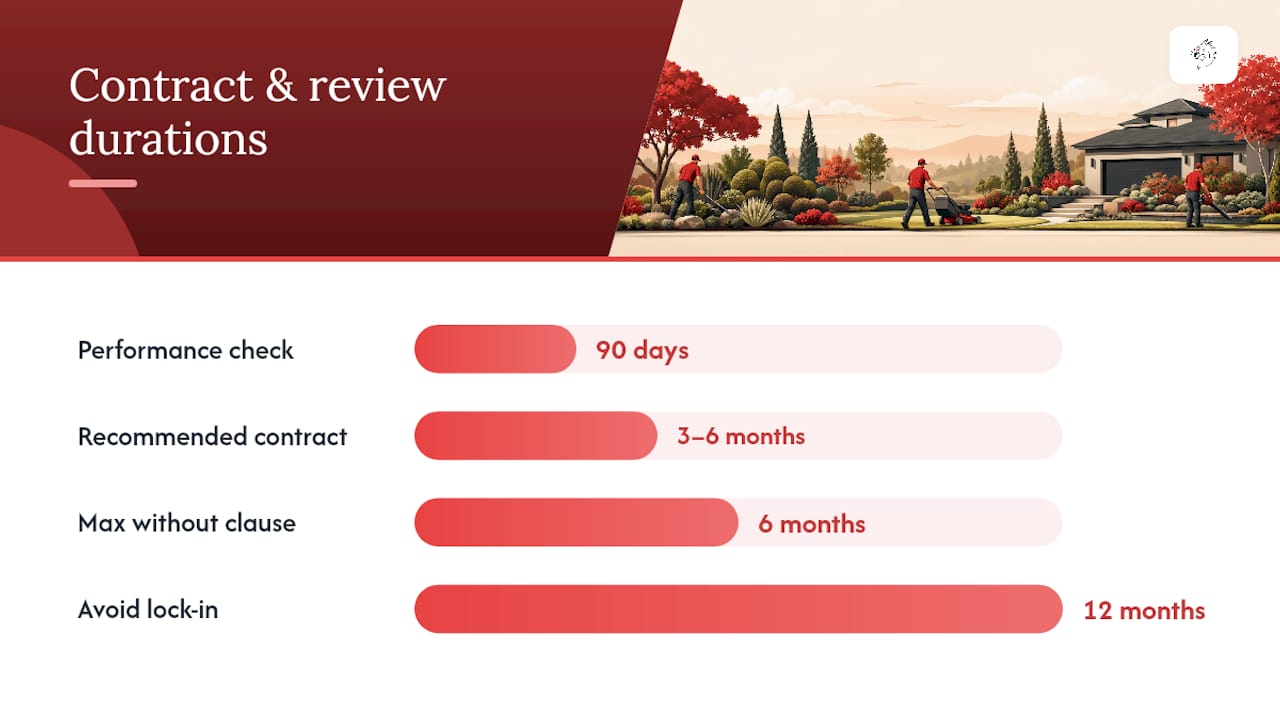
Most landscapers who've been burned by an SEO agency were burned by the same three things: vague reporting, no local specialization, and a contract that locked them in for 12 months with no results clause. Here's how to avoid that.
Questions to ask every agency before signing:
- 1.How do you measure success for a landscaping client? (Correct answer: calls, booked jobs, and Map Pack rankings, not just traffic)
- 2.Who manages my Google Business Profile, and how often do you update it?
- 3.How do you attribute leads back to SEO specifically?
- 4.What does your reporting look like, and how often do I see it?
- 5.Do you have experience with home service or landscaping clients specifically?
- 6.What happens if I don't see results in 90 days?
Red flags that should end the conversation:
- —Guaranteed #1 rankings (no one can guarantee a Google ranking)
- —"Secret" link networks or proprietary link-building methods they won't explain
- —Reporting that shows only keyword rankings with no call or lead data
- —Contracts longer than 6 months with no performance clause
- —No mention of GBP management in their deliverables
- —Pricing that seems too low to cover real work (sub-$300/month for "full SEO")
Trust signals to look for:
- —Case studies with before/after call volume or lead data from home service clients
- —Transparent deliverables list (what they build, what they manage, what they report)
- —A money-back or performance guarantee
- —Clear reporting cadence with KPIs tied to revenue, not vanity metrics
- —Specialization in local or home service SEO, not generalist digital marketing
Agency evaluation dimensions:
| Dimension | What to Look For |
|---|---|
| Deliverables | GBP management, service pages, content, link building, reporting |
| Pricing model | Monthly retainer with clear scope; avoid vague "custom packages" |
| Contract length | 3–6 months with a performance clause; avoid 12-month lock-ins |
| Specialization | Home services or local service industry experience |
| KPIs reported | Calls, booked jobs, Map Pack rank, organic traffic (not just keyword positions) |
Local SEO for home services requires a different playbook than national or e-commerce SEO. An agency that specializes in contractors will already know the seasonal patterns, the GBP categories, and the service-page structures that convert for your industry.
*
Vaultio results: what home service contractors actually see
The proof that matters for landscapers isn't abstract traffic charts. It's calls and booked jobs.
Vaultio's process for home service contractors follows a consistent sequence: GBP audit and optimization in week one, flagship service pages built and published by week three, review request automation live before the end of the first month. AI lead response engages every new inquiry within seconds, so no call goes to voicemail and no form submission sits unanswered overnight.
What Vaultio delivers:
- —Full GBP optimization and ongoing management (posts, photos, Q&A, review responses)
- —Flagship and supporting service pages built to convert, with schema markup
- —Automated review request system integrated with your dispatch or invoicing workflow
- —AI lead response that engages new inquiries within seconds, 24/7
- —Monthly reporting tied to calls, booked jobs, and Map Pack rankings, not just keyword positions
How Vaultio measures success: rankings in the Map Pack for your primary service and city, inbound call volume from organic, and estimate requests from service pages. The target is 10–15 additional jobs per month from organic and AI-assisted lead capture combined.
Every engagement is backed by a 30-day money-back guarantee. If you're not seeing movement in the first month, you don't pay.
*
What most landscapers get wrong about SEO (and what actually works)
The most common mistake I see landscapers make is building thin city pages. They copy the same service description, swap the city name, and expect Google to rank each one. Google sees it as duplicate content and ranks none of them. A real city page needs local specifics: neighborhoods you serve in that city, a project photo from that area, a testimonial from a customer in that zip code, and a paragraph about local conditions (soil type, common grass varieties, seasonal timing). That's what separates a page that ranks from one that doesn't.
The second mistake is no review system. Most landscapers ask for reviews occasionally, when they remember. The businesses dominating the Map Pack have a system: every completed job triggers a review request automatically. Volume and recency both matter to Google's local algorithm. A competitor with 200 reviews collected over three years will lose ground to a business that collects 15 reviews per month consistently.
The third mistake is slow galleries. A portfolio is your best sales tool, but unoptimized photos turn it into a lead killer. Visitors on mobile will wait about three seconds before bouncing. If your gallery takes eight seconds to load, you're handing those leads to whoever ranks below you.
On the DIY vs. hire question: if you have one location, a clear service area, and time to spend four to six hours per week on marketing, you can execute the basics yourself for the first 90 days. Once you're targeting three or more cities, running seasonal campaigns, and need consistent lead volume to hit revenue goals, the math on hiring a specialist almost always works in your favor.
*
Vaultio gets landscapers ranked and booked, fast
Ranking on Google is only half the battle. The other half is capturing every lead the moment they find you.
Vaultio is built for home service contractors who need both. The package covers GBP optimization, conversion-focused service pages, an automated review system, and AI lead response that engages every new inquiry within seconds, day or night. No long-term lock-in. No vague deliverables. Just a clear scope, monthly reporting tied to calls and booked jobs, and a 30-day money-back guarantee.
What's included:
- —GBP optimization and monthly management
- —Flagship service page plus two supporting local or service pages
- —Automated review request flow
- —AI receptionist for 24/7 lead qualification
- —Monthly reporting: Map Pack rank, calls, estimate requests
Most landscaping clients see their first organic calls within 60–90 days. The first booked job from SEO typically covers a significant portion of the monthly investment.
Request your free local SEO audit and find out exactly where your business stands in your market today.
*
Sources
- —Organic share of traffic increases to 53%
- —Page speed: how it impacts your SEO and how to improve it | OnCrawl
- —SEO for Cleaning Companies: Get More Bookings in 2026
- —Using Google Ads to Enhance Your Landscaping Business - Aspire
- —Is SEO dead or evolving in 2026?
- —The Ultimate Guide To SEO for Cleaning Companies 2024 Guide | ZenMaid Magazine
Recommended
Ready to Implement This?
We'll build your complete lead generation system in 72 hours. No contracts. 30-day money-back guarantee.