GEO for Contractors: 30–40% More AI Citations in 30–90 Days
# GEO for Contractors: 30–40% More AI Citations in 30–90 Days
Generative engine optimization (GEO) is the practice of structuring and proving content so AI systems like ChatGPT, Perplexity, and Google's AI Overviews cite it directly in generated answers. Three moves matter most: lock down your ranking foundation, restructure content into extractable passages, and back claims with original data and citations. Everything else is secondary. This guide walks through why those three priorities work and how to execute them.
*
TL;DR: - Adding sourced statistics and original data can increase the likelihood of your content being cited in AI-generated responses by up to 40 percent. - Structuring content into short, self-contained answer passages and including FAQ blocks and tables improves extractability for retrieval systems. - Implementing schema markups for articles, persons, and organizations, along with updating your dateModified field regularly, enhances citation confidence. - Focusing on commercial, high-value queries first yields better ROI, as retrieval systems prioritize passages with strong signals in those topics. - Using a voluntary llms.txt file to specify priority content is a low-cost way to increase the chances of your pages being referenced by language models.
*
Table of Contents
- —What Is Generative Engine Optimization, and Why Do Passages Matter?
- —SEO vs. GEO: What Changes and What Stays the Same
- —Why GEO Matters Now: Outcomes and Risks
- —High-Impact GEO Strategies: The Tactical Playbook
- —Structural and Technical Tactics: Schema, llms.txt, and Passage Engineering
- —How to Measure GEO Success and Run Tests
- —The 30 to 90 Day GEO Implementation Checklist
- —Proving Expertise: Author and Publisher Signals AI Trusts
- —How GEO Differs Across Chatbots, Search Engines, and Voice Assistants
- —Where GEO Fits Into a Long-Term Content Strategy
- —Vaultio: Done-for-You GEO and AI Lead Conversion for Contractors
- —Sources
- —FAQ
What Is Generative Engine Optimization, and Why Do Passages Matter?
GEO is the discipline of shaping content so large language models select it, trust it, and quote it when generating answers. Researchers first formalized the term in the GEO-bench study, which measured how specific content edits change a source's odds of being cited by generative engines.
The mechanism behind GEO is retrieval-augmented generation, or RAG. When you ask ChatGPT or Perplexity a question, the system does not just generate an answer from memory. It retrieves a handful of relevant passages from indexed web content, feeds them to the model as context, and the model synthesizes a response from that material. This is why a single long, meandering page rarely gets cited. The retrieval step pulls chunks of text, usually a paragraph or two, not entire articles. A page built from short, self-contained passages gives the retrieval system more usable chunks to grab.
GEO sits alongside a few related terms you'll see thrown around:
- —LLM SEO — optimizing specifically for how large language models parse and rank content, often used interchangeably with GEO.
- —AEO (answer engine optimization) — a narrower focus on winning featured-snippet-style direct answers.
- —AI search optimization — the broader umbrella covering both traditional AI Overviews and chatbot-style engines.
These aren't competing frameworks. They layer on top of each other, and most of the tactics below serve all three at once.
SEO vs. GEO: What Changes and What Stays the Same
Classic SEO still decides who gets into the pool that generative engines pull from. Google's own guidance confirms that foundational SEO best practices remain necessary for eligibility in AI-generated features. If a page isn't indexed, isn't crawlable, or isn't ranking reasonably well already, it rarely gets retrieved at all.
What GEO adds is a second filter that happens after retrieval:
- —Indexing and crawlability still gate entry. No index, no citation, full stop.
- —Extractability determines whether a retrieved passage is clean enough to quote without editing.
- —Entity resolution (does the model know who you are and trust the byline?) increasingly affects which of several similar passages gets chosen.
- —Original data breaks ties. When two pages say roughly the same thing, the one with a real number wins.
The divergence shows up most in commercial, competitive queries where a dozen pages say the same generic thing. Ranking gets you into the running. GEO tactics decide who actually gets quoted.
Why GEO Matters Now: Outcomes and Risks
An AI-generated citation carries brand impression value even when the reader never clicks through. That distinction changes how you should think about ROI.
GEO-bench found that adding sourced statistics, expert quotations, and citations can lift a page's visibility in generative engine responses by up to roughly 30 to 40 percent compared to unoptimized versions of the same content.
The risk side gets less attention than it deserves. Zero-click behavior means your traffic dashboards may understate real influence, which tempts teams to overreach with speculative claims just to get quoted. Don't. Some industry analysis warns that legacy tactics like keyword stuffing actively hurt GEO performance, and stale or uncorroborated claims raise the odds of a model either ignoring your page or misattributing a fact you never actually stated.
High-Impact GEO Strategies: The Tactical Playbook
The tactics with the strongest evidence behind them are also the least flashy. Here's what to prioritize, in order of proven impact:
- 1.Add sourced statistics and original data. GEO-bench's Statistics Addition method was one of the top performers in raising citation odds, and a proprietary number you publish first becomes something other sources have to cite back to you.
- 2.Cite credible external sources and quote them briefly. The same research found Cite Sources and Quotation Addition methods produced comparable lift. A two-sentence quote from a named expert or a linked government source gives the model something concrete to lean on.
- 3.Structure pages into short, self-contained answer passages. Every H2 should function as its own mini-answer, roughly 40 to 60 words, that makes sense pulled out of context.
- 4.Add FAQ blocks and short lists or tables. These formats are pre-chunked for retrieval. A three-row table beats three paragraphs saying the same thing.
- 5.Build third-party mentions and authoritative entity signals. Getting named on other credible sites strengthens the model's confidence that you're a real, checkable source rather than a content farm.
Pro Tip: Don't spread these five tactics evenly across a page. Concentrate statistics and quotations in the first two or three H2 sections. That's where retrieval systems pull most often, and where a citation is most likely to originate.
Structural and Technical Tactics: Schema, llms.txt, and Passage Engineering
An extractable passage follows a simple formula: answer first, in 40 to 60 words, with no pronouns or context that require reading the paragraph above it. Compare "This approach works well for most businesses" (unusable alone) to "GEO increases citation odds by pairing original data with short, self-contained passages" (quotable on its own).
Schema markup helps models resolve who's speaking and whether to trust it. Prioritize in this order:
- —Article schema with clear headline, author, and datePublished/dateModified fields.
- —FAQPage schema wrapped around your FAQ section so questions and answers are machine-parseable.
- —Person and Organization schema with `sameAs` properties linking to verified external profiles (LinkedIn, Crunchbase, Wikipedia where applicable). Entity resolution research shows this measurably raises citation confidence.
`llms.txt` is a proposed, voluntary file (placed at your site root, similar to robots.txt) that tells language models which pages you consider your priority content. Adoption is low-cost and complementary to schema, not a replacement for it. A minimal version just needs a list of your most authoritative URLs with one-line descriptions.
Pro Tip: Update your dateModified field every time you touch a page's statistics or facts, not just when you rewrite prose. Freshness signals are cheap to maintain and expensive to fake.
How to Measure GEO Success and Run Tests
Citation counts are the primary metric, but you'll rarely get a clean dashboard for them yet. Track these instead:
- —Branded mention volume — manually query ChatGPT, Perplexity, and Google AI Overviews monthly with your target queries and log whether you're named.
- —Referral clicks from AI platforms — check Google Search Console and GA4 referral data for traffic tagged from AI Overviews or chatbot referrers.
- —Ranking position on the underlying query — since top organic rankings still supply most AI citations, a ranking drop usually precedes a citation drop.
Set a baseline before you change anything: run your target queries across two or three engines, screenshot the results, and note whether you're cited. Make one structural change (rewrite the lead passage, add a stat, add FAQ schema), wait two to four weeks, then re-test the same queries.
For higher-volume pages, consider staged testing rather than one-shot rewrites. Emerging agentic GEO research shows that feedback-driven, iterative testing of passage variants produces more reliable lift than guessing at a single "best" version. You don't need automation to borrow the principle: test one passage change at a time and measure before layering on the next.
The 30 to 90 Day GEO Implementation Checklist
- 1.Days 1 to 10, pre-flight. Confirm the page is indexed, crawlable, and canonically correct. Fix any ranking foundation gaps first. Nothing downstream matters if the page never surfaces.
- 2.Days 10 to 30, on-page edits. Rewrite the first 40 to 60 words under each H2 to be a self-contained answer. Add one to three sourced statistics or short quotes. Build an FAQPage-schema FAQ block.
- 3.Days 30 to 50, structural markup. Add Article, Person, and Organization schema with `sameAs` links. Publish or update your `llms.txt` file with your priority URLs.
- 4.Days 50 to 70, distribution and authority. Publish one piece of original data or a case study. Pursue third-party mentions or guest citations that reinforce your entity.
- 5.Days 70 to 90, test and iterate. Re-run your baseline queries across two or three AI engines. Refine passages that still aren't getting cited, and repeat monthly.
Pro Tip: Treat this checklist as a monthly cycle, not a one-time project. GEO rewards pages that keep proving their current.
Proving Expertise: Author and Publisher Signals AI Trusts
Generative engines weigh source credibility heavily when two passages say roughly the same thing. The fastest way to build that credibility is visible, verifiable identity.
- —Populate Person schema for every byline with `sameAs` links to a real LinkedIn profile or professional bio page.
- —Populate Organization schema with your legal business name, address, and verified social profiles.
- —Publish original case studies with real numbers, and update the dateModified field whenever the data changes.
- —Keep author bios specific: name the actual role and years of relevant work rather than a vague "content team" credit.
Vaultio's own home service industry research on how generative engines rank local contractors is one example of using original data as a trust signal rather than a marketing brochure.
How GEO Differs Across Chatbots, Search Engines, and Voice Assistants
Not every generative engine retrieves and synthesizes the same way, and treating them identically wastes effort.
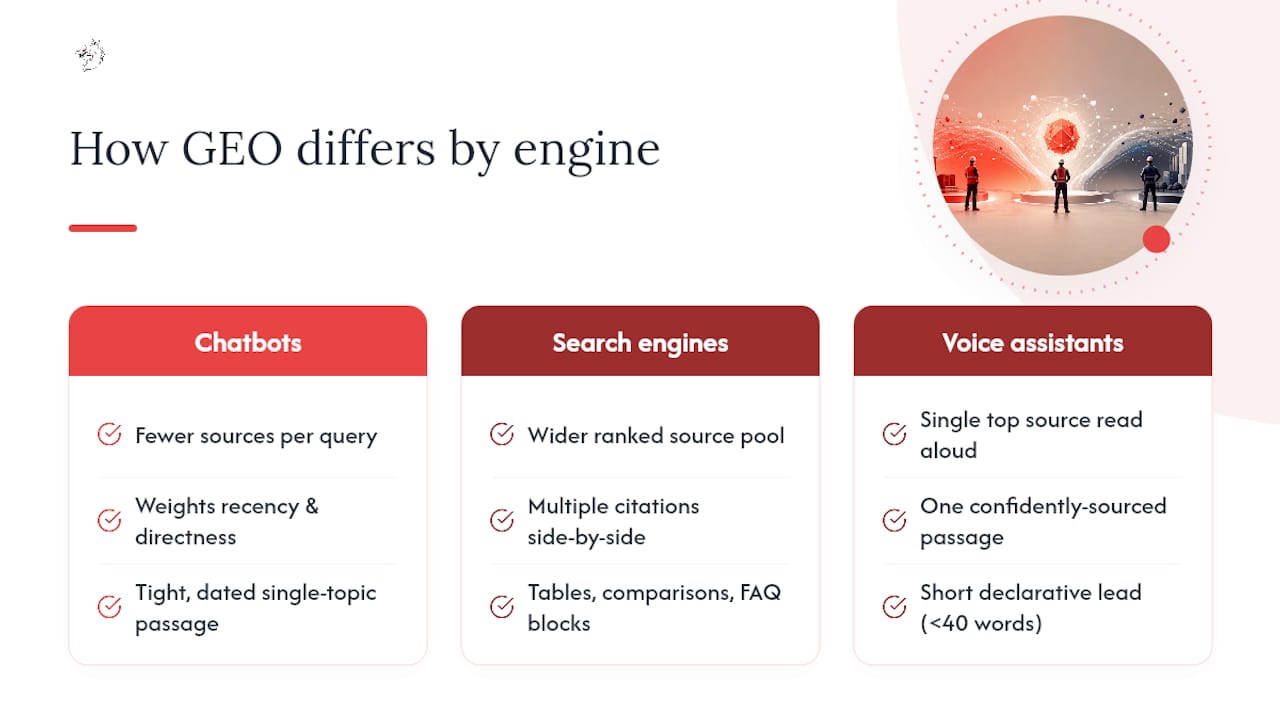
Chatbot interfaces like ChatGPT and Claude, when browsing is enabled, tend to retrieve fewer sources per query and weight recency and directness heavily. A tight, dated, single-topic passage outperforms a sprawling pillar page here because the model has less room to synthesize across sources.
Search-based answer engines, including Google's AI Overviews and Perplexity, pull from a wider set of ranked sources and often display multiple citations side by side. This is where classic ranking signals matter most, since the candidate pool is drawn directly from organic search results. Structured comparisons, tables, and FAQ blocks perform especially well because these engines visually surface multiple snippets at once.
Voice assistants add a harder constraint: only one answer gets read aloud, usually the single most confidently-sourced passage. That favors the shortest, most declarative answer passage on the page, ideally under 40 words, with no hedging language and a clear factual claim up front.
Practically, this means auditing your top pages by which engine actually cites you. A page that shows up in Google's AI Overview but never in a ChatGPT answer probably needs a shorter, more declarative lead passage, not more content.
Where GEO Fits Into a Long-Term Content Strategy
GEO doesn't replace SEO. It's additive, and it only pays off on pages that already have ranking foundation and something genuinely original to say. Prioritize it on commercial, high-value queries first, not your entire archive. Chasing every new tactic wastes effort that steady, monthly upkeep would spend better.
— Damian
Vaultio: Done-for-You GEO and AI Lead Conversion for Contractors
Running a contractor business means you don't have 90 days to spend rewriting passages and testing schema, so consider using general contractor software solutions to complement your GEO efforts effectively. Vaultio builds GEO directly into its AI SEO service, engineering your site's content, structured data, and citation signals so AI platforms and Google surface your business first when a customer asks who to call.
Visibility alone doesn't book jobs. That's why Vaultio pairs GEO work with an AI Chatbot & Scheduling system and an AI Receptionist that engage every new inquiry within seconds, so the leads your new AI citations generate actually convert into booked appointments instead of going cold. A steady flow of extra jobs every month is possible for contractors on done-for-you plans, backed by a 30-day money-back guarantee. If you run a plumbing, HVAC, electrical, or home service business and want your visibility work handled end to end, start with the done-for-you services page to see which package fits your market.
Sources
For deeper verification, start with the GEO-bench academic paper for the underlying data behind citation-boosting tactics, Microsoft's AEO and GEO guide for platform-level guidance, and Yoast's LLM SEO breakdown for implementation specifics on schema and llms.txt.
- —Generative Engine Optimization (GEO) — GEO-bench results (Aggarwal et al.)
- —From discovery to influence: A guide to AEO and GEO (Microsoft/ads guidance)
FAQ
What Is Generative Engine Optimization?
Generative engine optimization is the practice of structuring content, and proving its credibility, so AI systems like ChatGPT and Google AI Overviews cite it directly in generated answers rather than just linking to it.
How Is GEO Different From Traditional SEO?
Traditional SEO determines whether a page gets indexed and ranked at all, which remains a prerequisite for GEO. GEO adds a second layer on top: extractable passage structure, original data, and entity signals that determine whether a retrieved page actually gets quoted.
Does Adding Statistics Really Increase AI Citations?
Yes. GEO-bench experiments found that adding sourced statistics, quotations, and citations produced relative visibility improvements of roughly 30 to 40 percent in generative engine responses.
What Is llms.txt and Do I Need It?
llms.txt is a voluntary, root-level file that lists a site's priority content for language models to reference. It's low-cost and complementary to schema markup, not a replacement for it.
Can Vaultio Help With GEO for My Contracting Business?
Yes. Vaultio's AI SEO service builds GEO tactics, including structured data and passage optimization, directly into local visibility work for home service contractors, paired with AI lead response systems to convert that visibility into booked jobs.
Recommended
Ready to Implement This?
We'll build your complete lead generation system in 72 hours. No contracts. 30-day money-back guarantee.