AI Search Visibility: The 2026 Playbook for Marketers
# AI Search Visibility: The 2026 Playbook for Marketers
AI search visibility measures how often your brand is mentioned, cited, or recommended when AI engines like ChatGPT, Perplexity, Google AI Overviews, Claude, and Microsoft Copilot generate answers for your target queries. Your next move: run a 20-prompt audit across those five engines this week and log every mention, citation, and recommendation your brand earns.
Start here:
- —Sample 20 priority prompts from buyer-intent queries ("best HVAC contractor near me," "who fixes burst pipes fast") and brand queries ("Is [Your Brand] reliable?")
- —Test each prompt on ChatGPT, Google AI Overviews/Gemini, Claude, Perplexity, and Microsoft Copilot
- —Log three outcomes per result: mention (brand named, no link), citation (brand named with a source link), or recommendation (AI explicitly suggests your brand as the answer)
- —Check your robots.txt to confirm you are not blocking AI crawlers like GPTBot, ClaudeBot, or Google-Extended
- —Pick one tool or a plain spreadsheet to capture full AI responses and tag outcomes before your next team meeting
That audit is your baseline. Everything else builds from it.
*
Key Takeaways
AI search visibility is the metric that determines whether AI engines mention, cite, or recommend your brand — and it requires a fundamentally different measurement model than traditional SEO rank tracking.
| Point | Details |
|---|---|
| Run a 20-prompt audit first | Test buyer-intent, service, and brand queries across ChatGPT, Gemini, Claude, Perplexity, and Copilot this week. |
| Track six core metrics | Measure mention count, citation rate, recommendation count, share of voice, extractability, and answer depth every month. |
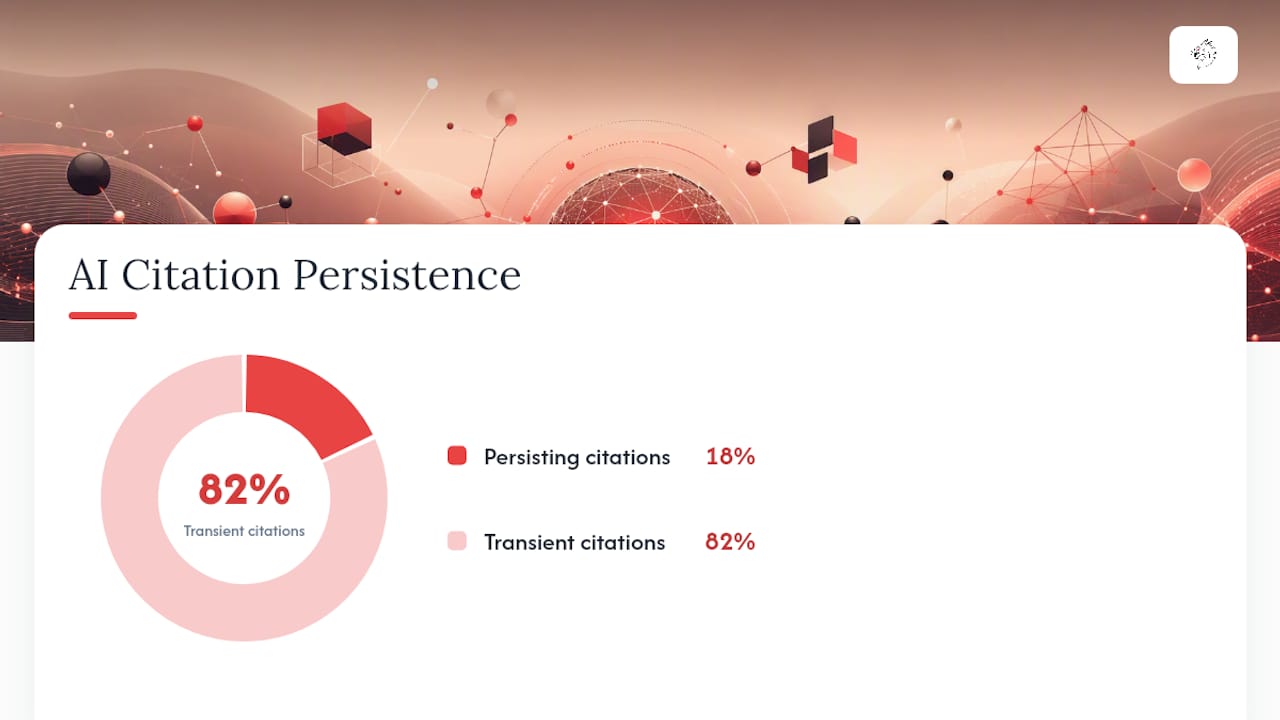
| Only 18% of AI citations persist | ACL 2026 research shows AI Overviews citations overlap just 18% across runs, so build for consistency, not fixed rankings. |
| Fix technical blockers first | Allow AI crawlers in robots.txt and serve key content in raw HTML; these are the fastest wins with the lowest effort. |
| Vaultio manages the full loop | Done-for-you audit, content production, schema, and AI lead capture — backed by a 30-day money-back guarantee. |
*
Table of Contents
- —What does AI search visibility actually cover?
- —Which metrics should you track for AI search visibility?
- —How do you run an AI visibility audit that produces repeatable data?
- —What tool categories do you need for AI visibility tracking?
- —What content and technical tactics actually get you cited?
- —How do you turn AI visibility tracking into recurring work?
- —Why is AI search visibility so volatile, and what should you do about it?
- —Vaultio delivers managed AEO and lead capture for home-service brands
- —DIY tooling vs. a managed partner: the real tradeoffs
- —Sources
What does AI search visibility actually cover?
Traditional SEO measures where your page ranks in a list of ten blue links. AI search visibility measures something different: whether an AI engine pulls your content into a synthesized answer, names your brand, and points users toward you. The unit of success shifts from page rank to passage extraction and entity citation.
The surfaces you must track in 2026 span five major engines:
- —Google AI Overviews and AI Mode — Google's AI Overviews appear above organic results for millions of queries. Google is now expanding AI Mode, a Gemini-powered experience that returns conversational, agent-capable responses with follow-up questions instead of a standard results page. Track both surfaces separately.
- —ChatGPT — OpenAI's assistant handles hundreds of millions of queries weekly and cites web sources when Browse is active. Home-service buyers increasingly ask it for contractor recommendations.
- —Claude — Anthropic's model is gaining ground in professional and research contexts and pulls from indexed web content when connected.
- —Perplexity — Built as an answer engine from day one, Perplexity cites sources inline on almost every response, making citation tracking straightforward.
- —Microsoft Copilot — Integrated into Windows, Edge, and Microsoft 365, Copilot reaches a broad commercial audience and draws on Bing's index.
The core shift: AI engines do not rank pages. They synthesize passages. A brand that ranks #4 organically but has a clean, extractable 150-word answer block can appear in an AI Overview while the #1 organic result gets ignored entirely. Answer-engine optimization (AEO) is the discipline that closes that gap.
The three outcome types matter for different business reasons. A mention builds brand familiarity but drives no direct traffic. A citation (linked mention) can send referral traffic and signals authority to the model. A recommendation ("call [Brand] for this job") is the highest-value outcome: it directly influences purchase decisions at the moment of intent.
For local service businesses tracking AI discovery, the recommendation outcome is the one that fills the phone.
*
Which metrics should you track for AI search visibility?
Define your measurement model before you touch a single tool. These are the six metrics that matter, plus the secondary signals that explain why your numbers move.
| Metric | Definition | How to quantify |
|---|---|---|
| Mention count | Times your brand appears in AI responses (linked or unlinked) | Count per prompt set per engine per run |
| Citation rate | Linked citations ÷ total appearances | Percentage; track weekly or monthly |
| Recommendation count | Responses where AI explicitly names your brand as the answer | Raw count; flag the exact prompt and engine |
| Share of voice | Your citations ÷ total citations across all brands in the prompt set | Percentage; compare to category average |
| Extractability score | Proportion of your pages that contain a self-contained answer block under a matching heading | Audit-based; score 0–100 per page |
| Answer depth | Word count of your content used verbatim or near-verbatim in the AI response | Estimate by comparing response excerpt to source passage |
Secondary signals feed these primary metrics. Log them during your technical audit:
- —Crawlability: Are GPTBot, ClaudeBot, PerplexityBot, and Google-Extended allowed in robots.txt?
- —Schema presence: Does the page carry Article, FAQ, HowTo, or Organization markup from Schema?
- —Last-updated timestamp: Visible publish/update dates signal freshness to retrieval systems.
- —Off-site entity mentions: Brand mentions on review platforms (Google Business Profile, Yelp, Angi), industry directories, and forums build entity salience independent of your own site.
- —Bot access logs: Server logs confirm whether AI crawlers are actually fetching your pages.
Understanding how AI ranks home service companies comes down to these signals working together, not any single factor.
*
How do you run an AI visibility audit that produces repeatable data?
Reproducibility is the whole game. AI outputs shift between runs, so your audit protocol must be consistent enough to detect real change rather than noise.
Step 1: Build your prompt set
Select 20–50 prompts across three query types:
- 1.Buyer-intent queries — "best plumber in [city]," "emergency HVAC repair near me," "licensed electrician for panel upgrade"
- 2.Product/service queries — "how much does a roof replacement cost," "what's included in an HVAC tune-up"
- 3.Brand queries — "[Your Brand] reviews," "is [Your Brand] licensed and insured"
Step 2: Run each prompt on all five engines
Test ChatGPT, Google AI Overviews/Gemini, Claude, Perplexity, and Microsoft Copilot. For each prompt, run three variants:
- —Concise — "best plumber in Santa Barbara"
- —Conversational — "who's the best plumber to call in Santa Barbara right now"
- —Multi-part — "I need a licensed plumber in Santa Barbara for a water heater replacement — who do you recommend and why"
That gives you up to 150 data points per audit cycle (50 prompts × 3 variants). Even a 20-prompt set with three variants across five engines yields 300 individual responses.
Step 3: Capture and tag every response
For each response, record:
- —Full AI response text (copy-paste or screenshot)
- —Source links cited (if any)
- —Exact excerpt that references your brand or a competitor
- —Outcome tag: mention, citation, or recommendation
- —Engine and prompt variant used
Store everything in a shared spreadsheet with columns for Date, Engine, Prompt, Variant, Outcome, Source URL, and Excerpt. This structure lets you pivot by engine, query type, or time period.
Step 4: Apply attribution rules
Map each AI excerpt back to the specific page and passage it came from. Check whether the cited URL matches the page that actually contains the passage — AI engines sometimes cite a homepage when the answer lives on a service page. Flag ambiguous sourcing (AI synthesizes from multiple pages without citing any) as a separate tag.
Pro Tip: Before each audit run, clear your browser cache and use a private window or a fresh API call to avoid personalization bias skewing results.
AI search selection follows a pipeline: discovery, retrieval, extraction, synthesis, citation. Pages fail at the discovery stage when crawlers are blocked, at extraction when content is JavaScript-only, and at synthesis when passages are too vague to stand alone. Your audit reveals exactly where in that pipeline you are losing ground.
*
What tool categories do you need for AI visibility tracking?
No single tool covers the full loop. You need capabilities across four categories, and the right mix depends on your team size and query volume.
Prompt monitoring and visibility trackers run your prompt set on a schedule and log brand appearances across engines. Look for: configurable prompt libraries, multi-engine coverage, outcome tagging (mention/citation/recommendation), and exportable reports. Sampling cadence should be at least monthly; weekly is better for competitive categories.
Answer-source monitors focus specifically on which URLs AI engines cite. Key features: passage-level attribution (not just domain), alert thresholds when citation rate drops, and integration with GA4 to correlate AI referral traffic with citation events.
Technical crawlers that simulate AI bots check whether your pages are accessible to GPTBot, ClaudeBot, and similar agents. They flag JavaScript-rendered content, blocked paths in robots.txt, and missing structured data. Run these quarterly or after any major site change.
Structured data validators confirm that your schema.org markup is syntactically correct and matches the content on the page. Google's Rich Results Test and Schema Markup Validator are the standard references.
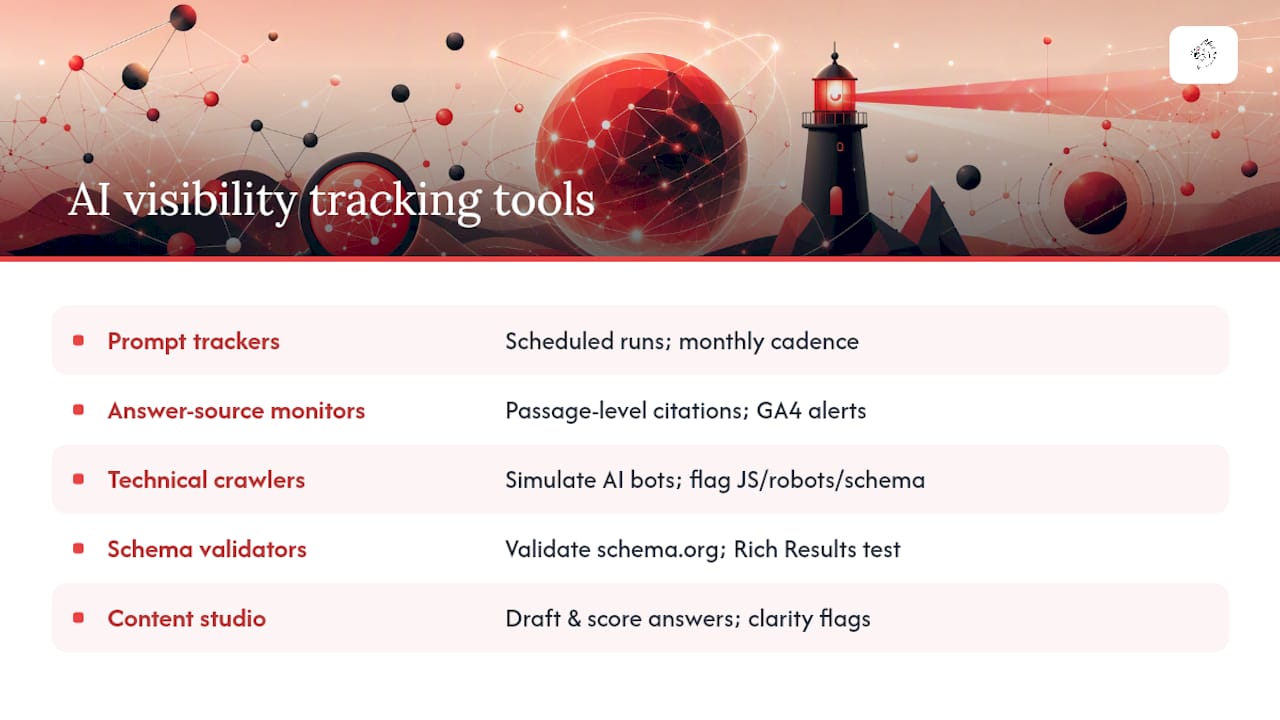
Content studio tools help you draft and score answer-first capsules before publishing. The best ones flag passages that are too long, lack a clear noun referent, or bury the answer in the third paragraph.
Buy vs. build checklist
- —Build a manual stack if you monitor fewer than 100 prompts per month, have a dedicated analyst, and need full data ownership.
- —Buy a paid tool if you track 100+ prompts, need weekly cadence, or want automated alerting and GA4 integration without engineering time.
- —Justify the spend when your citation rate improvement translates to measurable AI-referral traffic in GA4 — that is the ROI signal that earns budget approval.
*
What content and technical tactics actually get you cited?
Getting cited by an AI engine requires passing three tests: your page must be crawlable, your content must be extractable, and your brand must be recognized as a credible entity. Structured and extractable content — answer-first capsules, FAQs, and tables — correlates with higher inclusion in AI answers.
Write answer-first capsules
Place a 120–150 word, self-contained answer block directly under each targeted H2. The block must answer the question completely without requiring the reader to scroll further. Use a clear noun referent in the first sentence (not "it" or "this service" — name the thing). This is the single highest-leverage content change you can make.
Use the right schema types
Mark up your content with schema.org vocabulary. Priority types for home-service brands:
- —Article — for blog posts and guides
- —FAQPage — for Q&A sections (pairs directly with answer capsules)
- —HowTo — for step-by-step service explanations
- —Organization — for your business entity, including name, address, phone, and service area
- —LocalBusiness / HomeAndConstructionBusiness — for location-specific service pages
Schema does not guarantee AI citation, but it labels your content machine-readably and reduces ambiguity during extraction.
Build entity salience off-site
Unlinked brand mentions on third-party platforms — Google Business Profile, Yelp, Angi, HomeAdvisor, local news sites, and industry forums — signal to AI retrieval systems that your brand is a recognized entity. AI ranking factors for home services consistently show that off-site corroboration matters as much as on-page optimization. Prioritize getting your business name, category, and service area mentioned consistently across those platforms.
Fix technical blockers
- —Allow AI crawlers explicitly in robots.txt: `User-agent: GPTBot`, `User-agent: ClaudeBot`, `User-agent: PerplexityBot`, `User-agent: Google-Extended`
- —Many AI crawlers do not execute JavaScript — serve critical content in raw HTML or use server-side rendering
- —Add a visible last-updated timestamp to every service page and guide
- —Keep page load under 3 seconds; slow pages get deprioritized during high-volume retrieval
Pro Tip: Add at least one original statistic or a direct quote from a named source to each key page. Experimental research cited by CrawlRaven's LLM SEO guide found that original data points materially lift AI citation rates — AI engines favor content that adds something no other page says.
| Tactic | Impact area | Effort |
|---|---|---|
| Answer-first capsules (120–150 words) | Extractability, answer depth | Medium |
| FAQPage + HowTo schema | Extraction accuracy, entity labeling | Low |
| Allow AI bots in robots.txt | Discovery, crawlability | Very low |
| Server-side render key content | Discovery (JS-blocked pages) | High |
| Off-site brand mentions (GBP, Yelp, Angi) | Entity salience, recommendation rate | Medium |
| Original statistics or quotes per page | Citation rate | Medium |
| Visible last-updated timestamps | Freshness signals | Very low |
*
How do you turn AI visibility tracking into recurring work?
Measurement without a cadence is just a one-time project. Embed these rhythms into your marketing calendar.
Monthly: Run your full prompt set across all five engines. Log mention, citation, and recommendation counts. Update your share-of-voice calculation. Flag any new competitor citations that appeared.
Quarterly: Run a full technical audit — crawlability check, schema validation, bot log review, and page speed audit. Refresh any answer capsules that dropped in citation rate.
Continuous: Maintain a content priority queue. New services get a schema-marked page within two weeks of launch.
Dashboard KPIs and alerting
| KPI | Target | Alert threshold |
|---|---|---|
| Share of voice (prompt set) | Grow month-over-month | Drop of several percentage points |
| Citation rate | Track trend | Two consecutive months declining |
| Recommendation count | Increase per quarter | Zero recommendations for 30 days |
| AI-referral traffic (GA4) | Track as separate channel | 20% month-over-month drop |
Set up GA4 to capture AI referral traffic by filtering for sessions from ChatGPT.com, Perplexity.ai, Bing Copilot, and similar AI-origin domains. This connects your citation data to actual business outcomes.
Roles and responsibilities
- —Marketing manager: owns the prompt set, monthly reporting, and stakeholder KPIs
- —Content owner: writes and refreshes answer capsules, maintains the priority queue
- —SEO specialist: runs technical audits, validates schema, monitors bot logs
- —Developer: implements server-side rendering, robots.txt updates, and site speed fixes
- —External agency/partner: manages tool stack, prompt monitoring cadence, and cross-engine reporting
Timeline expectations: Quick wins (robots.txt fixes, schema additions, 3 answer capsules) show up in audit data within 2–6 weeks. Foundational work (full content refresh, entity building across review platforms) takes 2–3 months to move citation rate. Stabilization and consistent share-of-voice growth is an ongoing effort, not a finish line. AI lead capture integration should be live before citation rates climb — you want the phone to ring when the AI sends someone your way.
*
Why is AI search visibility so volatile, and what should you do about it?
The instability is not a bug. It is a structural property of how generative retrieval works. Research published at ACL 2026 found that only 18% of pages cited by Google AI Overviews were common between two runs of the same queries spaced two months apart — compared to 45% overlap for traditional organic results. That is not a minor fluctuation. It means the majority of your AI citations can disappear and reappear with no change to your site.
Your competitors may be getting cited from a forum post or a directory listing you have never tracked.
What this means for your strategy:
- —Stop optimizing for a fixed citation position. There is no "rank 1" in AI answers. Focus on being consistently extractable across a wide range of prompt variants.
- —Distribute your entity mentions. The more platforms that mention your brand accurately, the more retrieval paths exist for AI engines to find you.
- —Test reproducibly. Run the same prompt set, same engines, same variants every month. Variance between runs is noise; trends across three or more runs are signal.
- —Prioritize extractability over volume. One perfectly structured 150-word answer block outperforms ten vague paragraphs that bury the answer.
The practical shift: move from chasing citations to becoming a consistent, extractable source that AI engines can rely on regardless of which run they are on.
*
Vaultio delivers managed AEO and lead capture for home-service brands
Most home-service contractors do not have an in-house SEO specialist, a content team, and a developer available to run monthly prompt audits, refresh answer capsules, and fix JavaScript rendering issues. That is the gap Vaultio fills — and it fills it fast.
Vaultio's done-for-you service covers the full AEO execution loop: AI visibility audit, prompt monitoring, answer-capsule content production, schema implementation, robots.txt and technical fixes, and Google Local Service Ads management. When your citation rate climbs and a buyer asks ChatGPT or Perplexity who to call, Vaultio's AI lead response system engages that inquiry within seconds — before your competitors even see the notification.
The result contractors see: 10–15 extra booked jobs per month, measurable AI-referral traffic growth in GA4, and a brand that shows up first whether the buyer searches Google, asks an AI, or checks a review platform.
30-day money-back guarantee. No long-term lock-in to start.
Ready to own your market on every AI engine? See what Vaultio delivers for home-service brands or get a local SEO quote for your area and find out exactly where your AI visibility stands today.
*
DIY tooling vs. a managed partner: the real tradeoffs
The honest answer is that both paths work — for different teams.
DIY makes sense when you have a dedicated marketing analyst who can commit 8–12 hours per month to prompt testing, a developer who can implement schema and server-side rendering changes within a week, and a content writer who understands answer-first structure. Data ownership is a real advantage: you control the prompt set, the methodology, and the raw outputs. The cost floor is low — a spreadsheet and manual testing costs nothing except time.
The managed path wins on speed and local execution. A managed partner brings a pre-built prompt library, multi-engine monitoring tools, and a content production process that does not compete with your team's other priorities. For home-service brands where the goal is booked jobs, not marketing sophistication, the faster path to citations and lead capture usually justifies the monthly fee.
Ask yourself these questions before deciding:
- —Does your team have 10+ hours per month available specifically for AI visibility work?
- —Can you implement technical changes (robots.txt, schema, server-side rendering) within two weeks of identifying them?
- —Do you need localized lead capture tied directly to AI citation growth?
- —Is your monthly query volume above 100 prompts across five engines?
If you answered no to two or more, a managed engagement is likely faster and cheaper than building the capability in-house.
Pro Tip: Pilot any managed engagement with a 60-day scope: one full prompt audit, three answer capsules, schema implementation on five pages, and a technical fix list. That scope is small enough to price fairly and large enough to show measurable citation movement before you commit to a longer contract.
*
Sources
Recommended
Ready to Implement This?
We'll build your complete lead generation system in 72 hours. No contracts. 30-day money-back guarantee.