40–80 Word Answers That Get Cited in AI Overviews for SEO Teams
# 40–80 Word Answers That Get Cited in AI Overviews for SEO Teams
Yes, you can optimize for AI Overviews, and the payoff is real: pages that get cited win visibility even when clicks drop. Start with three moves. Confirm every target page is indexed and snippet-eligible, write a 40 to 80 word answer at the top of each section, and start tracking citation rate this week. Local businesses need one more layer: entity signals that prove context, not just proximity.
*
TL;DR: - Ensuring your top pages have clear, citable definition sentences and sourced statistics within the first 80 words is crucial for AI overview citations. - Confirm all pages are properly indexed, free of blocking tags, load quickly, and have accurate schema to qualify for retrieval and citation by Google's AI system. - Structuring content as direct questions with concise answers and linking to sources increases the likelihood of being cited in AI-generated summaries. - Local businesses must focus on maintaining consistent entity signals like updated Google Business Profiles and structured schema to boost local AI visibility. - Regularly monitor citation rates and adjust answer content, schema, and technical SEO to leverage AI Overviews and improve downstream engagement.
*
Table of Contents
- —How AI Overviews Work: RAG, Grounding, and Citation Behavior
- —Eligibility and Technical Requirements Every Page Must Pass
- —How Do You Write Content AI Overviews Will Cite?
- —Which Schema Types Help Pages Get Cited?
- —What KPIs Should You Track for AI Overview Visibility?
- —What Does Local 5.0 Mean for AI Overviews?
- —Risks, Attribution, and Content Controls
- —How Vaultio Applies This Playbook for Contractors
- —What Should Teams Prioritize in the Next 90 Days?
- —Get the AI Overview Playbook Built Into Your Marketing
- —Sources
- —FAQ
How AI Overviews Work: RAG, Grounding, and Citation Behavior
AI Overviews run on retrieval-augmented generation, or RAG. Google's own documentation confirms the system pulls from indexed, snippet-eligible pages and stitches those passages into a generated answer, rather than inventing one from a static model alone. A "supporting link" in this context is any page the system retrieved and quoted from, in whole or in part, to construct its answer.
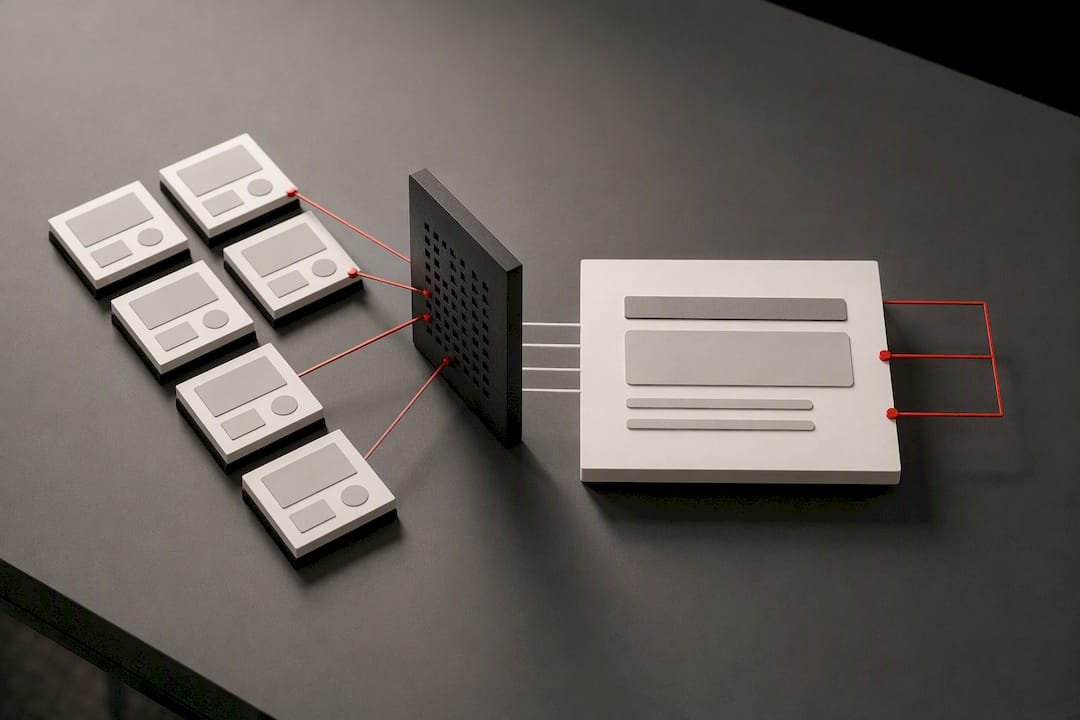
That retrieval step changes what "ranking" means. Traditional search rewards a page for matching intent across a full document. AI Overviews reward whichever three or four sentences on that page answer the question most cleanly. The system does not read your page. It extracts from it.
What gets extracted tends to fall into a narrow set of shapes: definition sentences ("X is Y"), a stat paired with its source, or a short numbered sequence of steps. Google's AI features guidance makes clear that indexing and snippet eligibility are prerequisites, not guarantees, for a page to be pulled into an overview.
Statistic Callout: Pew Research found that users click through to source pages less often when an AI summary appears above the results. Citation without a click is still worth measuring, but it no longer guarantees traffic.
The practical implication is blunt: ranking #1 no longer guarantees visibility if your top passage is not written in a citable shape. Here are three things worth doing immediately:
- —Audit your top 20 pages for a clean definition sentence in the first 80 words.
- —Check whether your best stats have a named source attached in the same sentence.
- —Rewrite any answer buried in paragraph four to sit in paragraph one instead.
Eligibility and Technical Requirements Every Page Must Pass
None of the content tactics below matter if a page fails Google's baseline. AI Overviews inherit the same crawl and index requirements as regular search, and Google's generative AI optimization guide states there are no extra technical hoops beyond being indexed and eligible to show a snippet. Foundational SEO is still the floor.
Work through this sequence before touching a single headline:
- 1.Confirm indexing. Use Search Console's URL Inspection tool to verify the page is indexed, not just crawled.
- 2.Check for blocking directives. A `noindex` tag removes a page from consideration entirely; `nosnippet` blocks it from ever being quoted, even if indexed.
- 3.Audit robots.txt. A single disallowed directory can silently remove an entire content cluster from eligibility.
- 4.Verify rendering. If content loads via JavaScript that Googlebot struggles to execute, the extractable text may never reach the index.
- 5.Test page experience basics. Slow load times and intrusive interstitials still suppress ranking, which suppresses retrieval odds.
- 6.Request recrawl after changes. Submit the URL through Search Console once you've restructured a page, rather than waiting for the next natural crawl cycle.
- 7.Monitor AI-feature performance. Search Console's Performance report increasingly separates AI Overview appearances from standard results. Check it monthly.
Skip any one of these and the rest of this playbook is wasted effort. A beautifully written answer sitting behind a `noindex` tag is invisible to both Google and the reader.
How Do You Write Content AI Overviews Will Cite?
The answer format matters more than the topic. Structure each section as a direct response to a question, and put the answer in the first 40 to 80 words, before any throat-clearing or backstory. Practitioner data from LLM Pulse shows this pattern consistently correlates with higher citation rates across tested query sets.
Four formatting habits separate citable pages from ignored ones:
- —Use question-format H2s and H3s. "How Long Does a Water Heater Last?" outperforms "Water Heater Lifespan Information" because it mirrors how the AI decomposes the user's actual query.
- —Lead with a definition sentence. "A tankless water heater is a unit that heats water on demand rather than storing it" gives the system a clean, quotable unit of meaning.
- —Attach a source to every stat. A number without provenance is far less likely to be lifted into an answer than one with a named source in the same sentence.
- —Keep paragraphs to three sentences or fewer. Long paragraphs bury the extractable sentence inside noise the model has to parse around.
Bullets and small tables help when you're presenting steps, comparisons, or ranges. Bold the term you're defining on first use. Save FAQ schema for questions with genuinely short answers. Google can't cite a 300-word FAQ answer as a snippet, so keep each one to two or three sentences that stand alone without the rest of the page for context.
Pro Tip: Write your H2 as the exact question a customer would type into Google, then answer it in the very next sentence before you explain anything else. If you can't answer your own heading in one sentence, the heading is wrong, not the content.
This is also where AI-friendly content templates built for specific trades tend to outperform generic blog frameworks. A plumbing FAQ written like a general marketing article rarely produces a citable sentence; one written like an actual customer question usually does.
Which Schema Types Help Pages Get Cited?
JSON-LD is the preferred format because it separates structured meaning from display code, which reduces the odds Google misreads your markup. The schema types worth prioritizing for AI Overview eligibility are Article, FAQPage, and HowTo, each matched to content that genuinely fits the format. HubSpot's analysis of AI Overview optimization confirms schema accuracy, not schema volume, drives results.
The rule that matters most: your markup has to match what a visitor actually sees on the page. Inflated or mismatched schema, like an FAQPage schema wrapping content that isn't really a Q&A, tends to get ignored or, worse, flagged.
Run this checklist before publishing:
- —Byline and publish date are present and visible on the page, not just in the markup.
- —FAQPage answers in the schema match the visible answer length, roughly two to three sentences each.
- —HowTo steps in the markup mirror the numbered steps a reader actually sees.
- —Every schema block passes Google's Rich Results Test without warnings.
What KPIs Should You Track for AI Overview Visibility?
Citation rate is the percentage of your target queries where an AI Overview appears and cites your domain as a source. Share of answer measures how much of the generated response your content contributed relative to competing sources cited in the same overview. Both need to be tracked at the query-cluster level, not the individual keyword level, because AI Overviews group related questions together in ways traditional rank trackers don't.
Build the measurement loop like this:
- 1.Baseline your top 50 query clusters before making structural changes, noting whether an AI Overview appears at all and who gets cited.
- 2.Push structural edits (answer-first rewrites, schema fixes) to a test group of pages, leaving a control group untouched.
- 3.Recrawl and monitor weekly using Search Console plus a third-party AI-overview tracker, since Google's own reporting on AI features still lags standard rank data.
- 4.Tie citation lifts to conversions, not just visibility, by cross-referencing which cited pages also drove form fills or calls.
Statistic Callout: Practitioner data compiled by Search Engine Land points to an "authority halo" effect, where businesses cited in AI Overviews see stronger downstream engagement than competitors excluded from the same overview. Getting cited is not just a vanity metric; it correlates with who the searcher trusts next.
Read our AI search ranking factors guide for a deeper breakdown of which signals move citation rate fastest for service-area businesses specifically.
What Does Local 5.0 Mean for AI Overviews?
Local 5.0, a framework described by Search Engine Land, argues that AI-driven local visibility now rewards validated context across multiple sources rather than proximity or listing completeness alone. Being three miles closer to the searcher no longer wins if a competitor's Google Business Profile carries stronger, more consistent evidence.
That evidence comes from a specific set of signals worth auditing this quarter:
- —Google Business Profile completeness, including services, service areas, and photos updated within the last 90 days.
- —Structured local business schema on your site that matches your GBP listing exactly, not an outdated version.
- —Review velocity and response rate, since AI systems appear to weight recency and owner engagement, not just star average.
- —Consistent NAP data (name, address, phone) across your website, GBP, and every directory that lists your business.
The hard part isn't collecting these signals once. It's governing them so they stay consistent as your business grows, adds locations, or changes phone systems. A generative AI local ranking guide covers how a designated source-of-truth record, maintained through automation rather than manual spreadsheet updates, keeps that consistency intact across dozens of directories at once.
Risks, Attribution, and Content Controls
Three risks come with AI Overview visibility: hallucination (the AI misstates your claim), misattribution (it credits a competitor for your data), and copyright exposure when your content gets lifted into a summary without context. Review any Creative Commons licensing terms before assuming reuse of your own visuals or text is unrestricted elsewhere.
- —Use `nosnippet` on pages you don't want quoted at all, and `data-nosnippet` on specific page sections you want indexed but never extracted.
- —Set `max-snippet` limits if you want partial visibility without full-paragraph extraction.
- —Check AI-generated citations of your brand monthly and request corrections through Search Console when Google misrepresents a claim.
How Vaultio Applies This Playbook for Contractors
Some providers combine top search rankings with fast lead response, engaging new inquiries quickly so contractors capture customers competitors lose. That speed matters because a citation without a fast follow-up is a wasted lead.
- —AI SEO work applies the answer-first structure and schema checklist above directly to service pages.
- —GBP hygiene and review management address the Local 5.0 signals covered earlier.
- —AI chatbots and lead scoring convert the traffic citation work generates before a competitor's team calls back first.
Case studies and author credentials for this playbook are available on request through Vaultio's contractor resources.
What Should Teams Prioritize in the Next 90 Days?
Start with technical health, not content volume. A single indexed, well-structured FAQ answering your highest-value query beats twenty pages nobody can retrieve. Ship one extractable answer per priority cluster, measure citation rate weekly, and let the data tell you where to expand next.
Don't drop traditional SEO work to chase AI citations. The two overlap almost entirely, and Google's own guidance treats generative features as additive, not a replacement for indexability and page experience fundamentals. Treat this as a new layer on a foundation you still need to maintain.
— Damian
Get the AI Overview Playbook Built Into Your Marketing
Reading the checklist is one thing. Having someone rebuild your service pages, fix your schema, and monitor citation rate every week is another. Vaultio's AI SEO service applies this exact playbook to contractor websites, pairing answer-first content structure with the Google Business Profile hygiene that Local 5.0 now demands.
Some companies build their models around measurable job bookings each month, sometimes offering money-back guarantees, so the work described above isn't a one-time audit that gathers dust. It may be paired with an AI-powered lead response system that engages new inquiries quickly, aiming to turn visibility into booked jobs instead of missed calls. If you run a plumbing, HVAC, electrical, roofing, or cleaning business and want your service pages structured for citation instead of guesswork, explore the done-for-you service packages built specifically for home service contractors, or start with the SaaS tools if you want to run the content engine in-house first.
Sources
Google's AI features documentation is the only primary source for how AI Overviews retrieve and cite content, and it should be your first stop whenever Google updates the feature. Pew Research's work on declining click-through when AI summaries appear explains why citation rate now matters as much as rank position. For tactical validation beyond this playbook, Babylovegrowth's AI Overviews guide covers additional citation tactics worth testing.
- —AI features and your website | Google Search Central
- —Google users are less likely to click on links when an AI summary appears
- —How to Optimize for Google AI Overviews
- —How to Optimize for Google AI Overviews — HubSpot
FAQ
Is There an AI Tool for SEO?
Yes, several tools now track AI Overview citations specifically, alongside traditional rank trackers, and Vaultio's AI SEO Content Engine is built to structure content for both traditional ranking and AI citation simultaneously. Most standard rank trackers still don't separate AI Overview appearances from regular results, so a dedicated tool or manual query audit remains necessary.
What Is the 80/20 Rule in SEO?
Focus technical fixes and answer-first rewrites on your highest-value query clusters first rather than spreading effort evenly across your entire site.
How Do You Do SEO for AI Search?
Confirm every target page is indexed and snippet-eligible, then rewrite the first 40 to 80 words of each section to directly answer the heading's question. Add accurate JSON-LD schema, track citation rate by query cluster, and layer in Local 5.0 signals like GBP completeness if you serve local customers.
What Is AI SEO Called Now?
Practitioners use several overlapping terms, including AI Overview optimization, generative engine optimization, and simply AI Overviews SEO, but no single term has become the standard yet. All describe the same underlying work: structuring content so retrieval-augmented systems like Google's can extract and cite it accurately.
Does Optimizing for AI Overviews Hurt Regular SEO Rankings?
No, the tactics reinforce each other. Answer-first structure, clean schema, and strong technical health are foundational SEO practices that Google's own guidance confirms support both traditional rankings and AI Overview eligibility at the same time.
Recommended
Ready to Implement This?
We'll build your complete lead generation system in 72 hours. No contracts. 30-day money-back guarantee.