Two Way Texting for Contractors: Book 10–15 Extra Jobs a Month
# Two Way Texting for Contractors: Book 10–15 Extra Jobs a Month
Two way texting lets a business send a text and receive the customer's reply in that same conversation thread, instead of blasting a message into the void. That single shift turns SMS from a broadcast tool into a live conversation, which is why it drives faster confirmations, fewer no shows, and higher conversion than one way alerts. It only works legally when the recipient has opted in first.
*
TL;DR: - Two way texting supports real-time conversations with customers, enabling faster confirmations and higher response rates compared to one way SMS broadcasts. - The platform must include a conversation inbox, automation rules, MMS support, delivery reporting, and integrations to be effective at scale. - Using long codes or toll-free numbers depends on volume needs, with carriers not guaranteeing message order, requiring timestamp-based conversation reconciliation. - Compliance requires explicit opt-in, clear consent language, proper A2P registration, and support for STOP and HELP keywords to avoid regulatory and carrier issues. - Starting with simple appointment confirmation flows and testing fallback options helps prevent over-automation and customer frustration before scaling up.
*
Table of Contents
- —What Is Two Way Texting and How Is It Different From One Way SMS?
- —How Two Way Texting Works Behind the Scenes
- —What Features Actually Matter in a Two Way Texting Platform
- —Where Two Way Texting Actually Pays Off
- —Staying Compliant: Consent, TCPA, and Carrier Rules
- —Building the Workflow: From Platform Choice to Live Pilot
- —How Vaultio Builds Two Way Texting Into a Managed System for Contractors
- —What to Pilot First, and the Trap Most Teams Fall Into
- —Get Two Way Texting Running Without Hiring for It
- —Sources
What Is Two Way Texting and How Is It Different From One Way SMS?
One way SMS is a megaphone. You send a reminder, a promo, or an alert, and the message ends there. The customer can't reply, and if they try, it either bounces or lands in a dead inbox nobody checks. That's how most mass texting tools worked for the better part of a decade, and it's still how a lot of businesses use SMS today.
Two way texting flips that. The customer can text back "YES," "RESCHEDULE," or a question, and that reply shows up in a live thread the business can see and act on. Vendor documentation on two-way SMS messaging describes it as viewing incoming texts alongside customer profile context, so the person answering isn't working blind. That context matters more than it sounds. A reply of "can we do Tuesday instead" means nothing without knowing which appointment, which customer, and which service it refers to.
The industry term for this is conversational SMS, and it's worth knowing that phrase because most platform documentation and compliance guidance uses it instead of "two way texting." Interactive texting, SMS conversation tools, and message reply features all point at the same capability. Whatever you call it, the mechanics are the same: inbound and outbound messages live in one thread, and someone or something on your end is watching for the reply.
How Two Way Texting Works Behind the Scenes
Every two way conversation runs on a message flow with two directions, a process seamlessly supported by reliable communications providers offering robust messaging services. Outbound messages leave your platform, hit a carrier network, and land on the customer's phone. Inbound replies travel the same path in reverse, get parsed by your platform, and route into a conversation view or trigger an automated action. The number you send from determines a lot about how that flow performs.
Here's what businesses actually choose between:
- —Long codes (standard 10-digit numbers) support two-way conversations at moderate volume and work well for appointment reminders, service updates, and support threads.
- —Short codes (5 or 6 digit numbers) handle high-throughput broadcast and reply volume, common for large retail or alert programs, but cost more to lease and take longer to provision.
- —Toll-free numbers now support two-way SMS at reasonable throughput and are often the fastest to get verified for a new program.
The throughput and cost trade-offs matter most once volume climbs. A plumbing company texting 200 appointment confirmations a week has very different needs than a national retailer texting 200,000 promotional replies a day.
Keywords are the other piece of the machinery. When a customer replies "STOP," "HELP," "YES," or a custom word you've configured, the platform parses that reply and fires a rule: unsubscribe them, escalate to a human, confirm the appointment, or route them into a different flow. This is where most of the automation value in two way texting actually lives, not in the sending, but in what happens after the reply arrives.
One technical detail that trips up more implementations than it should: carriers do not guarantee message order. Two texts sent seconds apart can arrive out of sequence, and replies can be delayed by network congestion. Platform guidance from Amazon's two-way SMS documentation is direct about this: applications must reconcile conversations by timestamp, not by the order messages happen to arrive. Build a booking flow that assumes arrival order matches send order, and you'll eventually double book a slot or confirm the wrong appointment.
What Features Actually Matter in a Two Way Texting Platform
Plenty of texting software solutions market themselves as "two way capable" without the feature depth that makes conversations manageable at scale. Here's what separates a usable platform from one that looks good in a demo:
- —Conversation inbox with contact context — every inbound message shows customer history, not just the raw text, so whoever replies isn't starting from zero.
- —Automation rules — keyword routing, autoreplies for common questions, and escalation triggers that hand a conversation to a human when it gets complicated.
- —MMS support — the ability to send and receive photos, which matters for service businesses when a customer texts a picture of a leaking pipe or a broken unit instead of trying to describe it.
- —Analytics and delivery reporting — open rates, response rates, and delivery failures broken out by campaign, not buried in a generic dashboard.
- —Integration options — an API or native connector into your CRM or scheduling system so a reply doesn't just sit in a texting app disconnected from the rest of your operation.
Industry engagement data explains why this feature set gets built out aggressively. CTIA's annual survey points to messaging as one of the highest-engagement channels available to businesses, and that engagement is worthless if the reply lands in a tool nobody's watching. A platform without a real conversation inbox turns a high-response channel into a pile of unread texts.
MMS deserves a specific mention here because it's the difference between "describe your problem" and "show me your problem." Home service businesses in particular lean on this: a homeowner can text a photo of a water heater's model plate or a cracked roof tile, and that single image often replaces five minutes of back-and-forth questions.

Where Two Way Texting Actually Pays Off
The use cases below aren't theoretical. Each one maps to a specific business outcome, and most can be piloted with a single automation rule and a template.
- 1.Appointment reminders with reply options. A message like "Reminder: your HVAC tune-up is tomorrow at 2 PM. Reply YES to confirm or RESCHEDULE to pick a new time" turns a passive reminder into an active confirmation loop. Scheduling platforms like Square Appointments build this reply-to-confirm pattern directly into their reminder features, and vendor guidance on appointment reminder timing recommends a two-message sequence, one at 24 hours out and a second a few hours before, to cut no-shows without becoming annoying.
2. Lead qualification by text. A new inquiry texts in, an automated flow asks two or three qualifying questions, and the reply routes the lead straight to a scheduler or a sales rep based on the answers. This is text-to-qualify, and it works because most leads would rather answer three quick texts than fill out a form or sit on hold.
3. Customer service status updates. "Your technician is 15 minutes out" or "Your part has shipped, ETA Thursday" keeps a customer informed without a phone call, and the reply channel stays open if they have a follow-up question.
4. Conversational promotions. Reply-to-claim offers, where a customer texts a keyword to unlock a discount, tend to outperform static promo blasts because the reply itself is a small commitment that increases follow-through.
5. Surveys and feedback. A one-line reply scale, "Rate your service 1 to 5," gets dramatically higher response rates than an emailed survey link, mostly because it takes ten seconds instead of two minutes.
Every one of these depends on the same underlying capability: a reply that means something specific enough to trigger the next step automatically.
Staying Compliant: Consent, TCPA, and Carrier Rules
None of this works if the compliance layer is an afterthought, and it's usually the part businesses rush past. The FCC's guidance on unwanted robocalls and texts lays out consumer rights and complaint channels that apply directly to business texting programs, and getting on the wrong side of it isn't a small risk. TCPA violations carry real financial exposure, and carriers themselves will filter or block traffic from senders who look non-compliant.
Here's the checklist that actually protects a texting program:
- —Capture opt-in explicitly, ideally with a timestamp and the exact language the customer agreed to, whether that's a checkbox at booking or a keyword text-in.
- —State message frequency and content type in your consent language ("You'll receive appointment reminders and occasional promotions, message frequency varies").
- —Register for A2P (application-to-person messaging) through your carrier or platform. Unregistered traffic gets filtered or throttled, and that filtering can happen with little warning.
- —Support STOP and HELP as functioning keywords every single time, with an immediate unsubscribe on STOP.
- —Watch frequency and timing. Texting too often, or texting outside reasonable hours, is one of the fastest ways to get flagged as spam by both carriers and customers.
Pro Tip: Don't bury your opt-in language in fine print. Carriers increasingly review consent language during A2P registration, and vague or missing consent wording is one of the most common reasons a business texting campaign gets rejected or throttled before it ever sends a message.
Carrier rules shift more often than most businesses expect, and a platform that handles A2P registration on your behalf removes a real operational headache. That's one reason managed providers exist in this space at all: the compliance overhead is not a one-time setup, it's ongoing maintenance.
Building the Workflow: From Platform Choice to Live Pilot
Getting two way texting running well is less about picking the fanciest platform and more about getting the workflow right before you go live.
Start with a platform checklist: does it support a real conversation inbox, keyword automation, API access, and A2P registration handling? If a vendor can't answer clearly on all four, keep looking.
Integration comes next, and there are three common paths. A direct API gives the most control but requires development resources. Middleware platforms sit between your texting provider and your CRM or scheduler, handling the translation without custom code. Native connectors are the simplest, built-in integrations some scheduling tools already support. Acuity Scheduling's text reminder setup, for example, routes through a third-party provider and requires business verification before it'll send customized reminders. Some vendors go further with fully automated SMS booking flows, where a lead texts in, the system checks calendar availability, proposes open slots, and confirms the booking by reply, all without a human touching it.
A sample workflow looks like this: inbound lead texts in, an automated flow asks two qualifying questions, the system checks calendar availability, proposes a slot, and the customer confirms by replying YES. That's four steps, and each one needs testing before launch, including sandbox numbers, real delivery tests across multiple carriers, and edge cases like a customer replying with unexpected text instead of the expected keyword.
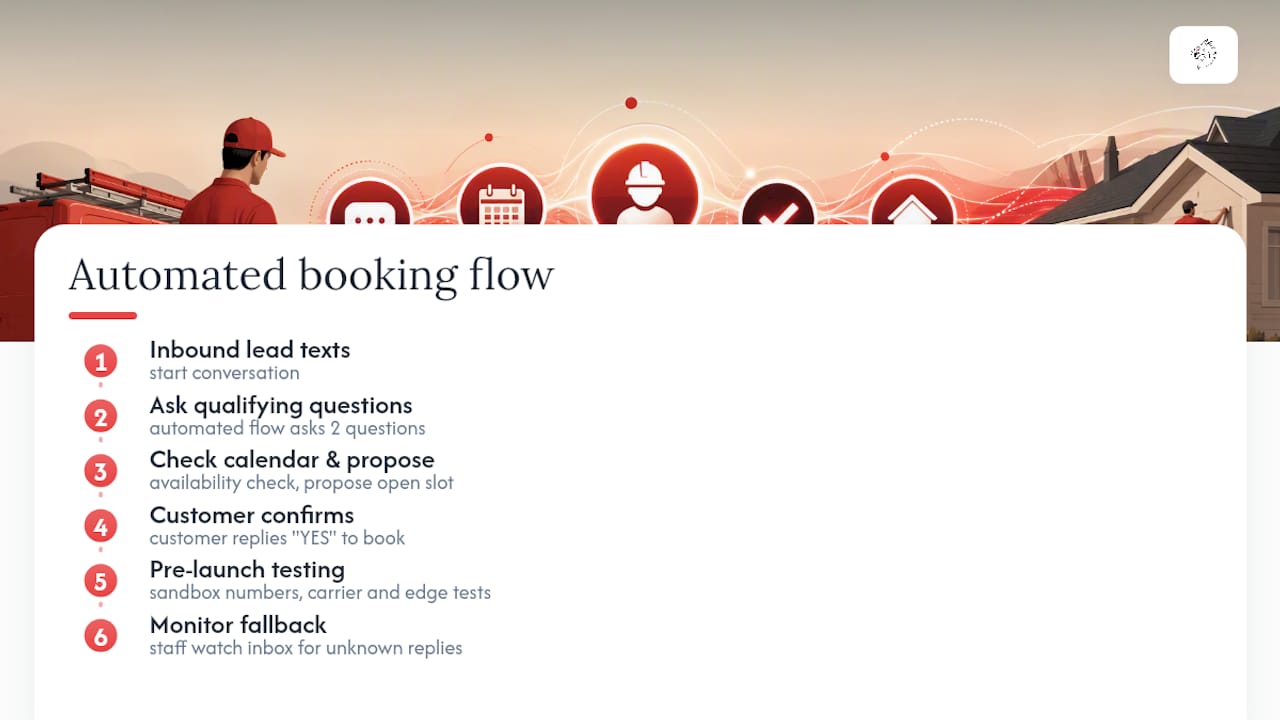
Before flipping it on for real customers, staff for the fallback. Even a heavily automated flow needs someone monitoring the inbox for replies the automation doesn't know how to handle.
How Vaultio Builds Two Way Texting Into a Managed System for Contractors
Most contractors don't have a spare person to sit on a texting inbox all day, watching for replies and manually confirming bookings. Some managed providers build two way texting into a system with AI chatbots that respond to inbound leads quickly, day or night, so a text coming in late can get a prompt reply before the customer considers other options.
The flow works end to end: a lead texts in from a Google listing or website form, the AI chatbot qualifies them conversationally, and the system books the job directly onto the calendar with a confirmation sent back by text, no extra staff required on your end. That combination of fast response and automated scheduling is core to how Vaultio turns raw inquiries into 10 to 15 extra booked jobs a month for home service contractors without adding headcount.
Contractors researching automation options for their own teams can see practical examples in Vaultio's breakdown of AI tools for plumbers, or the specific tactics covered in after-hours lead capture strategies for HVAC companies.
What to Pilot First, and the Trap Most Teams Fall Into
Start small. Pilot appointment confirmations paired with a single autoreply flow, YES to confirm, RESCHEDULE to pick a new time, before building anything more elaborate. That combination alone usually delivers the biggest visible drop in no-shows.
The trap is over-automation. Teams get excited about keyword routing and stack five or six automated branches before testing a human fallback, and customers notice fast when a reply gets misread by a bot with no escape hatch. Test the fallback before you scale the automation. Once your team can't keep pace with reply volume, that's the signal to move to a managed provider rather than hiring another person to babysit an inbox.
— Damian
Get Two Way Texting Running Without Hiring for It
Setting up two way texting yourself means picking a platform, handling A2P registration, writing automation rules, and staffing someone to watch the inbox, on top of running your actual business. Some managed systems combine an AI chatbot that answers inbound texts quickly, automated scheduling from conversations, and local SEO work to help contractors get found.
This isn't a bolt-on texting tool. It's paired with services like Google Local Service Ads management, so the leads flowing into your two way texting inbox are ones Vaultio already helped generate. Contractors in specific markets can see how this comes together on pages like Vaultio's Santa Barbara marketing agency page or the San Luis Obispo SEO services page. Every plan comes backed by a 30-day money-back guarantee, so there's no long-term risk in testing whether managed lead response actually converts better than what you're running now. Reach out to Vaultio and ask for a walkthrough of how the texting and scheduling flow would work for your specific trade.
Sources
- —Stop unwanted robocalls and texts — FCC
- —CTIA 2025 annual survey highlights
- —Square Appointments — reminders
Recommended
Ready to Implement This?
We'll build your complete lead generation system in 72 hours. No contracts. 30-day money-back guarantee.