Add 10–15 Jobs a Month with Power Washing SEO for Contractors
# Add 10–15 Jobs a Month with Power Washing SEO for Contractors
Two moves drive most booked jobs from search: optimizing your Google Business Profile for the Map Pack, and publishing one photo-rich service+city page with instant lead response wired to it. Start well before your busy season. Local ranking movement shows up within a few weeks; a steady flow of booked jobs takes some months to develop.
*
TL;DR: - Prioritize completing and optimizing your Google Business Profile with detailed service descriptions, proper categories, and weekly photo updates to boost local visibility. - Build service and city pages with clear, unique content, keyword placement in URLs, titles, images, and schema markup to attract relevant local searches. - Focus on acquiring reviews that mention specific services and neighborhoods within two hours of completing jobs, and respond to all feedback promptly. - Use photo-rich galleries showing before and after images, and load them in fast formats like WebP for better mobile site speed and user experience. - Expect to see measurable results in booked jobs within three to six months, with consistent tracking of impressions, calls, and conversions from search to booking.
*
Table of Contents
- —What Is Power Washing SEO?
- —How Do You Optimize Google Business Profile for Power Washing?
- —How Should You Structure Service and Location Pages?
- —Which Keywords Actually Drive Power Washing Leads?
- —Why Do Photos and Reviews Win the Map Pack?
- —What Technical SEO Issues Slow Down Power Washing Sites?
- —How Do You Turn Website Traffic Into Booked Jobs?
- —How Long Does Power Washing SEO Take to Work?
- —How Does Vaultio Turn Search Visibility Into Booked Jobs?
- —What Should You Do First This Week?
- —Get Your Power Washing Business Ranked and Booked
- —Sources
What Is Power Washing SEO?
Power washing SEO is the practice of ranking your business in Google's local results, the Map Pack, and organic listings when someone searches for exterior cleaning services near them. In the industry, this overlaps heavily with "pressure washing SEO," and Google treats the two terms as close cousins, not identical twins. That distinction matters for how you structure your site, which is covered in the keyword section below.
Google's own ranking documentation makes clear that visibility comes down to relevance, expertise, and content that actually helps the searcher. For a pressure washing company, that means a complete Google Business Profile, service pages built around real neighborhoods, and photo evidence that a searcher can trust before they ever pick up the phone.
How Do You Optimize Google Business Profile for Power Washing?
Google Business Profile is the single biggest lever for local visibility in this trade, and it's free. Most power washing companies leave it half filled out, which is exactly why the ones who finish the job win the Map Pack.
Start with categories. Set your primary category to "Pressure washing service," then add secondary categories that match what you actually do: "Gutter cleaning service," "Window cleaning service," "Deck cleaning," or whatever applies. Skipping secondary categories is one of the most common ways contractors leave visibility on the table.
Your service list needs real detail, not vague labels. "Driveway cleaning" tells Google nothing useful. "Concrete driveway pressure washing, starting at $150" tells both Google and the searcher what to expect.
- —Set service area boundaries to cities and zip codes you can actually reach within a reasonable drive; don't fabricate coverage in towns you rarely serve.
- —Upload three new photos per week for the first 60 days, name the files something like `driveway-pressure-washing-thousand-oaks.jpg` before uploading, and write captions that mention the surface and the neighborhood.
- —Ask for reviews by text message within two hours of finishing the job, while the clean surface is still fresh in the customer's mind.
- —Coach customers toward specific phrasing ("great job pressure washing our driveway in [city]") rather than a generic "great service."
- —Respond to every review, good or bad, within 48 hours.
Text-based review requests convert far better than delayed email asks, and reviews that mention a service and a location carry more local ranking weight than generic five-star praise, according to local SEO research for pressure washing companies.
Pro Tip: Set a recurring calendar reminder to check your GBP messaging inbox daily. Unanswered GBP messages quietly kill conversion, and most owners never even know the feature is turned on.
How Should You Structure Service and Location Pages?
Your website's job is to convert the searcher your GBP profile already earned. That means every page needs to answer one question fast: can this company handle my specific job, in my specific neighborhood?
Decide early whether "power washing" and "pressure washing" need separate pages. If your local search data shows meaningfully different intent between the two terms in your market, build separate pages. If they're functionally interchangeable in your area, pick one term as primary and use the other naturally in the copy instead of duplicating pages.
Every service+city page needs the same core anatomy:
- 1.An H1 that pairs the service and the city, such as "Driveway Pressure Washing in Thousand Oaks."
- 2.Between 400 and 700 words of unique copy describing the surface, the process, and common problems you solve there.
- 3.A before/after photo gallery specific to jobs done in that area.
- 4.A testimonial from a customer in that city or neighborhood.
- 5.An embedded Google Map showing your service radius.
Structure URLs cleanly: `/services/driveway-pressure-washing-[city]` or `/power-washing-[city]`, and keep the pattern consistent across every page you build. Link service pages to each other and back to a central location hub page so Google understands the relationship between them, and use canonical tags if you have near-duplicate content across similar cities to avoid confusing the crawler.
Add LocalBusiness and Service schema markup with precise, specific service descriptions rather than generic boilerplate. This is one of the "expertise and helpful content" signals Google's ranking systems reward, and it's cheap to implement once and forget.
Which Keywords Actually Drive Power Washing Leads?
Vanity rankings for broad terms like "pressure washing" rarely convert. The keywords that book jobs almost always pair a service with a location: "driveway pressure washing Thousand Oaks," "roof soft washing Ventura County," "commercial power washing near me."
Treat "power washing" and "pressure washing" as two separate experiments rather than assuming one term covers both. Check your Search Console data after a few months; if searchers in your market use both terms at meaningful volume with different intent (residential versus commercial, for example), build pages for each. If one term dominates, don't split your authority across duplicate pages for no reason.
Placement matters as much as selection:
- —Put the target keyword in the URL, the page title, and the H1.
- —Use it again, naturally, in the first paragraph.
- —Name image files and write alt text around the same service+city phrase.
- —Include the term in your Service schema description.
Blog content earns its place by capturing informational searches you can't win with a service page. "How often should you pressure wash a driveway?" or "does soft washing damage stucco?" bring in searchers who aren't ready to book yet. Link every blog post back to the relevant service page so that traffic has somewhere useful to go. Vaultio's guide to home service SEO breaks down keyword prioritization for contractors more broadly if you want a wider frame of reference.
Why Do Photos and Reviews Win the Map Pack?
Power washing sells on visible transformation, which makes it one of the most photo-dependent trades in local search. Industry-specific SEO analysis consistently finds that operators who show real before/after photos convert searchers other contractors lose to a blank profile.
Build a simple weekly system:
- 1.Photograph every job's before and after, in consistent lighting, before packing up.
- 2.Rename files immediately on your phone using the pattern `[surface]-[service]-[city].jpg`.
- 3.Upload three photos to GBP per week and mirror the best ones into your website gallery.
- 4.Compress images before upload so galleries load fast on mobile.
- 5.Text the customer a review request within two hours, with a short script suggesting they mention the service and their neighborhood.
Layout matters on the website side too. Pair each before/after set side by side rather than stacking them, and keep galleries to a manageable dozen images per page rather than dumping in every job you've ever shot.
Pro Tip: Ask happy customers if you can post their photo alongside a first-name-only review. Real faces next to real driveways outperform stock photography every time.
What Technical SEO Issues Slow Down Power Washing Sites?
A photo-heavy site is a liability if it's not built correctly. Slow-loading galleries are the single most common technical problem in this industry.
- —Serve images in WebP or AVIF format instead of raw JPEG or PNG files.
- —Use responsive `srcset` markup so mobile phones download a smaller file than desktop screens.
- —Lazy-load below-the-fold images, but reserve their exact dimensions in the layout to avoid layout shift as they pop in.
- —Choose a fast host or CDN, compress everything, and cut render-blocking JavaScript that delays your first paint.
Mobile matters more than desktop for this trade. Most searchers looking for "power washing near me" are on a phone, often standing in their driveway looking at the mess. A persistent click-to-call button and a booking CTA that follows the scroll convert better than a buried contact form.
Site speed and mobile responsiveness are ranking and conversion factors simultaneously — Google's own guidance ties helpful, accessible content to ranking, and a slow gallery page is the opposite of helpful no matter how good the photos are.
Round out the technical basics: submit an XML sitemap, check robots.txt isn't blocking service pages by accident, and verify every service+city page individually in Search Console so you can track impressions and clicks page by page instead of guessing.
How Do You Turn Website Traffic Into Booked Jobs?
Ranking without converting is a wasted budget. Most power washing sites lose leads in the gap between a click and a phone call.
Keep forms to three fields, maximum: name, phone, and job type. Every extra field is a reason to bounce. Place a click-to-call button above the fold on every page, not buried in a footer.
- —Answer inbound calls or messages within seconds, not hours; leads that wait cool off fast.
- —Use phone or chat triage to ask job type, rough square footage, and desired timing, then route hot leads straight to a scheduler.
- —Send an SMS confirmation immediately after booking, with a link to reschedule, to cut down on no-shows.
- —Show starting prices or bundled packages, like "driveway plus walkway combo," to raise average ticket size without a phone negotiation.
Pro Tip: If you can't staff round-the-clock phone coverage, an automated first response beats no response every time. A missed call at 9 PM often becomes a booked job for a competitor by 9:05.
How Long Does Power Washing SEO Take to Work?
Expect local ranking signals to shift within 4 to 8 weeks of consistent GBP and website work. Booked jobs at a steady clip usually take 3 to 6 months, which is why starting before peak season isn't optional if you want to capture it.
Track these numbers monthly, not weekly:
- 1.GBP impressions and Map Pack appearances for your target categories.
- 2.Click-to-call events from both GBP and your website.
- 3.Form submissions by service page.
- 4.Booked jobs, tied back to the specific page or listing that generated the lead.
| Metric | Track it in | What it tells you |
|---|---|---|
| Impressions and Map Pack views | Google Business Profile insights | Whether searchers are finding you |
| Call clicks and form fills | Google Analytics plus call tracking | Whether your pages convert attention |
| Booked jobs | Your booking or CRM system | Whether marketing is actually paying for itself |
Connect Search Console, Analytics, call tracking, and your booking software so you can trace a booked job back to the exact page that earned it. This full chain, from search impression to completed job, is what structured pressure washing SEO frameworks are built around, and it's the only way to know which pages deserve more investment. Organic search remains one of the highest-value discovery channels available to small businesses, and industry SEO statistics show that investment here tends to compound rather than plateau.
How Does Vaultio Turn Search Visibility Into Booked Jobs?
Vaultio builds and manages exactly the system described above for home service contractors, including power washing companies, and specializes in pairing local rankings with lead response fast enough to actually close the job.
The gap between ranking and booking is where most contractors lose money. A searcher calls, nobody answers for twenty minutes, and that job goes to whoever picked up first.
- —Full Google Business Profile setup and ongoing management, including categories, photo cadence, and review requests.
- —Conversion-optimized service and location pages built around the structure covered above.
- —An AI receptionist that answers and qualifies leads within seconds, day or night.
- —Automated booking and SMS follow-up to cut no-shows.
Clients typically see 10 to 15 extra booked jobs per month once the system is running, backed by a 30-day money-back guarantee.
A contractor trialing Vaultio starts with a GBP and website audit, then moves into page builds and AI receptionist setup, with booked-job tracking in place from week one so results are visible, not assumed.
What Should You Do First This Week?
If you only do three things this month, do these: finish your Google Business Profile, publish one photo-rich service+city page, and turn on instant lead response so no call goes unanswered.
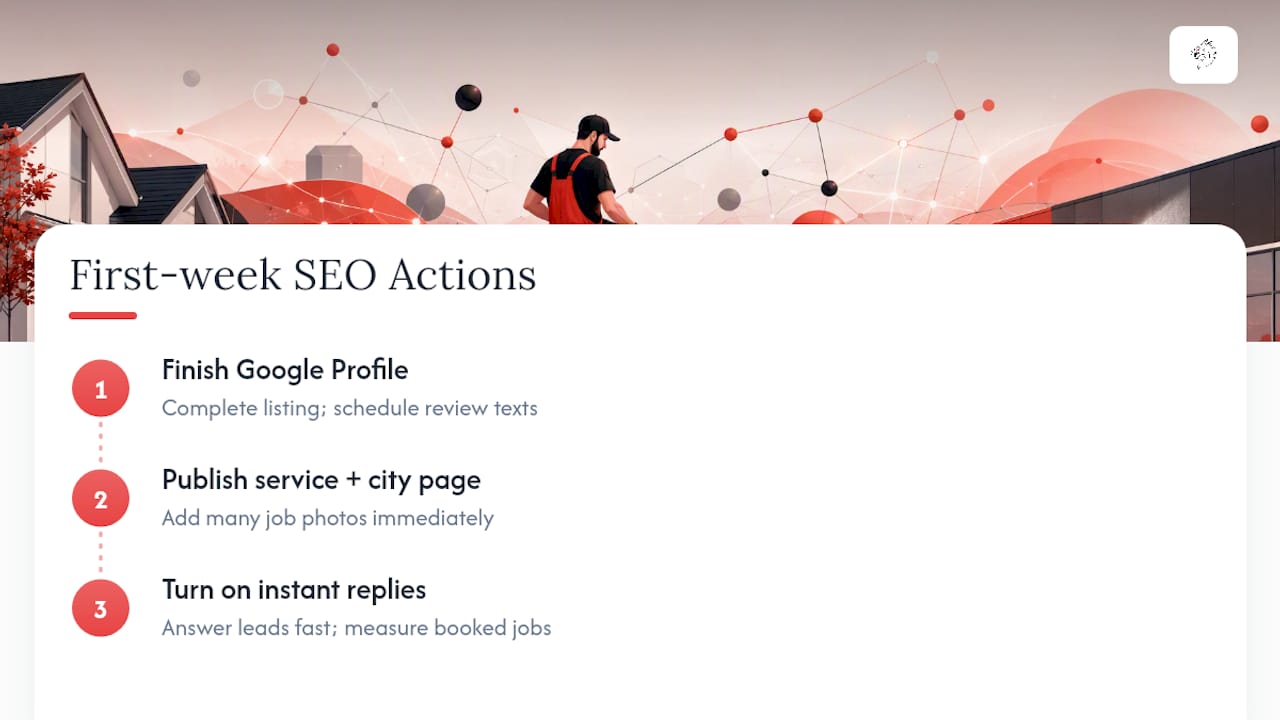
Start collecting job photos immediately and schedule a review-request text for every completed job, even before your pages are finished.
Measure booked jobs, not calls or impressions. Impressions feel good on a dashboard. Booked jobs pay the crew.
— Damian
Get Your Power Washing Business Ranked and Booked
There's a version of this playbook you execute yourself with a part-time marketing hire, and a version where a team runs GBP, builds your pages, and answers every lead in seconds while you're on a job site with wet gloves. Vaultio is the second version, built specifically for home service contractors who'd rather book jobs than manage a marketing checklist.
Vaultio combines the exact system covered above, Google Business Profile management, conversion-optimized service pages, and an AI receptionist that answers every call within seconds, into one done-for-you package backed by a 30-day money-back guarantee. Clients typically add 10 to 15 booked jobs a month once the system is fully live. If you're in the region, check out Vaultio's SEO service for Goleta contractors or Santa Barbara-area marketing support to see what a market-specific rollout looks like. Request a consult, and Vaultio's team will audit your current GBP and site, then walk you through exactly what it would take to rank and book more jobs before your next busy season hits.
Recommended
Ready to Implement This?
We'll build your complete lead generation system in 72 hours. No contracts. 30-day money-back guarantee.