30–90 Day Plan: Map Near Me Keywords to GBP, Pages for Contractors
# 30–90 Day Plan: Map Near Me Keywords to GBP, Pages for Contractors
"Near me" searches are proximity driven, high intent, and they convert fast. The single highest impact move is claiming and fully optimizing your Google Business Profile. From there, verify your business name, address, and phone number match everywhere online, confirm your hours and service area are accurate, and start tracking calls. Everything else in this guide builds on that foundation.
*
TL;DR: - Claims and optimizations should focus on completing your Google Business Profile, fixing NAP inconsistencies, and tracking calls to build a strong foundation. - Relevance and prominence factors can be improved by selecting accurate categories, adding complete service lists, and building local schema and location pages. - Mapping urgent service terms and neighborhood keywords to dedicated assets boosts local conversion rates, especially for hyperlocal service-area businesses. - Regularly updating reviews, fixing citations, and tracking rankings at the neighborhood level enhance visibility in local pack results. - Voice search and mobile accessibility require natural language FAQs, concise answers, and clear call-to-action buttons to capture inquiries effectively.
*
Table of Contents
- —Quick Wins to Rank for Near Me Keywords Right Now
- —How Do You Optimize Google Business Profile for Near Me Searches?
- —Should You Build One Location Page or Several?
- —How Do You Find and Map Local Keyword Opportunities?
- —How Do Reviews and Citations Affect Near Me Rankings?
- —How Does Mobile and Voice Search Change Near Me Results?
- —What Should You Track to Prove Near Me SEO Is Working?
- —Should Your Copy Actually Say "Near Me"?
- —Your 30 and 90 Day Rollout Plan
- —What This Looks Like When a Done-For-You Team Runs It
- —Where Near Me Search Is Headed
- —Turn Near Me Visibility Into Booked Jobs
- —Sources
- —FAQ
Quick Wins to Rank for Near Me Keywords Right Now
You don't need a six-month roadmap to move the needle. Local ranking runs on relevance, distance, and prominence, according to Google's own local ranking guidance, and most contractors are leaving prominence points on the table because of fixable gaps. Work this list in order.
- 1.Lock down your Google Business Profile categories, services, and hours. Pick the primary category that matches your core trade, add every relevant secondary service, and list special hours for holidays.
- 2.Audit your NAP (name, address, phone) across every directory. Inconsistent formatting between your website, GBP, and directories like Yelp confuses Google's location matching.
- 3.Add structured data to your website. LocalBusiness schema tells search engines exactly what you do and where, which matters more than most contractors realize.
- 4.Update location pages with embedded maps. A live Google Map embed on your contact page reinforces the address data in your schema and profile.
- 5.Turn on review requests as a standing workflow. Recency and volume both factor into how prominent you appear.
- 6.Set up call tracking with unique numbers or UTM parameters. You can't fix what you can't measure, and near me searchers call before they click through anything else.
Each of these takes an afternoon, not a quarter. Do the GBP audit first. It's the fastest lever you have, and it's free.
How Do You Optimize Google Business Profile for Near Me Searches?
Google's local ranking algorithm weighs three factors: relevance, distance, and prominence. Distance you can't control. Relevance and prominence, you can, and GBP is where most of that signal lives. Search Engine Land's near me optimization guide confirms that these queries typically trigger the local pack, which makes your profile the single most valuable asset you own for this traffic.
Start with the fields Google weighs heaviest:
- —Primary category should match the exact service you want to rank for. A plumber who lists "Contractor" as the primary category is handing relevance to competitors who picked "Plumber."
- —Services list needs every job type you actually perform, written the way customers search ("water heater repair," not "water heater services").
- —Service area matters enormously for businesses that travel to customers rather than operating from a storefront. Set it to the ZIP codes and cities you genuinely cover, not an aspirational radius.
- —Attributes like "open 24 hours," "free estimates," or "women-owned" feed directly into the filtering Google does behind the scenes.
- —Hours, including holiday hours, control whether you show up in "open now" filtered searches, which are common on mobile.
Photos and Q&A carry more weight than most owners assume. Profiles with recent photos and answered questions tend to show up more often in local-pack results, and Google Business Profile Help explicitly recommends complete, accurate listings as a ranking lever. Upload new job-site photos monthly, not once at setup. Seed your own Q&A section with the three or four questions customers actually ask, then answer them yourself before a stranger posts something inaccurate.
Avoid the mistakes that get profiles suppressed or suspended. Don't stuff your business name with keywords ("Bob's Plumbing Emergency 24/7 Near Me" violates Google's naming policy). Don't create duplicate listings for the same location. Don't let a former employee keep manager access after they leave.
Pro Tip: Set a recurring calendar reminder to check your GBP dashboard weekly. Google rolls out new attributes and features constantly, and the businesses that adopt them first tend to see a visibility bump before the feature becomes standard.
Should You Build One Location Page or Several?
The right architecture depends entirely on how many physical locations or service areas you operate. A single storefront business needs one strong, complete location page. A contractor covering ten cities across a county needs a different structure entirely, and picking the wrong one wastes both your time and Google's crawl budget.
One location page works if you operate from a single address and serve a tight radius. Put everything there: hours, service list, embedded map, reviews, and photos.
Multiple location pages make sense when you have distinct physical offices or warehouses in different cities. Each page needs unique content, not a template with the city name swapped out.
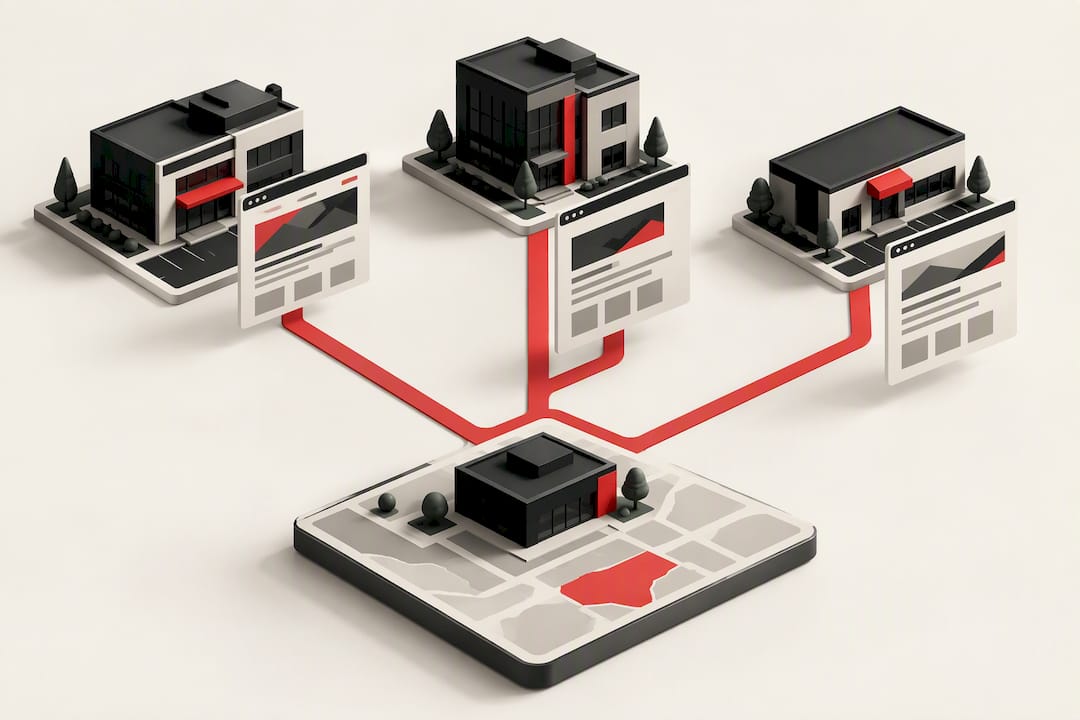
Service-area pages fit contractors who travel to customers without a public storefront in every town. Build these around the service plus the city ("Emergency HVAC Repair in Thousand Oaks"), not the city alone.
Whichever structure you choose, the on-page details matter more than the architecture:
- —Title tags and H1s should read like something a human would type, not a keyword string. "24-Hour Plumbing Repair in Ventura County" beats "Plumber Near Me Ventura."
- —NAP data belongs in the page footer or a dedicated contact block, formatted identically to your GBP listing.
- —Deploy LocalBusiness and, where relevant, ImageObject schema to mark up your address, hours, and photos so search engines parse the page correctly rather than guessing.
- —Internal links from your homepage and blog posts should point to these location pages using descriptive anchor text, a tactic covered well in this internal linking guide.
- —Page speed on mobile isn't optional. Most near me searches happen on a phone, often while someone is standing in a hallway with a leaking pipe.
Semrush's research on ranking for near me terms notes that on-page locality signals correlate with organic ranking lifts, though local-pack placement is less predictable and depends more heavily on GBP and proximity than on the page itself.
How Do You Find and Map Local Keyword Opportunities?
Near me keyword research isn't really about the phrase "near me" at all. It's about building a durable set of terms around service, urgency, availability, and geography, then assigning each cluster to the asset best suited to answer it. Here's the process that works.
- 1.Research your core service terms without geography first. Find every way customers describe the job ("drain clog," "clogged drain," "backed up sink") before layering location on top.
- 2.Add urgency and availability modifiers. Words like "emergency," "same-day," "24-hour," and "weekend" change buyer intent dramatically and often deserve their own GBP service entries or ad groups.
- 3.Layer in geography last. Search Engine Land's local keyword guide recommends combining service, urgency, and location modifiers, then mapping each combination to the asset that serves it best rather than cramming everything onto one page.
- 4.Assign clusters to the right asset. Broad service terms go on your main service pages. Urgent, high-intent phrases go into ad groups and GBP service listings. Conversational questions become FAQ content.
- 5.For service-area businesses, prioritize neighborhoods and ZIP codes over whole cities. Hyperlocal targeting faces less competition and, according to Semrush's local keyword research guide, often converts better than city-wide pages when your review volume or content bandwidth is limited.
Mapping urgency terms to dedicated GBP services and ad groups isn't just an organizational nicety. It measurably improves conversion for time-sensitive searches, because someone searching "emergency electrician near me" at 11 p.m. is a different buyer than someone researching electricians for a kitchen remodel next spring. If your ad copy and landing pages don't reflect that urgency, you lose the click to a competitor who does. Google Ads campaigns built around these urgency clusters can capture that traffic while your organic and GBP work catches up.
How Do Reviews and Citations Affect Near Me Rankings?
Review recency, volume, and your reply rate all factor into prominence, one of the three pillars Google uses for local ranking. A profile with 200 reviews from three years ago reads differently to Google's algorithm than one with steady reviews arriving every week, even if the total count is lower.
Build the ask into your existing customer touchpoints instead of treating it as a separate task:
- —Send a text immediately after job completion with a direct link to your review page, not a generic homepage link.
- —Train technicians to mention it verbally before they leave: "If you have sixty seconds, a review helps other people in the neighborhood find us."
- —Follow up once by email three days later for customers who didn't respond to the text.
- —Respond to every review, positive or negative, within 48 hours.
Citation accuracy matters just as much as review volume. Search your business name across Yelp, Angi, Facebook, and industry-specific directories, and fix any address or phone number that doesn't match your GBP exactly. Duplicate listings, especially ones created by aggregator sites without your involvement, actively hurt you and need to be claimed and merged or removed.
Pro Tip: When responding to a negative review, address the specific complaint by name and state what you changed as a result. Vague apologies read as damage control; specific fixes read as accountability, and future customers notice the difference.
How Does Mobile and Voice Search Change Near Me Results?
Google infers your location from device GPS, account history, and IP address, and proximity is one of the three primary ranking factors for local results. That means the same search for "plumber near me" returns different results for two people standing three miles apart, which is exactly why distance isn't something you can game your way around, only earn through service-area accuracy.
Mobile context shapes almost every part of this. Pew Research's mobile usage data shows how deeply people rely on smartphones for everyday tasks, and near me searches skew even further mobile than the average query. Someone typing "roofer near me" is usually standing in their driveway looking at storm damage, not sitting at a desktop.
Voice search and AI assistants add another layer worth testing for:
- —Phrase your FAQ content the way someone would speak it aloud: "Who fixes water heaters near me?" reads more naturally than a keyword fragment.
- —Keep answers concise and front-loaded. Voice assistants and AI tools tend to pull short, direct sentences rather than paragraphs.
- —Use FAQ schema so structured answers are available for both voice assistants and AI-driven search summaries to parse.
- —Test your own business name and service phrases in voice search on your phone. If a competitor answers before you do, that's a gap worth closing with clearer content.
- —Make sure your call-to-action (call or get directions) is one tap away from any mobile answer, since assistants often surface just the top result.
What Should You Track to Prove Near Me SEO Is Working?
Vanity metrics won't tell you if this is working. Track outcomes tied to action, not just visibility.
- 1.GBP Insights: impressions, actions, and direction requests. These live inside your profile dashboard and show whether people are finding and engaging with your listing.
- 2.Call volume via tracking numbers or UTM-tagged campaigns. This is your clearest signal of real demand, since local search consumers act quickly after finding a business.
- 3.Neighborhood-level rank tracking, not just city-wide averages, since local-pack results shift block by block.
- 4.A/B test one variable at a time. Change your GBP primary category or a page's H1, hold everything else steady for two to three weeks, then compare impressions and calls before and after.
Expect ranking volatility. Local-pack results fluctuate week to week even with no changes on your end, so judge trends over a full month rather than reacting to a single day's dip.
Should Your Copy Actually Say "Near Me"?
Usually not, and forcing it tends to backfire. Google's local ranking system already understands proximity intent without you typing the phrase into your headline. Google's own SEO starter guide warns explicitly against unnatural keyword repetition, and a page stuffed with "plumber near me, near me plumbing, plumbing near me" reads as manipulative to both Google and the customer reading it.
There are a few places the phrase or its variants fit naturally:
- —Inside customer testimonials that genuinely mention proximity ("They were at my house in twenty minutes, closest option near me by far").
- —In FAQ questions phrased the way customers actually search ("How do I find a licensed electrician near me?").
- —In conversational microcopy on a contact page ("Looking for help near you? Call now.").
Outside those spots, prefer natural alternatives: neighborhood names, "near you," or simply the city and service combined. It reads better and carries the same intent signal without the spam risk.
Your 30 and 90 Day Rollout Plan
Sequence matters. Trying to do everything at once is how projects stall.
- 1.Days 1 to 30: foundation. Fully complete your GBP profile, fix every NAP inconsistency you can find, publish one strong location page with schema markup, and turn on a standing review request workflow.
- 2.Days 31 to 60: expansion. Build neighborhood or service-area pages for your top three markets, start publishing local content (project photos, service explainers), and begin outreach for local citations and backlinks.
- 3.Days 61 to 90: scale and measure. Layer in call tracking across every channel, run your first A/B test on a GBP attribute or page header, and review a full month of GBP Insights data to decide what to double down on.
- 4.Assign owners early. Even a two-person shop should name who owns GBP updates, who handles review responses, and who checks tracking numbers weekly. Diffused ownership is why most local SEO plans die by week three.
Multi-location contractors should stagger this rollout by market instead of launching everywhere simultaneously. Nail the playbook in your strongest city first, then replicate it with the fixes you learned baked in.
What This Looks Like When a Done-For-You Team Runs It
Everything in this guide is doable in-house. The question is whether your team has the hours to run it consistently, month after month, while also running job sites. That's the gap a done-for-you provider is built to close, and it's worth knowing what good execution actually looks like before you hire anyone.
- —A competent provider should show you the exact GBP fields, schema markup, and location pages they touched, not a vague "we did SEO" report.
- —Lead response speed should be measured in seconds, not hours. A near me searcher who calls three plumbers is going with whoever answers first.
- —Any guarantee should be specific and checkable, not a vague promise of "more visibility."
Some done-for-you providers build their process around this exact playbook, combining AI-powered lead response with the GBP, review, and content tactics covered above, and back the engagement with a 30-day money-back guarantee.
Pro Tip: Before hiring any provider, ask to see your own current GBP audit results first. A provider who can't tell you what's broken today has no business promising what they'll fix tomorrow.
Where Near Me Search Is Headed
AI assistants are already summarizing local results instead of just listing them, and that shift favors businesses with clean, structured, consistently repeated information over businesses with clever copy. Proximity will stay the anchor signal, but prominence, especially reviews and structured data, will matter more as AI tools lean on it to break ties between nearby competitors.
The contractors who win this next phase won't be the ones who guessed right. They'll be the ones who tested a GBP attribute change, measured the call volume shift, and adjusted. Run one small experiment this month. Don't wait for a complete strategy before you start.
— Damian
Turn Near Me Visibility Into Booked Jobs
A completed Google Business Profile gets you found. It doesn't answer the phone at 9 p.m. when a customer with a burst pipe is calling three competitors at once. Vaultio closes that gap by pairing done-for-you local SEO and Google Business Profile management with AI-powered lead response that engages every inquiry within seconds, so the job goes to you instead of whoever picks up first.
Vaultio's done-for-you services cover the full playbook in this guide: GBP optimization, location pages, schema, review workflows, and Google Ads built around urgency keywords, all managed rather than handed to you as a checklist. Contractors who want the organic side handled with AI-assisted content and technical fixes can start with AI SEO, while businesses that want every missed call captured and booked automatically should look at the AI Receptionist.
Some engagements come with a 30-day money-back guarantee, reducing the risk in finding out what a properly run near me strategy does for your call volume. Book a discovery call and get a free audit of your current GBP and location page setup at Vaultio.
Sources
For readers who want to dig into primary documentation rather than take this guide's word for it, start with Google's local ranking guidance and the Search Central SEO starter guide for policy details straight from Google. Search Engine Land's near me optimization guide and its local keyword research guide cover tactics in more depth than this article's space allowed. For schema implementation specifics, schema.org's documentation lays out every relevant markup type, and Semrush's near me keyword guide offers additional on-page case notes.
- —"Near Me" SEO: Optimize for Local Searches That Convert
- —Tips to improve your local ranking on Google - Google Business Profile Help
- —Local keyword research: A step-by-step guide
- —How advertisers can extend their relevance with search (Think with Google research)
FAQ
What Are Good Near Me Keywords for a Local Business?
Good near me keywords combine your service, urgency, and geography, such as "emergency plumber near me" or "same-day HVAC repair near me." The strongest sets pair a core service term with an availability modifier, then let your Google Business Profile and location pages capture the geography rather than stuffing it into every headline.
Where Can I Find Near Me Keyword Ideas?
Start with your own Google Business Profile Insights and Google Search Console, which show the actual phrases people already use to find you. Keyword research guides like Search Engine Land's local keyword guide and tools such as Semrush can round out the list with urgency and service variations you haven't covered yet.
What Are the Five Most Important Near Me Keyword Types?
The five worth building around are core service terms, urgency modifiers ("emergency," "same-day"), availability phrases ("open now," "24-hour"), action words ("repair," "install," "replace"), and geography (neighborhood or ZIP-level, not just city). Mapping each type to the right asset, whether that's a GBP service entry, an ad group, or an FAQ page, matters more than the exact phrase.
What Are Examples of Near Me Keywords for Contractors?
Examples include "roof repair near me," "24-hour electrician near me," and "AC repair near me tonight." Contractors get better results treating these as intent clusters rather than single keywords, since urgency and availability terms often convert differently than a plain service search.
Does Vaultio Help With Near Me Keyword Optimization?
Yes. Vaultio's AI SEO and done-for-you services cover Google Business Profile optimization, location page builds, and keyword mapping for home service contractors specifically. Current pricing for these services is listed on the Vaultio site rather than published here.
Recommended
Ready to Implement This?
We'll build your complete lead generation system in 72 hours. No contracts. 30-day money-back guarantee.