Missed Call Text: 15 Minute After Hours Setup for Small Businesses
# Missed Call Text: 15 Minute After Hours Setup for Small Businesses
A missed call text is an automatic SMS that fires the moment a caller can't reach you, keeping the conversation alive instead of letting it die on a voicemail no one checks. Enable it today. It costs almost nothing, takes under an hour to configure, and stops every ringing phone from becoming a competitor's new customer.
*
TL;DR: - A missed call text typically fires within 5 to 60 seconds, with faster responses leading to higher read and reply rates, especially in urgent trades. - Registration through the 10DLC system is essential to prevent messages from being blocked or flagged as spam by U.S. carriers. - Crafting concise, conversational messages with necessary business details and opt-out options maximizes response and compliance. - Pairing automated missed call responses with live AI answering significantly reduces missed calls and increases the likelihood of booked jobs. - Testing the system involves confirming delivery times, sender ID accuracy, and reply routing, with ongoing monitoring to optimize reply and booking rates.
*
Table of Contents
- —What Is a Missed Call Text and How Does It Trigger?
- —What Results Should You Actually Expect?
- —What Compliance Rules Apply to Missed Call Texts?
- —How Do You Set Up Missed Call Text Step by Step?
- —What Should a Missed Call Text Actually Say?
- —How Do You Test, Fix, and Measure the System?
- —Why Pairing Live Answering With Text-Back Wins
- —A 15-Minute Checklist to Get This Live Today
- —Vaultio's AI Receptionist Turns Every Missed Call Into a Booked Job
- —Sources
What Is a Missed Call Text and How Does It Trigger?
A missed call text back and an auto reply are close cousins, not twins. Text back fires only after a call goes unanswered. Auto reply is broader and can trigger for voicemails, abandoned calls, or after hours windows too. Either way, the mechanism behind the missed call notification runs one of three ways:
- —Ported VoIP line: your existing business number moves onto a platform that detects missed calls natively.
- —Call forward trigger: your current number forwards to a tracking or virtual number that watches for no answer.
- —Dedicated virtual number: you list a new number specifically wired for call and text automation.
Most platforms fire the text within 5 to 60 seconds of the missed call, though some wait until after a set number of rings or a voicemail drop.
What Results Should You Actually Expect?
Speed is the whole game. A caller who hits voicemail moves on to the next search result in under a minute. A caller who gets a text within seconds usually reads it, because SMS open rates dwarf email and voicemail callback rates by a wide margin.
By the Numbers: Industry roundups report SMS messages get read within minutes of delivery, far outpacing email response times, which is why a missed call sms reply recovers leads that a voicemail simply cannot.
Realistic expectations look like this:
- —Home service trades (plumbing, HVAC, electrical) tend to see the strongest lift because callers are often mid-emergency and reply fast.
- —Salons and clinics see solid pickup for rescheduling but lower urgency than trades.
- —Restaurants see the weakest text reply rates since many callers just want a reservation confirmed by phone.
- —Urgent calls (a burst pipe, a locked-out tenant) still need a live human or an AI receptionist. Text alone isn't enough when someone needs help in the next ten minutes.
What Compliance Rules Apply to Missed Call Texts?
Every carrier in the United States filters unregistered business SMS traffic, and that filtering is not a courtesy warning. It's a wall. Unregistered numbers get texts silently blocked, delayed, or flagged as spam, which means your automated missed call response might be firing perfectly and still never reaching the caller. Registering your number and campaign through the 10DLC system tells carriers who you are and what you're sending, and it's the single biggest reason a good setup fails without it.
Beyond registration, three rules keep you out of trouble:
- —Keep every automated text transactional, not marketing. For example, messages acknowledging missed calls with callback info are appropriate, but promotional blasts are not.
- —Include opt-out language ("Reply STOP to opt out") on every automated message you send.
- —Check your platform's per-number sending limits and daily quotas before you scale to multiple locations.
Pro Tip: Confirm your sending number is actually capable of texting before you launch. Toll-free tracking numbers on many platforms cannot send SMS messages at all, which is the number one reason a "working" setup delivers zero texts.
How Do You Set Up Missed Call Text Step by Step?
Getting this live is a checklist, not a project. Here's the order that avoids rework.
- 1.Pick your connection method. Porting your number gives the cleanest experience but takes longer to activate. Forwarding to a tracking number is faster to launch but adds a hop. A dedicated virtual number is quickest of all but means training customers on a second number over time.
- 2.Register for 10DLC compliance before you send a single automated text, not after.
- 3.Set your trigger rules. Decide whether the text fires after the call rings out, after voicemail, or only during after hours windows. Add a throttle, like a 20 minute wait step or a "first call" tag, so a caller who dials three times in ten minutes doesn't get three separate texts.
- 4.Write two messages, not one. An open hours message ("Sorry we missed you, we'll call back in 15 minutes") and a closed hours message ("We're closed until 8am, text us your issue and we'll respond first thing") behave very differently.
- 5.Insert merge fields. Pull in your business name and a realistic callback ETA automatically so the message never reads like a form letter.
- 6.Test the full flow end to end, including a check for abandoned calls, since some platforms trigger the text even when the caller hangs up before it rings.
- 7.Schedule a monthly review of delivery logs and reply rates so a silent failure doesn't run for weeks unnoticed.
A DIY option like IFTTT's Android missed call recipe can work for a one-person shop testing the idea, but it lacks a real business sender ID and any compliance handling, so treat it as a prototype, not a permanent fix.
What Should a Missed Call Text Actually Say?
Every high-converting message follows the same four-part structure: business name, quick acknowledgment, a simple call to action, and an opt-out line. Stay under 160 characters so the text lands as a single SMS segment instead of splitting into two.
- —Trades (plumber, electrician, HVAC): "Hi, this is [Business]. Sorry we missed your call! Reply with your issue and we'll call back within 15 min. Reply STOP to opt out."
- —Clinics: "[Business] here. We missed you. Text us to reschedule or call back in 10 min. Reply STOP to opt out."
- —Salons: "Thanks for calling [Business]! We're with a client. Text to book your slot or we'll call back shortly. Reply STOP to opt out."
- —After hours (any business): "[Business] is closed now. We open at 8am and will call first thing. Text your details anytime. Reply STOP to opt out."
Keep the tone conversational, not corporate. A caller who just tried to reach a human wants to feel like one texted them back.
How Do You Test, Fix, and Measure the System?
Run this checklist before you call the setup finished, and again anytime you change platforms or numbers.
Testing: Call your own line and let it ring until it registers as missed. Confirm the SMS arrives within 30 to 60 seconds, check that the sender ID displays your business name or number correctly, then reply from the test phone and verify that reply routes into your CRM or inbox.
Troubleshooting: If the text doesn't send, check these four culprits first.
- —Carrier filtering from an unregistered 10DLC campaign.
- —A landline caller, which should never trigger an SMS attempt in the first place.
- —A toll-free or tracking number that isn't SMS-capable.
- —A throttle rule silently blocking a repeat trigger from the same caller.
Integration: Log every reply into your CRM automatically, add a one-tap booking link inside the message (a long booking flow kills conversion fast), and route replies either to a staff member's phone or to an AI receptionist for after hours coverage. A website built for mobile-first booking flows makes that one-tap link far more likely to convert.
| Metric | What to track |
|---|---|
| Reply rate | Percent of texted callers who respond |
| Booking rate | Scheduled jobs traced back to the SMS |
| Time to first response | Minutes from missed call to first staff reply |
| Cost vs. recovered jobs | Monthly platform fee against jobs booked |
Pro Tip: Tag every booked job that started as a missed call text in your CRM. Without that tag, owners consistently underestimate how many jobs the feature actually recovers.
Why Pairing Live Answering With Text-Back Wins
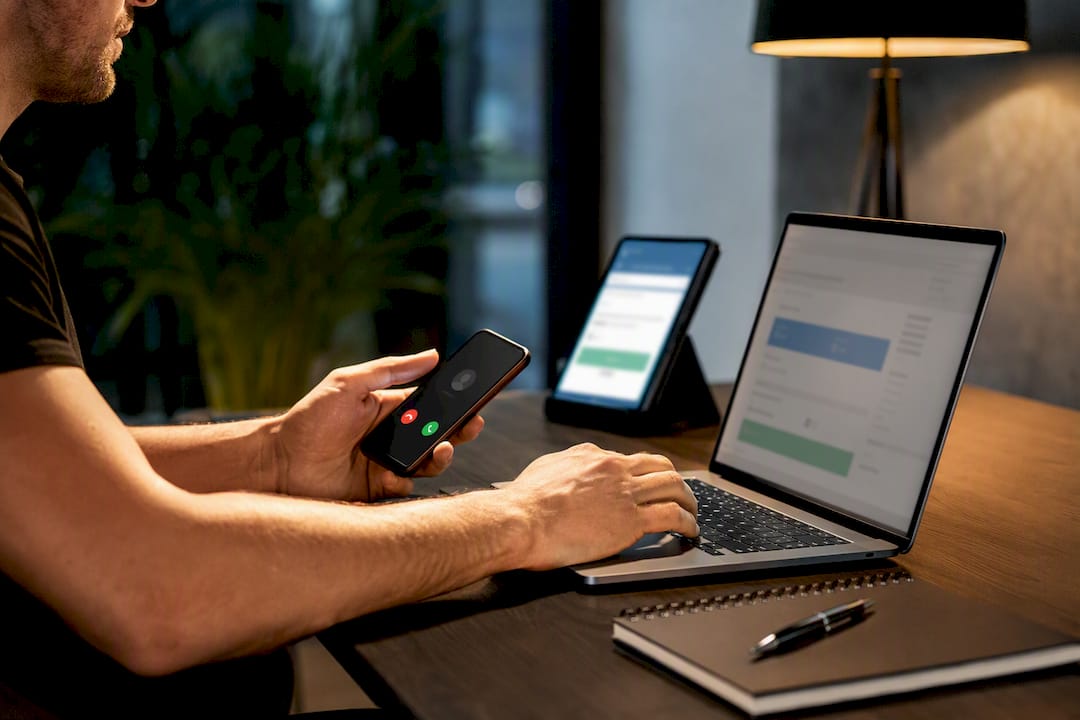
Treat missed call text as a safety net, not your whole strategy. It catches the calls that slip through, but the better move is preventing the miss in the first place. An AI receptionist answers in seconds, live, so the caller never hits voicemail at all. Text-back then stays active for the technical edge cases: dropped calls, dead zones, after hours volume that overwhelms even a fast AI.
The pairing outperforms either tool alone, because live AI answering prevents most misses while text-back cleans up what's left.
By the Numbers: Standalone missed call text-back tools generally run $20 to $100 a month, while AI receptionist services that answer calls live typically start higher given the added coverage.
Here's how to evaluate which stage you're at:
- —If you're missing more than a handful of calls a week, text-back alone is a patch, not a fix.
- —If your team is already stretched thin during peak hours, a live AI layer pays for itself in recovered jobs, not just recovered texts.
- —If your call volume is low and predictable, a solid text-back setup with tight throttling may be all you need for now.
The lead response model is built around ranking high in local search, then making sure every lead is captured quickly, often within seconds instead of hours.
A 15-Minute Checklist to Get This Live Today
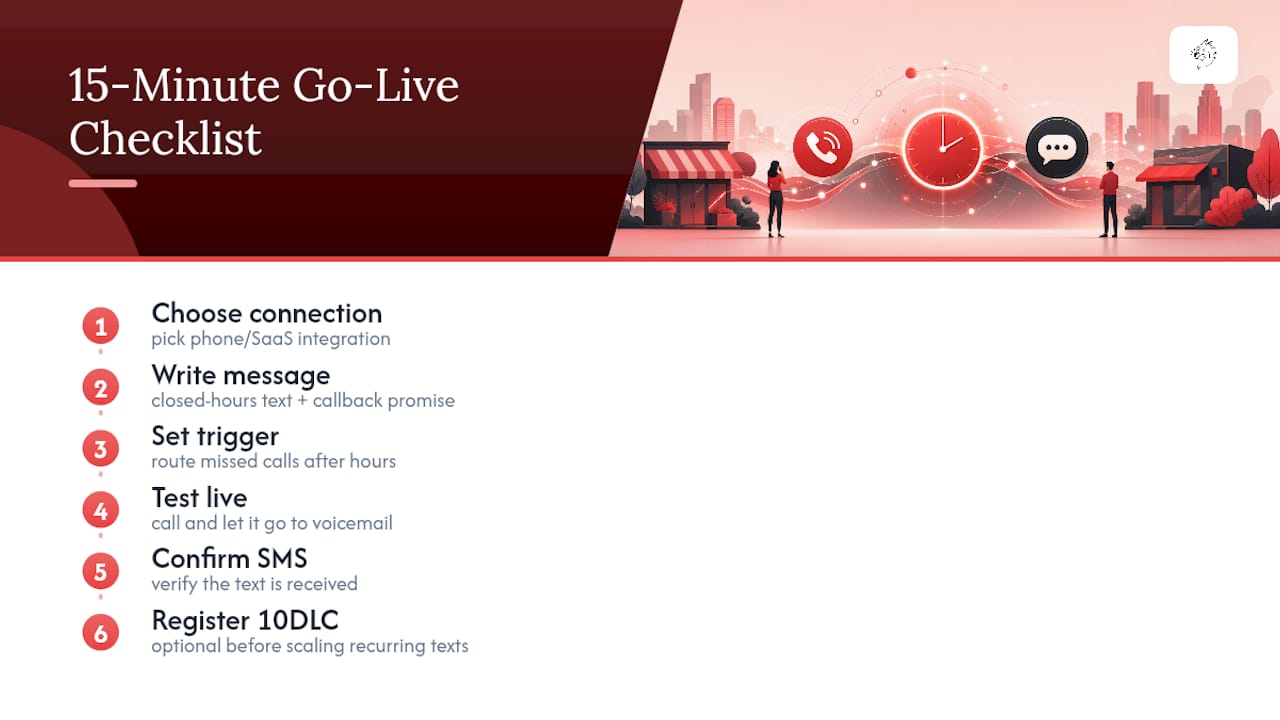
Enable one after hours message first. It's the lowest-friction win because you're not touching business hours behavior at all, just catching the calls you're already losing overnight.
Here's the 15-minute version: pick your connection method, write one closed-hours message with a callback promise, set the trigger, test it with a real missed call, and confirm the SMS lands. If you plan to send recurring business texts going forward, register for 10DLC before you scale past this first message.
— Damian
Vaultio's AI Receptionist Turns Every Missed Call Into a Booked Job
A DIY missed call text setup is a solid start, but it still leaves the initial answer to chance, and chance is what loses jobs to the competitor who picked up first. Vaultio's AI receptionist and scheduling system answers calls live in seconds, texts back automatically when a call still slips through, and books the appointment directly into your calendar without a staff member touching the phone.
If you're already stretched between job sites and the front desk, a managed system saves the hours you'd otherwise spend testing trigger rules, writing templates, and monitoring delivery logs yourself. It also pairs naturally with local SEO built for your market, so the leads you're capturing are ones actively searching for a business like yours in the first place. Check availability for your area and get a quote on the AI Chatbot and scheduling page to see what a fully covered lead line looks like.
Sources
- —Where and how to configure the missed-call text back feature — GoHighLevel Help
- —Missed Call Text Back: Best Tools & Setup Guide 2026 — AIRA blog
- —Create and Manage Missed Call Texts — Weave Help
Recommended
Ready to Implement This?
We'll build your complete lead generation system in 72 hours. No contracts. 30-day money-back guarantee.