Response Speed Is the Difference Between a Booking and a Bounce
# Response Speed Is the Difference Between a Booking and a Bounce
The faster you reply to an inquiry, the more likely it converts. Replies inside five minutes win. Replies after an hour usually lose. Harvard Business Review's lead-response research found that contact and qualification rates fall off a cliff after the first few minutes, and OTA platforms like Vrbo now track responsiveness as a metric that shapes what guests even see. This isn't a nice-to-have for hospitality operators. It's the single fastest lever you have on conversion.
Two things to do before you finish reading:
- —Pull your last 20 inquiries and time how long each one took to get a first reply.
- —Turn on an automated acknowledgement for every channel, even if a human follow-up still comes later.
Key Takeaways
Response speed is the strongest lever hospitality operators have on conversion, and replies inside five minutes consistently outperform replies made an hour or later.
| Point | Details |
|---|---|
| Speed drives conversion | Replies inside five minutes convert far better than replies after 30 to 60 minutes, per HBR lead-response research. |
| Benchmarks vary by channel | Live chat needs instant replies; email allows up to an hour during business hours. |
| OTA responsiveness compounds | Platforms like Vrbo track responsiveness, which can affect listing visibility over time, not just one guest's decision. |
| Measure before you fix | Audit your last 20 to 60 inquiries by channel to find your median response time and slowest link. |
| Automate the acknowledgement layer | Vaultio's AI Receptionist and AI Chatbot engage every inquiry within seconds, closing the gap that costs bookings. |
Table of Contents
- —How Response Speed Affects Booking Conversion
- —Do OTA Platforms Reward Faster Responses?
- —What Counts as a Fast Reply on Each Channel?
- —How Do You Measure Your Current Response Time?
- —How to Cut First-Response Time Without Losing the Personal Touch
- —How Do You Actually Implement This?
- —What Does Faster Response Actually Look Like in Practice?
- —Why Do So Many Operators Still Reply Too Slowly?
- —A Faster Response System You Can Actually Test
- —Sources
How Response Speed Affects Booking Conversion
Here's the math that should worry you: the same number of inquiries, converting at a dramatically different rate, based on nothing but how fast you replied. Hospitality-focused research on lead timing shows that replies inside five minutes produce sharply higher conversion than replies that arrive later, and the effect compounds because slow replies don't just convert worse. They often don't get a reply back at all.
A property manager fielding 40 inquiries a month who lifts their sub-5-minute response rate from 20% to 80% isn't adding leads. They're converting leads they were already paying to generate.
That's the real story here. You're not spending more on ads or SEO to get this lift. You're just stopping the leak.
The psychology behind it is straightforward. A guest messaging three properties at once anchors on whoever responds first, mentally shortlisting them as the "real" option before the others even reply. Attention-window research on consumer response timing backs this up: interest decays fast once someone moves on to the next tab, the next listing, the next email. Trust erodes just as quickly. A reply that arrives six hours later doesn't read as "busy." It reads as "not that interested in my business."
What this means operationally:
- —Speed doesn't replace a good property or a fair rate. It determines whether the guest ever sees your rate at all.
- —Every hour of delay is a small tax on your existing marketing spend, not a neutral wait.
Do OTA Platforms Reward Faster Responses?
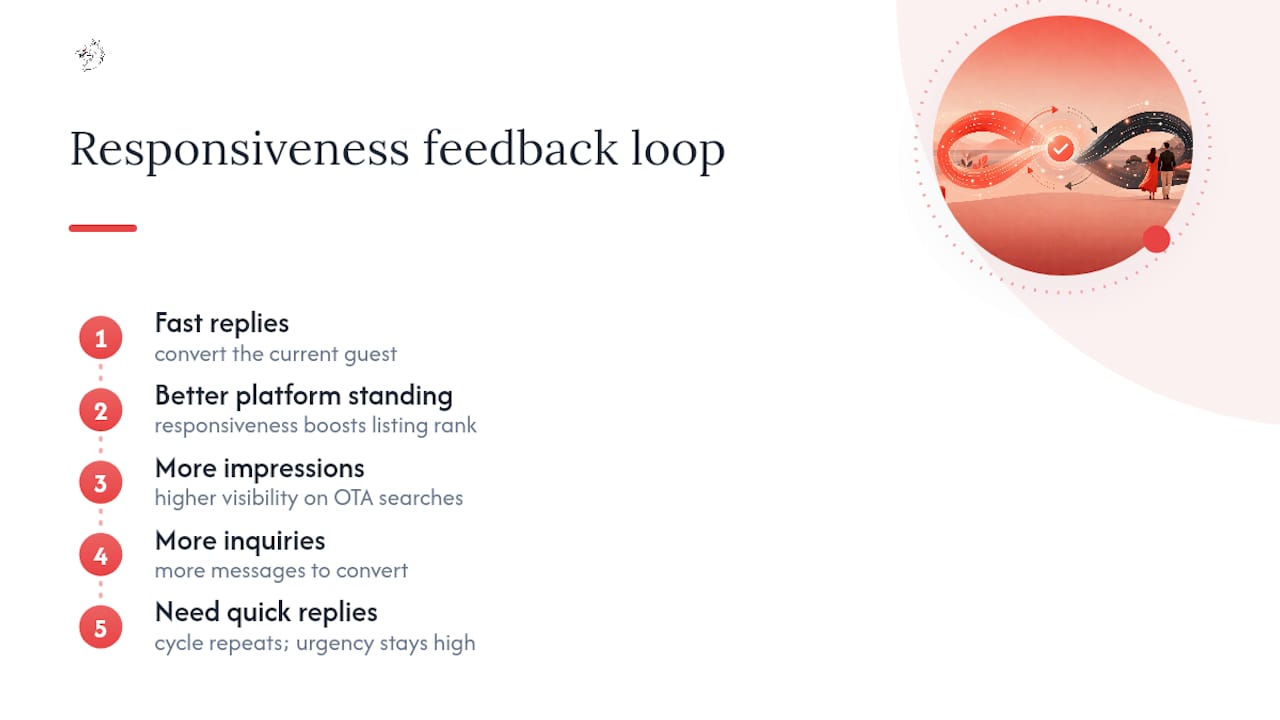
Yes, and in two separate ways. First, platforms like Vrbo built responsiveness metrics directly into their inbox systems, meaning slow reply patterns can affect messaging features and, over time, how often your listing surfaces in search. Second, and more immediately, a fast reply converts the specific guest in front of you before they move to a competing listing.
Those two effects compound. Consistent responsiveness improves your standing on the platform, which increases impressions, which sends you more inquiries to convert quickly, and the cycle repeats. If you have to triage, treat OTA messages and direct website inquiries as equally urgent. A slow reply on either channel costs you a guest now and costs you visibility later.
What Counts as a Fast Reply on Each Channel?
"Fast" isn't the same number everywhere. Guest expectations shift with the channel because the channel itself signals urgency.
- —Live chat: instant, or the guest assumes no one's there.
- —SMS/WhatsApp: a few minutes; these channels imply a real person is available.
- —Direct website inquiry form: under 60 seconds to 5 minutes for an automated acknowledgement, human follow-up shortly after.
- —OTA messages: under 5 to 15 minutes ideally; sector guidance on vacation rental response times puts under one hour as the minimum threshold before instant-booking conversion starts dropping.
- —Email: under 1 hour during business hours; guests treat email as inherently slower, but not open-ended.
Staffing realities will shift these targets. A single-property owner answering messages between shifts can't match a 24/7 answering desk, and that's fine as long as automation covers the gap between "guest messages" and "human responds."
How Do You Measure Your Current Response Time?
You need two numbers per channel: time-to-first-response (median and mean, since one slow outlier skews the average) and response rate within your target window (what percentage of inquiries got a reply inside 5 minutes, 1 hour, and so on).
- 1.Pull your last 20 to 60 inquiries across all channels.
- 2.Time-stamp the inquiry and the first reply for each one.
- 3.Calculate median response time per channel, not just overall.
- 4.Flag the slowest channel; that's your first fix.
- 5.Repeat weekly and track the trend, not just a single snapshot.
Pro Tip: Track median, not average, response time. One inquiry that sat unanswered overnight will make a fast team look slow on paper if you only look at the mean.
How to Cut First-Response Time Without Losing the Personal Touch
Speed and personalization aren't opposites. A generic "thanks, we'll get back to you" is fast but useless. A reply that includes availability, a rate snapshot, and a booking link is fast and moves the guest toward booking.
- 1.Build templates around information, not just tone: dates, price range, direct booking link, and one clarifying question.
- 2.Route every channel into a single unified inbox so no message sits in an app nobody checks.
- 3.Set push notifications for new inquiries, and route by urgency, not by which staffer happens to be free.
- 4.Use AI-first replies for the acknowledgement layer, reserving human attention for negotiation and edge cases. Conversational AI works because the first reply advances the booking instead of just confirming receipt.
Don't stop at reply one. Inquiries that go quiet after the first message aren't dead. A short follow-up at 24 hours and again at 72 hours recovers a meaningful share of guests who got busy, compared prices elsewhere, or simply forgot to reply. Vaultio's guidance on follow-up sequences for conversions covers the cadence that tends to work without feeling pushy.
How Do You Actually Implement This?
Turning benchmarks into practice takes five steps: measure your baseline, automate the acknowledgement layer, centralize your inbox and alerts, train templates and routing rules, then set a formal service standard.
- 1.Run the response-time audit above to know where you actually stand.
- 2.Turn on automated acknowledgements across every channel this week.
- 3.Consolidate messaging into one inbox with real-time notifications.
- 4.Train staff (or your AI system) on templates that include booking links and required guest info.
- 5.Set a written standard: acknowledgement within 15 minutes, full human reply within 2 hours during business hours, AI-first coverage the rest of the time.
Build in escalation rules too. If an AI system can't answer a pricing exception or a special request, it should hand off to a human with the guest's message history attached, not a cold restart.
Pro Tip: Don't try to fix every channel at once. Perfect your direct website inquiry flow first since you control it end to end, then extend the same standard to OTA messages and email.
What Does Faster Response Actually Look Like in Practice?
Operators who move to an AI-first response model typically report the same pattern: acknowledgement times drop from hours to seconds, and the human team spends its time on qualified conversations instead of chasing cold inquiries.
Speed alone doesn't book a stay. A fast reply that includes real availability and a clear next step is what turns an inquiry into a confirmed guest. That distinction is where most automation projects succeed or fail.
Damian, editorial lead at Vaultio, has watched this pattern hold across home service and hospitality clients alike. The mechanics transfer directly: measure your current baseline before changing anything, so you can prove the lift instead of guessing at it.
Why Do So Many Operators Still Reply Too Slowly?
The usual objections are staffing ("we can't watch messages 24/7") and image ("instant replies look desperate"). Neither survives contact with the data. Guests don't perceive a five-minute reply with real information as desperate. They perceive a six-hour silence as indifference. Test one channel this month, measure it honestly, and let the conversion numbers settle the argument.
A Faster Response System You Can Actually Test
Vaultio built its AI Receptionist and AI Chatbot & Scheduling products around exactly the problem this article covers: the gap between when a guest reaches out and when someone answers with real information. Instead of hiring another front desk shift or hoping staff check their phone between tasks, these systems engage every inquiry within seconds, day or night, with availability and a booking link ready to go.
That's not a theoretical fix. It's the same acknowledgement layer described in the implementation checklist above, running automatically instead of depending on someone being at their desk. Vaultio backs it with a 30-day money-back guarantee, so testing it against your current setup costs you nothing but the comparison. If you're ready to stop losing guests to silence, see how the AI Receptionist works and get it running on your busiest channel this week.
Sources
- —The short life of online sales leads (Harvard Business Review)
- —PMC article (relevant to lead response and timing)
- —About responsiveness metrics in the Vrbo inbox (Vrbo Help)
- —Conversational AI marketing trends report (Salesloft)
Recommended
Ready to Implement This?
We'll build your complete lead generation system in 72 hours. No contracts. 30-day money-back guarantee.