Electrician SEO Keywords: High-Intent List & 30-Day Plan
# Electrician SEO Keywords: High-Intent List & 30-Day Plan
Your highest-priority electrician SEO keywords are the ones that bring someone who needs an electrician right now. Start here:
- —"emergency electrician near me"
- —"electrician near me"
- —"[city] electrician"
- —"24 hour electrician [city]"
- —"electrical panel upgrade [city]"
- —"EV charger installation [city]"
- —"licensed electrician [city]"
- —"residential electrician near me"
- —"circuit breaker keeps tripping [city]"
- —"generator installation [city]"
The single best first action: optimize your Google Business Profile and build a matching service page for your top keyword. That combination is what gets you into the map pack, which is where emergency and near-me searches convert into calls. According to local SEO research for electricians, GBP completeness and review specificity have outsized impact on map-pack rankings for exactly these query types.
Your first-hour checklist:
- 1.Log into Google Business Profile and confirm your primary category is "Electrician."
- 2.Add at least three specific services (EV charger installation, panel upgrade, generator install) with keyword-rich descriptions.
- 3.Open Google Search Console and verify your site is indexed.
Pro Tip: Before you touch your website, get your GBP right. It is the fastest path to calls because it shows up before any organic result for local searches.
*
Key Takeaways
The fastest path to more booked electrician jobs is targeting emergency and near-me keywords on an optimized Google Business Profile, backed by separate service pages and a consistent review system.
| Point | Details |
|---|---|
| Emergency keywords convert first | Target "emergency electrician near me" and "24 hour electrician [city]" before any other keyword category. |
| One page per service | Split every service into its own URL with the city in the H1 to give Google a clear ranking signal. |
| GBP is the map-pack engine | Set your primary category to "Electrician," list specific services, and upload at least 10 job photos. |
| Track calls, not just rankings | Use GA4 conversions and a call-tracking number to connect keyword work to actual booked jobs. |
| Vaultio handles the execution | Vaultio manages GBP, service pages, LSA, and AI lead response so electricians capture more jobs without the DIY time cost. |
*
Table of Contents
- —What electrician SEO keywords should you target by category?
- —Where do you place electrician keywords on your website?
- —How do local signals turn your keywords into actual calls?
- —Which tools help you find and prioritize the right keywords?
- —Your copy-paste electrician keyword template
- —How do you track whether your keywords are producing real jobs?
- —Why done-for-you local SEO often beats DIY for busy electricians
- —What actually changed when I started targeting the right keywords
- —Vaultio gets electricians ranked and keeps the leads coming in
- —Sources
What electrician SEO keywords should you target by category?
The right electrician keywords are not a flat list. They fall into distinct intent categories, and each category maps to a different page type and a different stage of the buyer's decision. Knowing which category converts fastest tells you where to spend your first hours.
Emergency and panic queries
These convert fastest. Someone searching "power outage electrician near me" or "sparks from outlet [city]" is ready to call in the next five minutes.
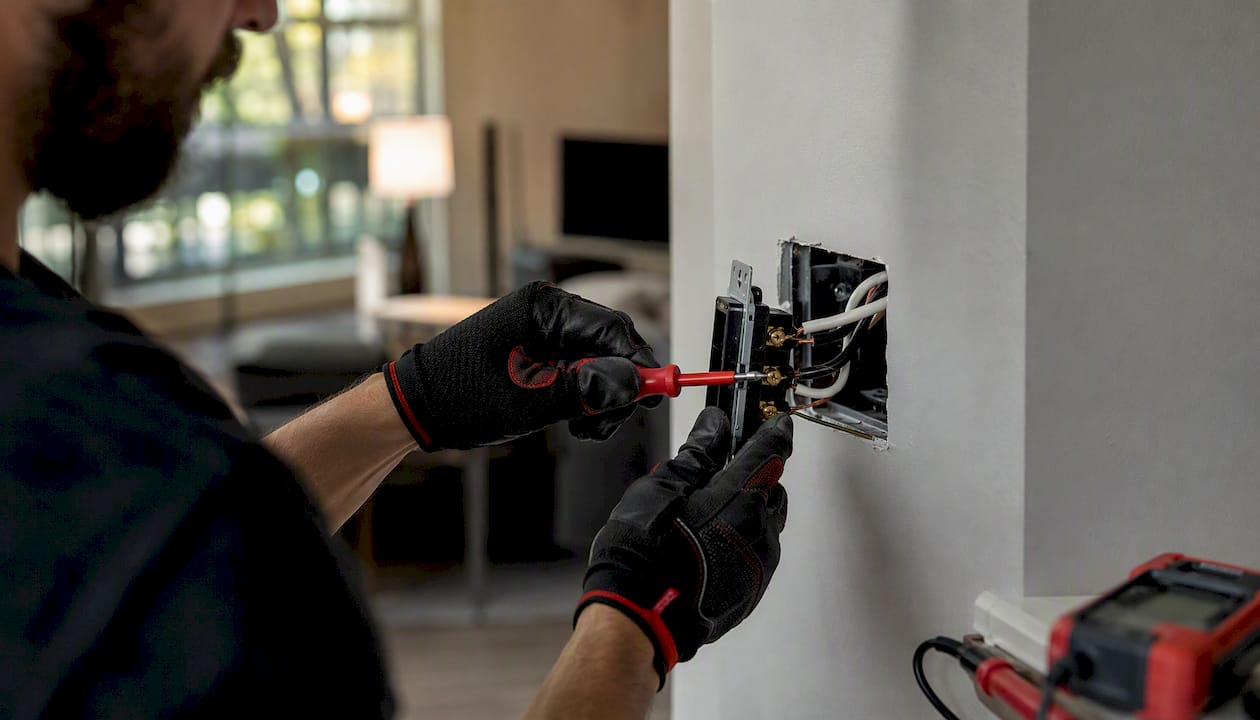
Example keywords: "emergency electrician near me," "24 hour electrician [city]," "electrician open now," "sparks from outlet," "no power in house electrician," "electrical emergency [city]," "tripped breaker won't reset," "burning smell from outlet."
Best placement: Google Business Profile services section, homepage headline, and a dedicated emergency service page.
Proximity and near-me queries
High volume, high intent. High-intent repair and emergency searches convert best, and near-me queries sit right alongside emergency terms in conversion rate.
Example keywords: "electrician near me," "local electrician," "electrician in [city]," "best electrician near me," "affordable electrician near me," "licensed electrician near me," "electrician [zip code]."
Best placement: GBP, homepage, and city landing pages.
Service-specific queries
These target planned work. Lower urgency than emergency, but higher average job value.
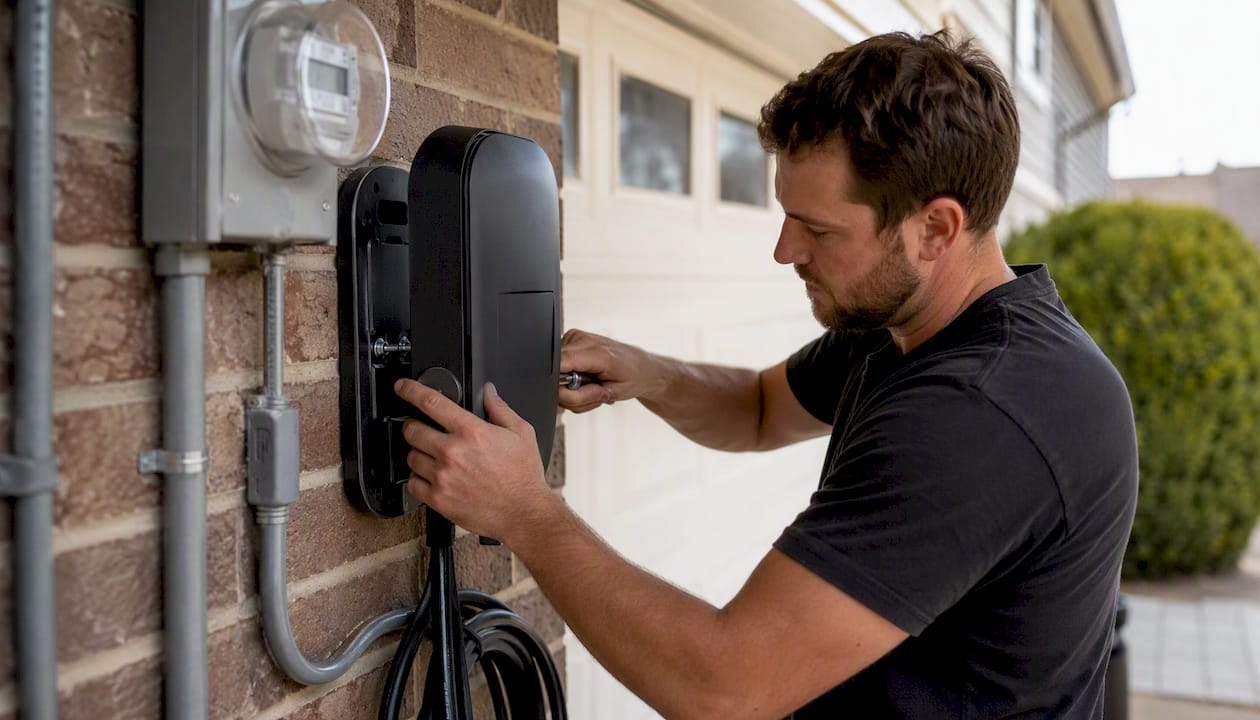
Example keywords: "electrical panel upgrade [city]," "EV charger installation [city]," "whole house rewire [city]," "generator installation [city]," "ceiling fan installation [city]," "outdoor lighting installation [city]," "smart home wiring [city]," "electrical inspection [city]."
Best placement: Dedicated service pages, one per service.
Residential vs. commercial queries
Residential and commercial buyers search differently and need separate pages.
- —Residential: "home electrician [city]," "residential electrical contractor," "house rewiring cost [city]"
- —Commercial: "commercial electrician [city]," "commercial electrical contractor," "office electrical upgrade [city]," "retail electrical installation"
Best placement: Separate residential and commercial service pages with distinct H1s.
Long-tail how-to and troubleshooting queries
Lower conversion rate individually, but they build authority and capture early-stage buyers who become leads.
Example keywords: "how to reset a circuit breaker," "why does my breaker keep tripping," "how much does an electrical panel upgrade cost," "signs you need to rewire your house," "how long does EV charger installation take."
Best placement: Blog posts and FAQ sections with schema markup.
Comparison and price queries
Buyers doing research before committing. These convert at a moderate rate.
Example keywords: "electrician cost [city]," "how much does an electrician charge per hour," "electrical panel upgrade cost," "EV charger installation cost," "best electrician [city]."
Best placement: Service pages with a cost-context section, and dedicated pricing blog posts.
| Category | Example Keyword | Intent | Ideal Page Type |
|---|---|---|---|
| Emergency | "emergency electrician near me" | Transactional | GBP + Emergency service page |
| Near me | "electrician near me" | Transactional | GBP + Homepage |
| Service-specific | "EV charger installation [city]" | Commercial | Dedicated service page |
| Residential | "home electrician [city]" | Commercial | Residential service page |
| Commercial | "commercial electrician [city]" | Commercial | Commercial service page |
| How-to / troubleshooting | "why does my breaker keep tripping" | Informational | Blog post + FAQ schema |
| Price / comparison | "electrical panel upgrade cost" | Commercial | Service page cost section |
Conversion order: Emergency queries convert fastest, followed by service-specific and near-me, then price/comparison, then informational how-to. Build your pages in that order.
As AI-assisted search surfaces more direct answers, structuring content with clear headings, lists, and schema increases the chance your pages get cited in AI overviews, which is a growing share of how local buyers find service providers.
*
Where do you place electrician keywords on your website?
Knowing the keywords is half the job. Placing them correctly is what actually moves rankings. Here is the structure that works.
Service page structure
Each major service gets its own page. A panel upgrade page and an EV charger page are not the same page. Build each one with this structure:
- 1.H1: Include the main keyword and city. Example: "Electrical Panel Upgrade in [City, State]."
- 2.Opening sentence: Restate the keyword naturally within the first 50 words.
- 3.Overview section: What the service is and who needs it.
- 4.Problems solved: The specific issues this service fixes (outdated panels, tripped breakers, code violations).
- 5.Process section: What happens when you show up, step by step.
- 6.Cost context: A realistic price range without committing to a quote.
- 7.CTA: Phone number, contact form, and a clear next step.
For contractor keyword-to-page mapping examples that translate this structure into real pages, the pattern is consistent: one keyword cluster per page, city in the H1, and a CTA above the fold.
Location pages
Create a separate location page for each city or suburb you serve. A page titled "Electrician in Santa Maria, CA" targets a different query than "Electrician in Goleta, CA." The trap most electricians fall into is duplicating the same content across location pages and just swapping the city name. Google treats that as thin content.
Make each location page unique by including:
- —A local reference (neighborhood, landmark, or local code requirement)
- —A service list specific to what that market needs
- —At least one locally relevant FAQ
Metadata and URL patterns
- —Title tag: "[Service] in [City] | [Business Name]" — keep it under 60 characters.
- —Meta description: Include the keyword and a call to action. Under 155 characters.
- —URL: Use clean, readable slugs like `/electrical-panel-upgrade-santa-barbara/` — no keyword stacking.
FAQ and blog use
Long-tail how-to queries belong in blog posts and FAQ sections, not on service pages. A service page for "EV charger installation" should not try to rank for "how long does EV charger installation take." Write a blog post for the question, link it to the service page, and add FAQ schema so Google can pull the answer directly into search results.
Implementation checklist (prioritized by time-to-impact):
- —Week 1: Optimize GBP services and categories
- —Week 1: Fix title tags and meta descriptions on existing pages
- —Week 2: Build or rewrite your top three service pages
- —Week 3: Create two to three location pages for your main service areas
- —Week 4: Publish two blog posts targeting long-tail how-to queries
- —Ongoing: Add FAQ schema to service pages and blog posts
Pro Tip: Google's spam policies explicitly flag keyword stuffing as a penalty trigger. Aim for one natural use of your target keyword per 150–200 words. If you are reading a sentence aloud and it sounds like a robot wrote it, rewrite it.
*
How do local signals turn your keywords into actual calls?
Keywords on a page do not generate calls by themselves. The local signals that surround them, especially your Google Business Profile, reviews, and citations, are what push you into the map pack where the calls actually come from.
Google Business Profile optimization
Your GBP is the primary asset for emergency and near-me searches. For electricians, the GBP wins panic searches while dedicated service pages win planned-project queries — treat them as separate but connected funnels.
- 1.Set your primary category to "Electrician." Do not use a generic category like "Contractor."
- 2.Add secondary categories where relevant: "Commercial Electrician," "Solar Energy Contractor."
- 3.List every service with a keyword-rich description (EV charger installation, panel upgrade, generator install, ceiling fan installation).
- 4.Write a business description that includes your city, your top two services, and a differentiator.
- 5.Upload at least 10 photos: job photos, your van with your logo, before-and-after shots of panel upgrades.
Review strategy
Review velocity and specificity both affect map-pack rankings. Getting five reviews in a week beats getting one a month, and a review that says "replaced our 200-amp panel in Goleta" is more valuable than "great service."
- —Ask for a review within 24 hours of completing the job, while the experience is fresh.
- —Send a direct link to your GBP review page via text.
- —Prompt the customer to mention the specific service. Prompting customers to name the service in their review materially increases relevance for those service keywords in your GBP.
- —Respond to every review, positive or negative, within 48 hours.
Pro Tip: Create a simple text template you send after every job: "Thanks for choosing us! If you have a minute, a quick Google review mentioning [the service you did] helps other homeowners find us." That one sentence doubles review specificity.
Citations and NAP consistency
Your business name, address, and phone number must be identical across every directory listing. A mismatch between "Joe's Electric LLC" and "Joe's Electrical LLC" across directories weakens your local authority. Audit your listings on Yelp, Angi, HomeAdvisor, and the BBB. For a broader look at local citation services and directory strategies, including alternatives to major listing platforms, a citation audit is a smart first step before building new listings.
Local Service Ads
Google's Local Service Ads are a pay-per-lead channel built specifically for home-service businesses. You pay only when a customer contacts you directly through the ad. For electricians, LSA shows up above both paid search ads and organic results, making it a high-visibility complement to your organic GBP work. The Google Guarantee badge on LSA listings also builds immediate trust with emergency callers. Manage LSA alongside your organic work rather than treating them as separate strategies.
GBP and reputation checklist:
- —Primary category set to "Electrician"
- —At least 10 services listed with keyword-rich descriptions
- —Business description includes city and top services
- —Minimum 10 photos uploaded
- —Review request system in place (text template ready)
- —NAP consistent across all directories
- —LSA account created and verified
*
Which tools help you find and prioritize the right keywords?
You do not need a $500/month SEO platform to build a strong electrician keyword list. Three tools cover most of what you need.
Google Keyword Planner is free and pulls real search volume data from Google's own index. Use it to validate volume for your target keywords and discover related terms you have not considered. Enter "electrician [your city]" and let the suggestions expand your list.
KeySearch is a paid tool (affordable at its entry tier) that shows keyword difficulty scores alongside volume. For local markets, difficulty scores matter more than raw volume because you are competing against a handful of local businesses, not national brands. Use KeySearch to find keywords where difficulty is low but intent is high.
Google Trends shows whether a keyword is growing or declining in your region. Search "EV charger installation" in your state and you will see a clear upward trend, which tells you that building a page for that keyword now positions you ahead of the curve. Use it to time content around seasonal demand spikes (generator installation searches spike before winter storms).
As AI-driven search increasingly surfaces concise answers, structuring your keyword-targeted content with clear headings and schema gives it a better chance of appearing in AI overviews alongside traditional results.
Prioritization framework
Rank your keyword list by three factors:
- 1.Intent: Transactional beats commercial beats informational. "Emergency electrician near me" outranks "how much does an electrician cost" in priority.
- 2.Estimated ROI: A single panel upgrade job is worth $1,500–$3,000. A keyword that drives one panel upgrade call per month is worth more than a high-volume informational keyword that drives zero calls.
- 3.Achievable local volume: A keyword with 200 monthly searches in your city is more valuable than one with 10,000 nationally if you can rank for it.
Practical workflow:
- 1.Discover: Pull 50–100 keyword ideas from Keyword Planner and KeySearch.
- 2.Cluster: Group them by service and intent category.
- 3.Map to pages: Assign each cluster to an existing or planned page.
- 4.Test rank: After publishing, check rankings at 30 and 60 days using Google Search Console.
- 5.Optimize: Rewrite underperforming pages to better match the query intent.
Quick-start tool checklist:
- —Google Keyword Planner (free, start here)
- —Google Trends (free, use for seasonal and regional signals)
- —KeySearch (paid, use for difficulty scoring and competitor gaps)
- —Google Search Console (free, use for rank tracking and indexing)
Pro Tip: When to escalate to an agency: if you are spending more than four hours a week on keyword research and page optimization without seeing ranking movement after 90 days, the time cost alone justifies professional help.
*
Your copy-paste electrician keyword template
Copy this into a Google Sheet. Replace the volume placeholders using Google Keyword Planner or KeySearch after entering your city. Customize the city column for every market you serve.
How to use this template:
- —Paste into Google Sheets and add a column for your city name.
- —Enter each keyword into Google Keyword Planner to fill in real monthly volume for your market.
- —Use KeySearch to add a difficulty score column.
- —Sort by Priority (1 first), then build or optimize pages in that order.
- —Revisit every 90 days and add new keywords as services expand.
*
How do you track whether your keywords are producing real jobs?
Rankings are vanity. Calls and booked jobs are the metrics that matter. Track both, and connect them.
Key metrics to monitor:
- —Keyword rankings for your top 10–20 target terms (Google Search Console)
- —Calls from GBP (GBP Insights shows call volume directly)
- —Form submissions (GA4 goal completions)
- —Lead-to-job conversion rate (track in your CRM or a simple spreadsheet)
- —Revenue per lead (total monthly revenue divided by total leads)
Tool setup:
- 1.Google Search Console: Free. Shows which queries bring impressions and clicks. Check it weekly for the first 90 days.
- 2.GA4: Set up conversion events for form submissions and phone click-to-call links. This tells you which pages generate leads, not just traffic.
- 3.Call tracking: Use a call-tracking number on your website (different from your GBP number) so you can attribute calls to specific pages. This is the step most electricians skip, and it is the one that tells you which keywords actually produce revenue.
- 4.Rank tracker: Google Search Console covers most needs for free. A paid rank tracker gives you daily updates and competitor comparisons if you want more granularity.
Mobile site speed directly affects conversions, and most "near me" and emergency searches happen on a phone. If your site loads slowly on mobile, you are losing calls before anyone reads your keywords. Check your mobile speed in Google PageSpeed Insights and fix issues before you invest more in content.
Realistic timeline for local SEO gains:
- —Weeks 4–8: GBP optimizations show up in map-pack impressions. Call volume from GBP starts to tick up.
- —Months 3–6: Service pages begin ranking for target keywords. Organic traffic grows. Form submissions increase.
- —Months 9–12: Compounding effect. Pages with reviews, backlinks, and consistent GBP activity dominate local results for multiple keyword clusters.
Reporting cadence: Check GBP call volume and Search Console weekly. Review GA4 conversions and keyword rankings monthly. Do a full audit of rankings, content gaps, and technical issues quarterly.
*
Why done-for-you local SEO often beats DIY for busy electricians
The Bureau of Labor Statistics classifies electricians under construction and extraction, a sector where most business owners are running crews, pulling permits, and managing job sites, not sitting at a desk optimizing title tags. That time gap is where DIY SEO breaks down.
The recurring tasks that move rankings are exactly the ones that get dropped first when a job runs long:
- —Weekly GBP posts to signal activity
- —Responding to reviews within 48 hours
- —Adding schema markup to new service pages
- —Fixing crawl errors flagged in Search Console
- —Building citations in new directories as your service area expands
Local SEO for electricians requires separate service pages, location pages, and ongoing GBP and review management to compete with larger players. The technical and content work is not a one-time setup — it is a recurring system that compounds over time. Electricians who treat it as a one-time project consistently lose ground to competitors who maintain it month after month.
The gap between an electrician who does a one-time SEO setup and one who runs a maintained system widens every quarter. Separate service pages, location pages, and ongoing GBP management are the high-impact levers, and all three require consistent attention, not a single afternoon of work.
The tasks most DIYers miss:
- —Schema markup on service pages (LocalBusiness, Service, FAQPage types)
- —Internal linking between service pages and blog posts
- —Disavowing toxic backlinks that accumulate over time
- —Updating GBP service descriptions when services or pricing change
- —Monitoring and responding to negative reviews before they compound
*
What actually changed when I started targeting the right keywords
Most electricians I talk to made the same mistake early on: they built one page called "Services" and listed everything on it. Panel upgrades, ceiling fans, EV chargers, commercial work, all on one URL. Google had no idea which query to rank it for, so it ranked for none of them.
The shift that produced real results was simple: one page per service, city in the H1, and a review request after every job that mentioned the specific service. Within 60 days of splitting services into separate pages, map-pack visibility for panel upgrade queries increased noticeably. Within 90 days, the phone was ringing for EV charger installs specifically, because there was a page that said exactly that.
The lesson is not that keywords are magic. It is that Google needs to understand what you do and where you do it, and a single "Services" page does not give it that signal.
Pro Tip: Review your keyword rankings every 30 days and look for pages stuck between positions 8 and 15. Those are your fastest wins. Add a FAQ section with schema, improve the opening paragraph, and get two more reviews mentioning that service. Most of them will move into the top five within 60 days.
*
Vaultio gets electricians ranked and keeps the leads coming in
You now have the keyword list, the page structure, the GBP checklist, and the tracking setup. The question is whether you have the hours to execute it consistently every month.
Vaultio does the execution for you. For electricians who want to own their local market without spending nights rewriting service pages, Vaultio handles:
- —GBP management: Category optimization, service descriptions, weekly posts, photo uploads, and review response.
- —Service and location pages: Built with the right keyword structure, city targeting, and schema markup from day one.
- —Local Service Ads setup and management: Get the Google Guarantee badge and pay only for real leads. See how LSA management works for home-service contractors.
- —AI lead response: Every new inquiry gets a response within seconds, so you capture the emergency caller before they dial the next electrician on the list.
- —Call tracking and reporting: Know exactly which keywords and pages are producing booked jobs, not just traffic.
The result is a predictable flow of 10–15 extra booked jobs per month, backed by a 30-day money-back guarantee. If you are ready to stop losing emergency calls to competitors who simply show up higher on Google, get your local SEO audit from Vaultio in Goleta or see what Vaultio does for contractors in Santa Maria and book a call today.
*
Sources
- —Business
- —Developers
- —Local SEO for Electricians: Winning the Map Pack and Google Business Profile | VT Wyatt
- —SEO for Electricians: Expert Advice for 2026 Strategy
Recommended
Ready to Implement This?
We'll build your complete lead generation system in 72 hours. No contracts. 30-day money-back guarantee.