Book Jobs 24/7: Appointment Booking Automation for Contractors
# Book Jobs 24/7: Appointment Booking Automation for Contractors
The fastest way to stop losing jobs to slow response times is to pair AI-powered appointment booking automation with your calendar and CRM, then pilot it for 2 to 4 weeks before rolling it out fully. Done right, it captures bookings 24/7, cuts no-shows, and gives your staff hours back every week. Contractors who want results fast without building it themselves can use a managed deployment instead of assembling the stack alone.
*
TL;DR: - Automating appointment booking requires integrating AI-powered systems with your calendar and CRM to ensure real-time sync and accurate logging. - Rapid lead response and automated reminders significantly reduce no-shows and increase bookings outside normal business hours. - A 2 to 4-week pilot is enough to evaluate improvements in bookings, no-show rates, and admin time, before full deployment. - Ensuring your system supports deposits, multiple communication channels, and seamless CRM updates maximizes ROI. - Starting with one service line and aligning scheduling rules with your team prevents common failures and optimizes automation benefits.
*
Table of Contents
- —What Is Appointment Booking Automation and Why Does It Matter?
- —How Does AI-Driven Appointment Booking Actually Work?
- —How Do You Set Up Appointment Booking Automation?
- —What Should Your Booking System Connect To?
- —What ROI Metrics Actually Prove the Automation Is Working?
- —Why Contractors Can't Afford to Ignore This
- —What Should You Check Before You Buy?
- —What I'd Tell a Contractor Before They Automate Anything
- —Get Booking Automation Without Building It Yourself
- —Sources
- —FAQ
What Is Appointment Booking Automation and Why Does It Matter?
Appointment booking automation is software that handles scheduling, confirmations, reminders, and rescheduling without a human touching the phone. The category now runs on artificial intelligence: conversational assistants read a customer's message, check availability, and lock in a time slot in seconds. Scheduling automation software automates booking, calendar syncing, reminders, and resource allocation across industries, from dental offices to HVAC companies.
Here's the real business case:
- —24/7 capture. A homeowner with a burst pipe at 11 p.m. can book a slot instead of calling three competitors before finding one who answers.
- —Fewer no-shows. Automated confirmations and reminders close the gap between "I'll be there" and actually showing up.
- —Admin hours saved. Staff stop playing phone tag and start doing billable work.
- —Better cash flow. Deposits collected at booking reduce last-minute cancellations.
- —Cleaner CRM data. Every booking logs a lead source and appointment note automatically, which makes follow-up marketing far more targeted.
One industry-specific scheduler built for automotive shops reports vendor-stated improvements like fewer no-shows and meaningful daily time savings once automation, reminders, and payments are all switched on together. Those figures come from the vendor, not an independent audit, but they track with what most operators feel the moment reminders go live.
How Does AI-Driven Appointment Booking Actually Work?
The mechanics are simpler than the marketing makes them sound. A customer reaches out through a website widget, an email assistant, a voice agent, or SMS. The AI layer parses what they're asking for, checks real-time availability, and holds a slot while it collects the details it needs.
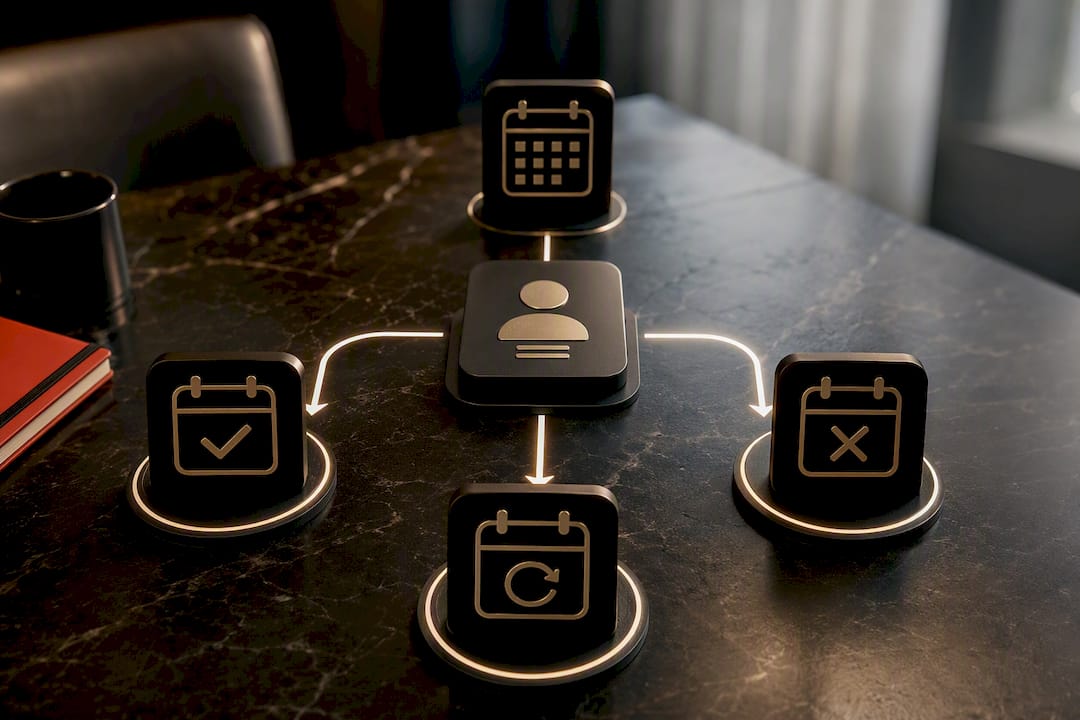
The flow generally looks like this, as detailed in our Workflow De Revisión Preventiva De Edificio: Guía Paso A Paso:
- —Intake: natural language parsing figures out the service requested, urgency, and location.
- —Availability check: the system cross-references staff calendars and existing bookings.
- —Slot hold and confirmation: the customer picks a time, and the system locks it in.
- —Reminders: automated texts or emails go out at set intervals before the appointment.
- —CRM logging: the booking, source, and notes get written to your customer database automatically.
Zapier's own documentation on AI appointment booking shows how these workflows can auto-generate booking links, send personalized messages, and notify staff the moment a new appointment lands. When native integrations fall short, platforms like Zapier stitch together the calendar, CRM, and notification layers using webhooks and APIs, which matters most for shops running older or specialized management software.
How Do You Set Up Appointment Booking Automation?
Getting a pilot live doesn't take months. It takes a clear sequence and someone willing to test it before going all in.
- 1.Map your services. List every service you offer with duration, buffer time, and which staff member can be assigned.
- 2.Connect your calendar and CRM. Verify the sync runs both directions, not just one.
- 3.Build and test your booking flow. Run a handful of sample bookings yourself before customers see it.
- 4.Set reminders and payment rules. Decide when reminders fire and whether deposits are required for certain jobs.
- 5.Run a 2 to 4 week pilot. Track bookings, no-shows, and admin time before expanding to every service line.
Pro Tip: Test your booking flow on a slow day first. If a scheduling conflict slips through when volume is low, it will multiply fast once real customers start filling the calendar.
What Should Your Booking System Connect To?
An appointment scheduler that doesn't talk to the rest of your business is just a fancier phone. The integrations decide whether it actually saves time or creates a second system to babysit.
- —Calendar sync: reliable two-way connections to Google Calendar or Outlook are non-negotiable.
- —CRM logging: every appointment should write lead source and notes back automatically.
- —Payments: Stripe or PayPal integration handles deposits and prepaid services without a separate invoice step.
- —Website and Google Business Profile: a booking widget on your site and a "book" button on your Google listing catch demand where customers are already looking.
- —Zapier, webhooks, and APIs: these fill the gaps when your shop management software wasn't built to talk to a modern scheduler.
All-in-one booking platforms now bundle website booking pages, SMS and WhatsApp reminders, payment acceptance, and built-in AI setup assistants into a single account, which cuts down on the number of separate tools you have to manage.
What ROI Metrics Actually Prove the Automation Is Working?
Four numbers tell you almost everything: bookings per day, no-show rate, bookings that land outside business hours, and average admin minutes per booking.
Run a simple before/after comparison over a reasonable baseline period with your current process, then compare the same metrics once automation is live. Vendor pages for industry-specific schedulers commonly claim reduced manual scheduling time and a jump in total bookings once online booking is enabled, largely because a real share of bookings happen outside office hours when nobody was answering the phone before.
- —Bookings outside business hours often reveal the biggest gap between what you thought demand looked like and what it actually is.
- —No-show rate tends to drop once automated reminders and deposits are standard, not optional.
- —Admin time per booking falls fast once staff stop manually re-entering the same details three times.
Faster response and more captured bookings compound directly into revenue, because a slot filled at midnight is a job that didn't go to a competitor by morning.
Why Contractors Can't Afford to Ignore This
Contractors lose jobs the moment a call goes to voicemail. A homeowner with a clogged drain doesn't wait around. They call the next name on the list, and if that business answers first, the job is gone before you even see the missed call. Automation removes that dead zone entirely.
Some providers pair local search visibility with rapid lead response and appointment automation, so a lead that finds you on Google or shows up through AI search gets engaged within seconds instead of hours. Picture a plumbing company that used to lose weekend calls to competitors; after automating booking and confirmations, that same business captures those calls as scheduled jobs instead of missed opportunities. Real-world outcomes vary by trade and market, and results like these are the kind you'd want to verify against documented case studies before assuming they'll match your business.
- —Missed calls become booked jobs instead of lost revenue.
- —Response speed becomes a competitive advantage, not an afterthought.
- —SEO visibility and booking automation work together, not as separate projects.
What Should You Check Before You Buy?
Before signing up for anything, confirm the basics work the way your business actually operates, not the way a demo video makes it look.
- —Calendar sync runs both directions without manual fixes.
- —CRM logging captures lead source and notes automatically.
- —Reminders cover text, email, or both, depending on your customer base.
- —Payment options support deposits for jobs where cancellations hurt most.
- —Staff assignment rules match how your team actually splits work.
- —Reporting shows the ROI metrics you'll need to justify the cost.
Market reviews of scheduling platforms point to calendar sync, integrations, pricing, and support as the axes that separate a solid platform from a frustrating one. If your team has limited time, no in-house technical skill, or you want visibility and booking working together instead of managed separately, a done-for-you provider usually gets you to results faster than piecing together five tools yourself.
Pro Tip: Ask any vendor how a rescheduled or canceled appointment updates your CRM. If the answer is vague, that gap will cost you hours every month once volume picks up.
What I'd Tell a Contractor Before They Automate Anything
Don't turn on automation before your team agrees on scheduling rules. I've seen the fastest failures come from skipping that step. Start with one service line, measure the results honestly, then expand. Automation without visibility is a nice tool nobody finds; pair it with SEO and local listings so the demand exists before you automate capturing it.
— Damian
Get Booking Automation Without Building It Yourself
There are alternatives to hiring a developer or juggling five disconnected tools for appointment booking automation in your market. Instead of stitching together a calendar app, a CRM, and a booking widget on your own, you can get local SEO visibility, fast lead response, and booking automation managed as one connected system, sometimes backed by a money-back guarantee.
The package is built around getting contractors found first and booked fast. It includes search rankings that put you ahead of competitors, lead response that engages new inquiries within seconds, and appointment automation that turns that speed into a job on the calendar instead of a missed call. If you run a home service business in Goleta and want to see what that looks like in your market, check out Vaultio's Goleta SEO services or review documented results from other contractors before booking a consultation.
Sources
- —AI Appointment Booking — Zapier
- —Scheduling Automation Software Reviews and Ratings
- —ScheduleAuto — smart scheduling for automotive professionals
FAQ
What Is Appointment Booking Automation?
It's software, usually AI-powered, that handles scheduling, confirmations, reminders, and rescheduling without staff manually managing the calendar. It typically connects to your existing calendar and CRM to keep records synced automatically.
How Long Does It Take to See Results?
A pilot period of 2 to 4 weeks is usually enough to compare no-show rates, booking volume, and admin time against your baseline. Full operational effectiveness generally takes longer, depending on how quickly staff and customers adjust to the new flow.
Does Automation Reduce No-Shows?
Yes. Automated confirmations, reminders, and deposit collection close the gap between a booked slot and an actual appointment, and industry-specific schedulers report meaningful drops in no-show rates once those features are active together.
Can Small Contractors Afford This?
Most platforms price on a subscription model with setup costs that scale by feature set, so a small plumbing or electrical shop can start with basic booking and reminders before adding payments or voice agents. A managed provider like Vaultio bundles automation with visibility work, which often costs less than buying each piece separately.
What's the Biggest Mistake Businesses Make When Automating Booking?
Turning on automation before staff agree on scheduling rules, buffer times, and who gets assigned what. That mismatch creates double bookings and confused customers faster than any software bug does.
Recommended
Ready to Implement This?
We'll build your complete lead generation system in 72 hours. No contracts. 30-day money-back guarantee.