What Is a Landing Page? Definition, Types, and Best Practices
# What Is a Landing Page? Definition, Types, and Best Practices
A landing page is a standalone web page built for one marketing campaign with one conversion goal: getting the visitor to take a single action. That's the whole job. Not browsing. Not exploring your services. One click, one form fill, one booked call.
Visitors don't stumble onto a landing page. They arrive from somewhere specific: a paid ad, an email link, a social post, a QR code on a truck wrap. A landing page is decoupled from your site's main navigation, which is what separates it from a homepage or service page.
Here's what makes a landing page different from every other page on your site:
- —One goal, one call to action, no competing links
- —Copy that matches the exact promise made in the ad or email that sent the visitor
- —A conversion mechanism (form, phone button, or booking widget) placed above the fold
- —Built to be disposable and swapped out per campaign, not permanent site architecture
For a home service contractor running a Google Ads campaign for emergency plumbing, the homepage talks about the whole business. The landing page talks about exactly one thing: getting that leaking pipe fixed today.
Key Takeaways
A landing page converts better than a homepage because it matches one campaign's message to one visitor's intent with zero distractions in the way.
| Point | Details |
|---|---|
| Definition | A landing page is a standalone page built for one campaign with one conversion goal. |
| Message match matters most | Headlines that echo the ad or email that sent the visitor reduce bounce significantly. |
| Benchmark to beat | Median dedicated landing pages convert around 4.02%, top performers reach roughly 11.45%. |
| Test headlines first | Headline changes typically produce the biggest conversion uplift of any single test. |
| Mobile speed is non-negotiable | Aim for load times under approximately two seconds to protect conversions. |
Table of Contents
- —What Is the Anatomy of a High-Converting Landing Page?
- —What Types of Landing Pages Should You Use?
- —How Is a Landing Page Different From a Homepage?
- —Why Do Marketers Rely on Landing Pages?
- —How Do You Build a Landing Page Step by Step?
- —What Should You A/B Test First on a Landing Page?
- —How Do You Measure Landing Page Success?
- —What Common Mistakes Kill Landing Page Performance?
- —How Does Vaultio Apply Landing Page Principles for Contractors?
- —An Editorial Take on Landing Page Advice
- —Sources
What Is the Anatomy of a High-Converting Landing Page?
Every element on a landing page earns its place by pushing the visitor toward one action. Strip out anything that doesn't.
Message match comes first. The headline has to echo the exact language from the ad, email, or search result that brought the visitor there. If someone clicks "24/7 Emergency Water Heater Repair" and lands on a page titled "Welcome to Our Plumbing Company," you've already lost them. Mismatched messaging is one of the biggest drivers of early bounce, and it's entirely avoidable.
Here's how the core pieces work together:
- 1.Headline repeats or closely mirrors the ad copy so visitors instantly know they're in the right place.
- 2.Hero section pairs a real photo (your crew, your trucks, the actual job site) with a one-sentence value proposition.
- 3.Call to action uses direct, active language: "Get My Free Quote" beats "Submit."
- 4.Form asks for the minimum: name, phone, service needed. Every extra field costs you conversions.
- 5.Trust signals (reviews, licenses, guarantees) sit near the CTA, not buried at the bottom.
Navigation menus, footer links, and social icons all give visitors a reason to leave. Landing pages designed with minimal navigation keep the visitor's eyes on one path: the button.
Pro Tip: Put your phone number as a clickable tap-to-call button in the hero section, not just in a header. Mobile visitors calling from a job emergency won't hunt for it.
Trust signals matter more than most people assume. Testimonials, star ratings, and license badges address the objection running through a visitor's head before they even ask it out loud, and modern landing pages need to build clarity, relevance, and trust to convert.

What Types of Landing Pages Should You Use?
Different campaign goals call for different page structures. Using the wrong type is like showing up to a job with the wrong tools; it might technically work, but you'll waste time and lose conversions.
- —Lead-capture pages trade something of value (a free estimate, a downloadable checklist, a discount code) for contact information. This is the workhorse for most contractors running paid search or social campaigns.
- —Click-through pages don't collect data directly. They warm up a visitor with more detail before sending them to a checkout or booking page, common in e-commerce and some higher-ticket service sales.
- —Event and launch pages promote a webinar, a seasonal promotion, or a new service offering with a registration deadline built into the copy.
- —Squeeze pages are stripped down to almost nothing: a headline, a single field, and a button. Used when the ask is small (an email address) and the offer is compelling enough to not need much persuasion.
- —Microsites function like a small cluster of linked landing pages, useful for a multi-service campaign or a seasonal push (think: a dedicated "storm damage roof repair" microsite during hurricane season).
Most contractors will live in lead-capture territory. That's where the money is, and it's where message match and reduced form fields do the heaviest lifting.
How Is a Landing Page Different From a Homepage?
Conflating these two page types is one of the most common (and costly) mistakes in digital marketing. They're built for opposite jobs.
A homepage exists to help visitors explore. It has navigation, multiple service categories, an "About Us" link, maybe a blog. A landing page exists to convert one visitor toward one outcome, and it removes every distraction that could pull them away from that path.
- —Objective: homepages support exploration; landing pages drive a single conversion.
- —Navigation: homepages have full menus; landing pages usually have none, or a stripped-down version at most.
- —Message match: homepages speak broadly to many audiences; landing pages speak narrowly to whoever just clicked a specific ad.
- —Exit paths: homepages want visitors clicking around; landing pages treat every extra link as a leak in the funnel.
A product page sits somewhere in between: focused on a single item, but still often part of the main site structure with navigation intact. A true landing page has neither.
Why Do Marketers Rely on Landing Pages?
Landing pages exist because generic pages convert generic traffic poorly. When you build a page around one specific promise for one specific audience, the numbers move.
Higher conversion rates and lower cost per lead are the headline benefits. When someone clicks a Google Ads listing for "same-day AC repair," landing them on a page built around exactly that offer converts far better than landing them on a general HVAC homepage where they have to hunt for what they need.
By the numbers: The median dedicated landing page converts at roughly 4.02%, with the top quartile hitting around 11.45%. That gap between median and top performers usually comes down to message match, page speed, and form friction, not luck.
Cleaner attribution is the underrated benefit. When each campaign gets its own page, you know precisely which ad, email, or QR code produced which lead. Try that with a homepage getting traffic from six different channels at once; the data turns to mud.
Real scenarios where this plays out for contractors:
- —A Google Ads campaign for "emergency roof leak repair" sends clicks to a page built entirely around that service and urgency.
- —A social ad promoting a seasonal HVAC tune-up discount links to a page with that exact offer front and center.
- —An email blast to past customers about a referral bonus points to a page built solely around the referral program.
- —A QR code on a yard sign after a completed job links to a review-request or booking page, not the general site.
How Do You Build a Landing Page Step by Step?
Building a landing page isn't complicated, but skipping steps is how most of them underperform. Work through this order.
- 1.Define the goal and audience first. Decide if you want a phone call, a form fill, or a booking. Know who's clicking (a homeowner with a broken furnace behaves differently than a property manager comparing quotes).
- 2.Write the headline to match the source. If the ad says "Same-Day Drain Cleaning," the headline says the same thing, not a rebranded version of it.
- 3.Build the hero section. Pair a real photo with a one-sentence value proposition. Skip stock photography if you can; real trucks and real crews build more trust than a generic stock plumber.
- 4.Place trust signals near the CTA. Reviews, licensing badges, and guarantees belong close to where the decision happens, not scrolled halfway down the page.
- 5.Build a minimal form. Name, phone number, and service type are usually enough. Every additional field is a chance for someone to give up.
- 6.Add tracking before you publish. Set up UTM parameters on every campaign link and confirm your conversion pixel (Google Ads, Meta, or whatever platform you're running) fires correctly.
- 7.Publish and check mobile rendering. Most contractor leads come from phones. If the page doesn't load clean on a phone screen, you're losing jobs before the visitor even sees the offer.
- 8.Run a smoke test. Submit a test form yourself. Confirm the lead notification hits your team and the tracking pixel logs the conversion.
Pro Tip: Test your own landing page on a phone with a spotty signal, like standing in a driveway on 4G. That's the real-world condition most of your leads will be in.
A conversion-optimized, mobile-first site built with this sequence in mind consistently outperforms pages thrown together without a plan.
What Should You A/B Test First on a Landing Page?
Not every test delivers equal value. Testing button color while ignoring your headline is like repainting a truck with a broken engine.
Test your headline before anything else. CRO specialists consistently point to the headline as the highest-leverage test because it's the first thing a visitor reads and the moment they decide whether to keep going or bounce.
Once the headline is dialed in, move down this priority list:
- —Headline and message match (test first, biggest expected uplift)
- —Call-to-action wording ("Get a Free Quote" vs. "Book Now" vs. "Call Today")
- —Hero image (real crew photo vs. generic stock imagery vs. before/after shots)
- —Form length (three fields vs. five fields)
- —Trust signal placement (above the fold vs. below the form)
For a basic experiment, run two versions of the page split evenly, and don't call a winner until you've collected enough traffic to trust the result. A rough rule of thumb: aim for at least a few hundred conversions per variant before drawing conclusions, and run the test for at least one to two full weeks to smooth out day-of-week traffic patterns. Calling a test after 20 clicks on a Tuesday is how you end up making decisions based on noise.
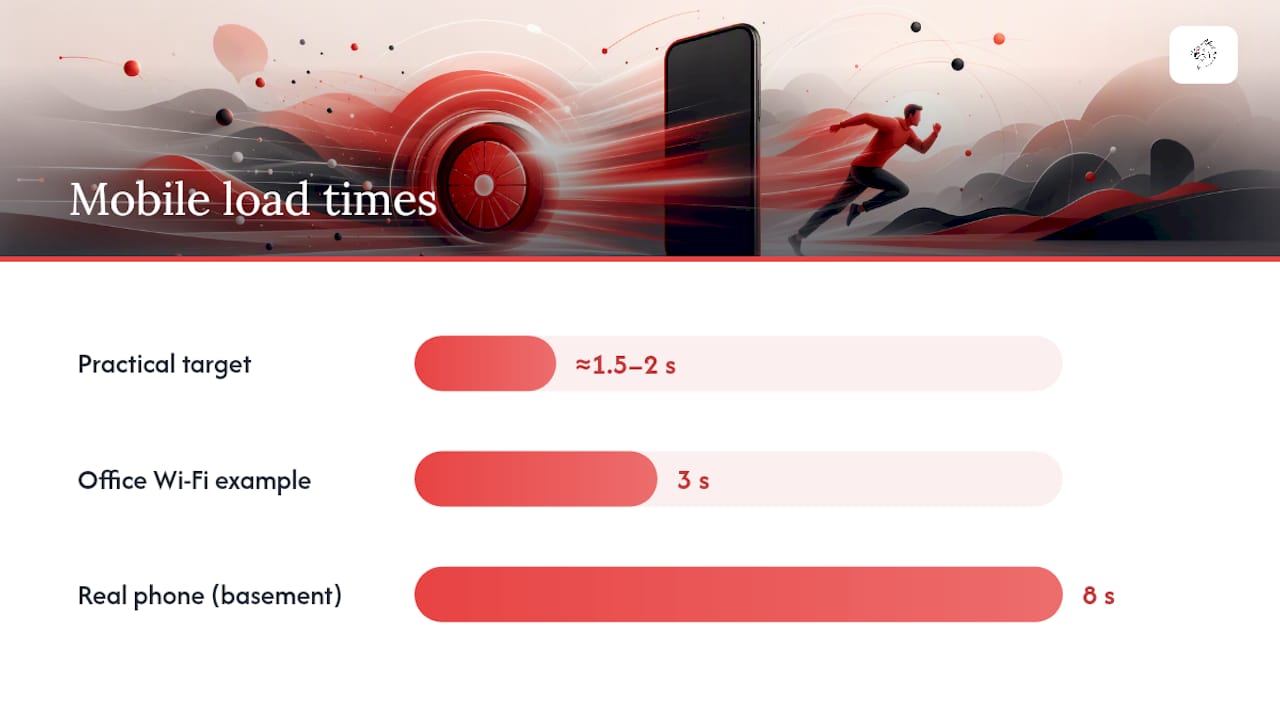
Speed matters more than most people think: Mobile load times under approximately one and a half to two seconds are the practical target; slower pages bleed conversions before the visitor even reads the headline.
Mobile-first optimization isn't optional anymore. Compress your hero images, cut unnecessary scripts, and test on a real phone over cellular data, not just Wi-Fi in your office. A page that loads in three seconds on your office Wi-Fi might take eight seconds on a homeowner's phone standing in a basement next to a broken water heater.
How Do You Measure Landing Page Success?
Conversion rate is the primary number that matters: total conversions divided by total visitors, expressed as a percentage. Everything else supports or explains that one figure.
Cost per lead comes next. Divide your total ad spend by the number of leads generated to see whether the math actually works for your business. Secondary signals like bounce rate, average time on page, and form abandonment rate help diagnose why conversion rate is high or low; they're diagnostic tools, not goals in themselves.
Benchmarks shift depending on traffic source and industry. A visitor who clicked a branded search ad already knows who you are and converts differently than someone who saw a cold social ad.
| Point | Details |
|---|---|
| Median conversion rate | Dedicated landing pages convert around 4.02% on average. |
| Top-quartile conversion rate | The best-performing pages reach roughly 11.45% conversion. |
| Cost per lead | Calculated as total ad spend divided by number of leads generated. |
| Mobile load target | Aim for mobile load times under approximately two seconds to protect conversion rate. |
Traffic source skews these numbers heavily. Paid search traffic with strong intent (someone searching "emergency plumber near me") typically converts at a different rate than cold social traffic seeing your ad for the first time. Compare your results against your own historical baseline more than against a generic industry average.
What Common Mistakes Kill Landing Page Performance?
Most underperforming landing pages share the same handful of problems, and most of them are quick to fix once you know what to look for.
- —Message mismatch: the ad promises one thing, the page headline says something else. Fix it by copying the ad language directly into the headline.
- —Competing links: navigation menus, footer links, and social icons all give visitors an exit ramp. Strip them out.
- —Form friction: too many fields scare visitors off before they finish. Cut it down to name, phone, and service needed.
- —Missing trust signals: no reviews, no licensing badges, nothing above the fold to reduce hesitation. Add at least one credibility element near the CTA.
- —Slow mobile load: heavy images and bloated scripts tank load time on phones. Compress images and test on real cellular data.
- —Broken or missing tracking: if your UTM parameters or conversion pixel aren't firing correctly, you're flying blind on which campaigns actually work.
How Does Vaultio Apply Landing Page Principles for Contractors?
Home service contractors face a specific problem: leads come in fast, often from a phone screen, often from someone with an urgent need. A landing page that's slow, cluttered, or vague loses that job to a competitor within minutes.
Vaultio builds every contractor landing page around three non-negotiables: message match between the ad and the page, a mobile load time target under three seconds, and clean UTM tracking on every campaign so contractors know exactly which channel produced which job. A visible, tap-to-call phone number stays in the hero section on every page, because a homeowner standing next to a flooding water heater isn't scrolling to find a form.
Fast lead response compounds the effect of a well-built landing page.
The gap between a landing page that converts and one that doesn't usually isn't design polish. It's whether the headline matches what the visitor clicked, whether the phone number is one tap away, and whether someone responds before the visitor calls the next contractor on the list.
Pairing that page structure with conversion-optimized website design and rapid lead response is how contractors turn campaign clicks into booked jobs instead of bounced traffic.
An Editorial Take on Landing Page Advice
Most landing page advice online treats every business the same, as if a SaaS signup form and an emergency plumbing call convert on the same logic. They don't. The research is clear that message match, trust signals, and speed drive conversion, but the priority order shifts for a contractor whose visitor is often mid-emergency on a phone screen.
Conventional advice overweights design polish and underweights response speed. For a home service business, the page's job is to get the phone to ring or the form to submit; everything after that moment matters just as much as everything before it.
If you take one thing from this: fix message match and mobile speed before touching anything cosmetic. Those two levers move the needle furthest, fastest, and with the least guesswork.
Sources
- —What is a landing page? Complete 2025 guide & best practices
- —Back to basics: What is a landing page and how do they work — SmartBug / Leadfeeder
- —Landing Page — Mailchimp marketing glossary
Recommended
- —Website Design for Home Services: Convert 3X More Visitors | Vaultio
- —Website Design for Home Service Contractors | Conversion-Optimized, Mobile-First Sites | Vaultio
- —Google Ads for Electricians: Stop Wasting Money on Bad Clicks | Vaultio
- —Digital Marketing for Home Services: Win More Leads in 2026 | Vaultio
Ready to Implement This?
We'll build your complete lead generation system in 72 hours. No contracts. 30-day money-back guarantee.