Types of Home Service Lead Funnels: What to Use and When
# Types of Home Service Lead Funnels: What to Use and When
Home-service businesses run on seven core funnel types: emergency/instant-response, estimator/instant-quote, scheduled/planned-project, recurring-maintenance, paid-search/LSA marketplace, organic SEO and content, and referral/partner funnels. Each one wins a different kind of job.
- —Emergency/instant-response: best for plumbers, HVAC, and electricians. Watch first-response time.
- —Estimator/instant-quote: best for roofing, remodeling, and solar. Watch quote-to-booking rate.
- —Scheduled/planned-project: best for landscaping and large remodels. Watch cost per booked consult.
- —Recurring maintenance: best for HVAC service plans and pest control. Watch retention rate.
- —Paid-search/LSA marketplace: best for fast market entry. Watch cost per lead (CPL).
- —Organic SEO/content: best for long-term dominance. Watch organic lead share.
- —Referral/partner: best for high-trust trades. Watch referral close rate.
Key Takeaways
Response time and verified lead quality determine booking rates far more than the number of leads a funnel generates.
| Point | Details |
|---|---|
| Match funnel to intent | Emergency calls need phone-first capture; research-stage homeowners need estimators and content. |
| Speed decides bookings | First-response time and lead-to-booking rate matter more than raw lead volume. |
| Build hybrid funnels | Combining estimators, booking widgets, and nurture sequences catches leads at multiple decision points. |
| Automate qualification | Service-area checks and CRM routing should happen within seconds of lead capture, not hours. |
| Vaultio speeds deployment | Vaultio pairs local SEO with AI receptionist capture and CRM routing to shorten setup and cut response times. |
Table of Contents
- —What Makes Home Service Lead Funnels Different
- —Funnel Stages and Components Every Contractor Needs
- —7 Types of Home Service Lead Funnels (And When to Use Each)
- —How to Capture and Qualify Leads That Actually Book
- —The Metrics That Actually Predict Booked Jobs
- —Choosing and Implementing the Right Funnel
- —How a Done-for-You Partner Speeds Up Funnel Setup
- —What I'd Prioritize First, and What I Wouldn't Expect Too Soon
- —Get More Booked Jobs Without Guessing at Which Funnel Works
- —Frequently Asked Questions
- —Sources
What Makes Home Service Lead Funnels Different
The single biggest difference between a home-service funnel and a typical eCommerce or SaaS funnel is time pressure combined with geography. A software buyer can browse for weeks. A homeowner with a burst pipe gives you minutes, and only if you actually service their zip code.
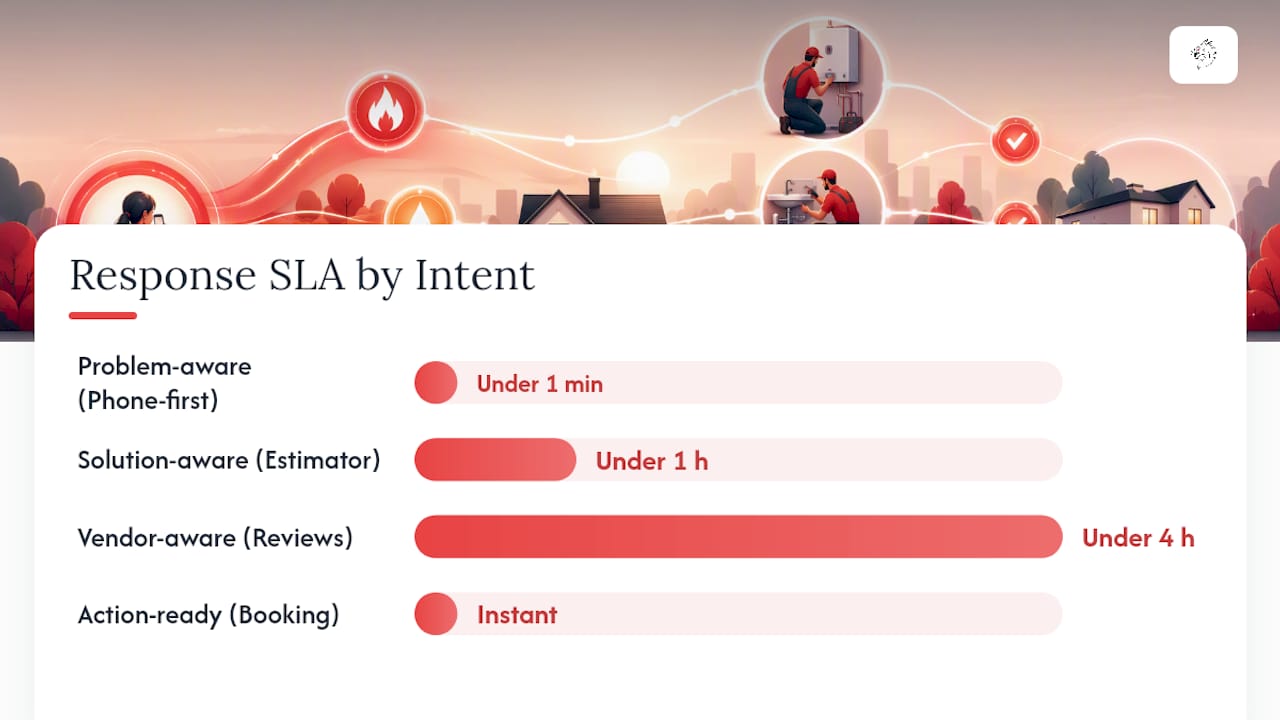
That urgency splits homeowner intent into four buckets, and each one demands a different funnel response. Problem-aware homeowners (something's broken, fix it now) need instant phone or chat capture. Solution-aware homeowners (I know I need a new roof, not sure what it costs) respond to estimator tools. Vendor-aware homeowners comparing contractors want proof: reviews, portfolios, guarantees. Action-ready homeowners just want a booking slot on the calendar.
Housecall Pro's research on home-service sales funnels makes the point directly: a funnel built for eCommerce falls apart the moment a homeowner needs same-day service. Dispatch capacity, technician availability, and service-area boundaries all constrain what a funnel can promise.
| Intent level | Best funnel tactic | Required response SLA |
|---|---|---|
| Problem-aware (emergency) | Phone-first capture, AI receptionist | Under a minute |
| Solution-aware | Estimator/calculator page | Under 1 hour |
| Vendor-aware | Content, reviews, comparison pages | Under 4 hours |
| Action-ready | Booking widget, confirmation flow | Instant |
Pro Tip: Emergency and estimator funnels live or die on speed. If your team can't verify service area and respond within minutes, an AI receptionist closes that gap before the homeowner calls a competitor.
Funnel Stages and Components Every Contractor Needs
Every reliable home-service funnel needs three stages, TOFU, MOFU, and BOFU, built on six components: service-area landing pages, an instant-chat or AI receptionist, phone-first capture, estimator pages, a booking widget, and a CRM that routes and enforces response SLAs.
Salesforce's breakdown of the lead generation funnel frames TOFU as the awareness layer (blog posts, service-area pages, social ads), MOFU as the conversion layer (lead magnets, estimator tools, landing pages), and BOFU as the close layer (quotes, consultations, booked appointments). For home services, that translates directly:
- —TOFU: service-area SEO pages, seasonal content, paid ads targeting "near me" searches.
- —MOFU: estimator forms, chat widgets, gated pricing guides that capture contact details.
- —BOFU: phone consultations, in-home quotes, booking confirmation with a signed date.
A concrete example makes the flow easier to picture. A homeowner searches "roof replacement cost" and clicks a paid ad. That lands them on an estimator page (MOFU), where they answer four quick questions about roof size and material. The system verifies their address falls inside your service area, then routes the lead to a scheduler.
- 1.Paid ad click lands on estimator landing page.
- 2.Homeowner completes a short estimator form (address, roof age, material preference).
- 3.System verifies service area instantly.
- 4.Booking widget offers the next available inspection slot.
- 5.Confirmation text and reminder email lock in the appointment.
This flow works because each stage removes friction one step at a time instead of asking for everything up front. HubSpot's guide to lead generation funnels backs this up: matching CTA directness to buyer intent, rather than pushing every visitor toward a hard sell, is what separates funnels that convert from ones that just collect abandoned forms.
7 Types of Home Service Lead Funnels (And When to Use Each)
Prioritize funnels by two things: how urgent the homeowner's need is, and what job you're actually trying to book. Here's how the seven main types stack up.
1. Emergency / Instant-Response Funnel
This funnel exists for one purpose: catch the homeowner the second they realize they have a problem. It runs on phone-first capture and an AI receptionist that answers around the clock, verifies service area, and books or dispatches on the call. Setup checklist: a click-to-call number on every page, call routing rules, and an AI receptionist trained on your service menu and pricing ranges. Cost and timeline run fast, typically live within a week once call routing is configured. The KPI that matters most is first-response time, not lead volume.
2. Instant-Quote / Estimator Funnel
Homeowners who are solution-aware but not yet ready to call want a number first. An estimator page asks a handful of qualifying questions (square footage, material, urgency) and returns a price range or triggers a callback. Setup takes a landing page, a short-form calculator, and a routing rule that flags high-value estimates for immediate follow-up. Expect a two- to four-week build. Track quote-to-booking rate; a well-tuned estimator should convert a meaningful share of completed quotes into scheduled visits.

3. Scheduled / Planned-Project Funnel
Big-ticket work like full kitchen remodels or landscape overhauls needs a longer runway. This funnel pairs a conversion-focused website with long-form content (project galleries, cost guides) and retargeting ads that keep your name in front of homeowners who aren't ready yet. Best for remodelers, landscapers, and solar installers. Setup takes longer, often three to six months to build authority and content depth. Watch cost per booked consultation over time, not per click.
4. Recurring Maintenance / Retention Funnel
This one isn't about winning a new customer, it's about keeping one. HVAC tune-up plans, pest control contracts, and gutter cleaning subscriptions all run on automated renewal reminders and seasonal check-in campaigns. Setup checklist: a CRM tagging system for plan customers, automated renewal texts, and a simple upsell offer at each touchpoint. Retention rate is the number that matters here, since a retained customer costs far less to keep than a new lead costs to acquire.
5. Paid-Search / Local Service Ads Marketplace Funnel
Google's Local Service Ads and traditional paid search put you in front of homeowners actively searching, fast. This funnel type is best for contractors who need volume now and can absorb variable lead quality. Setup involves budget allocation, ad copy testing, and a fast-response process since LSA leads often go to whoever calls back first. Modernize's research on home services lead generation notes that verified-call and form-fill leads from marketplaces deliver strong volume, though exclusivity and verification vary by provider. CPL is the metric to watch, but only alongside lead-to-booking rate.
6. Organic SEO & Service-Area Content Funnel
This funnel compounds over time instead of paying for every click. Service-area pages, blog content answering common homeowner questions, and local citations build rankings that keep generating leads without a per-click cost. It's the slowest to build, often three to six months before meaningful traffic arrives, but it becomes your cheapest lead source over the long run. Track organic lead share as a percentage of total leads.
7. Referral / Partner Funnel
High-trust trades like plumbing and electrical work often close a large share of jobs through referrals from real estate agents, property managers, or past customers. Setup is mostly relational: a simple referral tracking system, a thank-you incentive, and a follow-up cadence with partner businesses. Referral close rate tends to run higher than any paid channel, since the trust transfer happens before the first call.
Pro Tip: Most estimator forms fail because they ask for too much too soon. Cut the form to three questions, get the phone number, and let a human or AI receptionist ask the rest live. Shorter forms convert to scheduled visits at a noticeably higher rate.
Hybrid funnels, ones combining an estimator page, a booking widget, and an automated nurture sequence for leads that don't book immediately, tend to outperform any single-channel approach because they catch homeowners at multiple points in their decision.
How to Capture and Qualify Leads That Actually Book
The capture method has to match both the homeowner's intent and how fast you need to verify them. A phone call demands instant verification; a content download can wait a day.
Effective capture channels for home services include paid-search landing pages, service-area SEO pages, chat or AI receptionist widgets, phone-first forms, estimator calculators, referral forms, and LSA marketplace leads. Prioritize phone and chat capture for anything urgency-flagged, and forms or calculators for research-stage visitors.
Once a lead comes in, four qualification layers separate a bookable job from noise:
- 1.Service-area check: confirm the address falls inside your coverage zone before a technician's time gets committed.
- 2.Ownership verification: renters calling about a landlord's HVAC system need a different routing path than homeowners.
- 3.Timeframe indicator: "need it today" versus "planning for spring" changes which funnel and rep handles the lead.
- 4.Technician availability: don't promise a slot your schedule can't deliver.
A quick implementation checklist for any team building this out:
- —Capture name, phone, address, and service need on every form, no exceptions.
- —Verify service area automatically before routing to a live rep.
- —Flag high-urgency keywords ("leak," "no heat," "sparking") for immediate callback.
- —Route qualified leads to the CRM within seconds, not hours.
Softwired Digital's guide to setting up a home services sales funnel makes the case for automation here: CRMs with built-in job scheduling, two-way texting, and automated reminders cut the manual handoffs where leads typically get dropped. A chatbot handles the initial triage; an estimator widget handles pricing questions; the CRM handles everything after that, without a person having to babysit each step.
The Metrics That Actually Predict Booked Jobs
Lead-to-booking rate and first-response time matter more than raw lead volume. A hundred leads that sit unanswered for six hours will lose to twenty leads answered in sixty seconds, every time.
Track these core metrics on every funnel:
- —Cost per lead (CPL): what you're paying to generate each raw lead.
- —Lead-to-booking rate: the percentage of leads that turn into a scheduled appointment.
- —Booking-to-close rate: the percentage of appointments that become paid jobs.
- —First-response time: how fast a lead gets a human or AI reply.
- —Job value: average revenue per booked job, by funnel source.
- —ROI / cost per booked job: total spend divided by jobs actually closed.
A simple testing checklist keeps funnels improving instead of stagnating:
- 1.Test landing page CTAs (call now versus request a quote).
- 2.Test form length against completion rate.
- 3.Test chat capture against phone-first capture for the same traffic source.
- 4.Test response-time SLAs and measure the booking-rate impact.
- 5.Track estimator conversion rate separately from overall funnel conversion.
- 6.Audit channel attribution monthly so budget follows what actually books jobs.
Seasonality skews these numbers. PM Magazine's coverage of rising costs and shifting customer behavior in home services points out that channel performance varies as costs rise, which means a CPL benchmark from HVAC season won't hold for a roofer in the off-season. Compare metrics within the same trade and season, not across them.
Choosing and Implementing the Right Funnel
Choose your funnel by three factors: job size, urgency profile, and how much booking capacity your team can actually absorb. A one-truck electrician chasing emergency calls needs a different setup than a remodeling company booking six-week projects.
Before signing with any vendor or tool, ask:
- 1.What's the guaranteed response SLA on delivered leads?
- 2.How is service-area verification handled before a lead reaches us?
- 3.Is this an exclusive lead or shared with competitors?
- 4.What reporting do we get, and how often?
Red flags worth walking away from: no SLA on lead delivery, vague or missing attribution data, and long setup timelines with no pilot results to show first.
Realistic timelines: a simple estimator landing page takes two to four weeks. LSA setup with a working budget can go live in days to weeks. A full SEO and service-area content funnel takes three to six months to mature.
How a Done-for-You Partner Speeds Up Funnel Setup
A specialist handling this for you typically delivers three things a solo setup struggles to match: faster time-to-launch, more consistent lead flow, and tighter response automation.
The workflow usually runs discovery first, then service-area SEO or paid-ad setup, then capture and AI receptionist deployment, then CRM routing, then ongoing optimization based on the metrics above.
Owners working with Vaultio can reasonably expect faster first-response times, measurable CPL improvements, and additional booked jobs each month, though results vary by trade, market, and starting point.
The gap between a good funnel and a great one usually isn't strategy. It's speed: how fast you respond, how fast you verify, and how fast a lead becomes a booked job.
- —Discovery and service-area mapping
- —SEO or paid-search funnel build
- —AI receptionist and capture deployment
- —CRM routing with SLA enforcement
- —Ongoing testing and optimization
What I'd Prioritize First, and What I Wouldn't Expect Too Soon
If I were building funnels for a single-location contractor, month one would go entirely to response speed: phone-first capture, an AI receptionist, and service-area verification. Month three shifts toward the estimator funnel and early SEO content. One honest expectation: paid funnels book jobs in days; SEO funnels need months before quality traffic shows up, so don't judge them on the same timeline.
Get More Booked Jobs Without Guessing at Which Funnel Works
Building all seven funnel types yourself, then testing response times, verification steps, and CRM routing until something actually books jobs, takes months most contractors don't have to spare. Vaultio builds the emergency-response and estimator funnels together: local SEO to get found, an AI receptionist to answer instantly, and CRM routing so no lead sits unanswered.
Contractors working with Vaultio typically see a steady flow of extra booked jobs each month, backed by a 30-day money-back guarantee. If instant response and lead capture are the pieces you're missing, start with the AI Receptionist page and see how it plugs into your existing funnel.
Frequently Asked Questions
What are the main types of home service lead funnels? The seven core types are emergency/instant-response, estimator/instant-quote, scheduled/planned-project, recurring-maintenance, paid-search/LSA marketplace, organic SEO and content, and referral/partner funnels.
Which funnel type generates leads fastest? Paid-search and Local Service Ads marketplace funnels generate leads fastest, often within days of launch, though cost per lead runs higher than organic channels.
How long does an SEO funnel take to produce quality leads? Most service-area SEO funnels take three to six months to build enough authority and content depth to produce consistent, quality leads.
What KPI should I track first when comparing funnel types? Track lead-to-booking rate alongside first-response time before looking at raw lead volume or cost per lead in isolation.
Do I need different funnels for different trades? Yes. Emergency-heavy trades like plumbing and HVAC need instant-response funnels first, while project-based trades like remodeling benefit more from scheduled-project and content funnels.
Sources
- —Lead generation funnel — Salesforce
- —Lead generation funnels: a complete guide for growing sales & marketing teams — HubSpot
- —How to set up your home services sales funnel: lead gen → CRM → conversion — Softwired Digital
Recommended
Ready to Implement This?
We'll build your complete lead generation system in 72 hours. No contracts. 30-day money-back guarantee.