NAP Consistency for Contractors: Fix Listings in 2–3 Hours
# NAP Consistency for Contractors: Fix Listings in 2–3 Hours
NAP consistency means your business Name, Address, and Phone number (add your website and it's called NAP+W) appear identically everywhere online. It matters because mismatched listings erode Google's confidence in your business and confuse customers trying to call you. Fix it today: write down your master NAP exactly as it should appear, then check it against your Google Business Profile.
*
TL;DR: - Most NAP discrepancies are due to inconsistent business name, address formatting, conflicting call tracking numbers, or outdated listings, which harm rankings. - Prioritize fixing the most visible and traffic-driving listings first, especially your Google Business Profile and top directories, and keep detailed records of updates. - Use a repeatable audit process with manual searches, automated tools, and spreadsheets to identify, track, and correct citation inconsistencies regularly. - Address errors involving wrong digits, address mismatches, duplicate listings, and tracking number conflicts, while minor formatting differences rarely impact SEO. - Treat NAP management as a continuous task with scheduled audits and consider managed services to maintain accuracy across multiple locations and directories effectively.
*
Table of Contents
- —What Nap Consistency Actually Means And Where Your Data Lives
- —Why Inconsistent Listings Cost You Rankings And Jobs
- —How To Audit Your Nap Consistency Step By Step
- —Common Nap Errors And The Exact Fix For Each
- —Choosing The Right Tool For Ongoing Nap Management
- —Locking Nap Consistency Into Your Website Itself
- —How Often To Check Your Listings
- —A Contractor's Operational Playbook For Nap And Lead Capture
- —What Contractors Get Wrong About Nap Consistency
- —Get Managed Nap And Local Seo Help From Vaultio
- —Sources
What Nap Consistency Actually Means And Where Your Data Lives
Your master NAP is the single, locked version of your business name, address, and phone number that every other listing must match. Example: "Ace Plumbing Co." not "Ace Plumbing" on one site and "Ace Plumbing, LLC" on another. Moz defines NAP+W as the same data set with your website URL added, and recommends it stay identical across your site, Google Business Profile, and every directory that lists you.
Your NAP shows up in more places than most contractors realize:
- —Your website (homepage footer, contact page, schema markup)
- —Google Business Profile and Google Maps
- —Directories like Yelp, Angi, HomeAdvisor, and industry-specific listings
- —Review platforms and social media bios (Facebook, Instagram, LinkedIn)
- —Local news mentions, supplier partner pages, and chamber-of-commerce listings
Search engines treat each of these as a vote confirming you are who you say you are, located where you say you're located. When ten sources agree and two don't, Google doesn't throw out the two, it just trusts you a little less overall. That's the mechanism behind every ranking problem this article solves.
Why Inconsistent Listings Cost You Rankings And Jobs
Every mismatched listing chips away at the trust Google places in your business data. NAP consistency is considered a foundational local SEO requirement, not an optional polish step, because Google's local algorithm cross-references citations to verify you're a real, stable business at a real, stable location. Fragmented signals mean Google has to guess which version is correct, and it often defaults to caution: lower visibility in the Local Pack, the three-listing map result that captures most "near me" clicks.
Voice search makes this worse. When someone asks a smart speaker for "a plumber near me," the assistant pulls from the listing it trusts most, not the one with the best website. If your phone number is wrong on even one authoritative directory, you can lose that call entirely and never know it happened.
The customer-facing damage is just as real. Inconsistent NAP data actively harms consumer trust and referral traffic, according to BrightLocal's research on local search behavior. A homeowner who calls a disconnected number, or drives to an old address, doesn't try you again. They call the next name on the list.
This is why local SEO specialists treat NAP accuracy as table stakes: the baseline requirement you clear before reviews, backlinks, or content marketing can do any good. Pouring budget into local SEO tactics while your citations conflict is like advertising a store that's occasionally at the wrong address. Fix the foundation first.
How To Audit Your Nap Consistency Step By Step
Run this audit start to finish, then repeat it on your maintenance schedule. It takes most single-location contractors two to three hours the first time and far less on repeat passes.
- 1.Define your master NAP. Write out the exact business name (legal name or DBA, pick one and stick with it), the exact address format (suite number included, USPS abbreviation style chosen), and the phone number you want listed everywhere. Save this in a shared document your whole team can reference.
- 2.Check Google Business Profile first. This is the listing Google trusts most and the one customers see first in Maps and the Local Pack. Claim and verify it if you haven't, and confirm every field matches your master NAP exactly.
- 3.Run manual searches to catch stray mentions. Search your business name in quotes, search your phone number in quotes, and try a `site:yelp.com "your business name"` style query across major directories. Old listings from a previous address or a former owner surface fast this way.
- 4.Scan with an automated citation tool. Manual searches catch the obvious problems, but automated scanners catch the ones buried on page four of search results. This step follows the standard audit sequence local SEO guides recommend: define, check, scan, then fix.
- 5.Export everything into one spreadsheet. List every listing found, its current NAP data, whether it matches your master version, and a status column (correct, needs fix, disputed, pending).
- 6.Prioritize fixes by visibility and traffic. Google Business Profile, your top three directories, and any site sending you real referral traffic get fixed first. A dormant listing on a directory nobody visits can wait.
- 7.Fix, then document the date. Every correction gets a timestamp in your spreadsheet. Directory updates can take days or weeks to reflect, so you need a record of when you submitted the change versus when it actually went live.
That spreadsheet becomes your source of truth. The next audit isn't a cold start, it's a re-check against a document you already built.
Common Nap Errors And The Exact Fix For Each
Most NAP problems fall into four buckets, and each has a specific, repeatable fix.
- —Inconsistent business name. A listing shows "Ace Plumbing" while your legal filing says "Ace Plumbing Co." Pick one form (usually your official DBA) and update every listing to match it exactly, including punctuation.
- —Address formatting drift. One directory lists "123 Main St. Suite 4," another shows "123 Main Street #4." Standardize on the format Google Business Profile displays, since that's the version customers and algorithms weight most heavily.
- —Phone number conflicts from call tracking. Marketing teams often publish a tracking number instead of the main line, breaking consistency across listings. Map every tracking number to its specific channel, keep the primary public number stable on every citation, and never publish a dynamic number insertion (DNI) script's output on a static directory listing.
- —Duplicate or outdated third-party listings. Old locations, former ownership, or auto-generated directory entries create duplicates. Claim and merge them where the platform allows it, or submit a correction request where it doesn't.
Pro Tip: Not every discrepancy is worth fixing. Minor formatting differences like "St." versus "Street" rarely hurt your rankings; focus your limited hours on wrong addresses, wrong digits, and missing suite numbers first.
Choosing The Right Tool For Ongoing Nap Management
You have three realistic paths, and the right one depends on how many locations you manage and how much time you have.
- —Manual tracking with a spreadsheet works for a single location with a handful of core citations. It costs nothing but your time, and it demands discipline to repeat quarterly.
- —Listing-management platforms push updates to dozens of directories from one dashboard and flag new mentions automatically. They save hours but usually charge monthly and vary widely in how many directories they actually cover.
- —Data aggregators feed corrected information to the major directory networks in bulk, which helps multi-location businesses but offers limited dispute support when a stubborn third-party site refuses to update.
- —A managed service or agency handles audits, fixes, and disputes on your behalf, which matters most when you have zero spare hours and multiple locations to track.
When evaluating any tool or vendor, ask three questions: how many directories does it actually reach, how fast do corrections propagate, and does it offer human dispute support when an automated fix gets rejected.
Locking Nap Consistency Into Your Website Itself
Your website should be the most reliable version of your NAP, not another source of drift. Add LocalBusiness schema markup with your name, address, telephone, URL, and sameAs links to your social profiles, so search engines can read your data directly from code instead of guessing from page text.
Keep one canonical contact page, and mirror that exact NAP in your site's footer. Publishing two different phone numbers on your site, one for a landing page campaign and one in the footer, creates the exact fragmentation this whole guide is about fixing. If you're rebuilding your site, conversion-focused website design should treat the contact page as a data source, not just a design element.
Mobile click-to-call links matter too. Make sure the number behind that tap button matches your published NAP, and canonicalize any duplicate pages (like separate mobile URLs) so Google indexes one authoritative version.
How Often To Check Your Listings
You don't need daily monitoring, but you do need a rhythm.
- 1.Monthly: Do a five-minute spot check of Google Business Profile and your top three directories.
- 2.Quarterly: Run the full audit workflow, including the automated scan and spreadsheet review.
- 3.Immediately after any change: New address, new phone system, name change, or ownership transfer triggers an audit the same week, not at the next scheduled check.
This cadence matches what local SEO practitioners recommend for most single-location and small multi-location businesses. Assign one person, usually the office manager or marketing lead, to own the change log so updates don't fall through the cracks between busy seasons.
A Contractor's Operational Playbook For Nap And Lead Capture
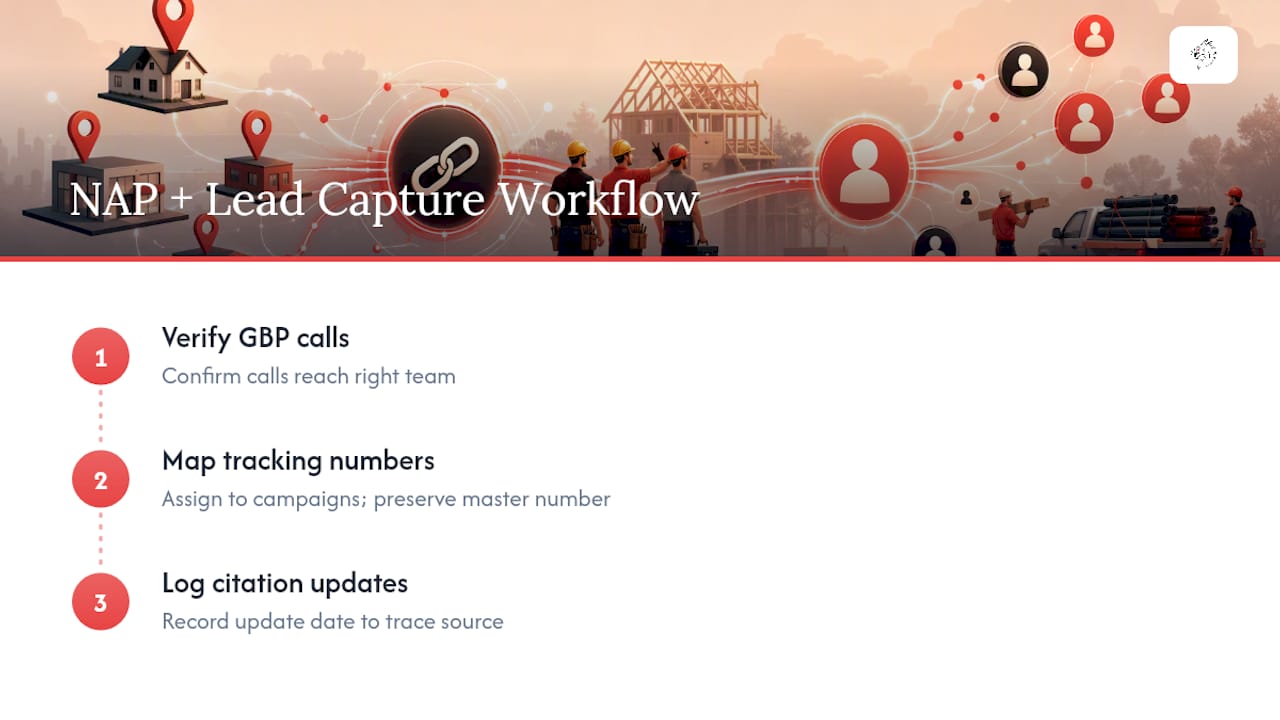
Accurate listings only pay off if the leads they generate actually get answered. For home-service contractors, that means treating NAP maintenance and lead routing as one workflow, not two. Check daily that calls from your Google Business Profile route to the right team, map every tracking number to its campaign so nothing overwrites your master phone listing, and log every citation update with a date so you can trace where a lead actually came from.
Pro Tip: A perfectly consistent NAP still loses jobs if nobody answers the phone fast. Faster local rankings and instant lead response work together, not separately.
What Contractors Get Wrong About Nap Consistency
Most local SEO advice treats NAP consistency as a one-time cleanup project. It isn't. Directories re-scrape old data, employees publish new phone numbers for one-off campaigns, and franchise or multi-location businesses accumulate drift the moment a second location opens. The businesses that stay clean treat it as a recurring operational task, not a launch checklist you finish once.
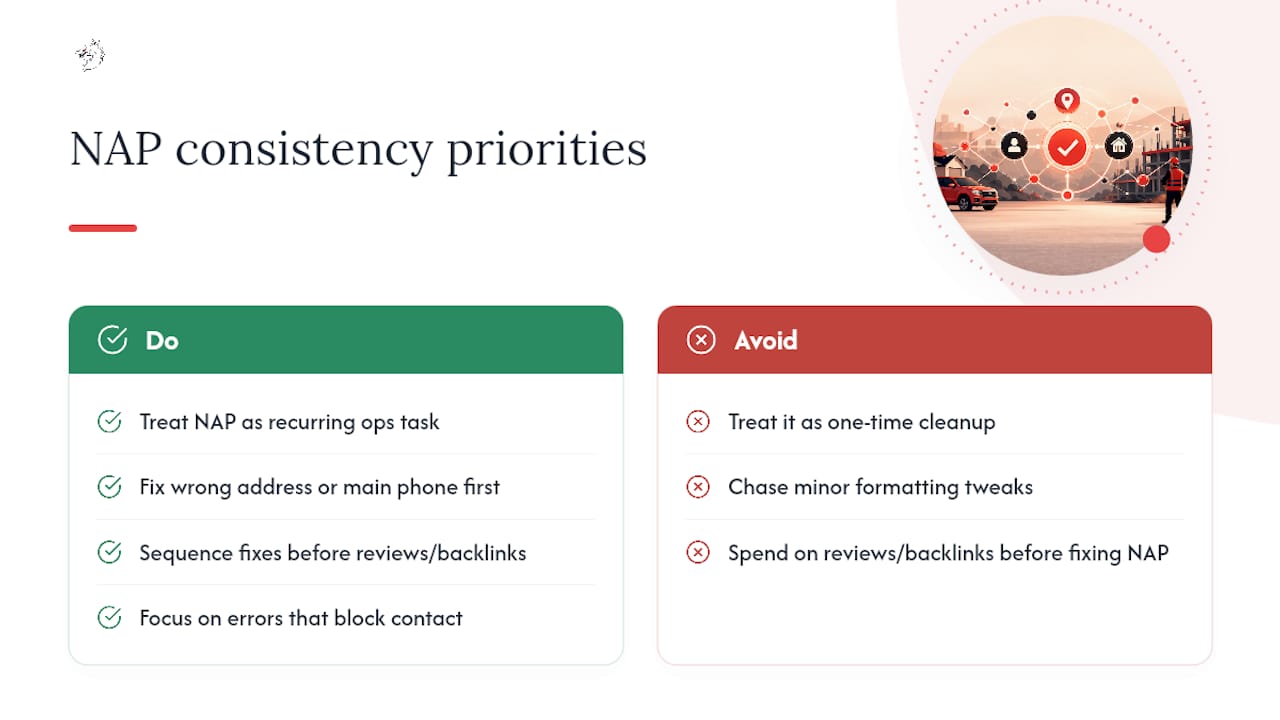
The bigger blind spot is sequencing. Contractors spend money on reviews and backlinks while their address is wrong on four directories, and wonder why rankings stall. Fix the foundation before you build on it.
I'd also push back on chasing perfection. Minor formatting quirks between "Suite" and "Ste." aren't costing you customers. The address that's flat-out wrong, or the tracking number that overwrote your main line, is what's actually costing you jobs. Spend your limited hours on the errors that break a customer's ability to reach you, not the ones that just look untidy in a spreadsheet.
— Damian
Get Managed Nap And Local Seo Help From Vaultio
Running a quarterly audit is manageable. Running it across five directories, three locations, and a call-tracking setup while also chasing new jobs is where most contractors fall behind, and that gap is exactly what costs you the Local Pack spot a competitor grabs instead. A managed service handles listings management and local SEO as a done-for-you service, correcting citation errors, keeping your Google Business Profile verified and current, and pairing it with AI-powered lead response so every call and form fill gets answered promptly.
The goal isn't just clean data. It's more accurate listings turning into more booked jobs, backed by consistent visibility across Google, Maps, and AI-powered search. If you're a contractor in California ready to stop losing calls to a wrong number or a buried listing, check out Vaultio's local SEO services and get a direct read on where your citations stand today.
Sources
- —What is NAP in Local SEO? - Moz
- —What is NAP Consistency? How Does NAP Affect Local ... - CallRail
- —What is NAP and why is NAP consistency important? - BrightLocal
Recommended
Ready to Implement This?
We'll build your complete lead generation system in 72 hours. No contracts. 30-day money-back guarantee.