Book More Home Service Jobs in 90 Days for Contractors with GBP, Reviews, Ads
# Book More Home Service Jobs in 90 Days for Contractors with GBP, Reviews, Ads
Stop chasing every channel at once. The winning stack is simple: lock down your Google Business Profile and local SEO, layer in Local Services Ads, and Search, build a review engine, and answer every lead in seconds. Nail that sequence and you'll see more calls and booked jobs within 90 days, not "eventually."
*
TL;DR: - Claim and optimize your Google Business Profile with complete categories, detailed services, accurate hours, and weekly fresh photos to improve local ranking. - Focus ad spend on Local Services Ads first, segment campaigns by customer intent, and only add Search campaigns once lead quality and cost per lead are proven. - Build a review system that collects feedback immediately after service and responds within 24 hours, with a focus on Google reviews to boost visibility. - Fix your landing pages by prioritizing call-first design for emergencies and form-first for scheduled work, with proper call tracking to lower your cost per lead. - Accelerate growth by completing foundational SEO tasks within 30 days, then layering in paid ads in months two and three, while maintaining rapid lead response.
*
Table of Contents
- —Home Service Marketing Made Simple: The Four-Bucket Framework
- —How Do You Optimize Local SEO and Google Business Profile?
- —Should You Run Local Services Ads Before Search Campaigns?
- —How Do You Build a Review System That Actually Converts?
- —What Makes a Home Service Landing Page Convert?
- —What Content and Social Tactics Keep Customers Coming Back?
- —Which Metrics Actually Tell You What's Working?
- —What's the 90-Day Roadmap for Executing This Plan?
- —Proof the Playbook Works in Practice
- —Where Do Flyers, Local Events, and Partnerships Fit In?
- —How Do Referral Programs Build Loyalty in Home Services?
- —How Do You Differentiate from Every Other Contractor in Your Market?
- —An Honest Read on What Actually Moves the Needle
- —Get the Full Stack Running Without Hiring a Marketing Team
- —Sources
Home Service Marketing Made Simple: The Four-Bucket Framework
Most contractors drown in marketing advice because nobody hands them an order of operations. The fix is a four-bucket framework used by home-services-specialist agencies: Get Found, Get Chosen, Get Leads, Stay Top of Mind. Each bucket builds on the one before it. Skip a bucket and you'll pay more for worse leads.
Here's why the sequence matters:
- —Get Found (local SEO, Google Business Profile): You can't win jobs customers never see. This is your foundation.
- —Get Chosen (reviews, reputation): Being visible means nothing if the guy above you has 200 five-star reviews and you have 12.
- —Get Leads (Local Services Ads, paid search): Once you're visible and credible, paid traffic actually converts instead of leaking money.
- —Stay Top of Mind (email, SMS, content, social): Past customers and near-term prospects need a reason to call you again, not your competitor.
A phased build, GBP and local SEO first, then paid and reviews, reduces wasted ad spend and improves lead quality because you're not paying for clicks that land on a half-finished website with zero social proof.
Three tasks to knock out this week, no developer required:
- —Claim and fully complete your Google Business Profile categories, service list, hours, and service area.
- —Text your last 10 completed jobs a review link.
- —Add click-to-call buttons to every page on your mobile site.
That's the whole game plan in miniature. Everything else in this guide is execution detail.
How Do You Optimize Local SEO and Google Business Profile?
Your Google Business Profile is the single highest-leverage asset in home service advertising, and most contractors treat it like a business card instead of a lead machine. Fix that first, before you spend a dollar on ads.
Run this checklist in order:
- 1.Nail your primary and secondary categories. A plumber who only selects "Plumber" misses searches for "drain cleaning service" or "water heater installation." Add every relevant secondary category your license covers.
- 2.List every service with detail, not just labels. "Water Heater Repair" beats "Plumbing Services" for local intent matching.
- 3.Set accurate hours and a real service area. Nothing kills trust faster than a profile that says "Open" at 9 PM on a Sunday when you don't answer calls.
- 4.Upload fresh photos weekly. Trucks, technicians in uniform, before-and-afters. Stale photo galleries signal an inactive business to both Google and searchers.
- 5.Post updates at least twice a month. Seasonal promotions, completed jobs, service reminders. GBP posts are free real estate most competitors ignore.
- 6.Build service-specific landing pages for each core offering with basic schema markup (LocalBusiness, Service) so Google understands exactly what you do and where.
- 7.Audit your NAP (Name, Address, Phone) across every directory. Inconsistent phone numbers or old addresses on Yelp, Angi, or Facebook actively hurt your map pack ranking.
- 8.Prioritize your top five directories first, then expand. Chasing 40 directories at once with a skeleton crew is how NAP errors happen.
A tool like Vaultio's local SEO framework can help you track citation consistency across platforms without manually checking each one.
Pro Tip: Photo uploads with geotags attached to your service area carry more local relevance weight than generic stock images. Take them on the job site, not in the office.
The prominence signal matters more than most owners realize. Google weighs review volume, photo activity, and post frequency into how it ranks your map pack position, not just proximity to the searcher. A profile that's actively maintained will consistently outrank a "set it and forget it" competitor with a better location.
Should You Run Local Services Ads Before Search Campaigns?
Yes, when your trade qualifies. Local Services Ads (LSA) is a pay-per-lead product, meaning you're charged only for valid leads, not clicks, and it displays a Google Verified badge once your business passes background and license checks. That badge alone often outperforms unverified Search ads for urgent, high-intent searches like "emergency plumber near me."
Google publishes eligibility by category, and most core trades qualify, including plumbers, HVAC contractors, electricians, and pest control.
Structure your paid efforts into three intent buckets rather than one generic campaign:
- —Emergency: Burst pipes, no heat, no AC. Highest intent, highest acceptable cost per lead, fastest response required.
- —Scheduled installations: Water heater replacements, HVAC system upgrades. Longer consideration window, needs detailed landing pages with financing and warranty info.
- —Maintenance: Tune-ups, inspections, seasonal service. Lower urgency, lower CPL target, good fit for retargeting.
Segmenting campaigns this way matches your bid strategy and landing page experience to actual searcher intent instead of forcing every click through the same generic page.
Starter budgets vary by market and trade, but a practical way to set your target cost per lead is to work backward from job value: if your average ticket is $400 and you close 40% of leads, a $60 CPL still nets a healthy margin. High-value trades like roof replacement or full HVAC installs can justify a much higher CPL because the lifetime revenue per closed job absorbs it.
Run LSAs first when your category is eligible. LSA leads tend to convert at higher rates than standard Search because the verification badge does trust-building work your ad copy can't. Feed every LSA and Search lead into your CRM so you can validate lead quality and dispute any that were clearly spam or miscategorized. Paying for a lead that never should have qualified is money wasted, and Google does allow disputes for genuinely invalid leads.
Vaultio manages Local Services Ads campaigns and Google Ads programs built around this exact bucket structure, with lead data routed straight into rapid-response systems.
How Do You Build a Review System That Actually Converts?
Reviews aren't a nice-to-have. They're the deciding factor between two contractors with identical Google Business Profiles, and they directly influence how often AI assistants recommend you.
Build a two-step request workflow:
- —Ask in person immediately after the job, while the technician is still standing there and satisfaction is at its peak.
- —Follow up with an automated SMS or email within two hours, before the customer's attention shifts to dinner, kids, or the next fire to put out.
That short follow-up window matters. A review request sent immediately after service, backed by an SMS follow-up, consistently generates more reviews than a delayed email sent days later, and it converts more of those reviews into calls from future searchers who read them.
Prioritize Google reviews first, since they directly affect map pack ranking and LSA prominence. But don't stop there. In 2026, AI assistants pull from multiple review and listing platforms, so businesses with consistent, strong reviews across Google, Yelp, Facebook, and Angi get recommended more often when someone asks ChatGPT or a voice assistant "who's a good plumber near me."
When a negative review lands, respond within 24 hours, acknowledge the specific issue by name, and offer a path to resolution offline. Never argue in public. A simple escalation protocol, owner reviews any rating under three stars before a canned response goes out, prevents a frustrated technician's defensive reply from becoming a screenshot on social media.
Pro Tip: Ask happy customers for reviews that mention the specific service performed ("fixed our AC in July heat") rather than generic praise. Specific language matches more long-tail searches and reads as more credible to future customers.
What Makes a Home Service Landing Page Convert?
Traffic without conversion is just an expensive vanity metric. Fix your landing pages before you scale any paid spend.
- 1.Choose call-first for emergency intent, form-first for scheduled work. Someone with a flooding basement wants a phone number, not a contact form. Someone comparing HVAC install quotes will fill out a form if it promises a fast callback.
- 2.Include the non-negotiable trust elements: a large click-to-call button above the fold, licensing and insurance badges, real customer photos, and a clear, single call to action per page. Pages that try to sell five services at once convert worse than focused single-service pages.
- 3.Set up call tracking with dynamic number insertion so every lead source, GBP, LSA, Search, and organic, gets attributed correctly in your CRM. Without this, you're guessing which channel actually books jobs.
The upside of fixing conversion before scaling spend is enormous. Raising landing page conversion from roughly 7% to 14% can cut your cost per lead in half without spending an extra dollar on ads.
Run three quick tests this month: swap your header CTA button color and copy, test a short form (name, phone, service) against a longer one, and try adding a real technician photo near the call button instead of a stock image. Vaultio builds conversion-optimized, mobile-first sites specifically structured around this call-first versus form-first split.
What Content and Social Tactics Keep Customers Coming Back?
Content marketing for contractors doesn't mean blogging three times a week. It means showing up exactly when a past customer needs you again, and exactly when an AI assistant or search engine is deciding who to recommend.
Focus your limited time on a few high-return moves:
- —Publish short seasonal maintenance posts ("When to Flush Your Water Heater," "Fall HVAC Checklist") that match the voice and AI search queries homeowners actually type or ask.
- —Send maintenance reminder emails or texts on a seasonal cadence, spring AC tune-up, fall furnace check, so you're the first call before something breaks.
- —Ask every past customer for a referral 30 to 60 days after service, when satisfaction is still fresh but the job isn't top-of-mind enough to feel like a pitch.
- —Post before-and-after job photos and short technician spotlights on social media. Customers hire people, not logos.
- —Engage with local community pages and neighborhood groups where homeowners already ask for contractor recommendations.
None of this replaces local SEO or paid ads. It compounds them. Consistent content and multi-platform presence reinforce the same signals AI assistants and search engines already weigh when deciding who to recommend to a searcher.
Which Metrics Actually Tell You What's Working?
Vanity metrics like impressions and clicks don't pay your crew. Track outcomes that connect directly to revenue.
Your core dashboard should include:
- —Calls and form leads by source (GBP, LSA, Search, organic, referral)
- —Booked jobs and close rate per channel, not just total leads
- —Cost per lead (CPL) and cost per booked job
- —Revenue per channel, so you know which dollar actually produced the best return
Attribute every lead correctly using call tracking numbers tied to each channel, feeding straight into your CRM. Review this dashboard weekly for quick course corrections and monthly for budget reallocation decisions.
The scaling rule is straightforward: multiply CPL by close rate by average job value. If a channel's math nets a healthy margin, pour more budget into it before you experiment with a new one. Chasing a shiny new platform while your best-performing channel sits underfunded is one of the most common budget mistakes owners make.
What's the 90-Day Roadmap for Executing This Plan?
Sequencing prevents wasted spend, and the data backs a specific phased structure that most successful home service campaigns follow.
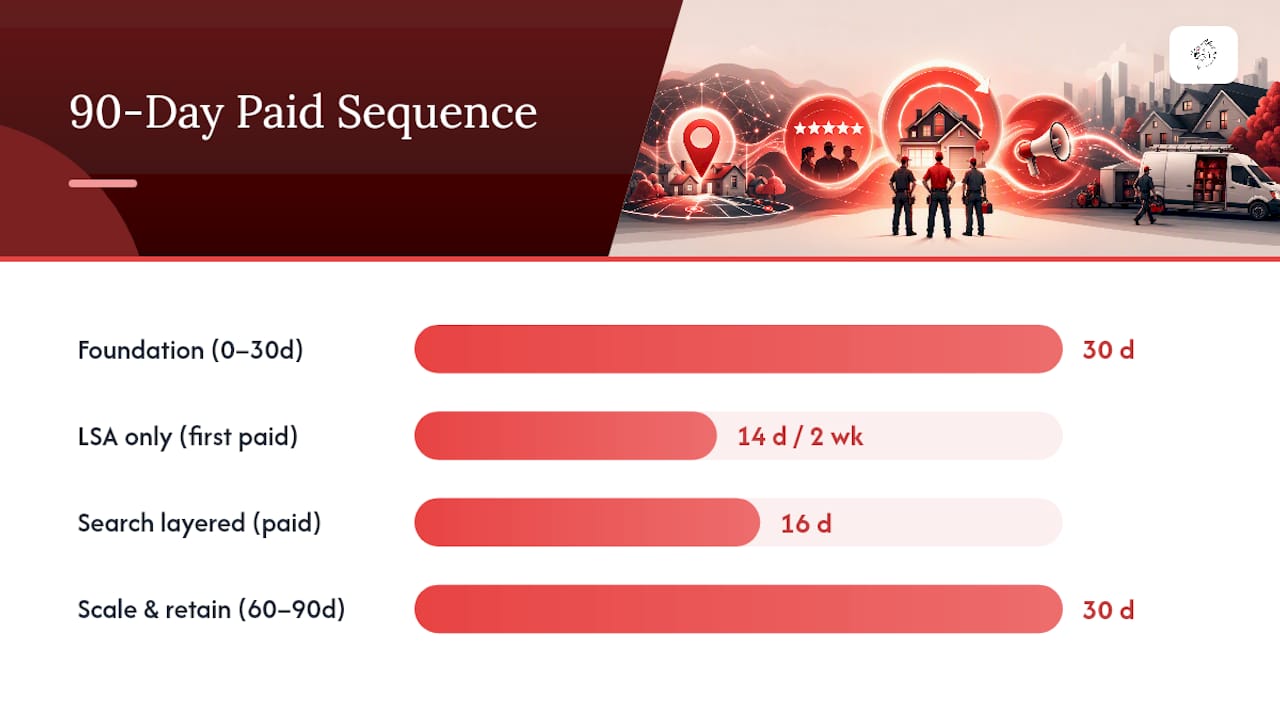
- 1.Days 0 to 30: Foundation. Complete your Google Business Profile, publish service-specific landing pages, install call tracking, and launch your review request workflow. Don't spend a dollar on paid ads yet.
- 2.Days 30 to 60: Paid launch. Turn on LSA campaigns if your trade qualifies, layer in Search campaigns segmented by intent bucket, and start A/B testing your landing pages against real traffic.
- 3.Days 60 to 90: Scale and retain. Double down on whatever channel is producing the best cost per booked job, add email and SMS maintenance flows, and establish a monthly content cadence.
This 30/60/90 structure mirrors what most agency playbooks recommend, and for good reason: paid traffic hitting an incomplete profile or a form-only landing page during an emergency search is money burned, not invested.
Small operations often outsource local SEO and ad management rather than hire in-house, since the learning curve on LSA bidding and GBP optimization is steep enough to eat months of margin if handled by trial and error.
Pro Tip: Don't launch LSA and Search simultaneously in week one of paid spend. Start LSA alone for two weeks, measure lead quality, then layer in Search once you trust your CPL targets.
Proof the Playbook Works in Practice
This roadmap isn't theoretical. Vaultio operationalizes each phase directly: local SEO and Google Business Profile builds in the foundation phase, Local Services Ads management and Search campaigns in the scaling phase, and rapid lead response systems that engage new inquiries within seconds so a completed campaign doesn't leak leads to a competitor who calls back faster.
A few things worth knowing about how this plays out for contractors:
- —Some service providers combine top search rankings with fast lead response, so visibility actually converts to booked jobs instead of stalling at the phone call.
- —The goal is a steady, predictable flow of additional booked jobs each month, rather than a one-time traffic spike.
- —Campaigns can run with measurable tracking at every stage, reducing guesswork on which channel is producing revenue.
- —City-specific service pages show how this playbook adapts to different local markets and trades.
Case studies and detailed client results will be added here as they're published.
Where Do Flyers, Local Events, and Partnerships Fit In?
Digital channels do the heavy lifting, but offline tactics still move the needle for home service contractors, especially in tight-knit neighborhoods where word travels fast.
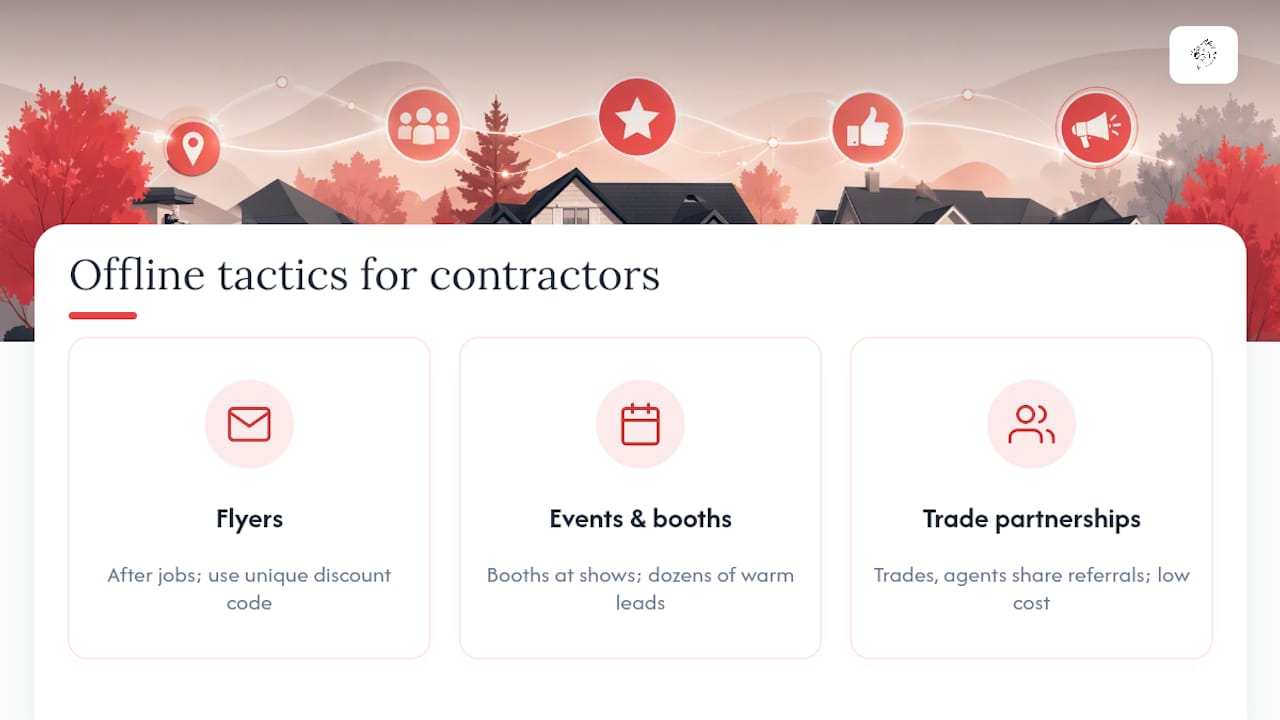
Door hangers and flyers work best immediately after you've completed a job on a street. Neighbors notice a truck, and a simple "we were just on your block" flyer with a discount code converts far better than cold neighborhood-wide distribution. Track redemption with a unique code so you know the tactic is actually paying off.
Local events, home shows, county fairs, hardware store partnerships, put your brand in front of homeowners already thinking about maintenance and repairs. A booth at a spring home and garden show costs a fraction of a month of paid search and can generate dozens of warm leads if staffed by someone who can actually answer technical questions on the spot.
Partnerships with complementary trades pay off quietly over time. A roofer who refers gutter work to a landscaper, and gets HVAC referrals in return, builds a pipeline that costs nothing but a phone call and a fair referral fee arrangement. Real estate agents and property managers are another underused partnership channel: they see plumbing, electrical, and HVAC issues constantly and need a reliable contractor list to hand clients.
None of this replaces your digital foundation. It reinforces it, especially in service areas where hyperlocal trust still beats a search ranking.
How Do Referral Programs Build Loyalty in Home Services?
Referrals are the cheapest lead source you have, and most contractors never formalize the ask.
A structured referral program beats a vague "let us know if you have friends who need work" comment at the end of a job. Offer a specific incentive, a $25 account credit, a discount on next service, or a small gift card, for every referral that books a job. Make the ask easy: a text message with a shareable link sent a few weeks after service completion, timed when satisfaction is fresh but not immediately after payment when it can feel transactional.
Loyalty programs work differently but complement referrals well. A simple punch-card style system, priority scheduling or a discount after a customer's third service call, keeps maintenance-heavy trades like HVAC and pest control top of mind for renewal instead of losing the customer to whoever shows up first when something breaks.
Track referral source in your CRM the same way you track paid lead sources. If a referral program is quietly producing 15% of your booked jobs at near-zero cost, that's a channel worth formalizing with better tracking and possibly a bigger incentive, not an afterthought mentioned once at checkout.
How Do You Differentiate from Every Other Contractor in Your Market?
Every home service market has a handful of competitors running nearly identical playbooks: similar GBP setups, similar Google Ads, similar "locally owned and operated" messaging. Differentiation happens in the details competitors don't bother to fix.
Start with a straightforward competitive audit. Search your top three service keywords and note who ranks in the map pack, what their review count and rating look like, and whether their landing pages are call-first or form-first. Gaps you find, slow response times, thin service pages, inconsistent reviews, are exactly where you position your advantage.
Specificity beats generic claims every time. "Fast, friendly service" means nothing when every competitor's website says the same thing. A guaranteed response time, a transparent pricing page, or a specific certification your competitors lack gives searchers an actual reason to choose you over a nearly identical option one map pin away.
Response speed is an underrated differentiator. Home service leads convert to whoever answers first far more often than whoever has the prettiest website. If your average response time is under two minutes while competitors take hours, that's worth stating explicitly in your ads and on your landing pages, not just quietly delivering it.
An Honest Read on What Actually Moves the Needle
The home service marketing advice you'll find elsewhere usually treats every channel as equally urgent, build a website, run some ads, post on social, hope for the best. That advice wastes budget. The research is consistent on one point: sequencing beats simultaneity. Contractors who fix their Google Business Profile and review systems before scaling paid spend get cheaper leads and higher close rates than contractors who throw money at ads first and fix the foundation later.
Where conventional advice really falls short is speed. Owners obsess over which platform to advertise on and barely think about how fast they respond once a lead comes in. A perfectly optimized campaign that gets a callback in four hours loses to a mediocre campaign with a two-minute response time, every time.
If you take one thing from this roadmap, prioritize your Google Business Profile and review workflow this week, then fix your lead response speed before you touch a single ad dollar. Everything else compounds from there.
— Damian
Get the Full Stack Running Without Hiring a Marketing Team
Vaultio is the alternative to piecing this together yourself, or hiring three separate freelancers for SEO, ads, and web design. One team builds your local SEO foundation, manages your Local Services Ads and Search campaigns, and answers new leads within seconds so the jobs you just read about how to attract actually get booked.
The offer is straightforward: Vaultio maps directly onto the roadmap above, Google Business Profile and local SEO work in the foundation phase, SEO management for your specific service area, Local Services Ads and Google Ads in the scaling phase, and rapid AI-powered lead response so no inquiry sits unanswered while a competitor picks up the phone first. Every engagement is backed by a 30-day money-back guarantee, so there's no long-term risk in testing whether the system delivers.
If you're ready to see what this stack looks like for your specific market, request an audit through Vaultio's home page and get a clear picture of where your current setup is leaking leads.
Sources
- —Local Services Ads | Google
- —Digital Marketing for Home Services: SEO, PPC & Lead Generation Tips | Straight North
- —Google Ads for Home Services: The HVAC, Plumbing and Roofing PPC Playbook | groas
Recommended
Ready to Implement This?
We'll build your complete lead generation system in 72 hours. No contracts. 30-day money-back guarantee.