Why Google Ads Drive Job Bookings for Contractors

# Why Google Ads Drive Job Bookings for Contractors
Google Ads drive job bookings by converting search intent into scheduled appointments, but only when campaigns track actual booked jobs rather than clicks or form fills. Contractors who feed real booking data back into Google's platform through offline conversion imports reduce their cost per booked job by 30–50% within 90 days. That number is not a rounding error. It reflects a fundamental shift in how the platform learns which clicks produce revenue. Understanding why Google Ads drive job bookings at that level requires understanding three things: conversion tracking accuracy, value-based bidding, and keyword discipline.
Why Google Ads drive job bookings better than other paid channels
Google Ads work for home service contractors because the platform captures demand at the exact moment a homeowner decides to act. Someone searching "emergency plumber near me" or "HVAC repair today" is not browsing. They are ready to book. No other paid channel reaches buyers at that decision point with the same precision.
The real advantage, though, is not just placement. It is what happens after the click. Most contractors measure success by form fills or phone calls. Those metrics lie. A form fill from someone asking about a job you do not offer, or a call that never converts, trains Google's algorithm to send you more of the same bad traffic. The platform gets smarter only when you feed it accurate signals.

A four-layer conversion stack built from enhanced conversions, call tracking, website goal completions, and offline job booking imports gives Google's Smart Bidding the full picture. Each layer adds signal quality. Together, they tell the algorithm which keywords, devices, times, and locations produce real revenue.
How offline conversion imports close the gap between clicks and booked jobs
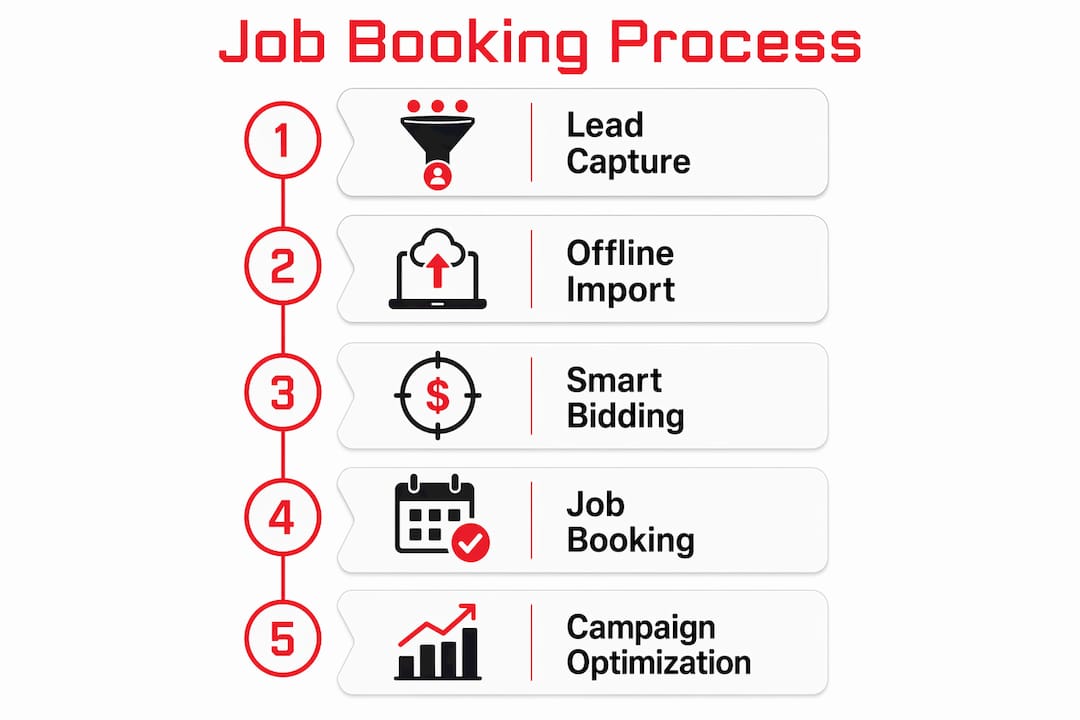
Offline conversion import is the process of sending confirmed job booking data from your CRM back into Google Ads. It closes the feedback loop that most contractors leave wide open. Without it, Google only knows a user clicked your ad. With it, Google knows that specific click turned into a $400 HVAC tune-up booked for next Tuesday.
The technical foundation is the Google Click ID, known as the GCLID. Every click on your ad generates a unique GCLID. Your website must capture that ID and store it alongside the lead record in your CRM. When that lead books a job, you export the GCLID and the booking value back to Google Ads. Missing GCLID capture is the most common failure point in the entire system.
Here is what a working offline conversion import workflow looks like:
- —Capture the GCLID on your landing page using a hidden form field or URL parameter script
- —Store it in your CRM alongside the lead's name, phone number, and service type
- —Tag the record when the job is confirmed and a dollar value is assigned
- —Export the data to Google Ads via manual upload, API, or a CRM integration like ServiceTitan or Jobber
- —Set a conversion window that matches your typical sales cycle, usually 30–90 days for home services
Smart Bidding then uses that booked job data to identify patterns across keyword, device, time of day, and location. Top contractors achieve 10.24x ROAS by feeding booked job data into the algorithm, compared to a median of 4.37x for those relying on form fills alone. That gap is entirely explained by data quality.
Pro Tip: Set up your GCLID capture before you spend a single dollar on ads. Retroactive fixes are painful and you lose all the historical signal data you paid for.
What keyword strategy actually filters in buyers and filters out waste
Keyword management is where most contractors bleed budget without realizing it. The problem is not choosing the wrong keywords. It is failing to exclude the right ones.
A disciplined keyword approach for home service Google Ads follows four steps:
- 1.Segment by intent. Separate high-intent terms like "water heater replacement cost" from research terms like "how does a water heater work." Bid aggressively on the first group and exclude the second.
- 2.Build a negative keyword list from day one. Add terms like "DIY," "free," "how to," "school," "training," and any job category you do not serve. This prevents your budget from funding curiosity, not bookings.
- 3.Run weekly search term reports. Google shows you the actual queries that triggered your ads. Mine that report for new negatives and new exact-match opportunities every week.
- 4.Tighten match types over time. Start with phrase match to gather data, then shift high-converting terms to exact match to protect your budget.
Continuous negative keyword management progressively improves lead quality and conversion rates over time. A recruiting campaign applying this method achieved a 6.12% click-through rate and a cost per acquisition of 3.61 CHF by filtering irrelevant queries. The principle applies directly to home services. Every irrelevant click you block is money redirected to someone ready to book.
Value-based bidding versus volume-based bidding: which one fills your schedule
Most contractors bid on volume, meaning they optimize for form fills or call volume, rather than revenue. This is the single most expensive mistake in home service advertising. Volume bidding tells Google to find you the most leads. Value-based bidding tells Google to find you the most profitable leads. Those are not the same audience.
Here is what separates the two approaches:
- —Volume bidding maximizes the number of conversions regardless of job size, service type, or close rate. You pay the same for a $150 drain cleaning lead as a $4,000 water heater replacement lead.
- —Value-based bidding assigns a dollar amount to each conversion. Google's Smart Bidding then prioritizes clicks that are statistically more likely to produce high-value jobs.
- —Target ROAS bidding is the most effective value-based strategy for established campaigns. It requires at least 30–50 conversions per month to function reliably.
- —Offline job booking imports are what make value-based bidding accurate. Without real revenue data, you are assigning guessed values to form fills, which defeats the purpose.
Pro Tip: Assign different conversion values by service type. A booked roof inspection is worth more than a booked gutter cleaning. Tell Google that, and it will find you more roof inspections.
The shift from volume to value bidding is not just a campaign setting change. It is a data infrastructure change. You need your CRM talking to Google Ads before the bidding strategy can work. Build the pipeline first, then flip the bidding switch.
What happens when you rely on Google Ads alone
Google Ads can fill your schedule fast. They can also drain your margin just as fast if you treat them as your only lead source. Rising CPCs can increase your cost per lead by up to 25% without any change in your campaign performance. That cost increase comes from external competition, not from anything you did wrong.
Single-channel dependency is a real business risk. The table below shows how different lead sources compare on key dimensions for home service contractors.
| Lead source | Cost control | Lead quality | Setup time |
|---|---|---|---|
| Google Ads (paid search) | Low, CPC driven | High intent | Fast |
| Local SEO and organic search | High, owned asset | High intent | Slow |
| Meta Ads (social) | Medium | Lower intent | Medium |
| Google Local Service Ads | Medium, pay per lead | Very high intent | Medium |
| Referrals and reviews | Very high | Very high | Ongoing |
Local SEO builds an owned asset that generates leads without a cost-per-click. It takes longer to produce results, but it does not disappear when you pause your budget. Contractors who combine paid search with organic authority protect themselves from CPC inflation and algorithm changes. Diversified lead generation is not a luxury. It is margin protection.
How to set up Google Ads campaigns that actually book jobs
Getting the setup right from the start saves you months of wasted spend. These are the steps that matter most:
- —Install GCLID capture on every landing page. Use a hidden form field that auto-populates with the URL parameter `gclid`. Test it before running any traffic.
- —Set up call tracking. Use a call tracking number that passes call data back to Google Ads. Every inbound call from an ad should be tagged as a conversion with a duration filter, typically 60 seconds or more, to exclude wrong numbers.
- —Structure campaigns by service and location. Run separate campaigns for plumbing, HVAC, electrical, and roofing. Within each, separate by city or zip code. This gives you budget control and performance visibility by service type and geography.
- —Import offline conversions weekly. Set a recurring export from your CRM every Monday. Upload the prior week's confirmed bookings with their GCLID and job value.
- —Audit performance monthly. Review cost per booked job, not cost per lead. If a keyword drives calls but no bookings, pause it. If a location converts at twice the rate, increase its bid modifier.
The Google Ads management setup for home service contractors is not complicated, but it requires discipline. Most contractors skip the GCLID step because it feels technical. That one skip costs them the entire performance advantage of Smart Bidding.
Key takeaways
Google Ads drive job bookings at scale only when campaigns are built on booked job data, not form fills or call volume.
| Point | Details |
|---|---|
| Offline conversion imports are critical | Feeding confirmed job data back to Google cuts cost per booked job by 30–50% within 90 days. |
| GCLID capture must come first | Missing GCLID data breaks Smart Bidding and wastes every dollar spent on ads. |
| Value-based bidding outperforms volume bidding | Assigning revenue values to conversions directs budget toward high-ticket jobs, not just any lead. |
| Negative keywords protect your budget | Weekly search term audits remove irrelevant traffic and lower cost per acquisition over time. |
| Diversify beyond Google Ads | CPC inflation can raise costs by up to 25%; local SEO and other channels reduce that exposure. |
What I've learned from watching contractors get this wrong
I have seen contractors spend $5,000 a month on Google Ads and book fewer jobs than a competitor spending $1,500. The difference is never budget. It is always data quality.
The most common mistake is treating Google Ads like a vending machine. You put money in, leads come out. That model worked in 2015. In 2026, the platform is a machine learning system. It learns from what you tell it. If you tell it that every form fill is a success, it finds you more form fills. If you tell it that only confirmed, paid jobs count, it finds you more of those.
The second mistake is impatience with value-based bidding. Contractors switch to Target ROAS, see performance drop in week two, and panic back to manual CPC. Smart Bidding needs a learning period. It needs data. Give it 30 days and at least 30 conversions before you judge it.
The third mistake is ignoring the diversification problem. I have watched contractors build their entire business on Google Ads, then watch a CPC spike cut their margin in half overnight. Organic search, referrals, and social ads are not backup plans. They are the foundation that makes paid ads sustainable.
The contractors who win long-term are not the ones with the biggest budgets. They are the ones with the cleanest data, the most disciplined keyword management, and the patience to let Smart Bidding do its job.
— Damian
Vaultio helps contractors turn ad spend into booked jobs
Paid search works best when it is part of a full system, not a standalone channel. Vaultio manages Google Ads for home service contractors with offline conversion imports, call tracking, and value-based bidding built in from day one. No setup guesswork. No wasted learning period.
Vaultio's done-for-you marketing services combine paid search management with local SEO, AI lead scoring, and 24/7 lead response. Contractors in Ventura County and beyond use Vaultio to build the kind of multi-channel presence that holds up when CPCs spike. If you want a predictable flow of booked jobs without rebuilding your ad account from scratch every quarter, Vaultio is built for exactly that.
FAQ
Why do Google Ads produce more job bookings than social ads?
Google Ads capture buyers at the moment of intent, when someone actively searches for a service. Social ads interrupt users who are not looking, which produces lower conversion rates for home services.
What is offline conversion import in Google Ads?
Offline conversion import is the process of sending confirmed job booking data from your CRM back into Google Ads so Smart Bidding can learn which clicks produce real revenue.
How does GCLID tracking improve Google Ads performance?
The GCLID links each ad click to a specific lead record. When that lead books a job, the GCLID carries that signal back to Google, allowing Smart Bidding to prioritize similar high-value clicks in the future.
How quickly does value-based bidding reduce cost per booked job?
Contractors who implement offline conversion imports and value-based bidding reduce cost per booked job by 30–50% within 90 days of proper setup.
Is Google Ads enough on its own for consistent job bookings?
No. CPC inflation can raise costs by up to 25% without any change in campaign performance. Combining Google Ads with local SEO and other lead channels protects your margins and keeps bookings stable.
Recommended
- —Google Ads for Home Service Contractors | PPC Management for Plumbers, HVAC & More | Vaultio
- —Ojai Google Ads | Google Ads Company Ojai, CA | Vaultio
- —Meta Ads for Home Service Contractors | Facebook & Instagram Lead Generation | Vaultio
- —Local SEO That Works Everywhere | Google Maps + ChatGPT Recommendations | Vaultio
Ready to Implement This?
We'll build your complete lead generation system in 72 hours. No contracts. 30-day money-back guarantee.