Shortlist: Click Fraud Protection Vendors That Restore Smart Bidding

# Shortlist: Click Fraud Protection Vendors That Restore Smart Bidding
Real-time click fraud protection stops most budget-draining clicks and restores the accuracy of your bidding signals. The fix is not one tool, it's a stack: a real-time blocker, post-bid analysis, and platform-level syncing working together. Skip the guesswork. Run a two-week monitoring-only audit before you flip on auto-blocking, and you'll know exactly how much of your spend has been going to bots instead of buyers.
*
TL;DR: - Running a two-week monitoring-only audit helps identify what percentage of ad spend goes to fraud before enabling auto-blocking measures. - Vendors vary in signals used and platform integrations; real-time scoring typically analyzes over 30 signals and acts within 50 milliseconds. - Combining platform filters, third-party systems, and manual discipline remains the best defense against the estimated 10% to 30% of invalid traffic. - Self-serve SaaS tools like ClickPatrol and ClickCease are better suited for individual advertisers, while agencies and enterprises prefer multi-channel platforms. - Detailed audit logs, multi-signal blocking, and near real-time sync are critical for verifying effectiveness and disputing invalid clicks with ad networks.
*
Table of Contents
- —What Does Click Fraud Protection Actually Do?
- —Which Click Fraud Solutions Should You Trial?
- —How Does Click Fraud Detection Actually Work?
- —How Do You Choose the Right Click Fraud Vendor?
- —How Do You Deploy Click Fraud Protection Without Breaking Campaigns?
- —What KPIs Prove Click Fraud Protection Is Working?
- —What Does the Data Say About Ad Fraud Risk?
- —How Were These Click Fraud Tools Evaluated?
- —Is Vendor Protection Worth It, or Should You Just Tighten Campaign Discipline?
- —Protect Your Ad Spend While Vaultio Turns Clean Clicks Into Booked Jobs
- —Sources
What Does Click Fraud Protection Actually Do?
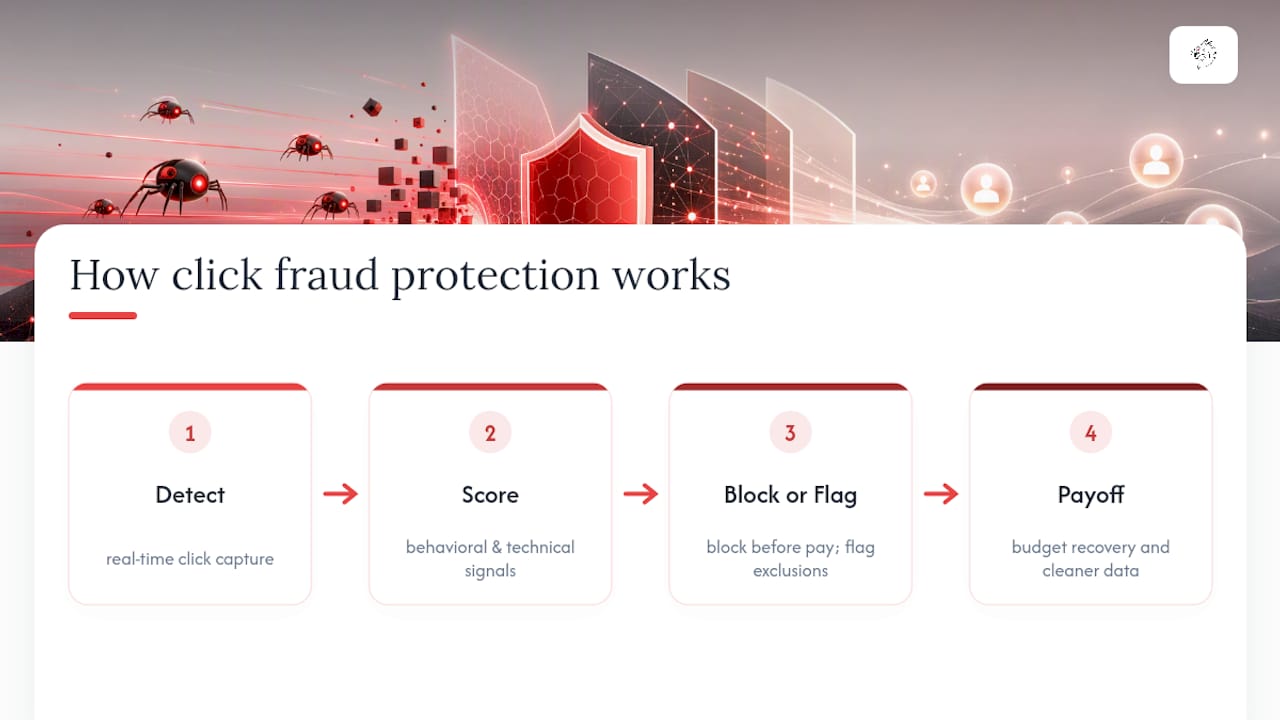
Click fraud protection software detects and blocks invalid clicks in real time, whether they come from bots, click farms, or a competitor manually hammering your ads. It works by scoring every click against behavioral and technical signals, then either blocking it before you pay or flagging it fast enough to exclude it from your audiences and conversion data, according to Human Security.
The payoff shows up in two places. First, budget recovery: money that was leaking to fraudulent clicks goes back to reaching real prospects. Second, and often more valuable long term, data hygiene. Google's automated systems already filter obvious invalid traffic, and Google recommends advertisers review traffic regularly on top of that filtering, because platform-level detection alone misses the sophisticated stuff. A layered approach with third-party monitoring stacked on top is what most experienced ad ops teams settle on. Dirty click data doesn't just cost you the click. It teaches Smart Bidding to chase the wrong audience for weeks afterward.
Which Click Fraud Solutions Should You Trial?
Vendors in this space generally fall into three categories. Real-time SaaS blockers score and block clicks as they happen, ideal if you're self-managing campaigns and want fast setup. Pre-bid and blocklist services work upstream of the auction, filtering known bad actors before you're even charged. Unified multi-channel platforms extend coverage across web, in-app, and affiliate traffic in one dashboard, better suited to agencies or advertisers running a complex media mix.
A shortlist worth trialing:
- —ClickPatrol — SaaS scoring with automated exclusion sync across major ad platforms, built for advertisers who want to activate quickly across multiple channels.
- —ClickFence — Device-fingerprint-first protection designed to catch anti-detect browsers and rotating-IP fraud without false-flagging real customers on VPNs.
- —Ciaro — Sub-50ms real-time scoring across more than 30 signals, useful for performance teams chasing low-latency auto-sync.
- —ClickTrust — A unified TQI score spanning web, in-app, and affiliate traffic, with rule sets built around MRC-style invalid traffic categories.
- —DataDome — Enterprise bot protection across web and app channels with a claimed low false-positive rate.
- —ClickCease — One of the most widely adopted names in the category, popular for straightforward onboarding on search and social.
- —Pixalate — Programmatic and CTV-focused, with pre-bid blocklists built from open-source intelligence feeds.
- —Human Security — Broad detection coverage built on behavioral analysis and machine learning models.
Self-serve advertisers tend to gravitate toward SaaS blockers like ClickPatrol or ClickCease. Agencies managing multiple client accounts often prefer unified platforms like ClickTrust. Enterprise programmatic buyers lean toward Pixalate or DataDome for scale.
How Does Click Fraud Detection Actually Work?
Detection tools lean on a handful of core signals, layered together rather than used in isolation:
- —Device fingerprinting — identifying a device by its configuration rather than its IP, since IPs rotate constantly through residential proxies.
- —IP reputation — cross-referencing known data-center ranges, VPN exits, and blacklisted addresses.
- —Behavioral entropy — mouse movement, click timing, and session patterns that separate humans from scripted behavior.
- —Anti-detect browser checks — flagging tools built specifically to spoof a real user's fingerprint.
Modern bots rotate residential IPs and mimic human timing, so IP-only blocking misses a growing share of fraud. Tamper-proof device identification paired with multi-signal thresholds catches what IP filtering alone can't, according to Human Security's industry guide.
Real-time systems score a click and act within milliseconds. Some providers analyze more than 30 signals and return a fraud score in under 50ms, pushing exclusions to ad platforms almost instantly. Delayed, post-bid analysis catches what real-time scoring misses, but by then you've already paid for the click, so the two methods are complements, not substitutes. The tradeoff with aggressive real-time blocking is false positives. Requiring multiple signals to agree before blocking, rather than triggering on one flagged trait, is what keeps real customers from getting shut out.
How Do You Choose the Right Click Fraud Vendor?
Run every vendor demo against the same checklist:
- 1.Signals used — device fingerprinting, behavioral analysis, IP reputation, or all three?
- 2.Platform integrations — does it sync exclusions to Google Ads, Meta, Microsoft Ads, and Performance Max, or just one channel?
- 3.Sync latency — how many milliseconds between detection and exclusion push?
- 4.Evidence and audit trail — can it export per-click logs with timestamps and classification reasoning for refund disputes?
- 5.False-positive controls — does it require multi-signal agreement before blocking, or trigger on a single flag?
- 6.Pricing model — flat fee, per-click, or percentage of spend?
Ask vendors directly: "What happens when a legitimate customer is on a VPN?" and "Can you show me a sample audit log from a real blocked click?" A vendor that can't produce a sample log in the demo is a red flag; so is one that can't explain its false-positive rate in specific terms.
Pro Tip: Run the pilot in monitor-only mode for at least two full campaign cycles, 14 to 30 days, before enabling auto-blocking. Compare fraud rate, cost per acquisition, and remarketing-list contamination before and after, so you're deciding on evidence rather than a vendor's demo dashboard.
How Do You Deploy Click Fraud Protection Without Breaking Campaigns?
Installation is straightforward, but sequencing matters more than the tag itself.
- —Install the tag or SDK across every landing page and ad account you want covered.
- —Start in monitor-first mode. Don't auto-block on day one.
- —Exclude confirmed fraudulent clicks from remarketing lists and conversion counts, not just from future bidding.
- —Loop in analytics, CRM, and sales teams so a lead flagged as fraud doesn't quietly disappear from a report someone else is relying on.
| Step | What to check |
|---|---|
| Install | Tag fires on every paid landing page |
| Monitor | Run 14 to 30 days before blocking |
| Sync | Exclusions push to ad platform automatically |
| Audit | Fraud logs match CRM and analytics records |
What KPIs Prove Click Fraud Protection Is Working?
Track fraud rate as a percentage of total clicks, recovered spend, and the shift in cost per acquisition and return on ad spend once bad clicks stop entering the funnel. Watch remarketing-audience contamination too. Fraudulent clicks that make it into a retargeting list keep costing you long after the original click.
For refund claims, ad networks want specifics: per-click logs, timestamps, device fingerprints, and the classification reasoning behind each flagged click. Vague claims get denied. A detailed audit trail gets paid.
Cleaner conversion data doesn't fix bidding overnight. Automated bidding systems relearn gradually, typically improving over several weeks as the signals it optimizes against stop pointing toward bots.
What Does the Data Say About Ad Fraud Risk?
Vendor estimates put invalid traffic at 10% to 30% of paid clicks in some verticals, and one federal case shows this isn't a hypothetical problem. U.S. prosecutors secured a multi-year sentence in a large-scale digital-ad fraud operation, built on detailed evidence trails documenting the fraudulent activity.
Layered defense, combining platform filters, third-party real-time blocking, and manual campaign discipline, is the accepted best practice among industry experts, not a nice-to-have add-on for advertisers with money to spare.
The practitioner takeaway is simple: keep an audit trail from day one, sync exclusions automatically rather than manually, and treat data hygiene as an ongoing discipline rather than a one-time cleanup.
How Were These Click Fraud Tools Evaluated?
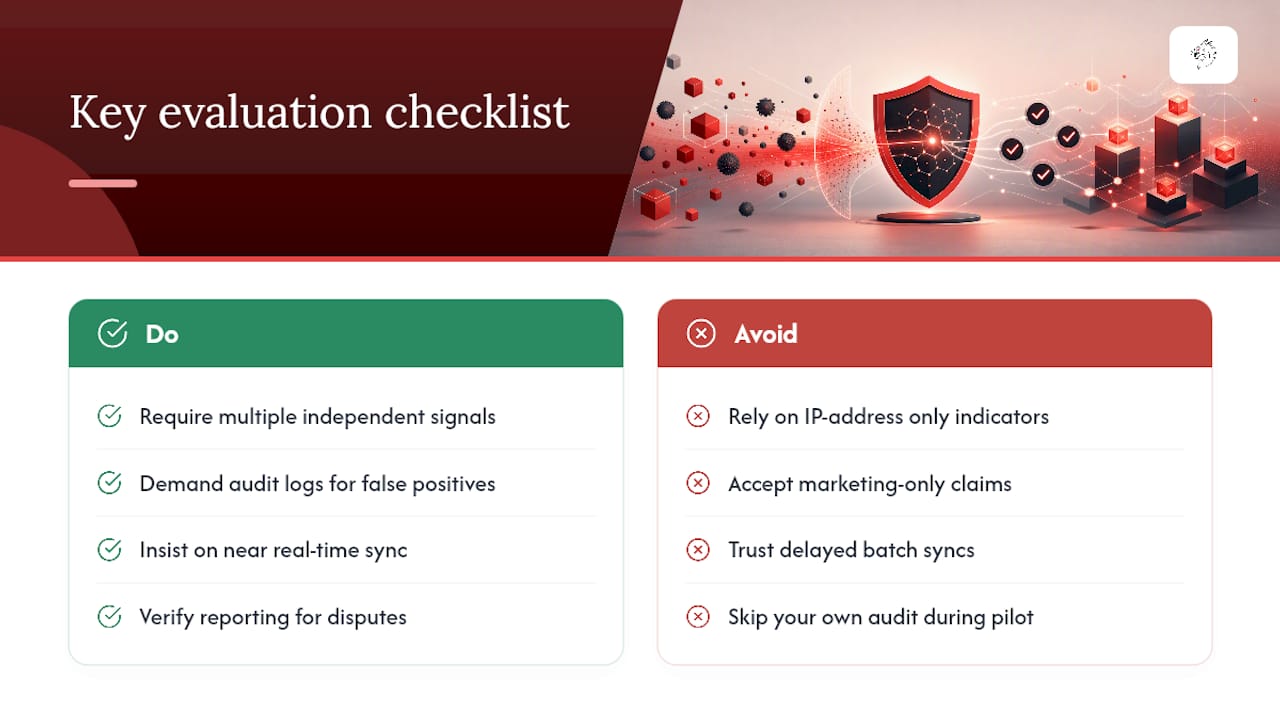
Evaluating a click fraud vendor comes down to four questions that matter more than any single feature list. Does it use multiple independent signals, or does it lean on one weak indicator like IP address alone? Can it prove its false-positive rate with a real audit log, not just a marketing claim? Does it sync to the ad platforms you actually run, in near real time rather than on a delayed batch? And does its reporting hold up if you need to dispute charges with a network?
The vendors named throughout this piece were assessed against their own published technical claims: signal count, latency, integration breadth, and the detection methods they document publicly. Where a vendor makes a specific quantitative claim, such as Ciaro's sub-50ms scoring across 30-plus signals, that's stated as a vendor claim rather than an independently verified benchmark, because no independent lab test data exists for the category yet. The honest posture for any advertiser is to treat vendor dashboards as a starting point and demand your own audit logs during a pilot before trusting the numbers at face value.
This is also why the monitor-first pilot matters more than any spec sheet. A vendor's fraud score means nothing until you've watched it run against your own traffic for a few weeks and checked it against what you already know about your customers.
Is Vendor Protection Worth It, or Should You Just Tighten Campaign Discipline?
Campaign discipline alone, tight negative keywords, geo restrictions, dayparting, catches the obvious waste. It won't catch a bot farm mimicking human click timing across rotating residential IPs. That's where a dedicated vendor earns its cost, especially once your monthly spend is high enough that a 10% fraud rate is real money, not rounding error.
For contractors running paid ads through a managed service, protection isn't a bolt-on. It belongs inside the campaign build from day one, feeding clean data back into bidding instead of getting patched in after the damage shows up in a monthly report.
— Damian
Protect Your Ad Spend While Vaultio Turns Clean Clicks Into Booked Jobs
Vaultio is the difference between paying a vendor to flag fraud and having a team that builds protection into your paid campaigns from the start, so every dollar you spend has a real shot at becoming a real customer.
Vaultio manages Google Ads for home service contractors with data hygiene baked into the setup, not added later: exclusions synced automatically, remarketing lists kept clean, and conversion signals protected so Smart Bidding optimizes toward homeowners who actually book jobs, not bots. That's paired with an AI-powered lead response system that engages every inquiry within seconds, so the clean leads your protected campaigns generate don't sit in an inbox while a competitor calls back first. Contractors working with Vaultio typically see 10 to 15 extra booked jobs a month, backed by a 30-day money-back guarantee.
If you're ready to stop wondering how much of your ad budget is going to fraud and start seeing where it actually lands, see how Vaultio's AI lead generation works for home service businesses, or check out Local Service Ads management as a pay-per-lead alternative to traditional PPC.
Recommended
Ready to Implement This?
We'll build your complete lead generation system in 72 hours. No contracts. 30-day money-back guarantee.